At a glance
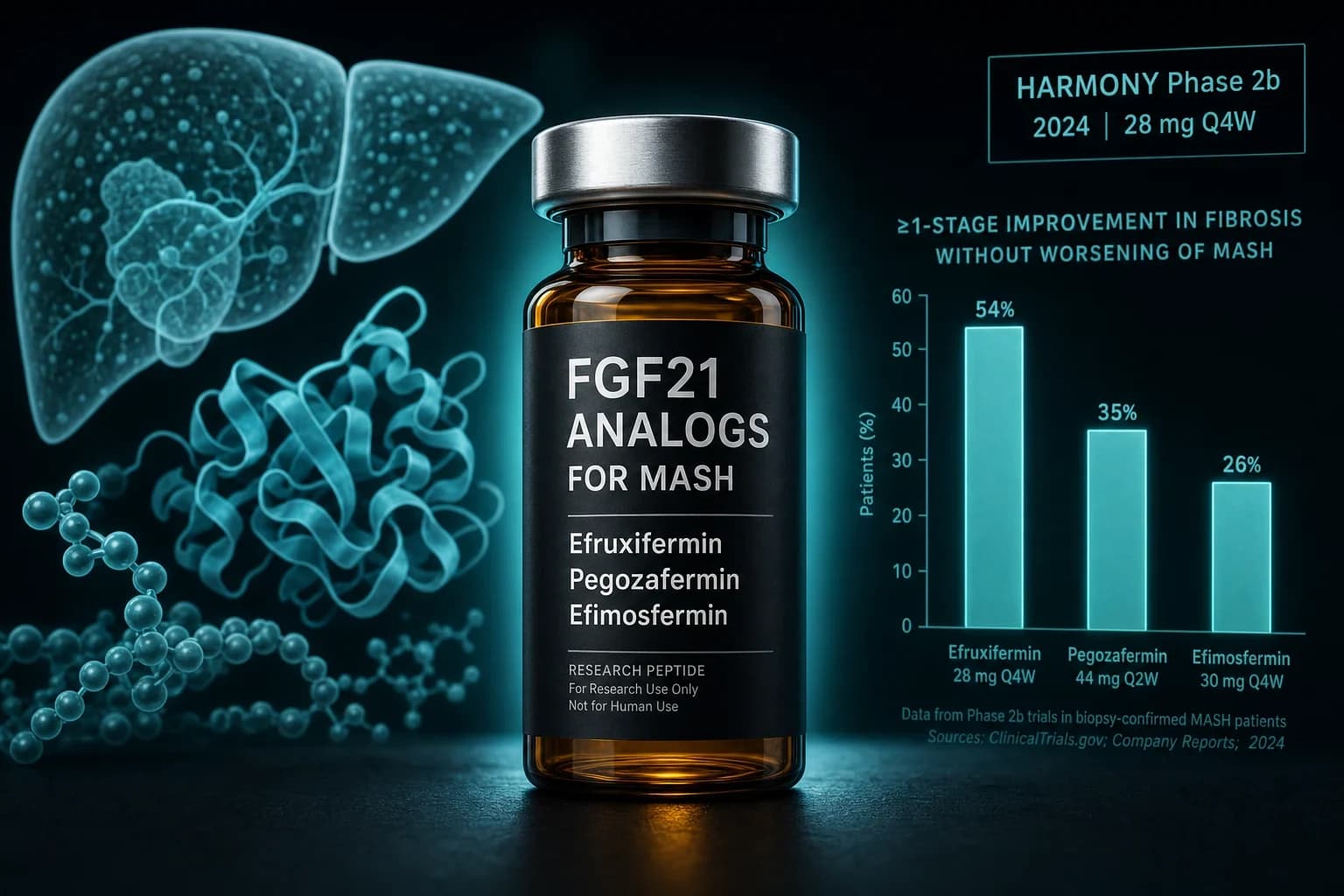
- Efruxifermin HARMONY: 49% F2-F3 fibrosis improvement at 96 weeks vs 19% placebo (Noureddin et al. 2025).
- Efruxifermin SYMMETRY (F4): 29% fibrosis regression at 96 weeks on 50 mg vs 11% placebo, primary 36-week endpoint missed.
- Pegozafermin ENLIVEN: 27% fibrosis improvement at 24 weeks vs 7% placebo (Loomba et al. NEJM 2023).
- Efimosfermin BOS-580: once-monthly Phase 2 data show fibrosis improvement without MASH worsening at 24 weeks.
- FGF21 analogs target liver fibrosis directly; GLP-1s and dual agonists reach MASH through weight loss and insulin sensitivity.
Most MASH coverage in 2026 is about semaglutide and tirzepatide. The bigger news is what happened outside the GLP-1 lane. Novo Nordisk paid up to 5.2 billion dollars for Akero Therapeutics in late 2025 to buy a single Phase 3 asset: efruxifermin, an FGF21 analog. The reason: efruxifermin is the first non-GLP-1 mechanism that reversed liver scarring in a randomized cirrhosis trial.
FGF21 analogs are the leading non-GLP-1 class in late-stage MASH development. Three drugs matter right now: efruxifermin (Akero, now Novo), pegozafermin (89bio), and efimosfermin alfa (Boston Pharmaceuticals). This article walks through the biopsy-level evidence for each, what the mechanisms actually do, and how the class stacks up against GLP-1 and GLP-1/glucagon options that dominate the rest of the pipeline.
What FGF21 does in the liver
Fibroblast growth factor 21 (FGF21) is a hepatokine that acts through an FGFR1c receptor coupled to a beta-Klotho co-receptor. Beta-Klotho is expressed in a limited set of tissues (liver, adipose, brain, pancreas), which is why FGF21 acts as an endocrine signal rather than a general growth factor (Geng et al. 2020 review).
At the metabolic level, FGF21 does three things that matter for MASH:
- Increases hepatic fatty acid oxidation and suppresses de novo lipogenesis.
- Improves adipose insulin sensitivity and adiponectin release.
- Acts on central nervous system pathways that modulate sympathetic tone to the liver, which further suppresses lipogenesis (Fisher et al. Cell Metab 2025, PMID 40367940).
Native FGF21 has a half-life measured in hours, which is useless as a drug. Engineered analogs solve this by fusing FGF21 to an Fc antibody fragment (efruxifermin, efimosfermin) or by glycopegylation (pegozafermin). Half-lives stretch to days or weeks, and dosing shifts from continuous infusion (unworkable) to weekly or monthly injection.
Note: FGF21 analogs are protein therapeutics, not small molecules. That means subcutaneous injection, cold-chain logistics, and no oral formulation on the horizon. Any comparison with oral GLP-1s like orforglipron is a route comparison, not a mechanism comparison.
The three FGF21 analogs in late-stage development
| Drug | Sponsor | Structure | Dosing | Furthest stage |
|---|---|---|---|---|
| Efruxifermin (EFX) | Akero (Novo Nordisk) | Fc-FGF21 fusion | Weekly SC | Phase 3 (F2-F3 and F4) |
| Pegozafermin | 89bio | Glycopegylated FGF21 | Weekly or every 2 weeks SC | Phase 3 (F2-F3 and F4) |
| Efimosfermin alfa | Boston Pharmaceuticals | Engineered FGF21 variant | Monthly SC | Phase 2 |
All three have hit the same headline endpoint in different trials: histological fibrosis improvement without worsening of MASH. That endpoint is the FDA's accepted surrogate for accelerated approval in MASH, which is why the class is drawing so much capital.
Efruxifermin HARMONY: 96-week F2-F3 data
HARMONY was a Phase 2b trial in adults with biopsy-confirmed MASH and F2 or F3 fibrosis. The 96-week results were published in The Lancet in August 2025 (Noureddin et al. Lancet 2025, PMID 40818852).
At 96 weeks, the primary endpoint of fibrosis improvement without worsening of MASH hit these numbers:
- Placebo: 19%
- Efruxifermin 28 mg weekly: 39%
- Efruxifermin 50 mg weekly: 49%
The 50 mg arm met the end-of-treatment primary endpoint. About one-third of participants on 50 mg showed near-complete reversal of MASH plus fibrosis improvement, which is the closest any biopsy trial has come to a disease-modifying claim in pre-cirrhotic MASH.
Earlier 24-week HARMONY results appeared in Lancet Gastroenterology & Hepatology (Harrison et al. 2023, PMID 37802088). Early gains held and expanded through 96 weeks, which is unusual: many MASH assets look best at week 24 and regress on longer follow-up.
Common adverse events were gastrointestinal (diarrhea, nausea) and injection site reactions, mostly mild to moderate. No new safety signals emerged with extended dosing.
Efruxifermin SYMMETRY: the compensated cirrhosis trial
SYMMETRY tested efruxifermin in a harder population: biopsy-confirmed compensated cirrhosis (F4, Child-Pugh A) due to MASH. Results appeared in the New England Journal of Medicine in June 2025 (Noureddin et al. NEJM 2025, PMID 40341827).
The primary endpoint at 36 weeks was fibrosis improvement without worsening of MASH:
- Placebo: 13%
- 28 mg: 18%
- 50 mg: 19%
That primary endpoint missed. The 36-week window was too short for the biological effect FGF21 produces in fibrotic cirrhosis.
The 96-week secondary analysis told a different story. Among 182 randomized participants, fibrosis improvement without worsening of MASH occurred in:
- Placebo: 11%
- 28 mg: 21%
- 50 mg: 29%
An expanded analysis of participants with paired biopsies at baseline and week 96 showed 39% of 50 mg patients had cirrhosis regression (F4 to F3 or lower) without MASH worsening. That is the number Novo Nordisk was buying when it took Akero out.
Bottom line: Efruxifermin missed its 36-week primary endpoint in cirrhosis but reversed cirrhosis in about four in ten patients at 96 weeks. That gap is why the drug moved into Phase 3 for both F2-F3 and F4 populations rather than dying at readout.
Pegozafermin ENLIVEN: the pegylated FGF21
Pegozafermin is 89bio's glycopegylated FGF21 analog. The ENLIVEN Phase 2b trial published in the New England Journal of Medicine in 2023 (Loomba et al. NEJM 2023, PMID 37356033).
ENLIVEN enrolled 219 adults with biopsy-confirmed MASH and F2 or F3 fibrosis. Participants were randomized to placebo, pegozafermin 15 mg or 30 mg weekly, or 44 mg every two weeks for 24 weeks.
Key 24-week endpoints (from the intention-to-treat analysis):
| Endpoint | Placebo | 30 mg weekly | 44 mg every 2 weeks |
|---|---|---|---|
| Fibrosis improvement without MASH worsening | 7% | 27% | 26% |
| MASH resolution without fibrosis worsening | 2% | 26% | 23% |
Both active arms hit statistical significance on both primary endpoints. Pegozafermin has since moved into Phase 3 with the ENLIGHTEN-Fibrosis program in F2-F3 and ENLIGHTEN-Cirrhosis in F4. Long-term extension data at 48 weeks continued to show fibrosis improvement, which lines up with the HARMONY pattern where longer dosing gives the antifibrotic effect more room to declare itself.
Adverse events were similar to efruxifermin: gastrointestinal, injection site reactions, transient increases in blood pressure at higher doses.
Efimosfermin alfa: once-monthly FGF21
Efimosfermin alfa (formerly BOS-580) is Boston Pharmaceuticals' engineered FGF21 variant with a 21-day half-life. The Phase 2a trial in phenotypic MASH was published in Lancet Gastroenterology & Hepatology in 2025, and a Phase 2 trial in biopsy-confirmed F2/F3 MASH was published in The Lancet the same year.
At week 24 in the biopsy-confirmed trial, once-monthly efimosfermin showed:
- MASH resolution without fibrosis worsening: 68% vs 29% placebo
- Fibrosis improvement without MASH worsening: 45% vs 21% placebo
The monthly dosing is the point. If confirmed in Phase 3, it would remove one of the biggest patient-facing objections to injected MASH therapy: weekly injections indefinitely. Whether the histology holds up in larger trials is the open question. Phase 2 numbers in MASH are notoriously optimistic, and efimosfermin is now the drug most at risk of a "worked in Phase 2, softer in Phase 3" outcome.
FGF21 versus GLP-1 and dual agonist mechanisms
MASH has two dominant late-stage mechanism families. FGF21 analogs target liver metabolism and fibrosis directly. GLP-1s and dual agonists reach the liver mostly through weight loss, insulin sensitivity, and (for glucagon co-agonists) direct hepatic effects.
| Class | Direct antifibrotic mechanism | Weight loss | Fibrosis regression at 96 weeks |
|---|---|---|---|
| FGF21 analog (efruxifermin) | Yes (FGFR1c/KLB, DNL suppression) | Modest (~4-6%) | 49% (F2-F3), 29% (F4) |
| GLP-1 (semaglutide) | Indirect via weight and insulin | Substantial (~15%) | See ESSENCE |
| GLP-1/glucagon (pemvidutide) | Yes (glucagon-driven hepatic lipid) | Substantial | See IMPACT |
| GIP/GLP-1 (tirzepatide) | Indirect via weight and insulin | Substantial (~20%) | See SYNERGY-NASH |
The likely clinical implication is that the two classes will combine rather than one replacing the other. Sanyal and colleagues published a Phase 2 study of efruxifermin added on top of a stable GLP-1 in participants with MASH and type 2 diabetes (Sanyal et al. Clin Gastroenterol Hepatol 2024, PMID 38447814). Adding FGF21 on top of a GLP-1 produced larger reductions in hepatic fat and liver enzymes than either alone. That is where the mechanism math gets interesting: metabolic weight loss plus a direct antifibrotic hit.
Tip: If you are reading this to make sense of "which MASH drug is best," the honest answer in mid-2026 is that none are FDA-approved for MASH biopsy endpoints yet outside of resmetirom. The FGF21 class is the leading candidate for the fibrosis-specific effect, and the GLP-1 class is the leading candidate for the weight-mediated effect. They will likely share the market rather than fight over it.
Why Novo bought Akero for 5.2 billion dollars
Novo Nordisk already dominates GLP-1 with semaglutide and has cagrilintide plus amycretin behind it. What Novo did not have was a non-GLP-1 mechanism that could show histological fibrosis regression in cirrhotic patients. Efruxifermin fills that gap.
The Akero deal terms were 54 dollars per share up front (4.7 billion) plus a 6 dollar contingent value right tied to future milestones (0.5 billion). The transaction closed around the turn of 2025-2026. It sits alongside Roche's move on 89bio, which puts pegozafermin under a big-pharma umbrella too. The FGF21 category, quiet for a decade, is now the second most consolidated late-stage MASH class after GLP-1.
For readers evaluating the space, three practical implications:
- FGF21 analogs will most likely reach the U.S. market for MASH before any current oral candidate. Efruxifermin is in Phase 3; pegozafermin is in Phase 3; both have accelerated approval pathways available through the fibrosis surrogate.
- Whether FGF21 analogs will ever compete with GLP-1 on obesity is uncertain. Weight loss in HARMONY and ENLIVEN is real but small (single-digit percentages). GLP-1s at maintenance dosing beat that comfortably.
- Combination trials of FGF21 plus GLP-1 or dual agonist are already running. Expect the eventual on-label positioning to include add-on to a GLP-1 in patients with residual liver disease after weight loss.
What this means for a peptide research reader today
None of the three FGF21 analogs are marketed. None are available through legitimate research supply outside of clinical trials, and none have credible presence in the gray peptide market that supplies compounds like BPC-157 or thymosin alpha-1. Anyone selling "efruxifermin" or "pegozafermin" powder outside of a trial is either selling something else or selling nothing at all. The upstream expression, folding, and Fc-fusion QC required for a working FGF21 analog is not compatible with the peptide research chemical supply chain.
For a MASH-focused reader, the practical options today are:
- Ongoing clinical trial enrollment (search ClinicalTrials.gov for HARMONY, ENLIGHTEN, and efimosfermin follow-up studies).
- Weight-based approaches through licensed telehealth GLP-1 prescriptions where clinically appropriate.
- Standard-of-care management: metabolic risk factor control, alcohol elimination, resmetirom for eligible F2-F3 patients on-label.
If you are exploring GLP-1 options for weight-driven metabolic liver disease under clinician supervision, our Ascension Peptides review covers the legitimate injectable side of the market with a 50% off code (ENHANCED) for research reference, and our Yucca Health telehealth review covers licensed prescription access.
Related reading on MASH mechanisms and GLP-1 liver evidence
- Semaglutide ESSENCE Phase 3 MASH evidence
- Tirzepatide SYNERGY-NASH Phase 2 evidence
- Pemvidutide IMPACT Phase 2b GLP-1/glucagon MASH evidence
- GLP-1s in cirrhosis and liver transplant evidence
- Retatrutide TRIUMPH-1 Phase 3 topline
- Semaglutide profile
- Tirzepatide profile
- Retatrutide profile
This article is for educational and research purposes only and is not medical advice. Efruxifermin, pegozafermin, and efimosfermin alfa are investigational drugs; none are approved by the FDA, EMA, or MHRA for any indication as of July 2026. HARMONY and ENLIVEN are Phase 2b trials; SYMMETRY missed its 36-week primary endpoint and its 96-week fibrosis regression numbers are secondary analyses. Cross-trial comparisons between FGF21 analogs and GLP-1 receptor agonists are context, not head-to-head evidence. FGF21 analogs are not available through the peptide research supply chain and cannot be legally obtained outside of clinical trial enrollment. MASH management should involve a hepatologist familiar with your biopsy status, fibrosis stage, and metabolic risk factors.