At a glance
- Gonadorelin is synthetic GnRH with a 2 to 10 minute distribution half-life, vs hCG at 24 to 36 hours
- Coviello 2005 (PMID 15713727): 250 IU hCG every other day prevented the 94% intratesticular testosterone drop caused by 200 mg/wk testosterone enanthate
- All published pulsatile-GnRH fertility data used continuous infusion pumps (5 to 20 mcg every 60 to 120 minutes), not twice-daily 100 mcg injections
- Mao 2017 (PMID 28051040): pulsatile GnRH produced first sperm at median 6 months vs 18 months on hCG/hMG in 202 CHH patients
- No published RCT compares twice-daily subcutaneous gonadorelin to hCG in men on suppressive TRT
Gonadorelin and hCG do not do the same thing on TRT
Gonadorelin became the default fertility-and-testicle-size add-on at U.S. telehealth TRT clinics after compounded hCG availability collapsed in 2020. Patients moved over without anyone running a head-to-head trial. The pharmacology is not friendly to the swap.
The molecule is GnRH itself, a decapeptide with a 2 to 10 minute distribution half-life and a terminal half-life under 40 minutes after subcutaneous dosing. Coviello and colleagues (JCEM 2005, PMID 15713727) showed that 250 IU of hCG every other day was enough to prevent the 94 percent collapse of intratesticular testosterone that 200 mg of weekly testosterone enanthate produces. There is no equivalent trial for gonadorelin given twice a day at 100 mcg, which is what telehealth scripts default to.
This piece works through what the GnRH and hCG literature actually shows, where the off-label twice-daily gonadorelin protocol sits relative to that evidence, and how to think about the trade between fertility preservation, testicular volume, and cost.
What gonadorelin actually is (and is not)
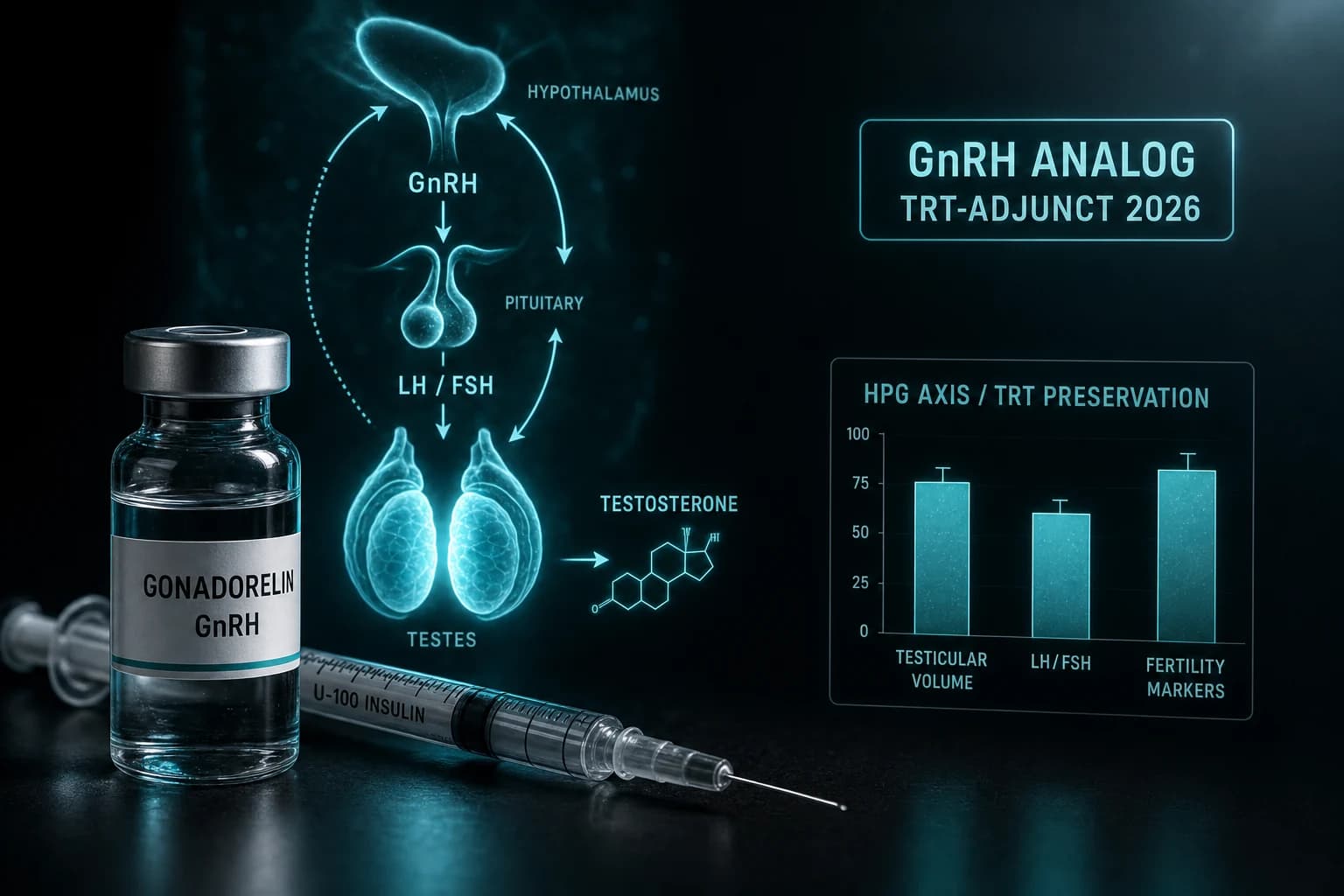
Gonadorelin (gonadorelin acetate, gonadorelin hydrochloride) is a synthetic decapeptide identical in sequence to native gonadotropin-releasing hormone (GnRH). Natural GnRH is released by the hypothalamus in pulses every 60 to 120 minutes. It binds GnRH receptors on the anterior pituitary gonadotrophs and triggers release of luteinizing hormone (LH) and follicle-stimulating hormone (FSH). LH then drives Leydig-cell testosterone synthesis. FSH supports Sertoli-cell function and spermatogenesis.
This is the same physiology kisspeptin targets one step upstream. For background on the upstream lever, see the kisspeptin and HPG-axis evidence review.
The FDA-approved indications for gonadorelin (Factrel, Lutrepulse) are narrow:
- Evaluation of gonadotrope responsiveness in suspected hypogonadotropic hypogonadism
- Induction of ovulation in women with primary hypothalamic amenorrhea via portable pulsatile infusion pump at 5 to 20 mcg every 90 minutes
It is not FDA-approved for testosterone replacement, post-cycle therapy, or fertility preservation in men on exogenous androgens. Every modern U.S. use in male hormone replacement is compounded and off-label. For context on how 503A compounding pharmacies became the access path for peptides like this one, see the FDA July 2026 peptide compounding review.
The pharmacokinetic problem the swap created
Gonadorelin's half-life is the central issue. After subcutaneous injection it is hydrolyzed by plasma peptidases within minutes. A single 100 mcg subcutaneous dose produces one 60 to 120 minute LH pulse and then the signal is gone.
By contrast, hCG has a beta subunit nearly identical to LH and a serum half-life around 24 to 36 hours. A single 500 IU injection of hCG keeps Leydig cells stimulated for 48 to 72 hours. This is why the published TRT-adjunct literature uses "every other day" dosing for hCG, and why fertility-induction protocols use continuous pulsatile pumps for GnRH.
When telehealth clinics switched from "250 IU hCG twice weekly" to "100 mcg gonadorelin twice daily," they kept the prescription cadence but moved from a long-acting LH analog to a short-acting LH-releasing hormone that hits the pituitary, fires a single pulse, and disappears. The two are not pharmacologically interchangeable, regardless of whether they share a clinical goal.
What the pulsatile pump literature actually shows
Continuous pulsatile GnRH delivery via portable infusion pump is the only setting where gonadorelin has serious clinical data in men.
Buchter, Behre, Kliesch, and Nieschlag (European Journal of Endocrinology 1998, PMID 9758439) followed 42 men with hypogonadotropic hypogonadism through 57 induction courses. Spermatogenesis was induced in 54 of 57 courses across either pulsatile GnRH or hCG plus hMG. Pregnancies followed in 26 of 42 men. The pulsatile-GnRH arm used a pump delivering doses every 90 to 120 minutes, around the clock, for months.
Mao and colleagues (Asian Journal of Andrology 2017, PMID 28051040) retrospectively compared 20 men with congenital hypogonadotropic hypogonadism (CHH) on pulsatile GnRH against 182 men on combined hCG plus hMG. Median time to first sperm was 6 months on pulses and 18 months on combined gonadotropins. Final testicular volume was larger in the pulse group as well.
Nachtigall, Boepple, Pralong, and Crowley (NEJM 1997, PMID 9010147) characterized 21 men with adult-onset idiopathic hypogonadotropic hypogonadism. Long-term pulsatile GnRH therapy restored normal testosterone, normal LH and FSH, and fertility in the five men followed through completion.
These are the canonical "pulsatile GnRH works" papers. Every single one used a Lutrepulse-class portable infusion pump dosing 5 to 20 mcg every 60 to 120 minutes, 24 hours a day, for 6 to 24 months. None of them studied two 100 mcg subcutaneous boluses per day.
What the hCG-adjunct-to-TRT literature shows
The TRT-adjunct evidence is almost entirely on hCG, not gonadorelin.
Coviello and colleagues (JCEM 2005, PMID 15713727) randomized 29 men with normal reproductive physiology to 200 mg of testosterone enanthate weekly plus saline placebo or 125, 250, or 500 IU of hCG every other day for three weeks. Intratesticular testosterone (ITT) was measured by fine-needle aspiration. The numbers are the cleanest dose-response data in the field:
| Arm | ITT change from baseline |
|---|---|
| Placebo (TRT only) | -94% (1234 to 72 nmol/L) |
| 125 IU hCG EOD | -25% |
| 250 IU hCG EOD | -7% |
| 500 IU hCG EOD | +26% |
Roth and colleagues (JCEM 2010, PMID 20484472) used the GnRH antagonist acyline to suppress gonadotropins in 37 normal men, then randomized them to 0, 15, 60, or 125 IU of hCG every other day. ITT rose linearly with dose, from roughly 77 nmol/L on placebo to 923 nmol/L on the 125 IU arm. The dose-response continues below what Coviello tested.
The combined Coviello-Roth picture is that 250 IU of hCG every other day is a near-perfect dose for keeping ITT in the eugonadal range during full TRT-induced suppression. No published study establishes the equivalent gonadorelin dose for the same endpoint.
Hochu, Geyer-Kim, and Kim (Translational Andrology and Urology 2025, PMID 41522318) reviewed the modern fertility-preservation literature and noted that compounded gonadorelin became the most widely used hCG substitute after FDA enforcement actions reduced hCG availability through 503A pharmacies, despite the absence of comparative clinical trials. The review treats gonadorelin as a mechanistically reasonable but empirically unproven swap.
The off-label twice-daily gonadorelin protocol: what we actually know
The standard telehealth gonadorelin protocol is 100 to 200 mcg subcutaneously twice daily, sometimes pushed to three times daily. The reasoning is mechanistic: each injection mimics a single hypothalamic GnRH pulse, the pituitary releases an LH pulse, and Leydig cells get a transient stimulus.
What this protocol does not do:
- Reproduce the pump dosing schedule that the published GnRH literature actually used
- Provide continuous LH support comparable to hCG every other day
- Have any controlled trial against an objective endpoint such as ITT, testicular volume, or sperm count in TRT-suppressed men
The argument in favor of twice-daily gonadorelin is that the pituitary still responds to spaced exogenous GnRH pulses and that even partial preservation of Sertoli-cell function may be enough to keep some spermatogenesis active. Plausibility is real here. It is also not a substitute for an endpoint trial.
Bottom line: All published evidence that pulsatile GnRH preserves spermatogenesis used continuous-pulse pumps, not twice-daily subcutaneous boluses. The TRT-adjunct evidence on testicular size and intratesticular testosterone is on hCG, not gonadorelin. Twice-daily gonadorelin sits between two literatures it does not formally belong to.
Gonadorelin vs hCG vs enclomiphene: how to think about the trade
| Factor | Gonadorelin (twice daily) | hCG (EOD) | Enclomiphene (oral SERM) |
|---|---|---|---|
| Acts at | Pituitary GnRH receptor | Leydig-cell LH receptor | Hypothalamic estrogen receptor |
| Releases | Endogenous LH and FSH | Mimics LH only | Endogenous LH and FSH |
| Half-life | 2 to 10 min | 24 to 36 hr | 10 to 16 hr |
| Trial evidence in TRT-suppressed men | None | Coviello 2005, Roth 2010 | Multiple Phase 2/3 monotherapy trials |
| FDA approval relevant to use | Diagnostic and ovulation-pump only | Pediatric cryptorchidism, ovulation induction | Investigational |
| Pituitary requirement | Functional pituitary | Not required | Functional pituitary |
| Typical compounded cost (monthly) | $40 to $80 | $80 to $200 | $30 to $60 |
| Best fit | Mechanistic pituitary preservation argument | ITT and testicular volume preservation | Monotherapy when TRT not started |
The cleanest summary is that hCG has the trial data for the goal most TRT patients actually care about (testicular volume, intratesticular testosterone, sperm preservation), gonadorelin has the trial data for a different goal (fertility induction in pituitary-intact hypogonadism using pump infusion), and enclomiphene has its own evidence base as a monotherapy option that mostly precludes adding exogenous testosterone.
For practical access context, the compounding pharmacy peptide access guide covers how 503A pharmacies handle gonadorelin and hCG availability state by state.
Where the modern evidence is improving
A handful of more recent papers address the question more directly.
Newer 2025 retrospective pump series from CHH cohorts continue to reinforce what Buchter and Mao showed: when GnRH is delivered in physiologic pulses to a pituitary-intact patient, spermatogenesis returns reliably in the 6 to 12 month range, and testicular volume gains often exceed what gonadotropin replacement produces. None of those studies have switched to bolus dosing as a delivery method.
Hochu and colleagues (2025) report that the closest comparator data for gonadorelin in TRT-adjunct use comes from small retrospective telehealth-clinic series that document preserved testicular volume but lack ITT or sperm-count endpoints. The authors describe this as the "least bad" evidence base, not a robust one.
The Crowley adult-onset IHH cohort continues to add follow-up data, and the broader pulsatile-pump literature now spans more than 40 years. The signal is consistent: when the pituitary is intact and GnRH is delivered in physiologic pulses, the HPG axis can be brought back online. That signal does not automatically transfer to twice-daily 100 mcg dosing.
Tip: If fertility on TRT is the actual goal, ask the prescribing clinician about hCG availability through 503A compounding pharmacies before defaulting to gonadorelin. The hCG evidence base is stronger and the dosing math is well characterized at 250 to 500 IU every other day.
Practical considerations for research-use protocols
A few points researchers and patients evaluating compounded gonadorelin should know:
- Reconstitution is straightforward: 10 mg of gonadorelin acetate in 10 mL of bacteriostatic water yields a 1 mg/mL solution. A 100 mcg dose is 0.1 mL, which is 10 IU on a U-100 insulin syringe. The reconstitution calculator handles the conversion if the vial size or BAC water volume changes.
- Subcutaneous administration is standard. The 27 to 31 gauge insulin syringes used for hCG and GLP-1s work without modification.
- Storage matches most peptides: refrigerated post-reconstitution, single-vial use typically allows 14 to 30 days before discarding.
- The "test response" question matters more than for hCG. Some patients show clear LH and FSH rise on bloodwork at 1 to 4 hours post-injection. Others show little movement, which suggests the pituitary is not responding well to spaced bolus stimulation. Pre-treatment and 4-hour post-injection LH measurements are the cleanest way to verify the pituitary actually fires.
- The side effect profile is mild but not zero: headache, flushing, injection-site reaction, and rare hypersensitivity have been reported. Estradiol can still rise via aromatization of Leydig-cell testosterone, which is the same downstream problem hCG creates.
For research-use compounded gonadorelin, Ascension Peptides stocks injectable gonadorelin and ships with third-party COAs. Use code ENHANCED for 50 percent off injectables. The Ascension Peptides review covers their COA process and shipping. A broader cross-vendor comparison sits in the best legit peptide vendors 2026 guide.
What the evidence supports, and what it does not
It supports:
- Pulsatile GnRH via continuous-pulse pump is an established therapy for hypogonadotropic hypogonadism, with multiple decades of fertility-induction data
- Low-dose hCG (250 IU every other day, with linear dose-response down to 15 IU EOD) preserves intratesticular testosterone in men on suppressive doses of exogenous testosterone
- Gonadorelin's mechanism (LH and FSH release via pituitary GnRH receptor activation) is intact when given as a subcutaneous bolus, with measurable LH rise in many patients
- Modern compounding-pharmacy access has made gonadorelin the default U.S. swap when hCG is unavailable
It does not support:
- That twice-daily 100 mcg subcutaneous gonadorelin produces the same testicular volume, intratesticular testosterone, or sperm-count outcomes as hCG every other day during TRT
- That gonadorelin "works as well as hCG for fertility preservation on TRT," which is the framing on most telehealth-clinic landing pages
- That gonadorelin is appropriate for men with pituitary insufficiency, in whom the upstream GnRH receptor will not respond
- That bolus dosing is equivalent to pump pulsing for fertility induction in hypogonadotropic hypogonadism
The narrow honest answer
For a TRT patient who values fertility or testicular volume preservation and has access to compounded hCG, the published evidence favors hCG. For a TRT patient where hCG is unavailable, gonadorelin is mechanistically defensible and has a generation of broader GnRH literature behind it, but no head-to-head TRT trial against hCG exists. For a man not yet on TRT who wants to preserve endogenous production, enclomiphene monotherapy has the cleanest trial base.
The gap that the current TRT literature has not closed is a randomized comparison of twice-daily subcutaneous gonadorelin versus 250 IU hCG every other day in men on suppressive testosterone, with ITT, testicular volume, and semen analysis as endpoints. Until that trial runs, the popular claim that gonadorelin is a like-for-like hCG replacement on TRT outruns the available data.
For a deeper look at the upstream HPG-axis lever that sits one step earlier in this pathway, the kisspeptin libido and fertility evidence review covers what kisspeptin is doing at the GnRH-neuron level. For context on growth-hormone-axis peptides that occupy a similar "endogenous-signal-restoration" framing, the sermorelin clinical research guide is the closest analog.
References
- Coviello AD, Matsumoto AM, Bremner WJ, et al. Low-dose human chorionic gonadotropin maintains intratesticular testosterone in normal men with testosterone-induced gonadotropin suppression. J Clin Endocrinol Metab. 2005;90(5):2595-2602. PMID 15713727
- Roth MY, Lin K, Bay K, et al. Dose-dependent increase in intratesticular testosterone by very low-dose human chorionic gonadotropin in normal men with experimental gonadotropin deficiency. J Clin Endocrinol Metab. 2010;95(8):3806-3813. PMID 20484472
- Buchter D, Behre HM, Kliesch S, Nieschlag E. Pulsatile GnRH or human chorionic gonadotropin/human menopausal gonadotropin as effective treatment for men with hypogonadotropic hypogonadism: a review of 42 cases. Eur J Endocrinol. 1998;139(3):298-303. PMID 9758439
- Liu Z, Mao J, Wu X, et al. Pulsatile gonadotropin-releasing hormone therapy is associated with earlier spermatogenesis compared to combined gonadotropin therapy in patients with congenital hypogonadotropic hypogonadism. Asian J Androl. 2017;19(6):680-685. PMID 28051040
- Nachtigall LB, Boepple PA, Pralong FP, Crowley WF Jr. Adult-onset idiopathic hypogonadotropic hypogonadism: a treatable form of male infertility. N Engl J Med. 1997;336(6):410-415. PMID 9010147
- Hochu G, Geyer-Kim I, Kim E. Preserving spermatogenesis in testosterone deficiency: innovations in replacement and stimulatory therapies. Transl Androl Urol. 2025;14(12):3975-3987. PMID 41522318
This article is for educational and research purposes only. None of the content above constitutes medical advice. Gonadorelin is FDA approved as Factrel and Lutrepulse for specific diagnostic and ovulation-induction indications. Off-label use in male hormone replacement, fertility preservation on TRT, and post-cycle therapy is not approved. Compounded gonadorelin requires a valid prescription. Decisions about testosterone replacement therapy and fertility belong with the patient and a qualified prescriber.