At a glance
- BPC-157 and TB-500 lead every serious tissue-repair protocol; both are injectable.
- BPC-157 research dose: 250-500 mcg subcutaneously daily, run in 4-week cycles.
- TB-500 loading: roughly 2-2.5 mg twice weekly, tapering after 4-6 weeks.
- GHK-Cu shifts collagen and 31.2% of skin genes toward younger expression (Pickart 2018).
- Nearly all healing data is animal, not human. Treat these as research compounds.
Four peptides do most of the heavy lifting in tissue-repair research, and two of them show up in nearly every serious recovery protocol. The rest of the field is noise, anecdote, or compounds borrowed from other categories. Here is how the real healing peptides rank once you weigh published evidence instead of forum hype.
Two things up front. First, the strongest data sits with BPC-157 and TB-500, which is why they anchor this list. Second, almost none of that data is human. That caveat runs through this entire guide, and we do not bury it.
The ranking in one paragraph
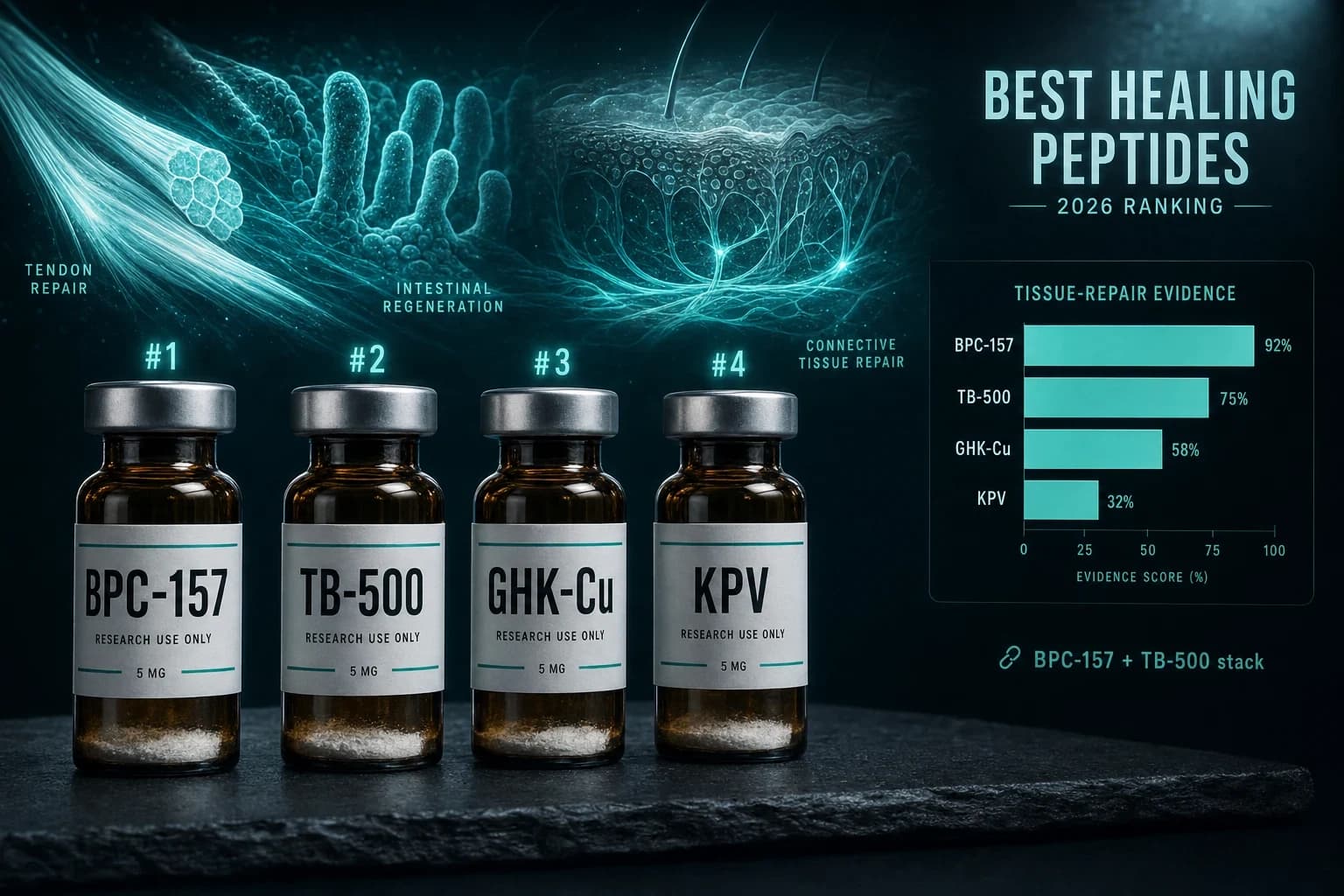
BPC-157 takes the top spot for its depth of connective-tissue and gut-repair evidence. TB-500 (thymosin beta-4) is second on the strength of quantified wound-healing data and a rare pair of human Phase 2 trials. GHK-Cu earns third for five decades of collagen and skin-remodeling research. KPV rounds out the list as the gut-and-inflammation specialist that happens to work orally. Everything below that line is either unproven for healing or better classified elsewhere.
How we ranked them
We did not rank by popularity. Four criteria decided the order:
- Depth of published evidence. How many studies, and do they report actual numbers instead of vibes.
- Breadth of tissue. A peptide that repairs tendon, gut, and vasculature beats one with a single trick.
- Mechanistic clarity. We want a known pathway, not "it just works."
- Safety and route flexibility. Fewer reported adverse effects, and options for how it is administered.
Animal studies with real effect sizes outrank human testimonials every time. If a claim rests only on a Reddit thread, it did not make the cut.
1. BPC-157: the tendon and gut all-rounder
Torn tendon, cranky ligament, or an irritated gut lining. BPC-157 is the pentadecapeptide researchers reach for across all three, and the breadth is the whole point.
The tendon evidence is the cleanest. Chang et al. (2011) showed that BPC-157 accelerated the outgrowth of tendon explants, increased tendon fibroblast survival under oxidative (H2O2) stress, and boosted fibroblast migration in a dose-dependent scratch assay. The proposed engine is angiogenesis: BPC-157 upregulates VEGFR2 signaling and the nitric-oxide pathway, laying down the new blood vessels that granulation tissue needs to knit a wound shut.
The gut story is just as developed. Vuksic et al. (2007) found that BPC-157 improved intestinal anastomosis healing in rats: less inflammatory infiltration early, then a jump in granulation tissue, reticulin, and collagen over the following days. That is why the injectable form is studied for systemic tendon and vascular work while the oral form is aimed squarely at the gut, where local intestinal action is the goal.
Full mechanism and protocol details live on the BPC-157 compound page. The common research dose is 250-500 mcg subcutaneously, once or twice daily, run in four-week cycles.
Bottom line: If you pick one healing peptide to understand deeply, make it BPC-157. Its evidence spans tendon, gut, and blood vessel repair, which no other compound on this list matches.
2. TB-500 (thymosin beta-4): the cell-migration specialist
Where BPC-157 builds the plumbing, TB-500 moves the crew. Thymosin beta-4 is an actin-binding peptide whose main job is mobilizing cells into a wound bed so repair can start.
The numbers are specific. Malinda et al. (1999) reported that thymosin beta-4 increased reepithelialization of full-thickness rat wounds by 42% at four days and by as much as 61% at seven days versus saline, while stimulating keratinocyte migration two to three-fold. It also increased collagen deposition and angiogenesis in treated wounds.
TB-500 also carries something almost unique in this category: human data. Treadwell et al. (2012) summarized preclinical healing across diabetic, steroid-treated, and aged animals, plus two Phase 2 trials in patients with pressure and stasis ulcers, where thymosin beta-4 accelerated closure by nearly a month in the wounds that healed.
The tradeoff is route. TB-500 is injectable only, with no meaningful oral form. See the TB-500 compound page for the full profile. Research protocols usually load at roughly 2-2.5 mg twice weekly for four to six weeks, then taper to a lower maintenance dose.
3. GHK-Cu: collagen, skin, and wound remodeling
GHK-Cu is the copper tripeptide your own plasma carries, and its level drops with age. That decline is exactly what makes it interesting for skin and wound repair.
Leonard Pickart spent decades documenting it. The review by Pickart and Margolina (2018) catalogs how GHK-Cu stimulates collagen, elastin, and glycosaminoglycan synthesis, supports dermal fibroblasts, and promotes blood-vessel and nerve outgrowth. Their gene analysis found it shifts expression of roughly 31.2% of human genes back toward a younger pattern, which is the molecular basis for its use in scar remodeling and skin regeneration.
GHK-Cu is the most route-flexible peptide here. It works topically for skin and cosmetic endpoints and is used as a subcutaneous injectable for deeper wound and connective-tissue research. Details are on the GHK-Cu compound page. Typical research use runs 1-3 mg topically or injectable.
4. KPV: the gut-and-inflammation utility peptide
KPV (Lys-Pro-Val) is the small one, and its edge is that it survives the trip through your gut. It is the C-terminal fragment of alpha-MSH, and it brings the parent hormone's anti-inflammatory action without the pigmentation effects.
Dalmasso et al. (2008) showed that KPV is transported into intestinal and immune cells by the PepT1 di/tripeptide transporter, where nanomolar concentrations shut down NF-kappaB and MAP-kinase inflammatory signaling. Oral KPV reduced the incidence and severity of colitis in mouse models. For anyone researching inflammatory gut conditions, that oral bioavailability is the selling point.
KPV pairs naturally with BPC-157 for gut protocols. See the KPV compound page. Oral research doses land around 200-500 mcg daily.
Head-to-head comparison
| Peptide | Primary use | Route | Evidence level | Typical research dose |
|---|---|---|---|---|
| BPC-157 | Tendon, ligament, gut, vascular | Injectable (oral for gut) | Extensive preclinical | 250-500 mcg daily SC |
| TB-500 | Wound closure, cell migration | Injectable | Preclinical + 2 human Phase 2 | 2-2.5 mg twice weekly |
| GHK-Cu | Collagen, skin, scar remodeling | Topical or injectable | Extensive preclinical | 1-3 mg topical/SC |
| KPV | Gut inflammation, IBD models | Oral or injectable | Preclinical | 200-500 mcg daily |
The classic pairing: BPC-157 + TB-500
Ask any group of recovery researchers what they run together, and this pair comes up first. The logic is that the two peptides cover different stages of repair rather than doing the same job twice.
BPC-157 drives angiogenesis and acts strongly at a local injury site. TB-500 distributes through tissue and pulls repair cells into the wound. One builds the supply lines, the other moves the workforce. That division of labor is why the combination is nicknamed the Wolverine protocol, and why it is sold pre-mixed as the Wolverine stack (BPC-157 10 mg + TB-500 10 mg).
If your goal includes skin and gut on top of connective tissue, the four-peptide KLOW stack layers GHK-Cu and KPV onto that base.
Tip: Reconstituting a stack correctly is where most people slip. Use the reconstitution calculator to convert your bacteriostatic-water volume into an exact unit count on the syringe before you draw.
Injectable vs oral: pick by target, not by fear of needles
The route question has a clean answer once you know where the injury is.
Systemic and connective-tissue endpoints favor injectable. Subcutaneous delivery near the area of interest is the most common approach for BPC-157 and the only real option for TB-500. If your target is the gut lining, oral makes sense: oral BPC-157 and oral KPV act locally in the intestine, where systemic absorption is beside the point. GHK-Cu splits the difference, going topical for skin and injectable for deeper tissue.
Choosing oral because you dislike needles, when your target is a tendon, is optimizing for the wrong variable.
Who each one fits
- Tendon or ligament injury: BPC-157 first, TB-500 alongside it if you want the pairing.
- Post-surgical or slow-healing wound: TB-500, given its quantified reepithelialization and human ulcer data.
- Skin, scarring, or cosmetic repair: GHK-Cu, topical or injectable.
- Gut inflammation or leaky-gut research: oral BPC-157 plus KPV.
- Whole-body recovery experiment: the BPC-157 + TB-500 base, GHK-Cu and KPV added if skin and gut matter.
Browse every option in the full peptide library if your target tissue is not on this list.
The honest evidence check
Here is the part most sellers skip. The healing data behind BPC-157 and TB-500 is overwhelmingly preclinical. Rats, mice, cell cultures. Impressive effect sizes, but not humans.
The rare human exception underlines the point. Lee et al. (2025) ran a safety pilot of intravenous BPC-157 in exactly two adults, escalating to 20 mg with no adverse effects and unchanged cardiac, hepatic, renal, and thyroid markers. Reassuring on safety, useless for efficacy. Two people is a case report, not a trial.
None of these compounds is approved for human use. The right mental model is: strong mechanism, strong animal data, thin human evidence. Anyone promising you a torn Achilles will heal on a schedule is selling, not citing.
Warning: These are research compounds, not licensed medicines. There are no established human efficacy doses, no long-term human safety data, and quality varies sharply between suppliers. Third-party testing is not optional.
Where researchers source them
Because purity decides whether a study means anything, sourcing matters as much as protocol. The injectables in this guide (BPC-157, TB-500, and the Wolverine stack) are available from Ascension Peptides with 50% off using code ENHANCED. Check the lab-tests library for those lots. Oral formulations like KPV capsules are handled through the orals partner.
Whichever compound you start with, match the dose to the tissue, run it in defined cycles, and log what you observe.
This article is for research and educational purposes only. It is not medical advice. BPC-157, TB-500 (thymosin beta-4), GHK-Cu, and KPV are research compounds that are not approved by the FDA for human use or consumption. Nothing here is a recommendation to use, purchase, or administer any substance. Consult a qualified healthcare professional before making any health decision.