At a glance
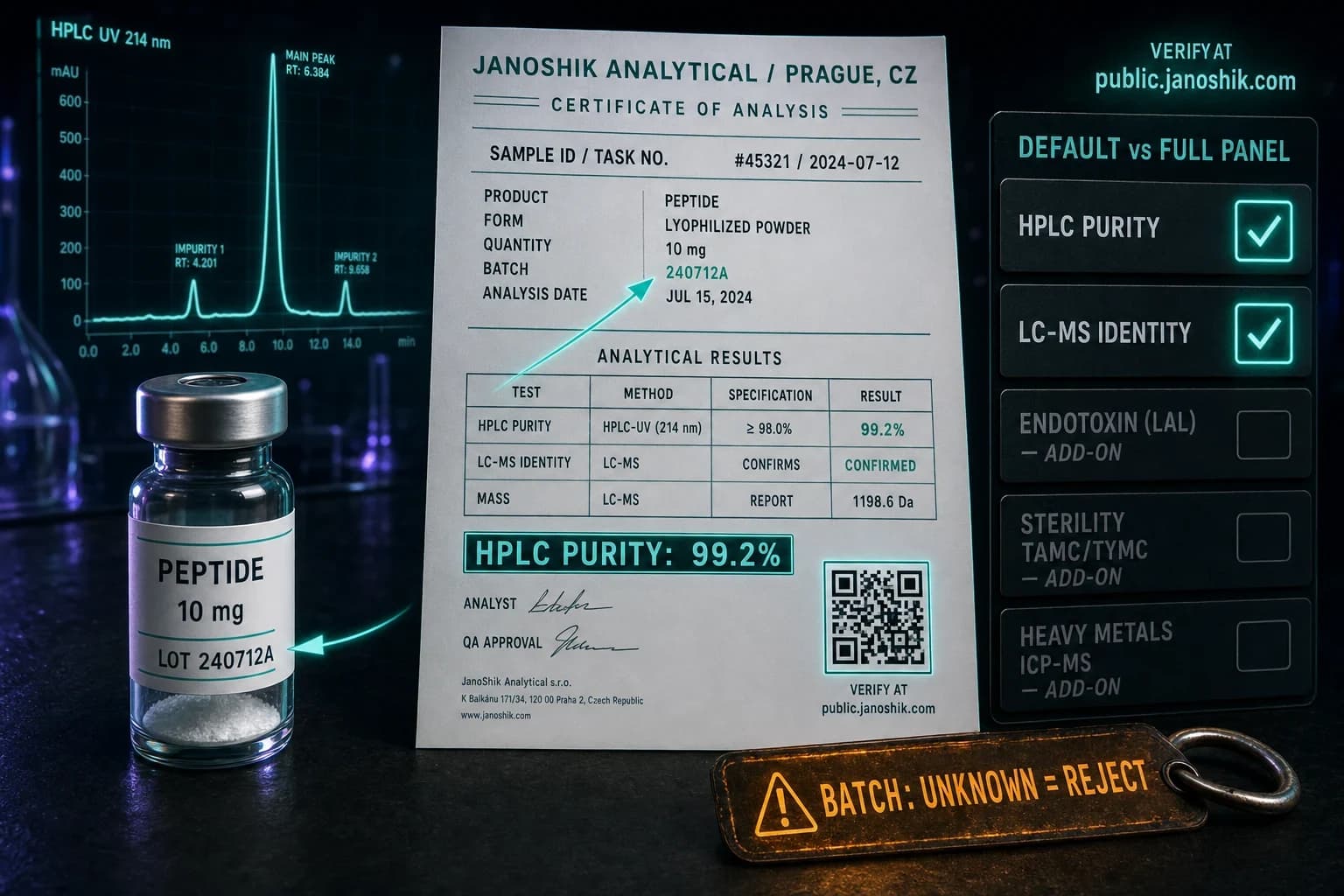
- Janoshik runs HPLC purity and LC-MS identity; endotoxin, sterility, and heavy metals are add-ons the default panel does not include.
- Every real Janoshik report has a unique sample ID or task number. Verify it directly on public.janoshik.com, not through the vendor's page.
- The batch line on the certificate must match the lot printed on the vial. A blank or 'Unknown' batch invalidates the report for that vial.
- A Janoshik HPLC line does not prove sterility for an injectable. Endotoxin (LAL) and sterility (TAMC/TYMC) are separate assays, separately reported.
- The safest vendor tier publishes per-lot COAs where lot, purity, test date, and product name all reconcile with the vial in your hand.
Janoshik Analytical is the single most-cited third-party lab in the peptide market. If you have ever hovered over a "third-party tested" badge on a research-peptide site, the certificate behind that badge probably came from Janoshik. That popularity is earned. It is also often abused.
A Janoshik certificate proves something specific. It proves that a sample submitted to a Czech HPLC lab reached a stated purity percentage on a stated date under a stated method. It does not prove sterility, does not prove endotoxin safety, does not always prove which vial the sample came from, and does not survive if the batch on the paper cannot be matched to the batch on the vial you are holding.
This is the field guide the site's own COA library is built on. Read it before you accept any Janoshik report at face value.
Bottom line: Janoshik peptide testing is a useful trust signal, not a completeness signal. A verifiable HPLC report on a matched batch is a floor for a research vendor to clear. Sterility, endotoxin, and heavy-metal data live in separate assays and are usually missing from the cheapest COA tier.
What Janoshik actually is
Janoshik is a private analytical laboratory registered as Janoshik s.r.o. in Prague, Czech Republic since October 2022, founded and run by Peter Magic, a Slovak analytical chemist. It sells peptide, anabolic steroid, and SARM purity and identity testing to individuals and to vendors on a per-sample basis. It is not accredited to ISO/IEC 17025, the international standard that pharmaceutical QC laboratories are audited against. Neither are its main peers in the harm-reduction analytical category (Chromate, Freedom Diagnostics, MZ Biolabs). That absence is a limitation of the category, not of Janoshik specifically.
The reason so many COAs cite Janoshik anyway is a network effect. Turnaround is short (five to ten business days for a common HPLC panel), costs are low (a few hundred dollars per sample), and every result is posted to a public database at public.janoshik.com that anyone can query by sample ID. That combination made it the default lab for the gray market, and the format most buyers now recognize at a glance.
What a Janoshik order actually gets you
The table below is a working reference, not a marketing brochure. Prices are approximate street prices reported by vendors and researchers who publish their invoices; the lab does not run a public rate card that guarantees these figures.
| Test | What it measures | What it does not | Typical cost | Turnaround |
|---|---|---|---|---|
| HPLC purity | Area-percent of the target peptide peak vs total UV-absorbing species | Whether the target sequence is correct | ~$100-$120 | 5-10 business days |
| LC-MS / LC-MS/MS identity | Molecular weight matches the expected peptide | Bulk purity or contamination | Add-on, ~$120-$170 | Same window |
| Blind test (GLP-1 or SARM/AAS) | Vendor-blinded identification of a mystery sample | Neither purity nor safety | ~$170-$300 depending on class | Same window |
| Endotoxin (LAL) | Bacterial endotoxin, quantitative EU/mg | Sterility, live pathogens | Add-on, ~$150-$175 | Same window |
| Sterility (TAMC + TYMC) | Aerobic microbial and yeast/mold counts | Endotoxin, viral contamination | Add-on | Same window |
| Residual solvents (GC-MS) | Trace acetonitrile, DMF, methanol, DCM from synthesis | Everything else | Add-on | Same window |
| Heavy metals (ICP-MS) | Arsenic, lead, cadmium, mercury, others | Non-elemental contamination | Add-on | Same window |
A vendor that publishes only an HPLC page has bought only the cheapest tier. That is enough to say the peptide is what it claims to be, at the percentage stated, on the day tested. It is not enough to say the injectable is safe.
The pharma expectation for a synthetic peptide API is greater than or equal to 98% by HPLC with any single unknown impurity below 0.5%. Well-run research-peptide vendors publish 98% to 99.5% on their Janoshik reports for finished vials. The reason to hold that ceiling is not that 96% peptide is unusable in principle; it is that the missing three to four percent may include synthesis-related sequence variants, and peptide-related impurities are the ones regulators focus on because immunogenicity risk lives there (De Groot et al., Drug Discovery Today, 2023).
What Janoshik does not test for
Four gaps are worth naming, because "third-party tested" is used as if it covers all four.
- Sterility. Sterility is not proven by HPLC. A synthetically pure vial can still be contaminated with viable bacteria if the fill and finish were done outside a controlled environment. Sterility (aerobic microbial count, yeast, mold) is a separate assay that Janoshik offers as an add-on. If the vendor's COA page shows only HPLC, sterility was not tested there.
- Endotoxin. Endotoxins are lipopolysaccharide fragments left behind when Gram-negative bacteria die. A sterile-appearing vial can still carry endotoxin from the manufacturing water. Endotoxin exposure at even nanogram-per-kilogram levels drives fever, chills, and in severe cases septic-shock physiology, which is why the FDA framed the Limulus Amebocyte Lysate assay as the end-product endotoxin test for injectable drugs decades ago (Munson, Prog Clin Biol Res, 1985). Janoshik runs quantitative LAL on request. The default HPLC-only order does not include it.
- Heavy metals. Peptide APIs, glass vials, and rubber closures can leach trace metals; ICP-MS is the standard screen for arsenic, lead, cadmium, mercury and platinum-group residues from catalysis (Lewen et al., J Pharm Biomed Anal, 2004). This is rarely listed on a research-peptide COA unless the vendor asked for the panel.
- Manufacturing-related impurities. Any peptide synthesized in bulk carries process residues: unreacted amino acids, capping and deprotection fragments, trace TFA, residual solvents. A 2024 Pharmaceutical Research study of follow-on GLP-1 products versus the originators found new impurity patterns unique to the follow-ons, including high-molecular-weight proteins, trace metals, counterions, and residual solvents that the originator manufacturers do not carry (Hach et al., Pharm Res, 2024). A single HPLC purity number does not surface those.
None of this makes Janoshik reports meaningless. It means a Janoshik purity line answers one question, and buying an injectable requires several more.
How to verify a Janoshik COA in under 60 seconds
Every real Janoshik report carries a unique key that the lab hosts on its own domain. The verification takes less than a minute; the number of buyers who skip it is the reason fake COAs still work.
Do this every time.
- Find the sample ID or task number on the certificate. Newer reports include a QR code and a task number in the header. Older ones list a sample ID alone. Any authentic Janoshik report has one.
- Go to public.janoshik.com directly. Type the URL. Do not follow a link from the vendor page and do not scan a QR code with an app that opens the vendor's own domain. The vendor should never be the middle-man for verification.
- Enter the sample ID. The lab returns the original report as posted. Compare it side by side with the vendor's PDF. Compound name, purity percentage, method, test date, and, critically, the batch or lot line should match exactly.
- Cross-check the vial. The lot printed on the vial in your hand should match the batch line on the verified report. If the vial says "LOT 240712A" and the certificate says "Batch: Unknown" or names a different lot, the certificate is not for that vial.
- Confirm the report is not stale. Peptide COAs are batch-specific. A 2023 report for BPC-157 lot A on a vendor's 2026 lot B is decoration, not evidence.
If any of those steps fails, close the tab and buy elsewhere. This is why the site's own COA library publishes lot-matched images tied to specific vendor product pages instead of a generic "we test everything" banner. Buyers who want the machinery in more depth can read what a peptide COA actually is alongside this page.
The red-flag checklist
Six patterns show up over and over on fake or misused Janoshik reports. Any single one on this list is enough to reject the vial.
- Batch line reads "Unknown" or is blank. A test that could not identify the batch it came from cannot support the vial you were shipped. During the site's Penguin Peptides audit we found a Janoshik sheet with a "Batch: Unknown" line, and the same shop's BPC-157 10 mg vial measured 8.45 mg of active peptide. See is Penguin Peptides legit for the full case notes.
- Batch on the sheet does not match the vial. Even when both are named, they must reconcile. A COA for lot 240301 does not certify a vial from lot 240712, and running a single "representative sample" and reusing the certificate across production runs is a common vendor shortcut.
- Purity vs mass mismatch. A COA can report 99.2% HPLC purity and the vial can still underdose the label if the fill was short. Purity is not quantity. When lot testing includes an active-mass line, verify it against the label; the reconstitution math on the reconstitution calculator only works if the label is honest to begin with.
- Verification link opens the vendor's own domain. Any legitimate Janoshik verification lives on janoshik.com or public.janoshik.com. A "verify here" button that opens a copycat page under the vendor's domain is a rehost, not a proof.
- Headers photoshopped or fonts do not match. Real reports use consistent template versions. Chopped headers, spacing anomalies, or two different fonts on the same page are the tells of a paste-up.
- Compound on the sheet does not match the label. Different compound, different peptide, different chain length. Old vendor trick: attach a real Janoshik report for a stable peptide (BPC-157, TB-500) to a fresh listing for something the vendor never actually tested (retatrutide, cagrilintide, tesofensine).
Two Janoshik reports for the same product on two consecutive lots, each verifiable, each with matching batch codes on the vials, is the format that survives scrutiny. Anything less is decoration.
Warning: A single "third-party tested" badge on a homepage is not evidence. A per-batch COA that verifies against public.janoshik.com is. Treat the badge and the certificate as unrelated claims until you have clicked through.
When Janoshik is enough, and when it is not
For a research-only buyer sourcing a stable, well-characterized peptide (BPC-157, TB-500, ipamorelin, PT-141, semax) from a vendor with a live Janoshik verification link, an HPLC purity in the high nineties is a reasonable trust signal. It answers the "is this the correct molecule at the correct purity" question that most buyers actually have.
For a buyer sourcing an injectable that will be reconstituted at home, that signal is not enough on its own. Injectables need endotoxin and sterility data because the site of use is inside the body, not on a bench. Ask the vendor whether the batch has been LAL and TAMC/TYMC tested and where the certificates are posted. If the answer is "the HPLC is on our COA page and that is our third-party testing," take it as an incomplete answer and treat the vial accordingly. The gray-market sourcing truth guide walks through why the safety-relevant panels matter more than the purity line for anything that ends up in a syringe.
For a buyer sourcing a follow-on GLP-1 (compounded semaglutide, tirzepatide, or retatrutide), a Janoshik HPLC alone is not a substitute for a full API package showing purity, related substances, water content, residual solvents, and endotoxin. The FDA's 2023 and 2024 safety updates on compounded GLP-1s are exactly about missing panels and dosing errors, not about which lab a vendor used (Sensenbrenner et al., poison-control case series on compounded semaglutide errors, Am J Health Syst Pharm, 2023). If a compounded-semaglutide program cannot show the full documentation package on request, prefer a US-licensed 503A route instead. The site's compounded semaglutide reviews and the FDA 503A peptide compounding review both walk through what the proper documentation looks like there.
Where we cite Janoshik on this site
The /lab-tests library tracks per-lot COAs published by the vendors we audit. Where a vendor uses Janoshik, we link straight to the Janoshik-hosted verification page for each lot rather than to a vendor-mirrored PDF. Sports Technology Labs is the most prominent example: our records for compounds like BPC-157 reference Janoshik reports directly from their COA page. Where a vendor uses a different independent lab (Ascension Peptides publishes per-lot COAs from a US-based independent HPLC lab that is not Janoshik), we link to that lab's records instead. What we care about is verifiability, not brand loyalty to one lab.
The vendor that ships us the fewest surprises across the audit continues to be Ascension. Its per-lot COA disclosure and refund posture are the reason we route the on-site CTAs there for injectables. See the Ascension Peptides review for the full audit, and use code ENHANCED for 50 percent off at checkout if you decide to buy.
The one-line answer
A Janoshik peptide test is one useful data point on one dimension of quality (identity and purity, by HPLC and mass spec, on the specific sample submitted). It is not a completeness certificate for an injectable. Verify the key on public.janoshik.com, match the batch on the vial, and then decide whether the vendor also covered the safety-relevant tests or stopped at the cheapest tier.
Research and education only. This is not medical advice, pharmaceutical quality-assurance advice, or a substitute for a licensed compounding pharmacist. All third-party testing references here are for informational verification of research-chemical listings. Do not administer research peptides to humans.