At a glance
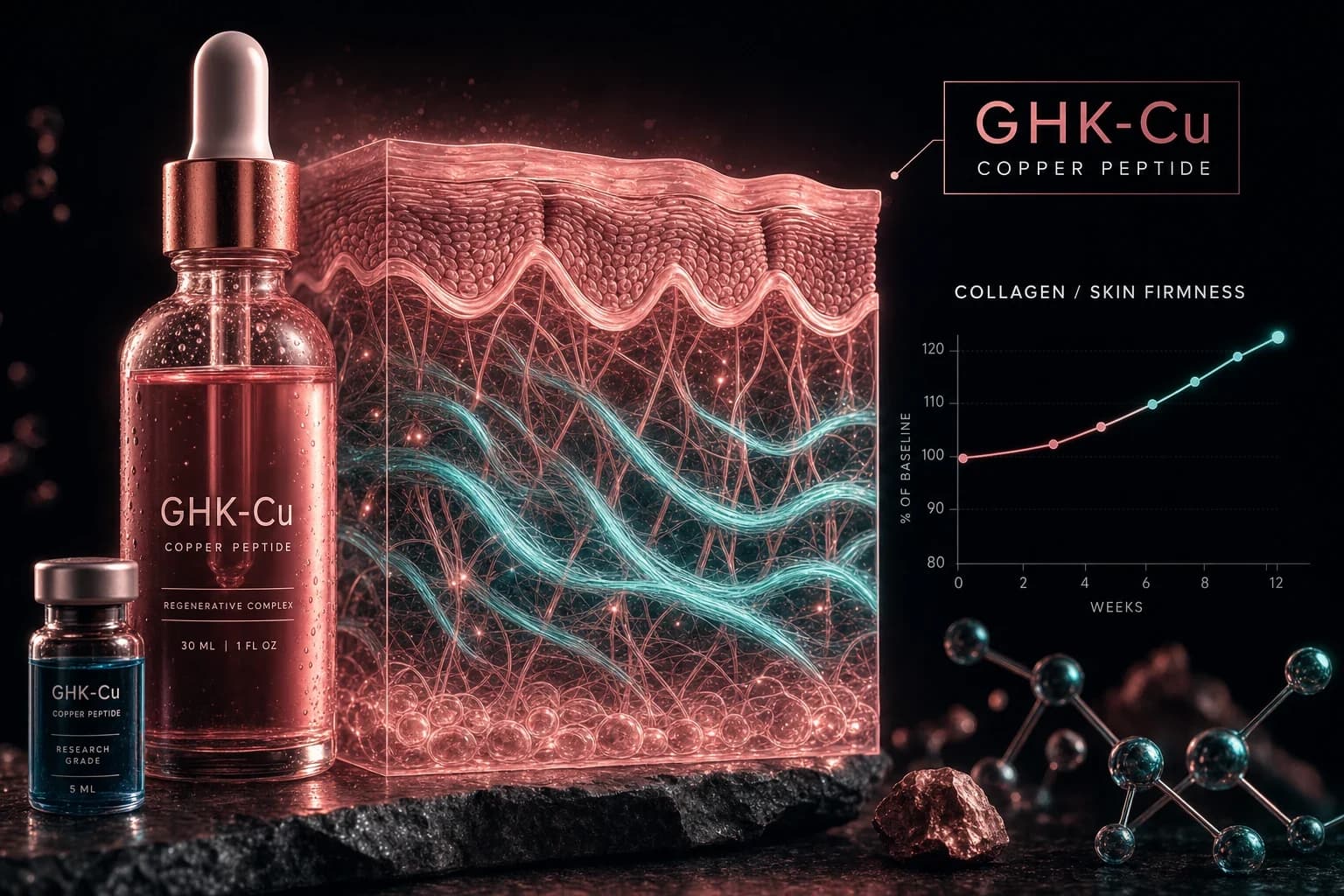
- GHK-Cu is the most-studied skin peptide and regulates thousands of genes (Pickart 2018).
- Matrixyl at 3 ppm beat placebo on wrinkles over 12 weeks (Robinson 2005).
- Argireline cut wrinkle depth up to 30% in 30 days (Blanes-Mira 2002).
- SNAP-8 rests on manufacturer and in-vitro data, not independent human trials.
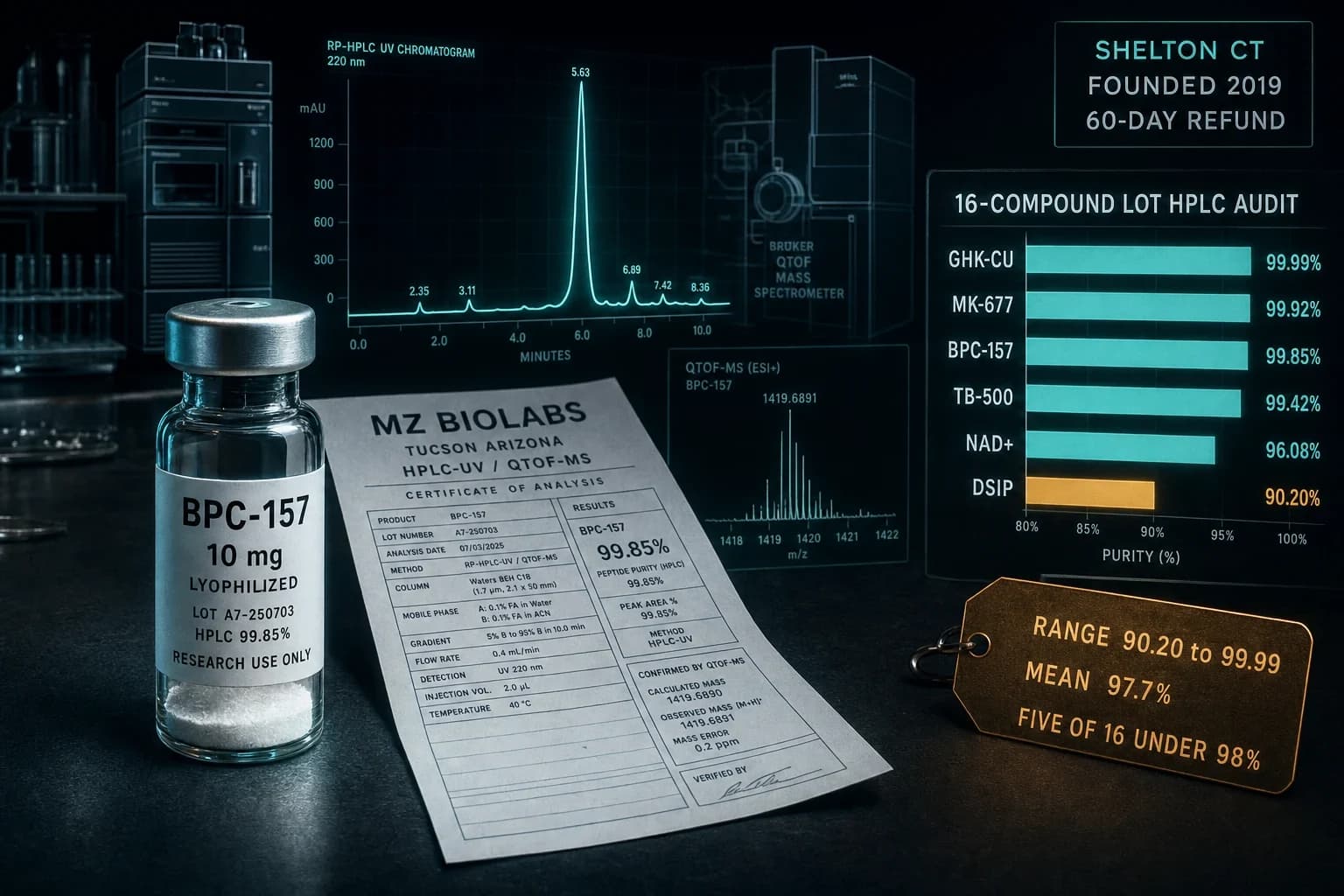
- BPC-157 has strong preclinical healing data but zero human skin trials.
Most "peptide" skincare rides on one manufacturer slide and zero independent trials. A few compounds actually have human data behind the claims. This is how you tell the two apart.
Skin care products containing peptides fall into two very different buckets, and confusing them is where people waste money. One bucket is cosmetic topicals: small peptides formulated into creams and serums, sold legally as cosmetics, meant to work at or just below the skin surface. The other is research injectables: systemic compounds sold for laboratory use only, with a skin angle that is mostly extrapolated from wound-healing studies in animals.
That two-bucket split is the single most useful lens for peptides skin care. Get it right and the marketing sorts itself out.
Two kinds of skin peptides, and they are not interchangeable
Cosmetic topical peptides include GHK-Cu, Matrixyl, Argireline, and SNAP-8. They are chosen because they are small enough to formulate, stable enough to sit in a jar, and backed by at least some human or mechanistic data on skin. Their effects are modest and cumulative. You measure results in months, not days.
Research injectables are a different animal. BPC-157 is the headline example: a healing peptide with real preclinical literature but no cosmetic approval and no human skin trials. It is sold research-only. Treating it like a face serum skips several steps the evidence has not taken yet.
Bottom line: For topical anti-aging with actual human data, GHK-Cu and Matrixyl have the strongest published record. Everything else on the shelf ranges from "modest but real" to "manufacturer says so."
GHK-Cu: the most-studied skin peptide
GHK-Cu is a copper-binding tripeptide (glycyl-L-histidyl-L-lysine complexed with copper 2+) that occurs naturally in human plasma and drops sharply with age. That decline is part of why it became a cosmetic target: restore the signal, restore some of the repair behavior of younger skin.
In a detailed review, Pickart and colleagues describe GHK acting less like a single-pathway drug and more like a reset switch, shifting the expression of thousands of human genes toward tissue repair, collagen and decorin synthesis, antioxidant defense, and anti-inflammatory activity (Pickart et al. (2015)). A follow-up gene-data review reported GHK-Cu influencing roughly 4,000 human genes, up-regulating repair pathways and down-regulating pro-inflammatory ones (Pickart & Margolina (2018)).
Here is the honest caveat. Much of that mechanistic weight is in vitro and animal work, and the controlled human cosmetic trials are fewer and often industry-run. GHK-Cu is the best-studied peptide on this list, but "best-studied" in this category is a lower bar than it sounds. Expect gradual improvements in skin firmness and texture over months, not a dramatic before-and-after.
If you want the deeper mechanism breakdown, the copper peptides guide covers the gene-expression data in full, and the GHK-Cu compound page has formulation and concentration notes. Researchers working with reconstituted material can check the GHK-Cu dosage chart. Topical GHK-Cu is available from Ascension Peptides with 50% off using code ENHANCED.
Matrixyl: the collagen-signaling fragment
Matrixyl is palmitoyl pentapeptide-4, better known as pal-KTTKS. The KTTKS core is a fragment of type I collagen. When skin sees that fragment, it reads it as a signal that collagen has broken down and responds by building more. The palmitoyl fatty-acid tail is bolted on to help the peptide cross the lipid layers of the stratum corneum.
The data here is unusually clean for a cosmetic ingredient. In a 12-week, double-blind, placebo-controlled trial of 93 women aged 35 to 55, a moisturizer carrying just 3 ppm pal-KTTKS produced significant improvement over the same moisturizer without it, measured by both instrument-based skin topography and expert grading of wrinkles and fine lines (Robinson et al. (2005)).
Matrixyl is topical only. There is no injectable rationale, and no reason to reach for one. See the Matrixyl compound page for concentration ranges used in formulations.
Argireline: the topical "Botox-like" peptide
Argireline is acetyl hexapeptide-8. The pitch is that it softens expression lines the way botulinum toxin does, without the needle. The mechanism is real in principle: Argireline interferes with SNAP-25, a component of the SNARE protein complex that nerve endings use to release neurotransmitters, which in turn reduces the muscle contraction that creases skin.
The original volunteer study reported that an oil-in-water emulsion containing 10% of the hexapeptide reduced wrinkle depth by up to 30% after 30 days of use (Blanes-Mira et al. (2002)). Take that number in context. Whether a topical peptide penetrates deeply enough to reach facial muscle is debated, the effect is far weaker than injected botulinum toxin, and most retail serums use concentrations well below 10%. The Argireline compound page has more on formulation strength.
SNAP-8: the extended analog with thinner data
SNAP-8 is acetyl octapeptide-3, an eight-amino-acid extension of the Argireline idea targeting the same SNARE machinery. On paper it is marketed as a stronger version. In practice, independent peer-reviewed clinical data is scarce. Most of the efficacy figures you will see quoted trace back to manufacturer testing rather than published randomized trials.
That does not mean SNAP-8 does nothing. It means the evidence behind it is weaker and less transparent than the evidence behind Argireline or Matrixyl, and you should read its marketing accordingly. The SNAP-8 compound page lays out what is known versus assumed.
BPC-157: a healing peptide, not a skin serum
BPC-157 is a stable pentadecapeptide derived from a protein in gastric juice. Its research reputation comes from tissue repair: it modulates angiogenesis, interacts with the nitric-oxide system, and influences growth-factor signaling. Seiwerth and colleagues reviewed its effects on blood-vessel formation and healing after various types of damage (Seiwerth et al. (2014)).
All of that healing evidence is preclinical, largely in rodents. There are no published human skin trials, and BPC-157 is sold for research use only, typically as an injectable or oral compound. Topical formulations are starting to appear, but their skin benefit is unproven.
Warning: BPC-157 has zero published human skin trials. The healing data is preclinical. Do not treat forum before-and-afters as evidence, and do not confuse a research injectable with a cosmetic. The BPC-157 compound page covers what the animal studies actually show.
How the evidence stacks up
| Peptide | Mechanism | What studies show | Topical or injectable |
|---|---|---|---|
| GHK-Cu (copper peptide) | Copper-binding tripeptide; signals collagen, decorin and GAG synthesis, plus wound repair | Shifts thousands of genes toward repair; collagen and healing data mostly in vitro and animal (Pickart 2018) | Topical creams; also injectable in research |
| Matrixyl (pal-KTTKS) | Type I collagen fragment that signals fibroblasts to rebuild matrix | 3 ppm beat placebo for wrinkle and fine-line reduction, n=93, 12 weeks (Robinson 2005) | Topical only |
| Argireline (acetyl hexapeptide-8) | Interferes with SNAP-25 in the SNARE complex, easing expression-line muscle contraction | Up to 30% wrinkle-depth reduction at 30 days from a 10% emulsion (Blanes-Mira 2002) | Topical only |
| SNAP-8 (acetyl octapeptide-3) | Longer analog of Argireline, same SNARE-targeting idea | Manufacturer and in-vitro data; no independent published clinical trials | Topical only |
| BPC-157 | Angiogenesis, nitric-oxide system, growth-factor modulation | Preclinical wound and blood-vessel healing; no human skin trials (Seiwerth 2014) | Injectable or oral in research; topical unproven |
What the data actually supports
Topical skin peptides deliver small, real, cumulative improvements when you use them consistently over months. They do not replace the two interventions with the deepest evidence for skin aging, which are daily sunscreen and a retinoid. Think of peptides as a supporting layer, not the foundation.
Ranked by strength of published human evidence: Matrixyl and GHK-Cu lead, Argireline shows measurable but modest line softening, and SNAP-8 plus topical BPC-157 lean on the weakest or least independent data. Any product promising rapid, dramatic change from a peptide alone is selling ahead of the science.
Where to start
Pick one or two peptides with the best evidence, use them daily, and judge results at the 8 to 12 week mark, not the first week. GHK-Cu is a reasonable anchor because it has the broadest research base and pairs well with a basic sunscreen-and-retinoid routine. Consistency beats stacking five ingredients you will abandon in a month.
Browse the full peptide directory to compare compounds side by side before you buy. Topical GHK-Cu is available from Ascension Peptides with 50% off using code ENHANCED.
This article is for research and educational purposes only. It is not medical advice, and nothing here is a recommendation to use any compound to treat, cure, or prevent a condition. Most peptides discussed are not approved by the FDA for cosmetic or therapeutic use. Consult a qualified healthcare professional before starting any new regimen.