At a glance
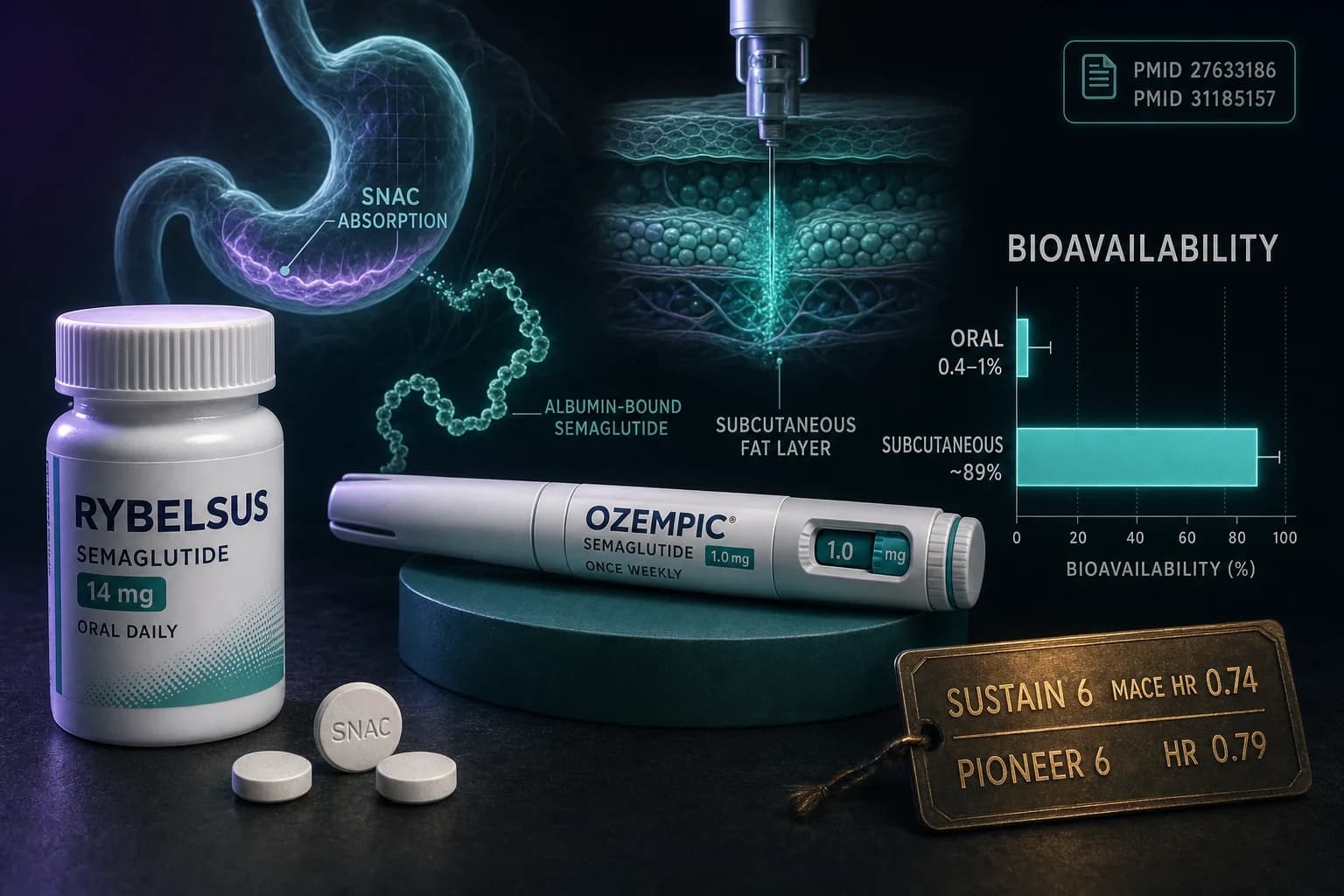
- Rybelsus and Ozempic are the same semaglutide molecule at different bioavailabilities: oral 0.4 to 1%, subcutaneous about 89%.
- Injectable semaglutide 1.0 mg cut HbA1c ~1.8% and body weight ~6.5 kg in SUSTAIN 7 (Pratley 2018).
- Oral semaglutide 14 mg cut HbA1c ~1.2% and body weight ~4.4 kg vs liraglutide in PIONEER 4 (Pratley 2019).
- SUSTAIN 6 (Marso 2016) showed a 26% MACE reduction with injectable semaglutide; PIONEER 6 (Husain 2019) hit non-inferiority only.
- Starting in early 2026 the 1.5, 4, and 9 mg Rybelsus tablets are being rebranded to Ozempic pills.
The most useful thing to know about Rybelsus vs Ozempic is that they are the same drug. Both are semaglutide, a GLP-1 receptor agonist made by Novo Nordisk. Rybelsus is a daily oral tablet; Ozempic is a once-weekly subcutaneous injection. The molecule is identical. Everything you feel or measure comes from how much of it reaches your blood, and that is where the two diverge.
If you only read one line of this comparison, read this one: at their FDA-approved diabetes doses, the injection produces slightly better HbA1c and weight outcomes, the pill trades some of that for the convenience of not injecting, and starting in early 2026 Novo Nordisk is renaming the higher-strength Rybelsus tablets to Ozempic pills in the US, collapsing a marketing distinction that never mapped to a real pharmacological one.
The 2026 Rybelsus rebrand
Novo Nordisk has begun migrating the higher-strength Rybelsus tablets (1.5, 4, and 9 mg) to the Ozempic pill brand in the US in 2026, aligning the oral formulation's name with its injectable counterpart. Rybelsus 3 mg remains the starter tablet; patients titrate onto the Ozempic-branded oral maintenance strengths. The molecule does not change. Label indications remain type 2 diabetes for both formulations, with the separate Wegovy brand still owning the chronic-weight-management indication (see Ozempic vs Wegovy for the diabetes-vs-obesity split).
Two things follow from that. First, articles that call Rybelsus "the pill version" of Ozempic have started to be literally correct rather than approximate. Second, once the transition finishes, the search query "Rybelsus vs Ozempic" will start meaning "oral Ozempic vs injectable Ozempic," and the answer will be the one this piece already gives.
Same molecule, one big absorption problem
Semaglutide is a 31-amino-acid peptide with a C18 diacid fatty-acid side chain that binds serum albumin, extending its terminal half-life to about 165 hours (roughly 7 days). That half-life is what lets a subcutaneous dose stretch to once weekly. Absolute subcutaneous bioavailability is around 89% by Novo Nordisk's own reporting; effectively all of what is injected reaches systemic circulation.
Oral peptides do not enjoy that. Stomach acid, pepsin, pancreatic proteases, and a low permeability across the gut wall together drive most peptide bioavailability under 1%. Rybelsus solves that with a co-formulated absorption enhancer called SNAC (sodium N-[8-(2-hydroxybenzoyl)amino] caprylate). SNAC buffers local gastric pH, blunts pepsin activity, keeps semaglutide as an absorbable monomer, and transiently permeabilizes the stomach epithelium enough for a small fraction of the tablet's contents to pass into portal blood (Buckley et al. (2018)).
Even with that engineered platform, oral bioavailability lands at roughly 0.4 to 1%. That is the entire reason the pill and injection differ in effect: the same molecule, but the tablet delivers around one one-hundredth of the plasma exposure per milligram of drug swallowed. A 14 mg oral dose does not equal a 14 mg subcutaneous dose. It approximates the exposure of a much smaller injection.
HbA1c: what the trials actually show
There is no head-to-head trial of Rybelsus vs Ozempic. The evidence is cross-trial. Both were developed against comparators, and the numbers below come from the pivotal Phase 3 trials in the PIONEER (oral) and SUSTAIN (injectable) programs.
| Trial | Formulation | Dose | HbA1c reduction | Weight loss | Comparator |
|---|---|---|---|---|---|
| PIONEER 3 (Rosenstock et al. 2019) | Oral | 14 mg daily | -1.3% (26 wk) | -3.2 kg | Sitagliptin 100 mg (-0.8% / -1.0 kg) |
| PIONEER 4 (Pratley et al. 2019) | Oral | 14 mg daily | -1.2% (26 wk) | -4.4 kg | Liraglutide 1.8 mg SC (-1.1% / -3.1 kg) |
| SUSTAIN 7 (Pratley et al. 2018) | Injectable | 1.0 mg weekly | -1.8% (40 wk) | -6.5 kg | Dulaglutide 1.5 mg SC (-1.4% / -3.0 kg) |
| SUSTAIN 6 (Marso et al. 2016) | Injectable | 0.5 or 1.0 mg weekly | -0.7 to -1.0% add-on | Modest | Placebo (MACE HR 0.74) |
Two patterns emerge. Injectable semaglutide at 1.0 mg pushes HbA1c reductions of about -1.5 to -1.8% and weight losses of about -5 to -6.5 kg in type 2 diabetes trials. Oral semaglutide at 14 mg reduces HbA1c by about -1.0 to -1.3% and weight by about -3 to -4.5 kg over 26 to 52 weeks. Indirect comparisons across the two programs converge on injectable semaglutide producing roughly 0.2 to 0.3 percentage points more HbA1c reduction and about 1 to 2 kg more weight loss than the highest currently-approved oral dose. The gap is meaningful but not huge.
That gap should shrink further as the higher oral-semaglutide doses (25 and 50 mg) reach the US label. Novo's OASIS 4 and PIONEER Plus dose-finding data suggest 25 mg oral semaglutide produces weight loss in a similar range to Ozempic 1 mg. The molecule is the same; the tablet is finally being dosed high enough to push a useful fraction across the gut.
Weight loss framing: neither is Wegovy
A common searcher error is treating Rybelsus or Ozempic as weight-loss drugs. They are not. Both are FDA-approved for type 2 diabetes only. Weight loss is a secondary effect the trials measured but the label does not indicate.
The dedicated weight-loss brand is Wegovy, also semaglutide, dosed to 2.4 mg subcutaneously once weekly. STEP 1 (Wilding et al. 2021) delivered a mean -14.9% body-weight change over 68 weeks in adults with obesity or overweight plus a risk factor, versus -2.4% for placebo. Ozempic tops out at 2 mg for diabetes, so its weight effect is lower simply because the exposure is lower. Rybelsus at 14 mg is lower still.
If weight loss is the primary endpoint, this is the wrong comparison to be running. See Wegovy vs Zepbound for the semaglutide-vs-tirzepatide obesity-dose head-to-head, and Ozempic vs Wegovy for the semaglutide diabetes-vs-obesity split.
The food timing tax on Rybelsus
The label constraint people underestimate on Rybelsus is the fasting rule that keeps SNAC absorption viable. Take Rybelsus in the morning, on an empty stomach, with no more than 4 ounces of plain water. Wait at least 30 minutes before food, other drinks, or other oral medications.
Break that window and bioavailability collapses toward zero. In the PIONEER 4 protocol, adherence to those instructions was tracked and reinforced; in real-world use, missed windows are one of the common reasons a patient on Rybelsus does not respond.
Ozempic has no such constraint. Inject once weekly on the day and time chosen, with or without food, and the pharmacokinetics do not care. That practical difference is why the injection remains preferred when a patient has trouble with morning routines or takes other oral morning medications, and it is part of why Novo built the fully self-contained SNAC-plus-tablet system to make the pill feasible in a home routine at all.
Cardiovascular outcomes
Both formulations have their own dedicated cardiovascular outcomes trial in high-risk type 2 diabetes patients, and the strength of evidence is not the same.
SUSTAIN 6 (Marso et al. 2016) randomized 3,297 patients to subcutaneous semaglutide 0.5 or 1.0 mg weekly or placebo for a median 2.1 years. The composite of cardiovascular death, non-fatal myocardial infarction, or non-fatal stroke occurred in 6.6% of the semaglutide group vs 8.9% of placebo (HR 0.74, p=0.02 for superiority). A retinopathy signal in that trial (HR 1.76) drove a labeled warning that now ships on every semaglutide product.
PIONEER 6 (Husain et al. 2019) randomized 3,183 similar-risk patients to oral semaglutide 14 mg daily or placebo, with median follow-up 15.9 months. The MACE hazard ratio was 0.79 (95% CI 0.57 to 1.11), meeting non-inferiority but not reaching superiority. Cardiovascular mortality specifically was lower with oral semaglutide (HR 0.51). The absence of superiority is partly a power problem: PIONEER 6 was smaller and shorter than SUSTAIN 6.
The read: injectable semaglutide has established MACE superiority; oral semaglutide has established non-inferiority with a suggestive but not statistically significant benefit signal. If cardiovascular protection is the specific reason a physician is picking a GLP-1, the injectable formulation has the stronger evidence base today.
Side effects and tolerability
Class effects are identical because the molecule is identical: nausea, vomiting, diarrhea, decreased appetite, occasional constipation, and rare pancreatitis or gallbladder events. What differs is the intensity curve.
Injectable semaglutide reaches steady-state plasma concentrations after 4 to 5 weeks on a dose, with a smooth once-weekly exposure profile. Oral semaglutide reaches Cmax about 1 hour after each morning dose and steady-state after 4 to 5 weeks; because 96% or more of tablet contents never enter circulation, day-to-day variability from missed food-timing windows is higher than injection variability from site rotation (see peptide injection sites for that separate story).
GI tolerability at matched exposure is roughly comparable across the two formulations. PIONEER 4 reported adverse-event discontinuation at 11% for oral semaglutide 14 mg, 9% for injectable liraglutide 1.8 mg, and 4% for placebo. SUSTAIN 7 reported 8 to 9% discontinuation on semaglutide 1.0 mg. Nausea peaks during titration and typically abates over 4 to 8 weeks either way.
Warning: Both formulations carry the same boxed warning for thyroid C-cell tumors observed in rodents and are contraindicated in patients with a personal or family history of medullary thyroid carcinoma or MEN 2. That warning is not specific to route.
Cost and access in 2026
Sticker prices from Novo Nordisk are similar for both brands, around $997 per month cash before rebates or insurance in the US as of mid-2026. Most commercial insurance covers one or the other with prior authorization for type 2 diabetes; neither is typically covered for weight loss.
The practical cost gap opens up around workarounds:
- Brand oral vs brand injectable. Roughly equal at retail cash.
- Compounded semaglutide. The 503A compounded market (see our compounded semaglutide online guide and the Yucca Health review) is injectable-only. There is no legitimate compounded oral semaglutide; the SNAC formulation is patent-protected and cannot be reproduced by compounders. If the goal is a cash-pay path, the injection is the format with a compounded route.
- Telehealth subscriptions. Clinics like Bodybuilding Health Plus (audited in the Bodybuilding Health Plus review) run injectable semaglutide under a monthly subscription. They do not stock Rybelsus or oral Ozempic.
- The cheapest paths consistently route through injectable formulations. Our GLP-1 cheapest guide walks the full waterfall.
Which one to pick, and when
The honest decision tree looks like this.
| Situation | Better choice | Reason |
|---|---|---|
| Needle aversion is a hard blocker | Rybelsus (oral Ozempic) | Removes the injection barrier entirely |
| Consistent morning routine, no other oral meds at wake | Rybelsus | The fasting window is doable |
| Chaotic mornings, other oral meds at wake | Ozempic | No food or timing rules |
| Established cardiovascular disease | Ozempic (injectable) | SUSTAIN 6 superiority vs PIONEER 6 non-inferiority |
| Type 2 diabetes with modest HbA1c goal (<0.5% delta) | Rybelsus | Adequate for the target |
| Type 2 diabetes with larger HbA1c goal (>1%) | Ozempic | More reliable at higher plasma exposure |
| Cash-pay, insurance denies both | Compounded injectable via telehealth | Only route with a compounded option |
| Weight loss is the actual goal | Neither; use Wegovy or Zepbound | Correct label indication |
Bottom line: For a person who can hold the fasting window and wants to skip needles, Rybelsus is a valid GLP-1 with real diabetes efficacy. For anyone whose target includes reliable HbA1c control, cardiovascular protection, or a cash-pay compounded path, Ozempic (the injection) is the sharper tool with the deeper evidence base. The 2026 rebrand of higher-strength Rybelsus to Ozempic-pill simplifies the naming without changing the underlying pharmacology.
What to read next
Our oral semaglutide vs orforglipron guide covers the semaglutide-vs-orforglipron oral small-molecule GLP-1 comparison. The semaglutide-vs-tirzepatide fight most searchers actually want is in Ozempic vs Mounjaro. Reconstitution math for research and compounded formulations sits on the semaglutide dosage chart, which pairs with the reconstitution calculator.
For a vendor audit of the primary partners we route to, the Ascension Peptides review covers the research-peptide side and the Yucca Health review covers the prescriber-managed compounded-semaglutide path. If you are pricing a compounded or telehealth semaglutide protocol, walk the GLP-1 cheapest guide before enrolling anywhere at brand pricing.
This article is for research and educational purposes only. It is not medical advice. Rybelsus, Ozempic, and Wegovy are FDA-approved brand-name semaglutide products marketed by Novo Nordisk. Compounded semaglutide is not FDA-approved. Any change to a prescribed GLP-1 regimen belongs to a qualified clinician, not to a search-result article. We have affiliate relationships with the vendors linked here and disclose them at those pages.