At a glance
- Tesamorelin is a full-length GHRH(1-44) analog. CJC-1295 is a GHRH(1-29) fragment with a DAC albumin-binding tag. Same receptor, different molecule.
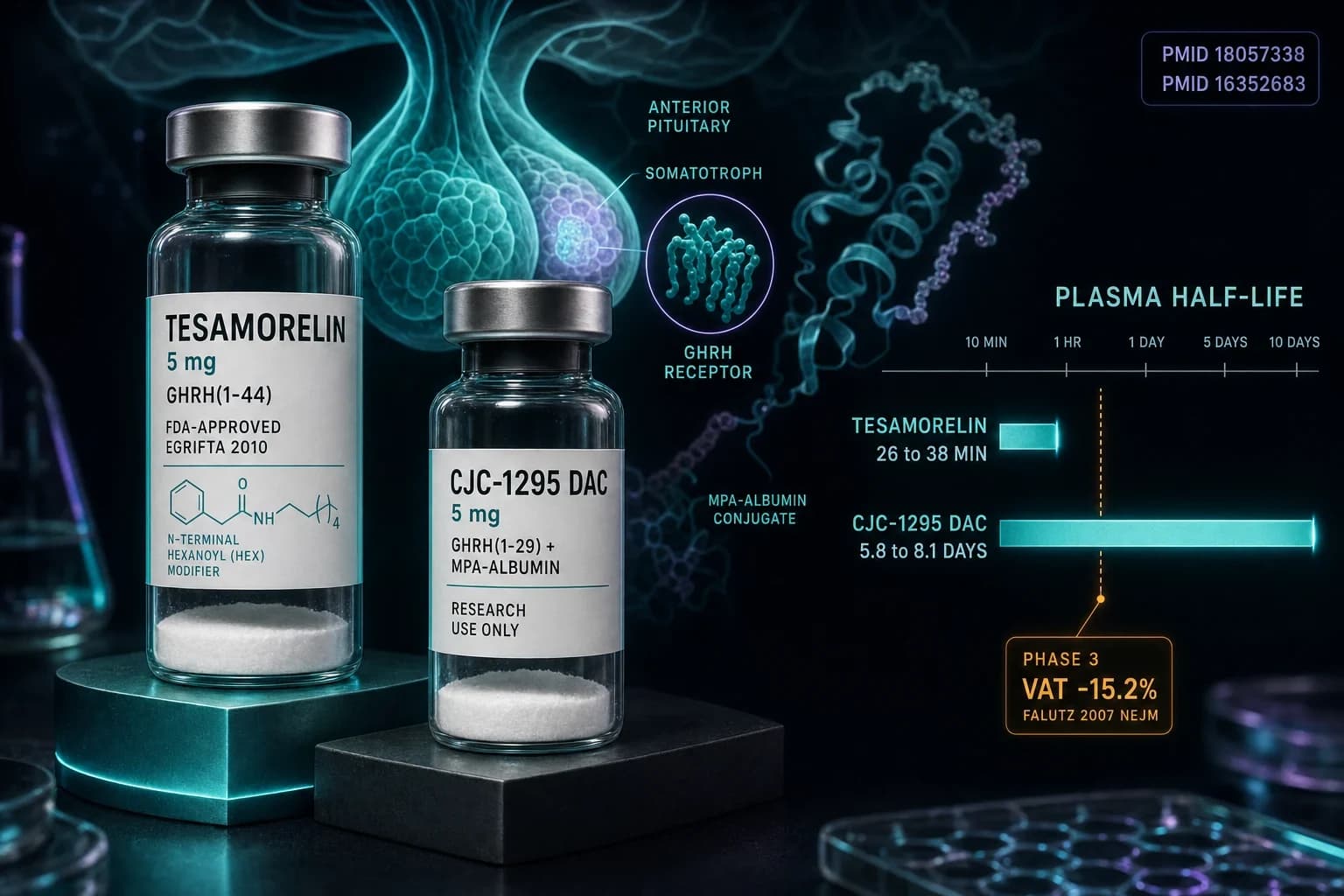
- Tesamorelin plasma half-life is 26 to 38 minutes. CJC-1295 with DAC is 5.8 to 8.1 days (Teichman 2006). Modified GRF 1-29, the no-DAC form, is roughly 30 minutes.
- Tesamorelin is FDA-approved (Egrifta, 2010) for HIV-associated visceral fat, dosed 2 mg subcutaneously once daily. CJC-1295 has no approval anywhere in the world.
- Falutz 2007 NEJM: tesamorelin 2 mg daily cut visceral adipose tissue about 15% over 26 weeks in 412 HIV patients (PMID 18057338). Stanley 2019 also reduced liver fat over 12 months.
- CJC-1295 has one published human PK/PD trial (Teichman 2006, n=64). Phase 2 development halted in 2007 after a trial death. There are no efficacy trials of the type tesamorelin has.
Both compounds bind the same GHRH receptor on the anterior pituitary. Both push a burst of endogenous growth hormone. That is where the similarity ends.
Tesamorelin is a full-length GHRH(1-44) analog with an N-terminal trans-3-hexenoic acid modification. It cleared two Phase 3 trials and has been FDA-approved as Egrifta since 2010 for HIV-associated visceral adiposity. CJC-1295 is a shorter GHRH(1-29) fragment carrying four amino acid substitutions and a drug affinity complex (DAC) tag that binds serum albumin. It reached Phase 2. Development stopped in 2007 after a trial participant died, and no efficacy trial in the tesamorelin sense has ever been published.
That gap frames the entire comparison. If you are researching visceral fat, hepatic steatosis, IGF-1 kinetics in adults, or subcutaneous injection frequency, the two molecules answer different questions and carry very different evidence bases.
Bottom line: Tesamorelin is the better-characterized, FDA-approved GHRH analog with real Phase 3 data on visceral fat and liver fat. CJC-1295 with DAC has one 64-subject pharmacokinetic study and no efficacy trials. If you want an evidence base, tesamorelin has one. If you want the longest-acting research GHRH analog on the gray market, CJC-1295 DAC has that property alone.
The molecule: full-length GHRH vs a fragment with a tag
The two peptides are not variants of the same design. They are different molecules that both happen to activate the GHRH receptor.
Tesamorelin is a 44-amino-acid analog of native human GHRH(1-44). The only change from endogenous GHRH is the trans-3-hexenoic acid group added to the N-terminus, which blocks dipeptidyl peptidase-4 (DPP-4) cleavage and extends the peptide's usable window in circulation. Everything else about the sequence is native GHRH. That structural conservatism is why the FDA reviewed it as a receptor agonist with a well-mapped downstream effect and why its safety profile has been studied at scale (Adrian, Spotlight on tesamorelin in HIV-associated lipodystrophy, PMID 22050344).
CJC-1295 is a modified GHRH(1-29) fragment. The active receptor-binding sequence is only the first 29 amino acids of GHRH, so the fragment retains the pharmacology but loses everything past position 29. Four amino acid substitutions (D-Ala at position 2, Gln at 8, Ala at 15, Leu at 27) block enzymatic degradation. Then a maleimidopropionic acid (MPA) linker is conjugated at the C-terminus, and that linker covalently binds a cysteine residue on serum albumin. Albumin becomes a carrier. The peptide rides in circulation for days instead of minutes.
Two variants live under the CJC-1295 name and searchers frequently conflate them. Modified GRF(1-29), sometimes labeled "CJC-1295 no DAC," is the fragment with the four substitutions but no MPA tag. Its half-life is roughly 30 minutes, comparable to tesamorelin. CJC-1295 with DAC has the tag. Its half-life is 5.8 to 8.1 days. When people ask "tesamorelin vs CJC-1295," they usually mean the DAC form. This guide follows that convention and notes the no-DAC form explicitly where it matters. For the DAC vs no-DAC deep dive on that side of the comparison, see CJC-1295 DAC vs Modified GRF 1-29.
Half-life: a 300x difference
The single most important pharmacokinetic difference between these two molecules is how long each one persists in blood after a subcutaneous injection.
| Property | Tesamorelin | Mod GRF 1-29 (CJC-1295 no DAC) | CJC-1295 with DAC |
|---|---|---|---|
| Sequence length | GHRH(1-44) full-length | GHRH(1-29) fragment | GHRH(1-29) fragment + MPA-albumin tag |
| Plasma half-life | 26 to 38 minutes | ~30 minutes | 5.8 to 8.1 days |
| Peak plasma time (Tmax) | ~15 minutes SC | ~15 to 30 minutes SC | Sustained plateau after single dose |
| GH release pattern | Pulsatile, cleared within hours | Pulsatile, cleared within hours | Sustained, days-long elevation |
| Weekly injections (typical research protocol) | 7 (daily) | 3 to 7 (varies by protocol) | 1 (weekly bolus) |
| Regulatory status | FDA-approved 2010 (Egrifta) | Unscheduled research chemical | Unscheduled research chemical |
| Published PK trials in humans | Multiple, incl. Phase 3 | Limited | 1 (Teichman 2006, n=64) |
Tesamorelin's short half-life is not a design flaw. Native GHRH itself has a plasma half-life under two minutes, and the pituitary somatotroph does not need a long circulating signal. A brief spike triggers release of pre-formed growth hormone stored in vesicles, and IGF-1 downstream stays elevated for hours after the peptide itself is gone. The FDA-approved label reflects that biology: one 2 mg subcutaneous injection into the abdomen per day is enough to reproduce the physiologic pulse pattern of endogenous GHRH.
CJC-1295 with DAC does the opposite. Once the MPA tag latches onto an albumin cysteine, the peptide-albumin complex circulates as a slow-release depot. Teichman and colleagues showed in their 2006 JCEM pharmacokinetic study (PMID 16352683) that a single subcutaneous injection produced a 2- to 10-fold rise in mean plasma GH for six days or more and a 1.5- to 3-fold rise in IGF-1 for 9 to 11 days. With weekly or biweekly dosing, IGF-1 stayed above baseline for up to 28 days. That is the mechanism the CJC-1295 DAC preparations sold as research peptides are built on.
The trade-off is physiologic. Growth hormone in healthy adults is pulsatile, with roughly six pulses per 24 hours and low interpulse concentrations. Continuous receptor exposure blunts that pattern. Whether sustained versus pulsatile stimulation matters clinically is not settled, but every FDA-approved GHRH-axis analog (tesamorelin, sermorelin) has been designed to preserve pulsatility, not override it.
Dosing frequency: daily vs weekly, and what that costs
If the two molecules have half-lives 300x apart, the injection schedule has to differ.
Tesamorelin (Egrifta, Egrifta SV, Egrifta WR). The FDA-approved dose is 2 mg subcutaneously once daily into the abdomen, delivered from a reconstituted lyophilized powder. The newer WR formulation delivers 1.28 mg once daily, and Egrifta SV delivers 1.4 mg once daily. Across all three, the total daily exposure is in the 1.28 to 2 mg range. The dosing chart for the research-grade compound tracks these numbers: see /dosage-charts/tesamorelin for the reconstitution ladder.
CJC-1295 with DAC. Most research protocols dose weekly or twice weekly at 1 to 2 mg per injection, based on Teichman's PK curve showing IGF-1 elevation for 9 to 11 days. Some protocols run every 10 to 14 days. The rationale is that half-life is 5.8 to 8.1 days, so a single weekly injection sustains a functional GH signal. See /dosage-charts/cjc-1295 for the standard reconstitution and dosing math.
Modified GRF 1-29 (CJC-1295 no DAC). Because half-life is ~30 minutes and there is no albumin depot, protocols mirror sermorelin: 100 mcg subcutaneously once or twice daily, often stacked with a GH secretagogue like ipamorelin to reproduce pulsatile release.
The practical result for a researcher is that CJC-1295 with DAC minimizes the injection burden. Seven vials-worth of tesamorelin per week versus one vial per week of CJC-1295 DAC translates to a real cost gap on the gray market, roughly $250 to $400 per month for tesamorelin at the 2 mg daily rate versus $60 to $120 per month for CJC-1295 DAC at a weekly protocol. That gap alone drives most of the search interest in the comparison. But the cost gap and the evidence gap point in opposite directions, and the evidence gap is what determines whether a compound is actually usable for the question a researcher is asking.
What tesamorelin actually did in human trials
Tesamorelin's evidence base is unusually strong for a GHRH analog because the sponsor ran two Phase 3 trials in HIV-associated central adiposity and a Phase 4 NAFLD trial in the same population.
Falutz et al. 2007 (NEJM). Metabolic Effects of a Growth Hormone-Releasing Factor in Patients with HIV (PMID 18057338) randomized 412 HIV patients with abdominal fat accumulation to tesamorelin 2 mg subcutaneously daily or placebo for 26 weeks. Visceral adipose tissue (VAT) measured by CT dropped 15.2% in the tesamorelin arm and rose 5.0% in placebo. Triglycerides dropped 50 mg/dL versus placebo. IGF-1 rose from a mean of 148 to 240 ng/mL. Subcutaneous fat was not significantly changed. Glycemic parameters (fasting glucose, HbA1c) did not worsen at 26 weeks, though a small subset showed transient impaired fasting glucose that normalized off drug.
Falutz et al. 2008 (AIDS). Long-term safety and effects of tesamorelin (PMID 18690162) extended the Phase 3 to 52 weeks in 154 patients who continued the drug. VAT reduction was maintained. No new adverse event signals emerged. The extension established that the visceral fat effect does not rebound while on treatment but reverses within weeks of discontinuation, which is a clinically important limitation.
Stanley et al. 2019 (Lancet HIV). Effects of tesamorelin on non-alcoholic fatty liver disease in HIV (PMID 31611038) enrolled 61 patients with HIV and a hepatic fat fraction of at least 5% on MR spectroscopy. Tesamorelin 2 mg daily for 12 months reduced hepatic fat fraction by an absolute 4.1% versus placebo. The number who dropped below the NAFLD threshold (5% fat) was 35% on tesamorelin vs 4% on placebo. Paired liver biopsies showed no progression of fibrosis on tesamorelin versus significant progression on placebo. Fourman and colleagues subsequently published a transcriptomic sub-study, Effects of tesamorelin on hepatic transcriptomic signatures in HIV-associated NAFLD (PMID 32701508), showing downregulation of fibrogenic and inflammatory gene networks on drug.
Grinspoon's group also reported (PMID 28832410) that VAT reduction on tesamorelin was correlated with improvement in ALT and AST, which is consistent with the mechanistic story that reduced ectopic fat in liver drives the transaminase change.
None of these trials studied cosmetic body-composition endpoints in healthy adults. Every published Phase 3 outcome is in HIV-associated lipodystrophy. Off-label extrapolation to healthy adults chasing generic "growth hormone benefits" is not what the evidence supports. If you want the visceral-fat-specific deep dive, Tesamorelin, Visceral Fat, and the GHRH Peptide Guide walks the full dose-response.
What CJC-1295 actually has in humans
The CJC-1295 side is thin, and that thinness is not accidental.
Teichman et al. 2006 (JCEM). Prolonged stimulation of GH and IGF-I secretion by CJC-1295 (PMID 16352683) is the only published clinical pharmacology study of CJC-1295 with DAC. Two ascending-dose Phase 1 trials, 64 healthy adults aged 21 to 61, dosed at 30, 60, 125 or 250 mcg/kg subcutaneously. Endpoints were GH concentrations, IGF-1 concentrations, half-life, and safety. That is a pharmacokinetic and pharmacodynamic paper. It is not a trial of a clinical outcome. It shows that the molecule does what it was designed to do (elevate GH and IGF-1 for days), and it demonstrates acceptable short-term safety at those doses.
What is not published. There is no Phase 2 outcome trial (visceral fat, lean mass, sleep architecture, wound healing, exercise capacity) that establishes CJC-1295 with DAC produced a durable clinical benefit. The Phase 2 program that would have generated that evidence was halted. Reporting on the development pause has consistently attributed it to the death of a trial participant, and the sponsor did not file a New Drug Application. The 2024 FDA Pharmacy Compounding Advisory Committee vote against including CJC-1295 on the 503A bulks list cited nonclinical toxicity findings (DNA damage in pituitary cells at high doses, injection-site necrosis in animal work) and an unresolved cardiac signal from the terminated Phase 2 as reasons to keep it out of compounded medicine. That is not the same as showing the drug is unsafe in humans at research doses. It is the reason there is no efficacy trial to cite.
Modified GRF 1-29 (no DAC). There is no meaningful separate clinical dataset. The compound is treated in the literature as pharmacologically indistinguishable from other short-acting GHRH-based analogs like sermorelin (which does have Phase 2 data in various indications). For the sermorelin side of that pharmacology, see Sermorelin vs Tesamorelin: GHRH Analog Comparison, which walks the closer of the two comparisons on efficacy.
Safety: what the published data actually says
The tesamorelin safety profile is well-characterized. Falutz 2007 and 2008 report the most common adverse events at rates that matter: injection-site reactions (~25%), arthralgia (~13%), extremity edema (~6%), fluid retention broadly (~7 to 12%), and small transient increases in fasting glucose that resolved off drug. Antibody formation against tesamorelin developed in roughly 50% of treated patients over 26 weeks and was clinically silent, without reducing efficacy or triggering hypersensitivity in the trials. Egrifta labeling contraindicates use in active malignancy, in pregnancy, and after hypophysectomy or hypopituitarism, since GH stimulation may accelerate tumor growth or is pointless without a functioning pituitary.
The CJC-1295 side is harder to characterize because the outcome trials that would surface a signal never ran. Teichman 2006 reported that adverse events at short-term Phase 1 exposures were "well tolerated" and that no serious adverse reactions occurred in 64 healthy subjects. Injection-site erythema and flushing were the dominant reactions. What is missing from that dataset:
- Long-term glucose and insulin effects at continuous supra-pulsatile GH exposure
- Cardiac data at physiologic and above-physiologic IGF-1 levels
- Antibody formation rates over months of dosing
- Any signal for the tumorigenesis concern that applies to all GH-axis drugs
- Immunogenicity data on the specific MPA-albumin conjugate
The 2024 FDA PCAC discussion cited nonclinical toxicity findings and the unresolved Phase 2 cardiac signal. Whether those findings translate to research-dose subcutaneous protocols is unknown, and unknown is the right word to use. For the deeper safety walkthrough of the compound on its own, see CJC-1295 side effects.
Sourcing, purity, and the reason the comparison matters at all
Tesamorelin, as a scheduled research chemical from a reputable vendor, ships with a certificate of analysis (COA) showing HPLC purity, mass spec identity confirmation, and endotoxin testing. Because it is a full-length 44-amino-acid peptide, synthesis is harder and the finished product is more expensive per mg. Expect to pay roughly $85 to $130 per 5 mg vial from vendors that publish current COAs.
CJC-1295 with DAC is a 30-amino-acid peptide plus a small-molecule linker. Synthesis is more forgiving and vials are cheaper: roughly $40 to $70 per 5 mg. That price gap is real, and it is a signal, not a feature. Because CJC-1295 has never gone through FDA CMC review, there is no reference standard for the MPA-conjugated final product. Different vendors sometimes ship product that is either the fragment without the linker (mislabeled), the fragment with an incomplete linker, or the fragment with the wrong conjugation stoichiometry. All three would still test as "CJC-1295" on a poor COA. The /lab-tests library tracks third-party HPLC and mass-spec results for research peptides across major vendors, which is the practical way to close that gap.
If you are choosing a vendor for either compound, our full review of Ascension Peptides walks the third-party testing, cold-chain shipping, and COA transparency practices we found on their catalog, including their tesamorelin-5mg and cjc-1295-5mg SKUs. That is the review that consistently ranks for buyer-intent peptide sourcing queries, and it is the source we would use ourselves. Code ENHANCED delivers 50% off across the injectables catalog.
For the actual reconstitution math on either compound, /calculators/reconstitution will convert vial size and bacteriostatic water volume into an insulin-syringe unit reading, which is where most dosing mistakes happen.
When to research which
The two molecules answer different questions.
Tesamorelin is the more appropriate tool when the research question is:
- Visceral adiposity reduction in a defined patient population, ideally with baseline CT or MR imaging
- Hepatic steatosis and NAFLD progression (the Stanley 2019 protocol is directly transferable)
- Acute GHRH receptor pharmacology, where a clean daily pulse is preferred to a sustained plateau
- Any protocol where the sponsor wants regulatory-traceable material with a real FDA label to reference (Egrifta, Egrifta SV, Egrifta WR)
CJC-1295 with DAC is the more appropriate tool when the research question is:
- Pharmacokinetic modeling of long-acting GHRH analogs specifically
- Injection frequency optimization studies, where the seven-per-week burden of tesamorelin is a design constraint
- Effects of sustained rather than pulsatile GH elevation on IGF-1 kinetics in animal models
CJC-1295 no DAC (Modified GRF 1-29) is the more appropriate tool when the research question is:
- Reproducing a native GHRH pulse pattern at low cost, usually in a stack with a ghrelin agonist like ipamorelin
- A comparator for sermorelin-style protocols
For the closer intra-family comparisons on the tesamorelin side, Tesamorelin vs Ipamorelin covers the GHRH analog against the ghrelin agonist that most stack protocols pair either compound with.
The honest summary
Tesamorelin has a Phase 3 evidence base for visceral fat and a Phase 4 evidence base for liver fat in HIV, an FDA label, and a well-mapped safety profile at the 2 mg/day dose. It also has a daily injection requirement and a higher per-mg cost. CJC-1295 with DAC has one 64-subject pharmacokinetic study, no efficacy outcome trials in humans, a Phase 2 program that stopped abruptly, and a cost profile a fraction of tesamorelin's, because it never carried the cost of a completed development program.
If you want a peptide with a track record, you take tesamorelin. If you want the longest-acting research-only GHRH analog and you accept that the evidence base for outcomes is a single old PK paper, you take CJC-1295 DAC. The choice is not really "which peptide is better." It is "which question are you trying to answer, and how much do you weight the presence or absence of a completed Phase 3 program."
This article summarizes published research on GHRH analogs and is intended for research and educational purposes only. It is not medical advice, and neither tesamorelin nor CJC-1295 is approved for use outside their labeled indications or regulatory statuses. Consult a qualified clinician before initiating any protocol involving a GHRH analog.