At a glance
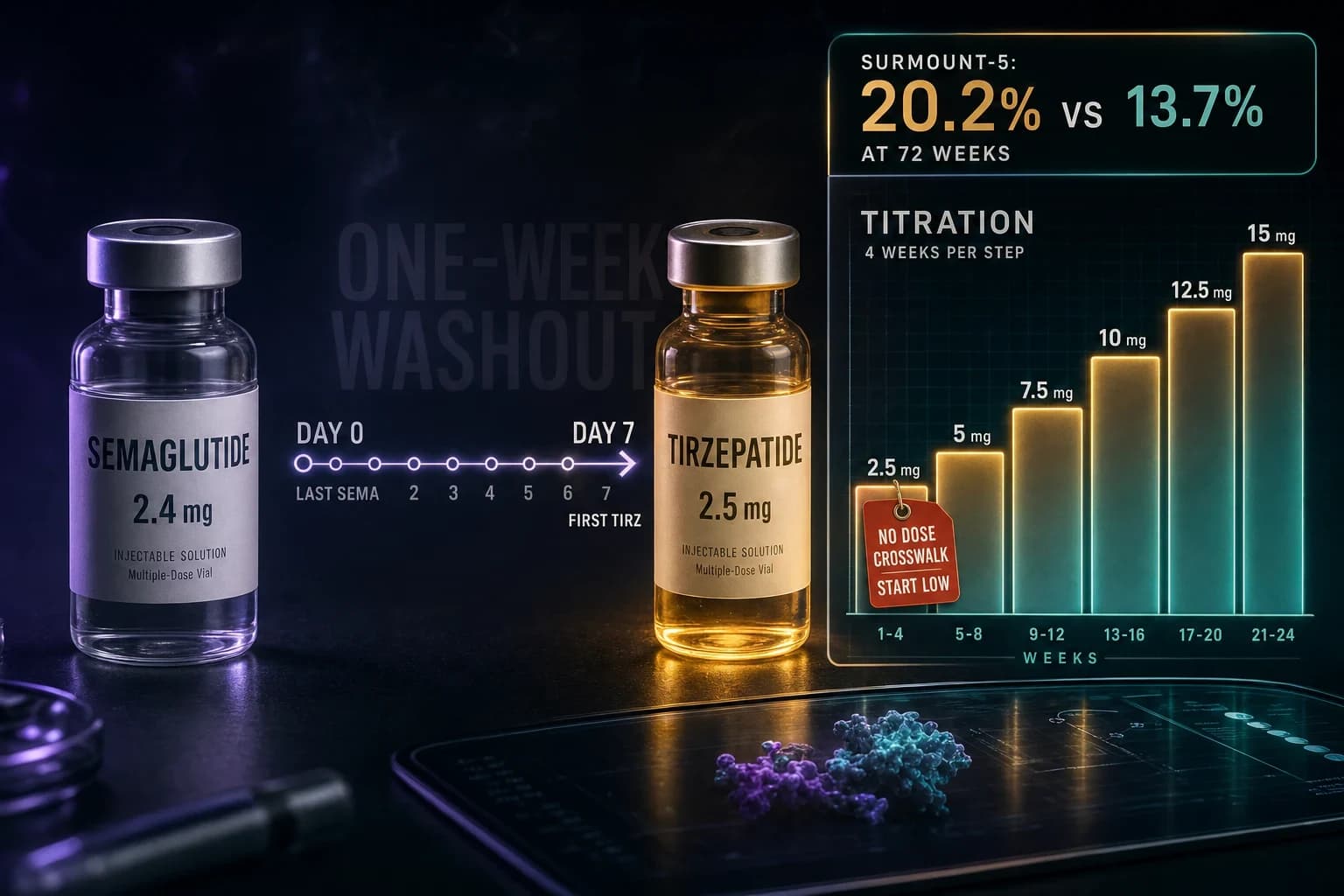
- No FDA-approved crosswalk exists: start tirzepatide at 2.5 mg regardless of prior semaglutide dose.
- Take your last semaglutide injection on schedule, wait one week, then start 2.5 mg tirzepatide.
- SURMOUNT-5 (n=751) showed 20.2% vs 13.7% weight loss at 72 weeks (Aronne 2025, PMID 40353578).
- Titration: 2.5, 5, 7.5, 10, 12.5, then 15 mg, four weeks per step, 20 weeks total.
- About 80-90% of GI side effects occur during titration and resolve within 4-8 weeks.
"Switching from semaglutide to tirzepatide" is a question with a simple mechanical answer and a harder judgment call. The mechanics: take your last semaglutide injection on the scheduled day, wait one full dosing interval, then start tirzepatide at 2.5 mg the following week regardless of what semaglutide dose you were on. The judgment call is whether the switch is worth doing at all, and what happens to the weight loss you already banked. This guide covers both.
Two 2025 papers changed the answer. SURMOUNT-5 (Aronne et al. 2025) is the first head-to-head trial in adults with obesity without diabetes: at 72 weeks tirzepatide produced 20.2% weight loss versus 13.7% with semaglutide, a 47% relative advantage. SURPASS-SWITCH (Billings et al. 2025) showed the same logic for glycemic control in a switching population. If you had been holding off on switching because you were "getting there" on semaglutide, the data now argue against waiting.
The two-question test before you switch
Before the timing table matters, answer these:
Are you switching for weight loss, glycemic control, tolerability, or supply? The answer changes what to expect and where the money goes. Weight-loss switchers gain the most from tirzepatide's second receptor. Glycemic switchers hit their HbA1c target faster (SURPASS-2, Frías et al. 2021). Tolerability switchers usually go the opposite direction, toward semaglutide, because tirzepatide's early titration produces nausea concentrated in the first four weeks after each step-up (Patel et al. 2024). Supply switchers in 2026 usually mean patients moving between compounded and brand programs as pharmacy access shifts. Our compounded tirzepatide access guide covers the 503A rules that changed in 2025.
Is your current dose actually maxed out? People on 1.0 mg or 1.7 mg semaglutide sometimes assume they have hit a ceiling. Wegovy's label maxes at 2.4 mg. Ozempic tops at 2.0 mg for type 2 diabetes. If your prescriber has not walked you to the label maximum, you are switching prematurely, and the SURPASS-SWITCH logic does not apply because you are not "inadequately controlled." Ask about titrating the drug you are on before rebooting on a new one.
Timing the switch: last dose, washout, first tirzepatide
Both drugs are engineered for once-weekly injection. Semaglutide's terminal half-life is roughly 165 to 184 hours (about 7 days), driven by albumin binding via a fatty diacid moiety. Tirzepatide's half-life is about 5 days, driven by a similar acylation strategy. That difference matters less than the shared dosing interval: you time the switch by injection cadence, not by drug-clearance math.
The pattern most US telehealth clinics use, and the one supported by the SURPASS-SWITCH trial design (Billings et al. 2025):
| Day | Action |
|---|---|
| Day 0 | Take your normal weekly semaglutide dose on schedule |
| Days 1-6 | No injection; expect appetite-suppression from residual semaglutide |
| Day 7 | First tirzepatide dose: 2.5 mg subcutaneous |
| Day 14 | Second tirzepatide dose: 2.5 mg |
| Day 28 | Titrate up to 5 mg |
Why one week and not two? After one half-life plus one dosing interval, both drugs are within their normal weekly steady-state fluctuation. Waiting longer creates a gap in which appetite rebound and blood-sugar drift can undo your progress. Waiting less risks additive gastrointestinal symptoms while both molecules are still active.
One exception: if you are switching because of severe GI intolerance to semaglutide, wait two weeks and start at 2.5 mg. The extra washout lets the gut return to baseline before a new molecule arrives, and 2.5 mg is intentionally sub-therapeutic to give tolerance a chance to build.
The dose map (2.5 mg is not a downgrade)
There is no FDA-approved crosswalk from semaglutide to tirzepatide. The label instruction is that everyone starts at 2.5 mg tirzepatide once weekly for four weeks, then follows the standard escalation, regardless of prior semaglutide dose.
That surprises people who were on 2.4 mg Wegovy. The 2.5 mg reset can read like a demotion. Three reasons it works differently in practice:
- Tirzepatide 2.5 mg is not the pharmacologic equivalent of semaglutide 2.5 mg. In SURMOUNT-1 (n=2539), even the 5 mg tirzepatide dose produced roughly 15% weight loss at 72 weeks (Jastreboff et al. 2022), comparable in magnitude to the 14.9% seen with semaglutide 2.4 mg in STEP 1 (Wilding et al. 2021).
- The starting dose builds tolerance rather than delivering peak therapeutic effect. Its purpose is to blunt GI adverse events during escalation. In the SURPASS trials, roughly 80 to 90% of nausea, vomiting, and diarrhea occurred during dose escalation and most events resolved within 4 to 8 weeks per titration step (Patel et al. 2024).
- Dropout math favors starting low. Trials that skipped a titration step saw higher discontinuation, which erases the efficacy advantage of the higher dose.
Your dose on Day 7, whichever prior semaglutide dose you were on:
| Prior semaglutide dose | First tirzepatide dose |
|---|---|
| 0.25 mg (Wegovy titration) | 2.5 mg |
| 0.5 mg (Wegovy titration or Ozempic maintenance) | 2.5 mg |
| 1.0 mg (Wegovy titration or Ozempic maintenance) | 2.5 mg |
| 1.7 mg (Wegovy) | 2.5 mg |
| 2.0 mg (Ozempic max) | 2.5 mg |
| 2.4 mg (Wegovy max) | 2.5 mg |
The full titration ladder is the standard tirzepatide escalation: 2.5, 5, 7.5, 10, 12.5, 15 mg, at four-week intervals. Total time to the top dose is 20 weeks. Our tirzepatide dosing chart has the maintenance dose recommendations for weight versus glycemic goals, and the semaglutide dosing chart documents the ladder you are stepping off of.
What SURMOUNT-5 predicts about your outcome
SURMOUNT-5 is the most directly relevant trial to a switching patient because it enrolled 751 adults with obesity, no diabetes, and randomized 1:1 to maximum tolerated tirzepatide (10 or 15 mg) versus semaglutide (1.7 or 2.4 mg), with 72 weeks of follow-up and the same behavioral support in both arms (Aronne et al. 2025).
| Outcome at 72 weeks | Tirzepatide | Semaglutide |
|---|---|---|
| Mean weight change | -20.2% | -13.7% |
| Achieved at least 25% weight loss | 31.6% | 16.1% |
| Waist circumference change | -18.4 cm | -13.0 cm |
| Serious adverse events | 5% | 4% |
That difference works out to 47% larger relative weight loss on tirzepatide. If you have already lost 10% on semaglutide, SURMOUNT-5 does not project that you will gain another 10% on tirzepatide. It projects that your ceiling shifts by roughly a third to a half, and that your realistic maintenance dose comes down as a result.
Real-world data agree. A 41,222-patient cohort in JAMA Internal Medicine found tirzepatide-treated patients were 1.76 times more likely to achieve at least 5% weight loss, 2.54 times more likely to hit at least 10%, and 3.24 times more likely to reach at least 15% within a year (Rodriguez et al., JAMA Internal Medicine, 2024). Trial and clinic numbers converge more than they usually do on this drug pair.
Bottom line: Switching to maximum-tolerated tirzepatide gives back the escalation weeks in exchange for a meaningfully higher ceiling. The upside compounds if your semaglutide plateau came before you reached 2.4 mg.
Managing side effects during the transition
Nausea in the first two to four weeks after each tirzepatide step-up is the modal experience, not the exception. Across SURPASS-1 to -5, gastrointestinal adverse events were the most common on tirzepatide (Patel et al. 2024):
- Nausea: 12 to 24% of patients across dose levels
- Diarrhea: 12 to 17%
- Vomiting: 5 to 10%
- Constipation: 6 to 11%
Most events were mild to moderate. About 6% of patients discontinued for GI reasons across the SURPASS program. What actually helps during the switch:
Titrate exactly on schedule. Do not skip the four-week wait at 2.5 mg to "catch up." Stacking tolerance steps predictably worsens the nausea math.
Eat smaller meals more often. Delayed gastric emptying is the mechanism. A 700-calorie lunch that felt fine on 1.0 mg semaglutide can produce three hours of nausea on 5 mg tirzepatide.
Hydrate deliberately. Dehydration amplifies both nausea and constipation. Two to three liters of water a day is the practical target during titration.
Rotate injection sites. Move between abdomen, thigh, and upper arm to avoid lipohypertrophy. If a site becomes tender or reactive, take a note and skip it for a month.
Ask about a dose hold before you ask about a dose down. If nausea at 5 mg is intolerable at week 3, holding another two weeks at 5 mg before escalating is usually enough. Dose reduction back to 2.5 mg is a last resort because it likely eliminates efficacy.
If GI symptoms are consistently worse than they were on semaglutide, do not force the switch. The tolerability profile can be different in individual patients even when population averages are similar. Some people simply do better on the GLP-1-only mechanism.
Insurance, cash, and compounding logistics
The financial layer of a switch matters more than the pharmacology for most patients in 2026.
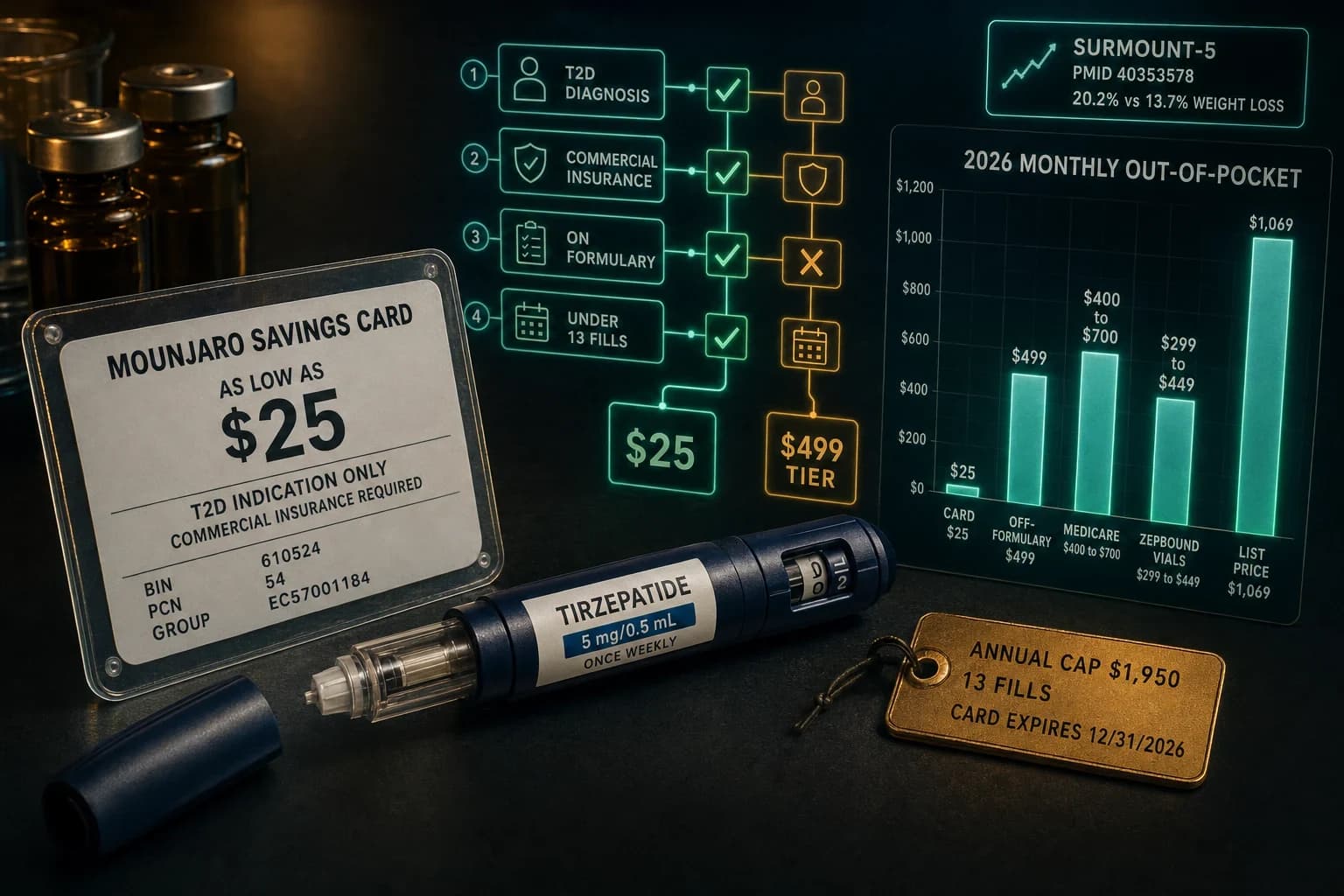
Insurance-covered. If you have Wegovy or Ozempic coverage, switching to Zepbound or Mounjaro almost always requires a new prior authorization. Some plans require documented plateau or inadequate response on the prior GLP-1; others require a step-therapy denial. Start the PA before your last semaglutide dose to avoid a gap in coverage.
Brand cash. Zepbound single-dose vials via LillyDirect are the cheapest brand path, and are dispensed to self-pay patients without insurance. Full details of the tirzepatide cash ladder and the vial-versus-pen split are in our cheapest GLP-1 access guide.
503A compounded tirzepatide. After the FDA declared the tirzepatide shortage resolved in October 2024, 503A compounding narrowed sharply. What survived: patient-specific prescriptions for tirzepatide-with-adjunct formulations (tirzepatide plus B12 or glycine, or non-commercial strengths that meet a clinical need). Telehealth-mediated 503A tirzepatide typically runs a few hundred dollars per month or less. Our Bodybuilding Health+ review covers the widest-menu clinic currently prescribing compounded tirzepatide, and the compounded tirzepatide route page lists the current legal options.
Pen versus vial. SURMOUNT-5 used single-dose auto-injector pens for both drugs, which is what most insurance plans reimburse. Vial programs are cheaper cash but demand the reconstitution math be correct. Our reconstitution calculator does the U-100 unit conversion for both molecules.
When switching is the wrong call
Three patient patterns where staying on semaglutide is the better decision:
Still climbing the titration ramp. If you are at 0.5 mg or 1.0 mg semaglutide and losing weight steadily, you have not stress-tested semaglutide's ceiling. SURMOUNT-5 compared max-tolerated to max-tolerated; the switching advantage is only proven at that comparison.
Semaglutide already caused significant GI trouble. Semaglutide-related nausea does not predict tirzepatide-related nausea perfectly, but the correlation is strong. If you were vomiting on 0.5 mg semaglutide, you will probably vomit on 5 mg tirzepatide, and possibly worse. Consider a different drug class before repeating the incretin experiment.
Pregnant, planning pregnancy, or breastfeeding. Both drugs are contraindicated. Neither one is a solution to the other's contraindication.
For anyone else with a max-dose semaglutide plateau and a legitimate weight-loss or glycemic target still unmet, the 2025 data justifies the switch. Our tirzepatide vs semaglutide comparison covers the direct efficacy math; the Wegovy vs Zepbound brand comparison covers the specific branded-obesity split; and Ozempic vs Wegovy covers the semaglutide brand split for anyone who is not sure which product they are actually on.
Bottom line
Switching from semaglutide to tirzepatide in 2026 is a mechanically simple transition with a well-defined evidence base behind the reset dose. Take your last semaglutide injection on schedule, wait one week, start tirzepatide at 2.5 mg regardless of your prior dose, and follow the standard 20-week escalation. Expect nausea concentrated in weeks 1 to 4 after each step-up and a maintenance efficacy ceiling roughly 40 to 50% higher than semaglutide alone.
Bottom line: The 2.5 mg starting dose is a tolerance-building step, not a therapeutic one. The efficacy advantage of tirzepatide sits at the top of the titration ladder, not the bottom, and skipping steps to get there faster reliably backfires.
Note: This article is written for research and information purposes. It is not medical advice and is not a substitute for evaluation by a licensed clinician. GLP-1 receptor agonists carry contraindications, drug-drug interactions, and boxed warnings that require professional prescribing judgment.