At a glance
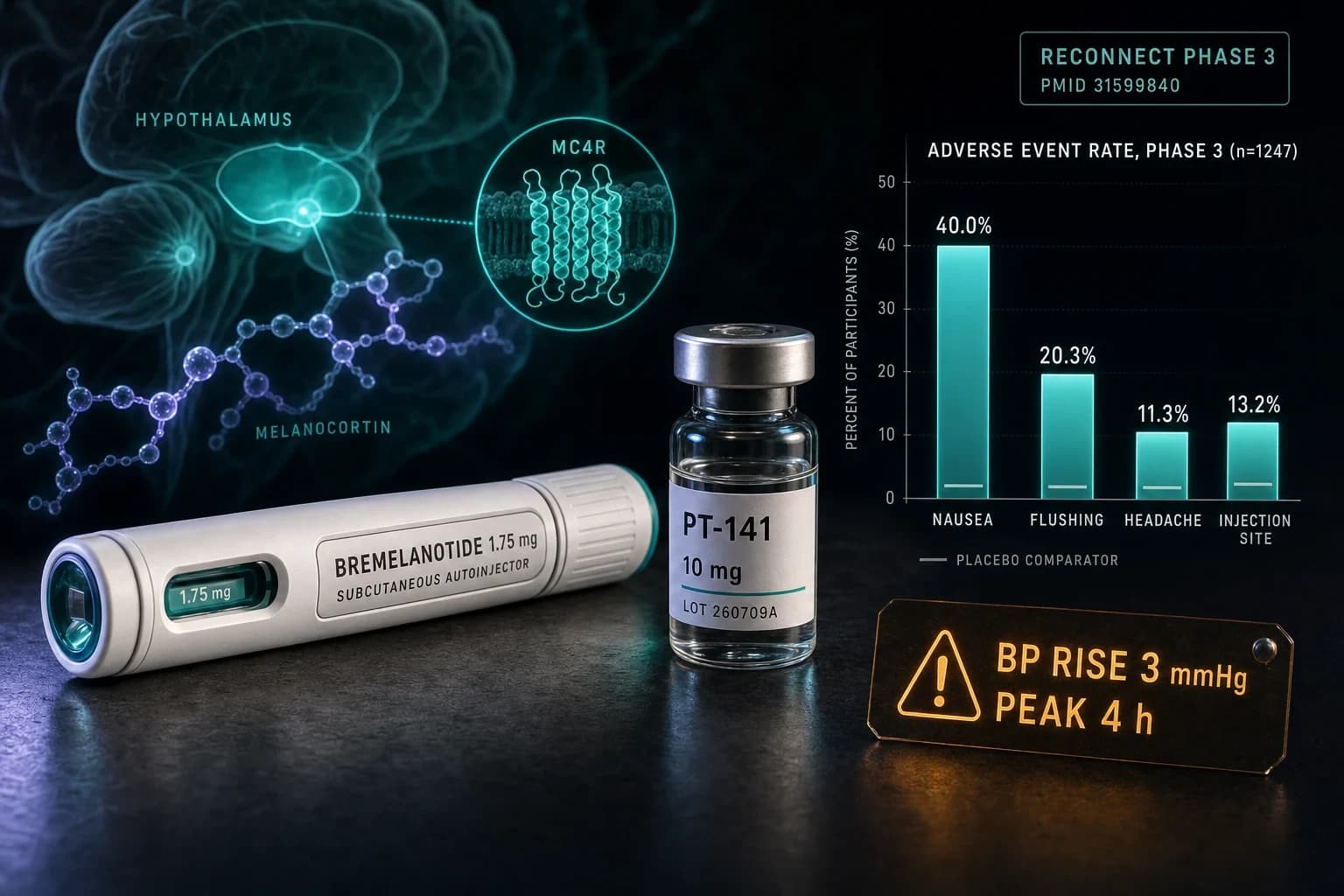
- Nausea leads the profile at 40.0% versus 1.3% placebo in the pooled RECONNECT Phase 3 data (Kingsberg 2019, PMID 31599840).
- Blood pressure rises 2 to 3 mmHg systolic on ambulatory monitoring, peaks by 4 hours, and returns to baseline by 8 to 10 hours (White 2017, PMID 27977473).
- Focal hyperpigmentation appears in about 1% of on-label users but hits 38% at daily dosing for 8 days; darker skin is a documented risk factor (Vyleesi label 2019).
- Contraindicated in uncontrolled hypertension and known cardiovascular disease. Alcohol interaction warning is on the label.
- The nasal spray program was killed in 2007 after hypertensive events; the approved product is a 1.75 mg subcutaneous autoinjector, not a spray.
PT-141, generic name bremelanotide, is the rare research-adjacent peptide with a completed FDA file. Vyleesi was approved in June 2019 for acquired, generalized hypoactive sexual desire disorder in premenopausal women, and the safety database behind that approval is unusually deep for the category: roughly 3,500 subjects across 43 completed studies, including two identical Phase 3 trials of 1,247 women each (Clayton et al., J Womens Health, 2022, PMID 35147466).
That depth is the reason PT-141 side effects can be ranked with real numbers instead of vibes. It is also the reason a smaller vendor selling an unapproved nasal-spray version can be evaluated against a specific, published risk profile. This page separates the trial-grade side effects from the label warnings, the off-label patterns, and the format-specific issues that show up when the peptide is used outside its approved presentation.
Bottom line: Nausea (40%), flushing (20%), and headache (11%) drive most of what users feel in the first few doses. Blood pressure rises a small, transient amount by design of the mechanism. Focal hyperpigmentation is the durable one to watch, particularly with frequent dosing and darker skin. Contraindications are narrow but specific: uncontrolled hypertension, cardiovascular disease, and heavy alcohol are the three the label singles out.
The five side effects that account for most of what people feel
The Vyleesi Phase 3 program pooled two identical trials (Studies 301 and 302) of 1,247 premenopausal women with HSDD randomized to 1.75 mg subcutaneous bremelanotide on demand versus placebo. The integrated double-blind treatment-emergent adverse event table is the reference document for what to expect in a normal cycle of use (Kingsberg et al., Obstet Gynecol, 2019, PMID 31599840; Clayton et al., J Womens Health, 2022, PMID 35147466).
| Adverse event | Bremelanotide 1.75 mg | Placebo | Onset | Typical resolution |
|---|---|---|---|---|
| Nausea | 40.0% | 1.3% | Within 60 minutes of injection | Hours, often first two doses only |
| Flushing | 20.3% | 1.3% | Within 15 to 30 minutes | 1 to 4 hours |
| Injection site reaction | 13.2% | 8.0% | Immediately | 24 to 48 hours |
| Headache | 11.3% | 1.9% | Within 1 to 2 hours | Hours to a day |
| Vomiting | 4.8% | 0.4% | Follows nausea when it occurs | Same as nausea |
Two things sit inside those numbers that a headline percentage will not show you. First, most events are graded mild to moderate; the discontinuation rate specifically attributable to nausea in the RECONNECT program was roughly 8%, meaning the majority of women who felt it kept dosing anyway. Second, tolerance builds. Long-term safety data from the 52-week open-label extension by Simon et al. (Obstet Gynecol, 2019, PMID 31599847) show that the nausea rate stayed similar in the extension cohort (40.4%), but the fraction of women rating it severe dropped over successive doses. The first shot is usually the worst one.
Antiemetic prophylaxis is off-label but common in real-world use, and the Vyleesi label explicitly notes ondansetron as an option a clinician may consider. There is no controlled trial supporting a specific antiemetic protocol; the label mentions the option because trial participants who took an antiemetic still had nausea, just less of it.
Blood pressure: the effect that shaped the whole program
Bremelanotide raises blood pressure. This is not a surprise finding; it is a predictable consequence of melanocortin-4 receptor agonism in central sympathetic pathways, and it is the reason a nasal-spray version of the same molecule never reached approval.
The most rigorous single dataset is a randomized, double-blind, placebo-controlled ambulatory blood pressure monitoring study of 397 premenopausal women with sexual dysfunction across three doses (0.75, 1.25, 1.75 mg subcutaneous). At the approved 1.75 mg dose, systolic ambulatory blood pressure rose 3.1 to 3.2 mmHg relative to placebo across 24-hour monitoring, with peak elevations lasting less than 15 minutes, accompanied by small reductions in heart rate (White et al., J Hypertens, 2017, PMID 27977473). The elevations peaked by 4 hours and returned to baseline by 8 to 10 hours.
Those numbers are small in the abstract. They are not small in the population the label excludes. Vyleesi is contraindicated in uncontrolled hypertension and known cardiovascular disease precisely because a 3 mmHg population mean masks individual excursions that were larger, and because the mechanism does not stop at the receptor targets one wants.
The historical context matters here. The bremelanotide clinical program originally included an intranasal formulation for both female sexual dysfunction and male erectile dysfunction. In 2007 the FDA placed a clinical hold on the nasal-spray program after hypertensive events were observed at higher exposures. Palatin, the developer, retooled around a subcutaneous autoinjector with a lower and more predictable pharmacokinetic curve, and that is the format that eventually carried RECONNECT to approval. A compounded nasal-spray PT-141 sold today is not the same product from a blood-pressure risk standpoint, and it does not have a corresponding regulatory file to compare against. Anyone weighing that trade-off should read the full clinical picture in our PT-141 bremelanotide libido peptide guide before making a routing decision.
Focal hyperpigmentation: the durable one
Melanocortin-1 receptor agonism drives melanin production in skin. Bremelanotide is not selective for MC4R over MC1R, and the on-label rate of visible pigmentary changes at once- or twice-weekly dosing is small. The rate at daily dosing is not small.
Two numbers from the Vyleesi US prescribing information tell the story. At the recommended dose limit of up to 8 injections per month, about 1% of women reported focal hyperpigmentation, most often on the face, gingiva, and breasts. In a separate clinical study evaluating daily dosing for 8 consecutive days, 38% of participants developed focal hyperpigmentation; among those who continued daily dosing for another 8 days, an additional 14% developed new pigmentary changes.
The label also notes that patients with darker baseline skin were more likely to develop focal hyperpigmentation, and that resolution after discontinuation was not confirmed in every case. This is not a purely cosmetic issue. Persistent gingival pigmentation is a specific, documented outcome, and the labeling does not promise reversal.
Post-marketing surveillance has reinforced the pattern seen in trials rather than surfaced a new one. Reported cases cluster in patients using bremelanotide at or near the label's monthly ceiling for more than 6 months, and the presentation is consistent with what MC1R pharmacology would predict. The takeaway for a research protocol: on-demand use inside the monthly ceiling is not free of pigmentary risk, but the risk climbs sharply if the label frequency is exceeded, and it climbs further with continuous or daily exposure.
Injection-site reactions and the flushing question
Injection-site reactions in the RECONNECT trials were mild to moderate in most cases: bruising, transient erythema, and small nodules that resolved within 24 to 48 hours. The autoinjector is a fine-gauge subcutaneous device, and the reaction rate is on the low end for injectable peptides in this dose range.
Flushing is more visible and more mechanistically informative. Melanocortin activation triggers vasodilation, particularly in the face and neck, through pathways overlapping the ones that make niacin cause the classic flush. The 20.3% rate in the Vyleesi trials underestimates how noticeable the flush can be; it is short (usually resolved by 4 hours) but it is unmistakable, and it is one reason on-demand dosing before intimacy is not a stealth intervention.
The PT-141 flushing question that comes up on forums has a mechanistic answer: it is not an allergic reaction, it is an on-target melanocortin effect, and it does not predict a more severe response on future doses. If it is severe enough to be distressing, the fix is dose reduction or discontinuation, not antihistamines.
Serious adverse events and discontinuation
Across 3,500 subjects in the completed clinical development program, no deaths were attributed to bremelanotide, and serious adverse events occurred at rates similar to placebo. Discontinuation for adverse events in the Phase 3 program ran higher than placebo (roughly 18% versus 2%), driven almost entirely by the nausea-flushing-headache cluster in the first one or two doses rather than a late-onset toxicity (Clayton et al., J Womens Health, 2022, PMID 35147466).
Subgroup analyses from the RECONNECT program looked specifically at whether age, baseline HSDD severity, or oral contraceptive use altered the safety profile. Adverse event rates were broadly consistent across subgroups; the mechanism does not appear to interact meaningfully with common covariates in the trial population (Kingsberg, Clayton, Portman et al., J Womens Health, 2022, PMID 35230162).
The takeaway is boring in the right way. A deep safety database, a real and predictable acute side-effect profile, a low serious-event rate, and a stopping reason that is almost always the acute cluster rather than a chronic toxicity that surfaces later.
Contraindications and warnings, verbatim from the label
Vyleesi's US prescribing information (initial approval 2019) lists four specific contraindications and warnings that matter for anyone considering the compound, whether for on-label use or in a research protocol.
- Uncontrolled hypertension. Do not use in patients with uncontrolled hypertension or known cardiovascular disease. The 3 mmHg population mean is not the individual risk, and the mechanism raises catecholamine-independent sympathetic outflow.
- Alcohol interaction. The label explicitly warns against ingestion of substantial alcohol shortly before or after dosing, and the adverse-event profile of the combination has not been characterized in controlled trials.
- Naltrexone interaction. Bremelanotide can decrease naltrexone plasma levels enough to compromise alcohol-use-disorder treatment; the label recommends against use in patients on oral naltrexone.
- Monthly ceiling. Maximum one dose per 24 hours and 8 doses per month. This is not a marketing suggestion; the pigmentary risk numbers above are why the number is 8, not 30.
None of these are exotic. All four show up on the label because the trial data forced them onto the label.
Off-label male use: what the data does and does not say
PT-141 is approved only for premenopausal women with HSDD. It is used off-label in men for erectile dysfunction, often as a nasal spray and often stacked with a PDE5 inhibitor. The peer-reviewed male-safety database is much thinner than the female one.
Early male-ED work by Diamond et al. (J Sex Med, 2006, PMID 16839319) was an intranasal study, which reported that PT-141 nasal spray enhanced erectile response to visual sexual stimuli in men who already responded to sildenafil. That work, and the parallel female arousal-disorder work, is what led to the eventual withdrawal of the nasal program on blood-pressure grounds; the safety profile did not scale to the higher exposures the nasal route produced. Subcutaneous male use has been studied at doses that overlap the female HSDD range but not in Phase 3 populations, and there is no completed regulatory file for male indications.
Mechanistically the basis is real. Molinoff et al. (Ann N Y Acad Sci, 2003, PMID 12851303) showed that PT-141 activates MC4R in hypothalamic and limbic regions in rats and non-human primates, and induces penile erection in both. Central melanocortin agonism does not discriminate strongly by sex at the receptor level. What differs is the safety file: the acute profile in male users appears to mirror the female data (nausea, flushing, headache, transient blood pressure elevation), but rates come from smaller and shorter studies without the placebo-controlled Phase 3 structure.
For men considering PT-141, the honest framing is that the on-target effect is real, the acute safety picture looks similar to the female data, and the missing element is a long-term controlled safety database at the doses and frequencies typically used off-label. The PT-141 women HSDD research deep dive covers the female evidence in greater depth for a side-by-side.
Nasal spray vs subcutaneous injection: same molecule, different risk profile
Compounded PT-141 nasal spray is common in the gray market and marketed as a needle-free alternative to the Vyleesi autoinjector. The regulatory record does not treat these as interchangeable.
Two things separate them. Pharmacokinetically, intranasal delivery of bremelanotide produces a higher peak plasma concentration and a shorter time to Cmax than subcutaneous dosing at nominally equivalent doses, and peak exposure is what drives the blood-pressure signal. That is the specific reason the 2007 FDA hold ended the nasal program at the exposures being tested for both female and male indications. Practically, dose control is worse: nasal sprays deliver a metered volume, but absorption fraction varies with mucosal state (allergies, congestion, deviated septum, prior use), so a given number of sprays does not produce a reliable systemic dose.
A subcutaneous 1.75 mg autoinjector puts a known dose under the skin, produces a predictable exposure curve, and matches the format the RECONNECT trials studied. A compounded nasal spray produces neither the predictable exposure nor a matched safety file. That is not an argument against PT-141; it is an argument for using it in the format that carries the evidence. The PT-141 dosage chart tracks subcutaneous dosing specifically for that reason.
When to stop
The Vyleesi label does not enumerate every stopping condition, but the trials, post-marketing data, and mechanism together support a short list. Stop, and consult a clinician, if any of these occur:
- New or worsening high blood pressure readings, particularly if greater than 10 mmHg above baseline sustained beyond the expected 8- to 10-hour window.
- Chest pain, shortness of breath, or a syncopal episode within 24 hours of a dose.
- Focal hyperpigmentation that is spreading or persisting on the face, gums, or breasts, particularly with dosing above the label frequency.
- Severe nausea unresponsive to standard antiemetic support after the first two or three doses; tolerance usually builds, and lack of tolerance is a signal.
- Any signal of an anaphylactoid reaction (throat swelling, urticaria, wheeze) even though this is not a documented common event with bremelanotide.
None of these are Vyleesi-specific stopping criteria. They are the general safety net that applies to any centrally acting on-demand injectable, sharpened by what the bremelanotide-specific data actually shows.
How PT-141 side effects compare to the other on-demand sexual-health drugs
Comparison against sildenafil and tadalafil is the one that comes up most often. It is the wrong comparison at the mechanism level but the right one at the practical level.
| PT-141 (bremelanotide) | Sildenafil (Viagra) | Tadalafil (Cialis) | |
|---|---|---|---|
| Mechanism | MC4R agonist, central | PDE5 inhibitor, peripheral | PDE5 inhibitor, peripheral |
| Approved population | Premenopausal women, HSDD | Men, ED | Men, ED; men, BPH |
| Typical acute AE | Nausea, flushing, headache | Headache, flushing, dyspepsia, visual changes | Headache, back pain, myalgia, flushing |
| Blood pressure | Small transient rise | Small transient fall (nitrate contraindicated) | Small sustained fall (nitrate contraindicated) |
| Cosmetic risk | Focal hyperpigmentation | None analogous | None analogous |
| Dosing frequency ceiling | 8 per month | Up to daily | Up to daily |
| Timing before activity | 45 minutes | 30 to 60 minutes | Onset 30 min, effect up to 36 hr |
The takeaway is not that one is safer than the other; it is that they are safer for different populations. PDE5 inhibitors are contraindicated with nitrates because their blood-pressure effect points the wrong direction; bremelanotide is contraindicated in uncontrolled hypertension because its blood-pressure effect points the wrong direction. The pigmentary risk sits only with the melanocortin path. The PT-141 vs Viagra head-to-head covers the efficacy side of that comparison in more depth.
Storage, handling, and vial-side safety
None of the side effects above involve how the vial is stored. But the safety picture of a research-peptide vial does include contamination risk, and the storage math is the same across peptides.
Vyleesi ships as a single-use autoinjector, and the label is straightforward: store between 2 and 25 C, do not freeze. A reconstituted research vial of PT-141 lyophilate follows the same practical clock as other injectable peptides: 14 to 30 days refrigerated post-reconstitution, on a separate clock from the bacteriostatic water it was mixed with. The full mechanics live in the bacteriostatic water shelf-life guide and the reconstitution calculator.
For anyone using a research-grade vial rather than the approved autoinjector, sourcing decides whether the safety profile in the trials translates to your bench. A lot-verified vial with a matched Certificate of Analysis is the floor; the mechanics of what a COA actually proves are in the Janoshik peptide testing walkthrough and the what is a peptide COA explainer.
Sourcing PT-141 with a matched COA
If you have decided the acute-safety profile is acceptable and you want the subcutaneous format that carries the trial evidence, the sourcing question comes next. Ascension Peptides publishes per-lot COAs on the 10 mg PT-141 vial and is the site's primary vendor audit, with 50% off using code ENHANCED. The lab-test library collects the underlying purity and endotoxin documentation the vendor ships, and the PT-141 dosage chart covers the subcutaneous math that matches the Vyleesi format.
Sourcing does not change the drug's side-effect profile, but it changes the confidence you can place in what is in the vial. A compounded nasal spray from an unaudited pharmacy and a lot-tested subcutaneous vial from a vendor that publishes third-party HPLC are not the same purchase.
Frequently asked side-effect questions
How long does PT-141 nausea last? Typically hours, not days, and usually worse on the first one or two doses. Long-term extension data show severity declining with continued use, though incidence stays similar (Simon et al., Obstet Gynecol, 2019, PMID 31599847).
Is the blood pressure effect dangerous for a healthy adult? Small (2 to 3 mmHg systolic) and transient in trial populations without cardiovascular disease (White et al., J Hypertens, 2017, PMID 27977473). The concern is individuals with uncontrolled hypertension or known cardiovascular disease; the label contraindicates those groups for that reason.
Does the hyperpigmentation go away? Sometimes, not always. The label specifically notes that resolution after discontinuation was not confirmed in every case, and darker skin is a risk factor. Staying at or below the 8-doses-per-month ceiling is the label's mitigation.
Are the side effects worse in men? The male safety database is much smaller. The mechanism and the acute profile look similar to the female data, but there is no Phase 3 male file, so the confidence interval is wider. Off-label male use should presume the female-derived safety picture and monitor accordingly.
Can I take an antiemetic with PT-141? The Vyleesi label acknowledges that clinicians may consider ondansetron; controlled trial data supporting a specific regimen is not published. Any co-medication decision is a prescriber conversation, not a research-vial one.
Is compounded nasal spray safer because there is no needle? No. The regulatory hold on the nasal program was placed for a specific reason (higher blood-pressure excursions at nasal exposures), and dose control by spray is inherently worse than by autoinjector. Needle-free is a form factor, not a safety upgrade.
Should I stop if the injection-site nodule persists? A small nodule for 24 to 48 hours is expected. One that persists beyond 72 hours, or that develops warmth, discharge, or spreading redness, is a clinical presentation and warrants a physician review.
What to do next
If you were searching for the PT-141 side-effect profile to decide whether to start, the honest summary is: the acute cluster is real, predictable, and mostly resolves inside a day; the blood-pressure and hyperpigmentation risks are the ones that shape the label's contraindications and monthly ceiling; and the subcutaneous format carries the evidence that the nasal format does not.
The best next reads on this site are the PT-141 bremelanotide libido peptide guide for the efficacy picture, the PT-141 women HSDD research deep dive for the female Phase 3 data in more depth, and the PT-141 dosage chart for the subcutaneous math. If you are still weighing vendors, the Ascension Peptides review and the lab-test library are the two references built for exactly that decision.
This article is for research and educational purposes only. Bremelanotide (Vyleesi) is FDA-approved for premenopausal women with acquired, generalized hypoactive sexual desire disorder and is a prescription drug in the United States; use in any other population is off-label and requires a licensed clinician. Research-only PT-141 sold as a lyophilized powder is not approved for human use and has not been established as safe or effective outside the specific clinical programs cited. Cited PubMed studies are peer-reviewed publications linked inline. Nothing in this article is medical advice; specific dosing, monitoring, and safety decisions should be made by a licensed practitioner familiar with your health status.