At a glance
- Anabolic steroids activate the intracellular androgen receptor directly. Peptides bind cell-surface receptors and act as upstream signals.
- All 64 named anabolic-androgenic steroids are Schedule III controlled substances in the US since the 1990 Anabolic Steroids Control Act.
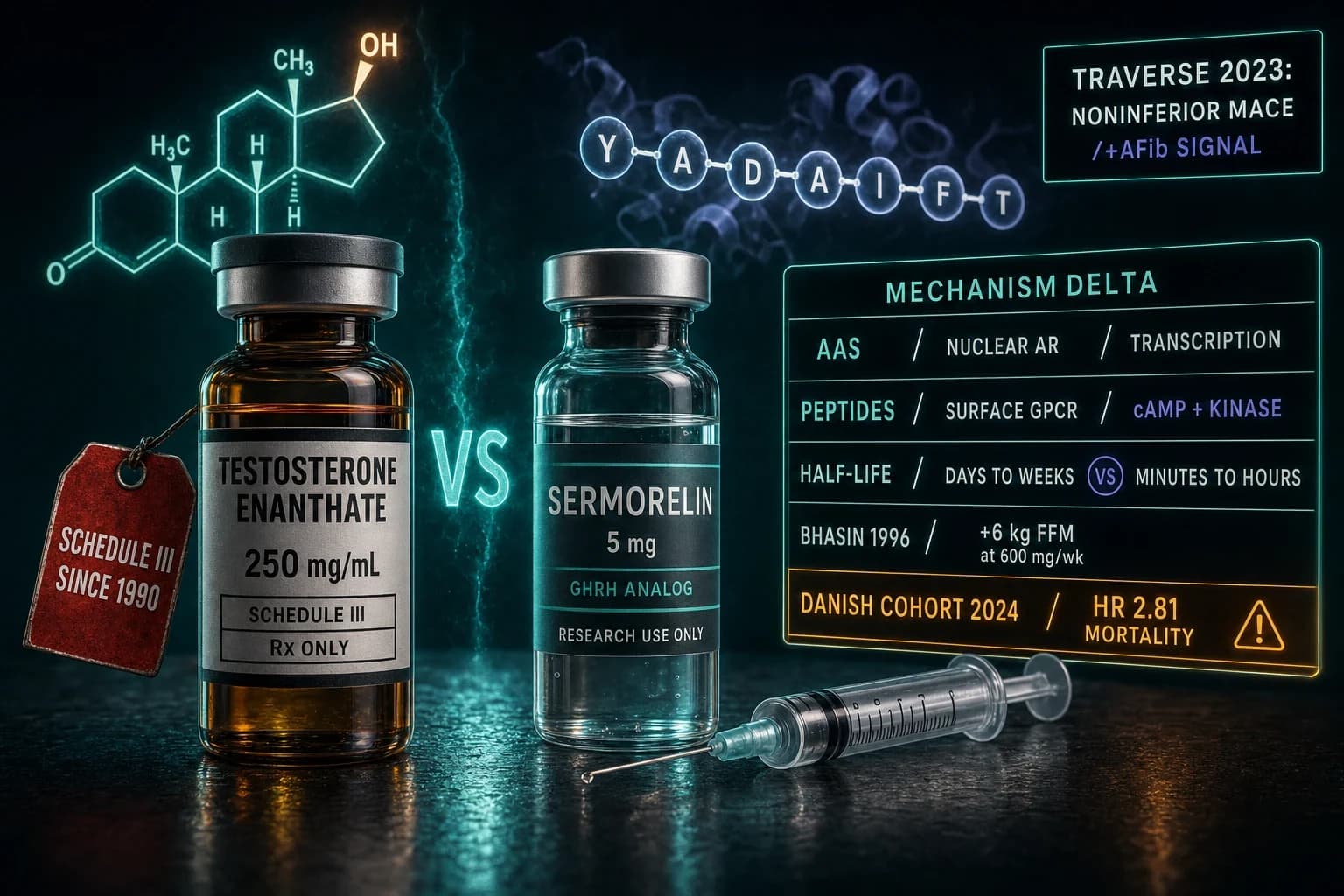
- A Danish cohort of 1,189 AAS users showed 2.81x all-cause mortality vs 59,450 matched controls (Horwitz et al. 2024, PMID 38483396).
- Four peptides carry Phase 3 evidence and FDA approval: sermorelin, tesamorelin, bremelanotide (PT-141), and semaglutide. BPC-157 and TB-500 do not.
- No honest peptide protocol matches Bhasin's 600 mg/week testosterone anabolism (Bhasin 1996 NEJM, PMID 8637535). The classes are not swappable for pure hypertrophy.
The two categories get treated as substitutes on the same forum threads, the same "safer alternative" landing pages, and the same TikTok explainer videos. They are not substitutes. Anabolic steroids are lipid-soluble testosterone derivatives that enter cells and act on nuclear receptors. Peptides are short chains of amino acids that bind receptors on the cell surface and trigger downstream signaling cascades. Different molecular class, different pharmacology, different legal status, different failure modes.
If you are searching "peptides vs steroids" because you want to know what actually replaces what, this piece pulls the real evidence together. It also gives the answer no vendor page will give you: for pure muscle mass, nothing in the peptide catalog matches supraphysiologic testosterone. That is not spin, that is what the 30-year-old Bhasin NEJM study still shows, and nothing published since has changed the picture.
The 30-second version
Anabolic-androgenic steroids (AAS) are testosterone analogs. They cross the cell membrane, bind the intracellular androgen receptor, and change transcription. Peptides are short amino-acid chains, generally under 50 residues, that bind receptors on the cell surface and trigger secondary messengers (cAMP, MAPK, JAK-STAT). The two groups share a broad theme (they influence body composition or performance) and share almost nothing at the molecular level.
The category with a well-established safety literature is AAS, and most of that literature is bad news. The category with heterogeneous evidence, ranging from Phase 3 trials to preclinical rat studies, is peptides. And the two are regulated very differently: AAS are Schedule III controlled substances in the United States, most research peptides are sold as "not for human consumption" chemicals without a controlled-substance designation, though the FDA and DEA are actively narrowing that gap.
Bottom line: These are different classes. Steroids act as end-effect hormones on nuclear receptors. Peptides act as upstream signals on surface receptors. The useful question is not "which is safer" but "for this specific goal, which compound has honest evidence and an acceptable risk profile."
What "steroids" means in this comparison
Not corticosteroids. When someone searches "peptides vs steroids" they mean anabolic-androgenic steroids (AAS): testosterone and its synthetic derivatives designed to maximize muscle-building activity and minimize androgenic activity. The list runs from esterified testosterone itself (cypionate, enanthate) through nandrolone (Deca), boldenone (Equipoise), trenbolone, oxandrolone (Anavar), stanozolol (Winstrol), oxymetholone (Anadrol), methandrostenolone (Dianabol), and dozens more.
AAS are lipid-soluble. They pass through the cell membrane, bind the intracellular androgen receptor, translocate into the nucleus, and change gene transcription. Muscle protein synthesis goes up. Nitrogen retention improves. Erythropoietin rises. So does hemoglobin and hematocrit. LH and FSH suppress via negative feedback, and endogenous testosterone production shuts down for the duration of use, often longer.
The oral steroids in that list share a specific chemical modification: a methyl or ethyl group at the 17-alpha position. That change makes the molecule resistant to first-pass hepatic metabolism, which is what lets you swallow it, but it also makes the compound hepatotoxic. Cholestatic injury, transaminase elevation, peliosis hepatis, and even hepatic tumors are all documented in the 17-alpha-alkylated literature.
What "peptides" means in this comparison
A peptide is a short chain of amino acids joined by peptide bonds, generally under 50 residues. Anything longer is usually called a protein. Peptides act on cell-surface receptors (G-protein-coupled receptors, growth factor receptors, cytokine receptors) rather than on nuclear receptors, because they are large hydrophilic molecules that cannot passively cross the lipid bilayer.
The peptide catalog on this site splits into two tiers:
- FDA-approved peptides with real trial evidence. Sermorelin, tesamorelin, PT-141 (bremelanotide), semaglutide, tirzepatide, and a handful more. These carry Phase 3 data, approved labels, and defined indications.
- Research-only peptides. BPC-157, TB-500, CJC-1295, ipamorelin, epithalon, GHK-Cu, and most of the "healing" and "growth-hormone-releasing" categories. Real preclinical literature. Very limited or no human trial data. Sold as research chemicals.
That split matters because the phrase "peptides are safer than steroids" is often defended by pointing at FDA-approved peptides (Ozempic, Vyleesi, Egrifta) and then applied to research-only peptides (BPC-157, TB-500) that do not share the same evidence base. Read that sentence twice. It is the specific move to watch for.
Mechanism, side by side
| Attribute | Anabolic-androgenic steroids | Peptides |
|---|---|---|
| Molecular class | Lipid derivatives of cholesterol | Short chains of amino acids |
| Typical molecular weight | ~300 Da | 400 to 5,000 Da |
| Route into cell | Passive diffusion through membrane | Binds cell-surface receptor |
| Receptor type | Intracellular / nuclear (AR) | GPCR, growth factor, cytokine |
| Mode of action | Direct transcriptional change | Second messengers, kinase cascades |
| Oral bioavailability | Yes if 17-alpha-alkylated | Almost none, injection or nasal |
| End effect | End hormone | Upstream signal |
| Duration in body | Days to weeks (depot esters) | Minutes to hours (short half-life) |
The last row matters. An esterified testosterone injection can hold levels supraphysiologic for a full week. Most short peptides (sermorelin, ipamorelin, BPC-157) have half-lives measured in minutes, which is why the protocols call for daily or twice-daily injection and why the systemic exposure is fundamentally different in shape.
Evidence: what is actually proven
Anabolic steroids build muscle. That is not in dispute. Bhasin's 1996 NEJM randomized trial gave 43 healthy men either 600 mg testosterone enanthate weekly or placebo for 10 weeks, with or without strength training. The testosterone-plus-exercise group gained roughly 6 kg of fat-free mass and increased bench press by 22 kg, dramatically outperforming both training-alone groups (Bhasin et al. NEJM 1996, PMID 8637535). That study is not new, but nothing published since has changed the picture: supraphysiologic testosterone is a powerful anabolic.
FDA-approved peptides carry real Phase 3 data.
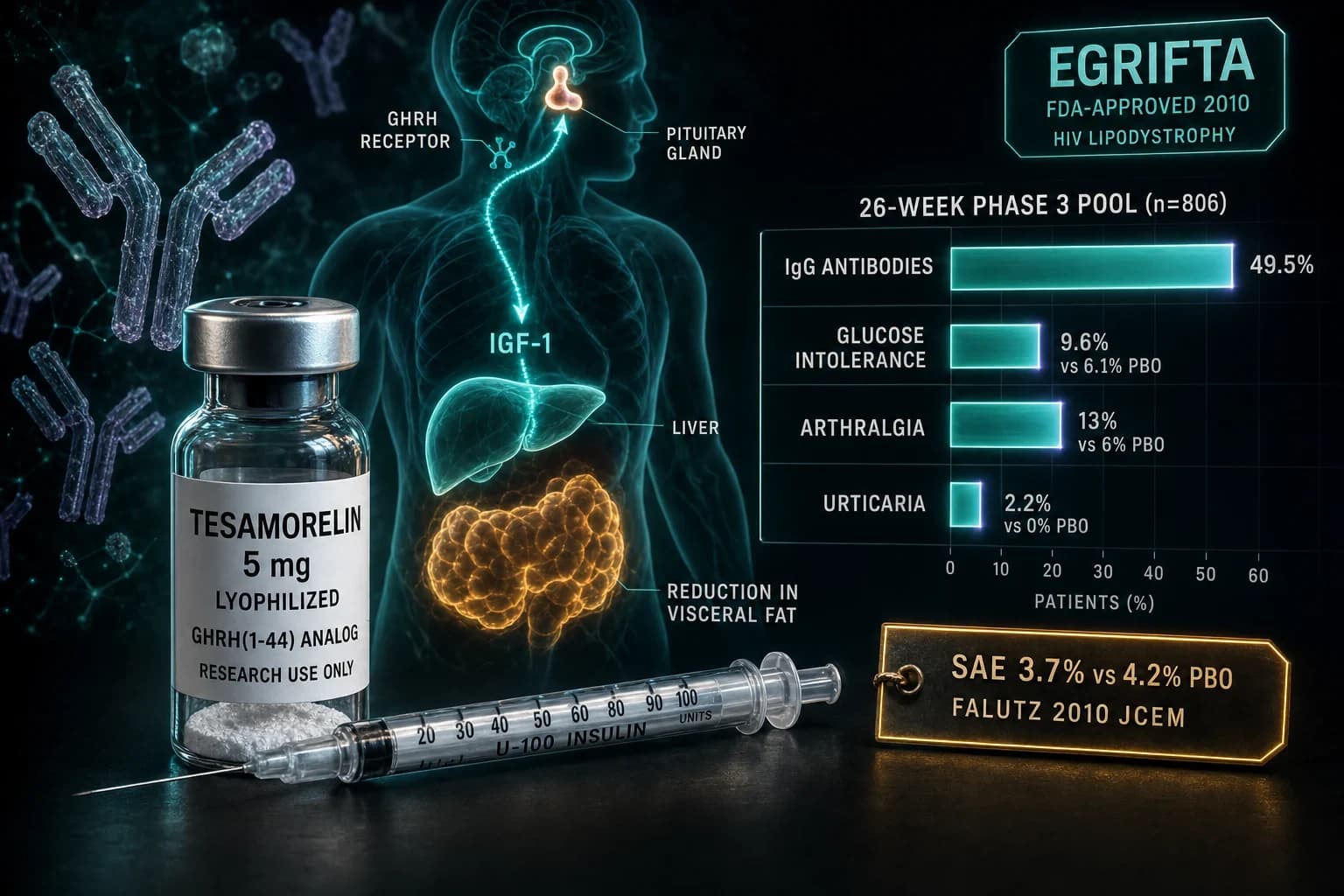
- Tesamorelin. In the pivotal Phase 3 trial, 412 HIV patients with treatment-associated abdominal fat received 2 mg daily subcutaneous tesamorelin or placebo for 26 weeks. Visceral adipose tissue dropped 15.2% in the tesamorelin arm and rose 5.0% in placebo, alongside improvements in triglycerides and cholesterol ratios (Falutz et al. NEJM 2007, PMID 18057338).
- Bremelanotide (PT-141). The RECONNECT program enrolled 1,267 premenopausal women with HSDD across two identical Phase 3 trials of on-demand 1.75 mg subcutaneous bremelanotide. Both trials met co-primary endpoints for desire and distress. FDA approved it as Vyleesi in June 2019 (Kingsberg et al. Obstet Gynecol 2019, PMID 31599840).
- Sermorelin and GHRH analogs. A five-month randomized trial of a GHRH-(1-29) analog at 10 μg/kg in adults aged 55 to 71 produced significant increases in nocturnal GH and serum IGF-I, increased skin thickness in both sexes, and increased lean body mass in men (Khorram et al. J Clin Endocrinol Metab 1997, PMID 9141536). A separate nightly-injection study in healthy elderly men showed increased mean nocturnal GH release and modest strength gains (Vittone et al. Metabolism 1997, PMID 9005976).
Research-only peptides have thin human evidence. BPC-157 has 40-plus preclinical papers on tendon, ligament, and gut healing in rats. Published human trials: essentially none. TB-500 is similar. That does not make them ineffective, but it does mean any claim about human outcomes for these compounds is not backed by the kind of trial that would satisfy the FDA. Our SARMs vs peptides comparison walks through the same asymmetry with a different comparator class.
Safety and mortality
The AAS safety literature is not ambiguous.
- Mortality. A Danish population-based cohort matched 1,189 males sanctioned for AAS use in fitness centers against 59,450 controls over roughly 11 years. All-cause mortality was 2.81x higher in AAS users (33 deaths vs 578, HR 2.81, 95% CI 1.98 to 3.99) (Horwitz et al. 2024, PMID 38483396). Unnatural deaths, mostly accidents, made up 17 of the 33.
- Cardiovascular disease. A 2025 Circulation review documents left ventricular hypertrophy, myocardial fibrosis, coronary artery disease, sudden cardiac death, and dilated cardiomyopathy across the AAS-user literature (Baggish et al. Circulation 2025, PMID 39945117). Blood pressure rises, LDL rises, HDL falls, and long-term users show accelerated atherosclerosis on imaging.
- Hepatotoxicity. Only the 17-alpha-alkylated orals (oxandrolone, stanozolol, methyltestosterone, oxymetholone) show this pattern reliably, and the case series include cholestasis, peliosis hepatis, and hepatic tumors.
Peptide safety is compound-specific and, for most research peptides, undercharacterized. FDA-approved peptides have adverse-event profiles that read very differently from the AAS list. Tesamorelin's Phase 3 adverse events were mostly injection-site reactions, arthralgia, and peripheral edema, at rates under 4% for serious events. Bremelanotide's most common adverse events were nausea, flushing, and injection-site reactions, with a small hypertension signal that led to a warning about pre-existing cardiovascular disease. Research peptides like BPC-157 have no equivalent safety database at all, and the human safety profile is inferred from clinician-reported case series and forum aggregation.
Warning: "Peptides are safer than steroids" is not a universal claim. It is only defensible for the specific peptide-plus-indication pair that has trial data. For BPC-157 in humans, the honest answer is "we do not know."
Peptides vs testosterone specifically
Testosterone deserves its own paragraph, because it is what "peptides vs steroids" usually means when the searcher is not a bodybuilder. Testosterone-replacement therapy (TRT) is not the same drug situation as, say, trenbolone, even though both fall under Schedule III. TRT at physiologic doses maintains normal male testosterone levels in men with documented hypogonadism. Supraphysiologic AAS use pushes levels 5x to 20x above the reference range.
TRT itself has now been assessed against placebo in a major cardiovascular outcomes trial. TRAVERSE randomized 5,246 middle-aged and older men with hypogonadism and elevated cardiovascular risk to transdermal testosterone or placebo. The primary MACE endpoint met noninferiority: testosterone did not increase major adverse cardiac events versus placebo. A secondary signal for nonfatal arrhythmias, particularly atrial fibrillation, ran higher in the testosterone arm (Lincoff et al. NEJM 2023, PMID 37326322).
That is the cleanest human safety data anyone has on any steroid class, and it applies only to physiologic TRT dosing in indicated men, not to supraphysiologic bodybuilding stacks. For a fuller treatment of where TRT sits legally, see is TRT a steroid.
Growth-hormone-secretagogue peptides (sermorelin, CJC-1295, ipamorelin, tesamorelin) are sometimes marketed as "TRT alternatives." They are not. They act on a different axis (somatotropic, not gonadotropic). They can improve body composition modestly in the right patients (see the Khorram and Vittone GHRH data above). They do not raise testosterone and will not restore libido, erectile function, or morning erections in a hypogonadal man. If TRT is the question, TRT is the answer.
Legal and regulatory status
AAS in the United States. Since the Anabolic Steroids Control Act of 1990 and the 2004 amendment, 64 named anabolic steroids sit in Schedule III of the Controlled Substances Act. Possession without a valid prescription is a federal crime. Trafficking penalties run into years of imprisonment.
Peptides in the United States. The status is not uniform. FDA-approved peptides (semaglutide, tirzepatide, sermorelin, tesamorelin, bremelanotide) are prescription drugs regulated like any other prescription drug. Research-only peptides (BPC-157, TB-500, most of the growth-hormone-secretagogues) are sold under the "for research use only" label because they are not approved for human use. That label sits in an increasingly narrow legal space; the FDA has explicitly told compounding pharmacies not to compound BPC-157, and USADA has banned BPC-157 for competitive athletes.
For dose transparency on the FDA-approved peptide side, our sermorelin dosage chart documents the standard escalation. For third-party COA and purity data on the injectable research-only side, see the Ascension Peptides vendor review.
Where each class actually fits
| Goal | AAS answer | Peptide answer |
|---|---|---|
| Documented hypogonadism | Prescribed TRT (physiologic dosing) | GH secretagogues do NOT substitute |
| Bulk / competitive bodybuilding | AAS stacks (illegal without RX, high risk) | No honest peptide alternative matches |
| Recomposition, moderate lean gain | TRT if hypogonadal | GH secretagogues, modest effect |
| HIV lipodystrophy | Not indicated | Tesamorelin (FDA-approved) |
| HSDD in premenopausal women | Not indicated | Bremelanotide (FDA-approved) |
| Tendon / ligament healing | Not indicated | BPC-157 / TB-500 (preclinical only) |
| Type 2 diabetes / obesity | Not indicated | GLP-1 peptides (FDA-approved) |
| Wound healing (skin) | Not indicated | GHK-Cu, BPC-157 (limited human data) |
Read the table as a decision aid, not a prescription. The first two rows are where the marketing confusion lives, and they are also where the honest gap between the two classes is largest. Peptides do not replace supraphysiologic testosterone for pure hypertrophy. They also do not replace TRT for a hypogonadal patient. Anyone selling either substitution is selling misinformation.
Buyer notes for the research-peptide side
If you are researching peptides in the FDA-approved category, work with a licensed prescriber. If you are researching the "research use only" side, source matters more than dose. That is why every serious buyer starts with third-party COAs and independent purity testing. The Ascension Peptides review walks through what a real COA library looks like and what to check for. Ascension carries the injectable research-peptide catalog referenced above and applies 50% off with code ENHANCED.
For general dosing math (concentration, insulin-unit conversion), our reconstitution calculator handles the arithmetic. For an overview of what compounds exist, see the peptides catalog.
Note: Nothing in this article is a recommendation to use any specific compound. It is a class-by-class comparison of what the published literature actually shows. Any human use of any compound named here is a medical decision that belongs with a licensed clinician.
The honest bottom line
Peptides and steroids are not swappable categories. AAS have decades of anabolic and adverse-event evidence, most of it bad if you are asking about supraphysiologic recreational use. Physiologic TRT is a different situation and has its own trial data now. FDA-approved peptides have narrow indications with real Phase 3 support. Research-only peptides have real preclinical mechanism but almost no human trial data.
The single most common mistake in this comparison is defending the safety of research peptides with the trial data from FDA-approved peptides, and then comparing that composite against supraphysiologic AAS use. That reads as a clean win for peptides. It is not a clean win, because the comparison groups do not match. Compare like with like: FDA-approved peptide vs FDA-approved drug at approved dose, or research chemical vs research chemical at unstudied doses.
Research purposes only. This article summarizes published pharmacology and does not constitute medical advice. Do not initiate any hormonal therapy or peptide protocol without consulting a licensed physician.