At a glance
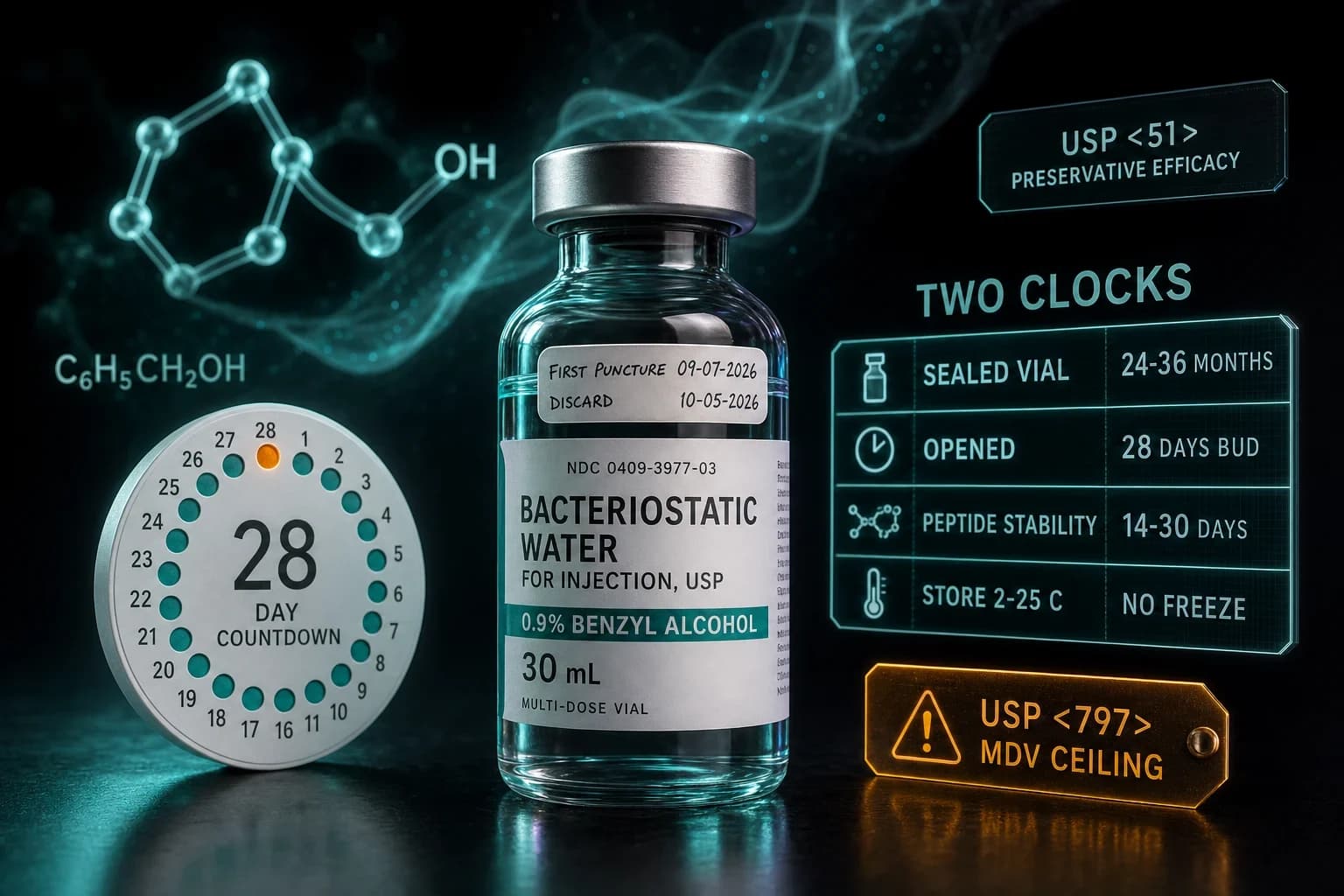
- Sealed 30 mL Hospira BWFI (NDC 0409-3977-03): 24 to 36 months from fill.
- Once punctured, USP <797> caps use at 28 days, refrigerated or room temperature.
- Benzyl alcohol 0.9% preserves; it does not sterilize. Aseptic technique still required.
- Reconstituted peptide runs on its own clock (14 to 30 days), often shorter than the bac water BUD.
- Above 25 C storage voids the label window. Freezing is not recommended.
The question hides two clocks. A sealed 30 mL Hospira multi-dose vial (NDC 0409-3977-03) carries a manufacturer expiration of roughly 24 to 36 months from the fill date; once you push a needle through the rubber stopper for the first time, USP General Chapter <797> caps in-use time at 28 days. Everything else people argue about on Reddit is a variation on those two numbers.
This guide separates the two clocks, cites the pharmacopoeia and PubMed literature behind each, and lays out the practical protocol a research user should actually follow. It assumes you are reconstituting a research peptide like BPC-157, TB-500, or semaglutide into powder-in-vial format. If you are looking for reconstitution volumes rather than shelf-life, our BPC-157 bacteriostatic water calculator guide and the reconstitution calculator are the right pages.
The two clocks in one table
| Vial state | Time limit | Source of the limit |
|---|---|---|
| Sealed 30 mL BWFI at room temperature | 24 to 36 months from fill (manufacturer date) | Hospira/Pfizer product label |
| First punctured, stored refrigerated (2 to 8 C) | 28 days | USP <797> BUD for preserved multi-dose vials |
| First punctured, stored at room temperature (below 25 C) | 28 days, absolute ceiling | USP <797>, temperature adds risk |
| First punctured, stored above 25 C | Not defined by USP; discard sooner | Preservative efficacy degrades faster |
| Reconstituted peptide (separate clock) | Peptide-specific, typically 14 to 30 days refrigerated | Peptide stability, not bac water |
The 28-day figure is a hard number in the compounding standard. It is not a manufacturer marketing choice, and stretching it does not have literature support that a research user should rely on.
What "bacteriostatic" actually buys you
Bacteriostatic water for injection is sterile water plus 0.9% (9 mg/mL) benzyl alcohol. The benzyl alcohol is a preservative, not a sterilant. It slows bacterial replication enough that a multi-dose vial can be re-entered several times over a bounded window without the contents turning into a broth. It does not kill spores. It does not sterilize a contaminated needle. It does not compensate for wiping the stopper on a dirty countertop.
The 0.9% concentration was set to sit above the minimum inhibitory concentration for common skin flora (Staphylococcus, Micrococcus) while remaining well below the acute human toxicity threshold. That threshold matters because benzyl alcohol has a documented toxic ceiling in specific populations. In a landmark case series, Gershanik et al. (1982) described 10 preterm neonates who developed a syndrome of metabolic acidosis, gasping respiration, cardiovascular collapse, and death after receiving benzyl-alcohol-preserved flush solutions at 100 to 240 mg/kg/day. The follow-up preclinical work of McCloskey et al. (1986) established an LD50 near 1000 mg/kg in adult and neonatal mice via intraperitoneal dosing, with delayed mortality lowering that to 650 mg/kg by day 7. Adults administering a few tenths of a milliliter subcutaneously are not in that dose region; neonates receiving cumulative flushes were. The takeaway is that "bacteriostatic" is a real preservative with a real dose ceiling, not a magic word.
Where the 28-day rule comes from
Three references converge on 28 days.
The manufacturer label (Pfizer/Hospira BWFI) states that repeated withdrawals are supported for up to 28 days provided the vial is stored appropriately and each entry uses aseptic technique. That is a claim the manufacturer supports with preservative-efficacy testing under USP General Chapter <51>, which measures how quickly a preserved formulation reduces a challenge inoculum of specified bacteria and fungi.
USP General Chapter <797> on pharmaceutical compounding sterile preparations sets a default beyond-use date (BUD) of 28 days after first entry for opened preserved multi-dose vials, unless the manufacturer specifies a shorter window. USP <797> is the standard US compounding pharmacies apply, and it is what a state board of pharmacy would inspect against.
The CDC's injection-safety guidance mirrors the USP number for clinical use: date the vial at first entry, discard at 28 days or manufacturer expiration, whichever is earlier. This is the language you will see in hospital pharmacy policies and outpatient injectable programs.
None of this means a vial is chemically fresh at day 27 and dangerous at day 29. It means that beyond 28 days, the preservative-efficacy data no longer supports repeated punctures, and the risk shifts from "documented small" to "undocumented growing."
Why 28 days and not 60
Real-world contamination is not zero at day 28 either. It is low enough to accept for a preserved vial with clean technique.
Independent hospital audits track how often multi-dose vials in actual use turn up contaminated. Nogler-Semenitz et al. (2007) examined 96 vials pulled from Austrian hospital wards and found 4 (4.17%) non-sterile, including 2 with spore-forming bacteria and 2 with coagulase-negative Staphylococci. The auditors also flagged that 28% of vials had no dated first-entry sticker and that 15 of 68 multi-dose vials had already been used beyond their in-use time limit. Sloppy dating, not the preservative, was the failure point.
An earlier German prevalence study by Mattner and Gastmeier (2004) traced two deaths from Pseudomonas aeruginosa meningitis to a single contrast-media vial that had been re-entered as a multi-dose over 8 days despite not being labeled for that use. A newer audit of 205 opened vials in a pulmonary teaching hospital by Baniasadi et al. (2013), published in the Brazilian Journal of Infectious Diseases, found 5.36% contamination, with insulin (a preserved multi-dose product frequently punctured many times) as the most common offender.
The pattern is consistent. Preserved multi-dose vials contaminate at low single-digit rates when protocol is followed and at meaningfully higher rates when it is not. Twenty-eight days is where the preservative-efficacy curve, the microbial-ingress data, and the label all agree.
The peptide vial is a different clock
This is the single most common mistake in the research-peptide community. The bacteriostatic water vial and the reconstituted peptide vial run on separate clocks.
Bac water shelf-life is governed by preservative efficacy and microbial ingress. Peptide shelf-life is governed by chemical degradation of the amino-acid sequence in aqueous solution. Those are different chemistry problems.
The classical review by Manning, Patel, and Borchardt (1989) and the 2010 update by Manning et al. enumerate the routes: hydrolysis (particularly at Asp-Pro and Asp-Gly bonds), deamidation of asparagine and glutamine residues, oxidation of methionine, cysteine, and tryptophan, disulfide scrambling in multi-Cys peptides, aggregation, and adsorption to container surfaces. Each pathway has its own rate constant, and each is accelerated by temperature, freeze-thaw cycles, pH extremes, and light.
In practice this means:
- The bac water in your peptide vial after reconstitution is still on the 28-day BUD clock.
- The peptide dissolved in that water is on its own, generally shorter, clock. For sequences rich in Asn/Gln/Met (GLP-1 analogs, BPC-157, TB-500 fragment), most vendors and researchers use a working window of 14 to 30 days refrigerated, with freezer stability at minus 20 C or minus 80 C for longer holds.
- Whichever clock expires first wins.
For the reconstitution volumes and unit-conversion math behind that clock, see the reconstitution complete guide and the site's how-to-reconstitute walkthrough. For dose-per-tick math, the reconstitution calculator removes the arithmetic risk.
Temperature: the modifier that people underestimate
The 28-day BUD assumes appropriate storage. "Appropriate" is a range, and the range matters.
Refrigerated storage at 2 to 8 C is the reference condition. Preservative efficacy is preserved, degradation rates for benzyl alcohol are near-zero, and microbial replication of common contaminants slows sharply. Twenty-eight days is the ceiling regardless.
Room temperature between 15 and 25 C is acceptable per the label, but every point above the reference condition compresses the safety margin. Preservative-efficacy testing under USP <51> uses defined temperature bands, and the 28-day claim only holds inside them. In routine use, a bac water vial that lives at bathroom-cabinet temperature is fine within the BUD if aseptic technique is otherwise clean.
Above 25 C, the manufacturer label offers no support. Neither does USP <797>. If a vial sits in a warm car for a day, treat it as compromised for repeated use. Do not extrapolate a 28-day BUD to a vial that was stored outside label conditions.
Freezing is not recommended for bac water. The 0.9% benzyl alcohol does not tolerate freeze-thaw in the same way peptides can, and the manufacturer label specifically says do not freeze.
What "expired" actually means
An expired bac water vial can fail in three ways, only one of which is visible.
The first failure is chemical. Benzyl alcohol slowly oxidizes to benzaldehyde and benzoic acid over years in solution. Below the label expiration date, that degradation is negligible; well beyond it, the preservative concentration drops enough that the bacteriostatic claim no longer holds.
Microbial failure is the second mode. Repeated punctures introduce airborne and surface bacteria to a small liquid volume with limited defense. Even under aseptic technique, a preserved multi-dose vial run past 28 days accumulates cumulative low-probability ingress that eventually crosses the detection threshold in the audits cited above.
Particulate contamination is the third. A rubber stopper punctured many times sheds micro-particles into solution (coring). These are typically invisible to the naked eye but can drive local injection-site reactions and, at extremes, granuloma formation.
None of the three prints a warning label. A vial that has been open for 45 days and looks fine is not thereby safe. The label window and the BUD exist because you cannot see the failure modes.
The practical protocol
The protocol that keeps a vial inside its supported window is boringly simple.
Date the vial at first puncture. Write it directly on the label with a fine-tip marker, and record the discard date (first-entry date + 28 days) on the same line. If the vial had already been stored past the manufacturer expiration date at first entry, use the manufacturer date; whichever is earlier wins.
Store between 2 and 25 C. Refrigeration is preferred once opened. Do not freeze. Do not leave in direct sun or in a car in summer.
Swab the stopper with a fresh 70% isopropyl alcohol wipe before every entry, and let it dry. Do not reuse needles. Do not top up a partially used bac water vial with contents of a second vial. Do not decant into a smaller vial for portability.
Inspect before each draw. A cloudy, discolored, or precipitate-containing vial is discarded on the spot regardless of the date.
Discard at 28 days. If the same vial was used to reconstitute a peptide with a shorter peptide-specific stability window, discard the peptide vial on that shorter clock even if bac water time remains.
The FDA/USP compliance conversation about peptide sourcing is downstream of this. A vendor that ships product with third-party HPLC and endotoxin data has done half the work; you complete the other half by keeping the reconstituted product inside its BUD.
Sterile water is not the same product
A parallel question comes up whenever someone finds sterile water for injection at a lower price. It is not the same product.
Sterile Water for Injection, USP (SWFI) has no benzyl alcohol. It is intended for single-dose use only, and its label states so. The moment you puncture the stopper, the vial has no preservative and no supported in-use window beyond immediate reconstitution and discard.
For a single reconstitution that will be entirely used within a few hours, SWFI is acceptable and is what most acute hospital use looks like. For a research-peptide protocol that draws micrograms per dose over weeks, SWFI is the wrong choice. The vial will be re-entered too many times to be safe without a preservative.
This is the same reason "preservative-free saline" is not a substitute either. If the label says preservative-free, treat the vial as single-dose.
Signs to discard before the date
Even inside the 28-day window, a vial is discarded when it shows:
- Any visible cloudiness, particulate, precipitate, or color change.
- A cracked, chipped, or damaged rubber stopper.
- A missing or unreadable first-entry date sticker.
- A history of storage outside the 2 to 25 C range.
- A shared-use pattern that cannot be reconstructed (someone else "borrowed" it and returned it).
The 28-day BUD is a ceiling, not a target. Nothing about the standard requires you to use every day of it.
Sourcing bac water without buying garbage
Vials sold as "peptide bac water" on gray-market marketplaces are frequently repackaged, mislabeled, or under-preserved. The two safest paths are a licensed US pharmacy with a written prescription (Hospira/Pfizer 30 mL BWFI NDC 0409-3977-03 is the standard reference product) or a research-supply channel that carries pharmaceutical-grade BWFI with a matched Certificate of Analysis.
For lot-verified research peptides and reconstitution supplies, Ascension Peptides publishes independent COAs per lot and is the primary vendor audit on this site. Use code ENHANCED for 50% off. For the underlying quality-assurance framework, our lab-test library documents what each COA metric actually proves, and the best-legit-peptide-vendors 2026 ranking sits next to it for cross-reference.
Frequently asked shelf-life questions
Does refrigeration extend bac water beyond 28 days? No. Refrigeration is preferred storage inside the 28-day window, but it does not push the BUD out. USP <797> caps preserved multi-dose vials at 28 days regardless of storage.
Can I use bac water past the printed manufacturer expiration date? Not for injectable research use. Manufacturer stability testing supports the labeled expiration; beyond it, benzyl alcohol concentration and sterility are outside the tested envelope.
Is 30 mL too much if I only reconstitute one 10 mg vial? Usually yes. A single 10 mg BPC-157 vial typically takes 2 to 3 mL of bac water. The remaining ~27 mL sits idle. If you cannot use the vial within 28 days, buy 3 mL or 10 mL sizes when available, or run several peptide vials off the same bac water within the BUD.
What about the vial the peptide came in? After reconstitution, that vial is a compounded sterile preparation, and it inherits the shorter of two clocks: bac water BUD (28 days from bac water first entry) or peptide chemical stability (14 to 30 days for most research sequences under refrigeration, sequence-dependent). Track both dates.
Does the vial size (10 mL vs 30 mL) change the 28-day rule? No. The BUD is time-based, not volume-based. Smaller vials tend to be used up before day 28, which is a practical advantage, not a longer window.
Can I re-seal a vial with tape or a fresh cap? No. The rubber stopper is engineered to reseal after each needle withdrawal. Adding tape does nothing for sterility and can trap contamination.
Bottom line: Sealed 30 mL bac water is good until its printed expiration date. Once punctured, 28 days is the ceiling under USP <797>, whether refrigerated or at room temperature. The reconstituted peptide inside runs on a separate, usually shorter, clock. Track both dates, discard on the earlier one, and stop treating "bacteriostatic" as permission to skip the calendar.
What to do next
If you need the reconstitution volumes for a specific peptide, our BPC-157 bac water calculation is the highest-traffic worked example on the site and the reconstitution calculator generalizes it. If you are still choosing a vendor, the Ascension Peptides review is the primary trust reference and the vendor comparison ranking sits next to it. If you want to understand what the COAs behind a vial actually prove, the COA explainer is the companion piece.
This article is for research and educational purposes only. Bacteriostatic water and the peptides reconstituted in it are used exclusively in laboratory research contexts. Nothing here is medical advice, no content should be used to diagnose or treat any condition, and human use of research peptides is outside the scope of this article. Consult a qualified physician before making any decisions related to peptides, hormones, or health. Product handling, storage, and disposal should follow the manufacturer's label and applicable pharmacopeia standards (USP <797>, USP <51>).