At a glance
- Sharma 2025 Vanderbilt CT cohort (n=20, mean weight loss 11 kg): median 9% total midface volume loss, with superficial compartments down 11% vs deep compartments down 7%
- Linear regression in the same cohort: roughly 7% facial volume loss per 10 kg of GLP-1 weight loss
- Daneshgaran 2025 systematic review confirms public search interest in 'Ozempic face' rose roughly 4,600 percent during the GLP-1 boom
- SURMOUNT-1 DEXA substudy (Look 2025, n=160): about 25% of weight lost on tirzepatide was lean mass, paralleling the facial pattern
- No GLP-1 RA carries a facial volume loss warning. The signal is real, but it tracks weight loss magnitude, not drug exposure independently
What "Ozempic face" actually describes (and what it does not)
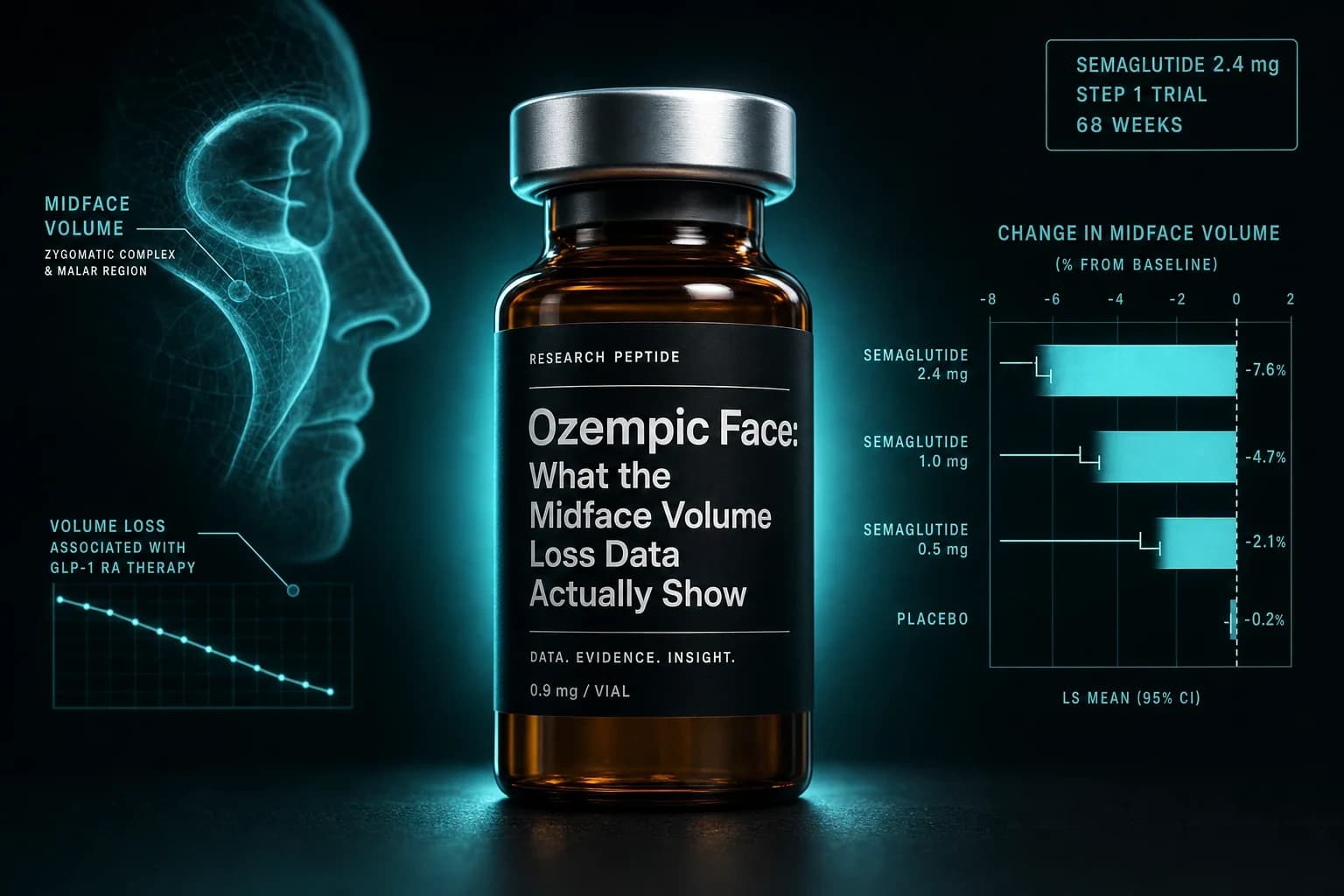
The first thing to know about "Ozempic face": Vanderbilt put it on a CT scanner. In a 2025 retrospective cohort, patients on GLP-1 receptor agonists lost a median 9.0% of total midface volume after a mean 11 kg weight loss, with superficial fat compartments down 11.0% and deep compartments down 7.0% (Sharma et al., Otolaryngol Head Neck Surg 2025, PMID 40407186). The phenomenon is real and quantifiable. It is also not a pharmacologic side effect of the drug. The face responds to rapid weight loss, and the drug delivers rapid weight loss. The mechanism is the patient's own subcutaneous fat doing what subcutaneous fat does when energy intake drops below energy expenditure for months at a time.
That distinction matters because most reader-facing coverage gets it wrong in either direction. Some pages frame "Ozempic face" as a unique drug toxicity comparable to a black-box warning. It is not on any semaglutide or tirzepatide prescribing information, and the facial plastic surgery literature has been consistent on this point since the term entered the medical record in 2023 (Sciscent et al., Facial Plast Surg Aesthet Med 2025, PMID 39056124). Other pages dismiss the concern as Instagram-driven panic. The Vanderbilt CT data and the 2025 systematic review (Daneshgaran et al., Aesthet Surg J Open Forum 2025, PMID 40626110) both push back on that framing.
Bottom line: Facial volume loss on GLP-1 receptor agonists is a function of total weight loss and weight loss velocity, not a direct pharmacological effect of semaglutide or tirzepatide. The Vanderbilt cohort shows it is measurable on imaging. The systematic review confirms it is a real signal. None of the GLP-1 RA labels carry a facial atrophy warning, and clinicians treat it as a downstream consequence of any rapid weight loss, including bariatric surgery and severe caloric restriction.
The Vanderbilt CT cohort, in plain numbers
The Sharma 2025 paper is the only published study to date that has measured midface volume changes on actual radiographic imaging of patients with paired pre-GLP-1 and post-GLP-1 scans. The investigators queried Vanderbilt's electronic record between 2017 and 2024 for patients with a GLP-1 RA prescription plus head and neck CT or MR imaging available both before and after the prescription period. Twenty patients met the inclusion criteria.
Mean GLP-1 RA exposure was 321 days. Mean total weight loss across the cohort was 11.0 kg. The midface was segmented into superficial fat compartments and deep compartments, and each was volumetrically measured on the pre-treatment and post-treatment scans.
| Outcome | Median change | IQR |
|---|---|---|
| Total midface volume | -9.0% | -3% to -14% |
| Superficial fat compartments | -11.0% | -5% to -15% |
| Deep fat compartments | -7.0% | -20% to +15% |
| Body weight | -11.0 kg | not reported |
The linear regression embedded in the paper produced a more practical number: roughly 7% midface volume loss per 10 kg of total weight loss. That converts cleanly to patient-facing math. A 20 kg total weight loss on semaglutide 2.4 mg, the average magnitude in STEP 1 (Wilding et al., N Engl J Med 2021, PMID 33567185), maps onto roughly 14 to 18% midface volume loss. A 22.5% body weight loss on tirzepatide 15 mg in SURMOUNT-1 (Jastreboff et al., N Engl J Med 2022, PMID 35658024) maps onto a still larger projected facial change.
The caveats on this cohort are equally specific. Twenty patients is a small dataset. The patients had imaging for clinical reasons unrelated to aesthetics, which means the sample is skewed toward people with sinus, dental, or ENT pathology. The regression coefficient is single-center. None of this invalidates the directional finding, but it does mean the 7 percent per 10 kg number should be read as a working estimate, not as a settled population effect.
Why the superficial compartments lose more than the deep ones
The fat-compartment specificity of the Vanderbilt finding is the most interesting part of the paper. Normal facial aging burns the deep midface compartments faster than the superficial ones, which is why the classic aged face has hollow medial cheeks, descended deep malar fat, and a relatively preserved superficial layer. The GLP-1 weight loss pattern in the Sharma cohort runs in the opposite direction. Superficial fat fell 11.0% on average, deep fat only 7.0%, and the superficial-deep distinction was the largest single signal in the dataset.
This is the mechanistic core of why a face that lost 10 kg on semaglutide can look unlike a face that aged 10 years through normal aging despite roughly similar total volume loss. The compartments hit hardest in the Sharma cohort were the medial cheek superficial fat, the sub-orbicularis oculi fat, and the temporal fat pads. Those are also the compartments aesthetic dermatologists most often restore with hyaluronic acid or biostimulatory fillers in the clinical case series literature.
The Sciscent 2025 review (PMID 39056124) puts the same observation in clinical language. The "Ozempic face" appearance is dominated by superficial volume loss, with secondary skin laxity that does not have time to remodel because the loss happens over months rather than years. The skin envelope was sized for the pre-loss face. Rapid loss leaves it draped over a smaller scaffold without the elastic adaptation that gradual loss permits.
The demand signal: this is now a clinical category, not a celebrity story
The aesthetic medicine literature has moved past "is this a thing" to "what do we do about it." The Daneshgaran 2025 systematic review (PMID 40626110) combined a PubMed systematic search with a Google Trends analysis and quantified the search demand explicitly. The term "Ozempic face" rose roughly 4,600% in relative search volume over the observation period, with significant linear regression on the trend line. Spearman correlations between weight-loss search terms and filler search terms remained significant after detrending, which is the analytic move that separates real co-movement from time-series coincidence.
The American Society of Plastic Surgeons reported more than 837,000 GLP-1 patients seen by member surgeons in 2024, with 39% considering surgical intervention and 41% considering non-surgical options. The American Society for Dermatologic Surgery's 2025 provider survey reported hyaluronic acid filler use in 81% of GLP-1 patients being treated for facial changes, with botulinum toxin co-use in roughly two-thirds of practices. These are not Instagram numbers. They are clinic-volume numbers from the trade associations of the specialties that handle facial aesthetics.
| Demand or volume signal | Source | Magnitude |
|---|---|---|
| "Ozempic face" search RSV increase | Daneshgaran 2025 systematic review | ~4,600% peak rise |
| GLP-1 patients seen by plastic surgeons | ASPS 2024 | 837,000+ |
| Considering surgical aesthetic intervention | ASPS 2024 | 39% of GLP-1 patients |
| Considering non-surgical aesthetic intervention | ASPS 2024 | 41% of GLP-1 patients |
| HA filler use in treated GLP-1 patients | ASDS 2025 provider survey | 81% |
The clinic-volume numbers above are the ones that justify the article existing at all. Plastic surgery and aesthetic dermatology have already standardized the GLP-1 face workflow, and the data show roughly what a semaglutide or tirzepatide responder can expect to know about before, during, and after the weight loss arc.
The parallel signal: lean mass loss
Facial volume loss does not happen in isolation. Both the Vanderbilt CT cohort and the lean-mass body-composition literature point to a single pattern: rapid GLP-1 weight loss preferentially burns peripheral and superficial soft tissue, including the fat compartments that pad the face and a measurable fraction of skeletal muscle mass elsewhere.
The SURMOUNT-1 DEXA substudy (Look et al., Diabetes Obes Metab 2025) measured this directly. In 160 SURMOUNT-1 participants who underwent DXA at baseline and Week 72, tirzepatide produced a 21.3% reduction in body weight, with fat mass down 33.9% and lean mass down 10.9%. About 75% of the lost weight was fat and 25% was lean mass. The placebo arm lost weight in roughly the same fat-to-lean ratio, which is the headline of the substudy: tirzepatide's body composition pattern is the standard pattern of any caloric-deficit weight loss, not a tirzepatide-specific catabolic effect.
The SEMALEAN study (Alissou et al., Diabetes Obes Metab 2025) read the same way for semaglutide. In 106 patients who completed 12 months on semaglutide 2.4 mg, total fat mass fell 18%, lean mass dropped by 3 kg at month 7 then stabilized, and handgrip strength actually rose by 4.5 kg at month 12. Sarcopenic obesity prevalence fell from 49% at baseline to 33% at 12 months, which is the more meaningful clinical outcome than the absolute lean mass change. The face and the leg both follow the same general pattern. Speed and magnitude matter more than which receptor was activated.
For a longer read on the muscle-side data, the GLP-1 muscle loss research review covers the bimagrumab and resistance training trial evidence in depth. For the parallel question on hair, the GLP-1 hair loss evidence review covers the telogen effluvium signal and what the clinical literature actually shows.
What treatment options have published evidence
The aesthetic medicine response splits into four categories with very different evidence bases.
Hyaluronic acid fillers are the workhorse intervention. The ASDS 2025 survey numbers above reflect routine clinical use. There are no randomized trials of HA filler for "Ozempic face" specifically, because the indication is not novel. HA filler for midface volume restoration has decades of safety and efficacy data, and the practice patterns simply migrated to a new patient phenotype.
Biostimulatory fillers (poly-L-lactic acid, calcium hydroxylapatite) work on a longer timeline, restoring volume by stimulating collagen production rather than acting as direct volume replacement. The aesthetic surgery literature in 2025 increasingly favors biostimulatory options for younger GLP-1 patients with anticipated long-term weight maintenance, because the collagen-driven volume holds beyond the 12 to 18 month duration of standard HA fillers.
Fat grafting is the third option and the most invasive. The ASPS 2024 data show a 50% increase in facial fat grafting procedures coinciding with the GLP-1 boom. The procedure transfers the patient's own adipose tissue to the volume-deficient compartments. Long-term retention runs 50 to 70% in published series, with the trade-off of a more involved procedure and a longer recovery.
Endotissutal bipolar radiofrequency was tested in a 24-patient case series with 12-month follow-up (Catalfamo et al., J Clin Med 2025, PMID 40806889). Patient satisfaction scores ran 8 or higher in the majority of cases, and the only adverse event reported was transient erythema. This is an open-label single-arm case series, not a controlled trial, but it is the cleanest published RF data set for the specific GLP-1 indication.
| Intervention | Mechanism | Time horizon | Evidence quality |
|---|---|---|---|
| HA filler | Direct volume replacement | 12 to 18 months | Established for midface volume; off-label for "Ozempic face" specifically |
| Biostimulatory filler (PLLA, CaHA) | Collagen induction | 18 to 24 months | Strong general evidence; case series in GLP-1 cohort |
| Autologous fat grafting | Transferred adipose tissue | Permanent (50 to 70% retention) | Decades of facial aesthetic surgery data |
| Bipolar RF | Dermal collagen remodeling | 6 to 12 months | One 24-patient case series specific to GLP-1 face |
Prevention while losing the weight
The evidence base on prevention is thinner than the treatment evidence, but a few principles are consistent across the body composition and aesthetic literature.
Speed of loss matters more than total loss. The Vanderbilt cohort lost weight over a mean 321 days. STEP 1 trial participants lost 17.3% of body weight over 68 weeks (Wilding et al., Diabetes Obes Metab 2022, PMID 35441470). Patients who hit larger losses in shorter windows accumulate more skin laxity per unit of fat loss, because the dermal collagen remodeling required to shrink the skin envelope cannot keep pace with the rate of fat compartment shrinkage. Lower-dose maintenance protocols and longer titration windows distribute the loss across more time and let the dermis remodel along the way.
Protein intake at 1.2 to 1.6 g per kg of body weight is the standard recommendation in the obesity nutrition literature for protecting lean mass during weight loss. The same applies in the GLP-1 context. SEMALEAN's stabilization of lean mass after month 7 occurred in a cohort that received structured nutritional counseling. The trials without that counseling, including STEP 1, showed steeper lean mass losses. The mechanism is the same one the resistance-training literature has anchored for decades. The signaling input to muscle protein synthesis scales with protein availability, and protein availability falls when total caloric intake falls hard.
Resistance training is the second pillar of lean mass protection. The published case series of GLP-1 patients prioritizing both protein and resistance work show lean mass changes ranging from -8.7% to +5.8%, which is a wide enough band to flag that the protocol matters more than the drug. Aesthetic outcomes generally track lean mass outcomes, because preserved muscle holds the face and limb scaffolding closer to the pre-loss baseline.
The stopping GLP-1s research review covers what happens to body composition after withdrawal, which is the other half of the prevention conversation. The GLP-1 dosing comparison 2026 covers the titration math that controls speed of loss for a given target.
Where peptides fit in skin recovery (and where they do not)
The peptide research literature contains zero RCTs of any compound specifically tested for GLP-1-associated facial volume loss. That is the first and most important fact. The marketing copy in the broader peptide space sometimes implies otherwise, and the gap between the implication and the published data matters.
What the published peptide literature does cover is the general dermal collagen and elastin response to specific compounds, almost always in vitro or in topical formulations. GHK-Cu has the cleanest in vitro and ex vivo data on collagen and elastin gene expression upregulation, plus a small number of topical formulation trials showing wrinkle depth and skin thickness improvements (Pickart et al., Biomed Res Int 2015, PMID 26236730). None of those trials were done in GLP-1 patients with measured facial volume loss, but the underlying mechanism is dermal collagen induction, which is the same mechanism aesthetic dermatologists target with biostimulatory fillers. Argireline (acetyl hexapeptide-3) has topical data on expression-line wrinkle depth but no volume restoration mechanism.
The BPC-157 + TB-500 + GHK-Cu skin recovery context is a more honest framing. None of these compounds restore midface volume, because midface volume is a function of adipocyte content, not dermal collagen content. They are positioned in the published research as adjuncts to dermal remodeling, not as substitutes for filler when filler is the indicated intervention.
Warning: Anyone selling a peptide stack as a treatment for "Ozempic face" volume loss is overstating the evidence. The dermal compounds with real research data (GHK-Cu in particular) influence skin quality, not subcutaneous fat compartment volume. Skin quality matters for the appearance of the post-loss face, but it does not bring back the medial cheek fat pad.
A practical decision framework
For most readers, the decision tree splits along three axes: how much total weight is being lost, how fast, and what aesthetic priority the patient is bringing into the protocol.
| Reader profile | Reasonable framework |
|---|---|
| 5 to 10% weight loss target, slow titration | Protein optimization, resistance training, monitor; intervention unlikely to be needed |
| 15 to 25% weight loss target, standard titration | Aesthetic consult before reaching maintenance dose; HA filler if midface flattening visible |
| Larger losses on tirzepatide 15 mg or retatrutide | Biostimulatory filler or fat grafting consult; protein and resistance training non-negotiable |
| Already at maintenance with visible volume loss | Aesthetic medicine consult; evaluate filler vs grafting vs RF based on patient priorities |
| Considering GLP-1 for cosmetic-only weight loss | Reconsider; the facial trade-off plus lean mass cost is real and underdiscussed |
For the deeper context on the underlying drug differences, the tirzepatide vs semaglutide SURMOUNT-5 head-to-head evidence covers the body composition signal at the trial level, and the GLP-1 bone density and fracture risk review covers the parallel skeletal signal that does not get separate aesthetic coverage but shows up in the same patient population.
Sourcing for the peripheral skin protocol
For the GLP-1 receptor agonists themselves, prescribing belongs to a clinician and pharmacy. None of the discussion above is a basis for sourcing the actual obesity therapeutic outside that channel. For the adjunct peptide compounds that some readers ask about in this context, GHK-Cu and the related dermal compounds are available from Ascension Peptides with code ENHANCED for 50% off the injectable line, and from Limitless Biotech with code ENHANCED for the topical and oral formulations. None of these compounds substitute for an aesthetic medicine consult when filler or biostimulatory intervention is the indicated step.
For the broader set of related evidence reviews on this site, the GLP-1 muscle loss research, the GLP-1 hair loss evidence, the stopping GLP-1s withdrawal data, the GLP-1 dosing comparison 2026, and the GHK-Cu hair loss research protocol are the cleanest companion reads. For dosing math on the underlying GLP-1, the reconstitution calculator handles the unit conversions.
This article is for educational and research purposes only and is not medical advice. No GLP-1 receptor agonist is FDA-approved with a labeled indication for facial volume loss prevention or treatment. The Vanderbilt CT cohort (Sharma 2025, PMID 40407186) is a 20-patient single-center retrospective observational study and the linear regression embedded in the paper should be read as a working estimate rather than a settled population effect. The aesthetic interventions discussed (HA filler, biostimulatory filler, fat grafting, radiofrequency) belong to the dermatology, plastic surgery, and aesthetic medicine specialties, not to a general-audience review article. The peptide compounds discussed have no published controlled trial data for the GLP-1-associated facial volume loss indication. Do not start, switch, stop, or self-source any GLP-1 receptor agonist, dermal filler, or peptide compound on the basis of this article. Consult a qualified clinician about your individual circumstances before acting on any information here.