At a glance
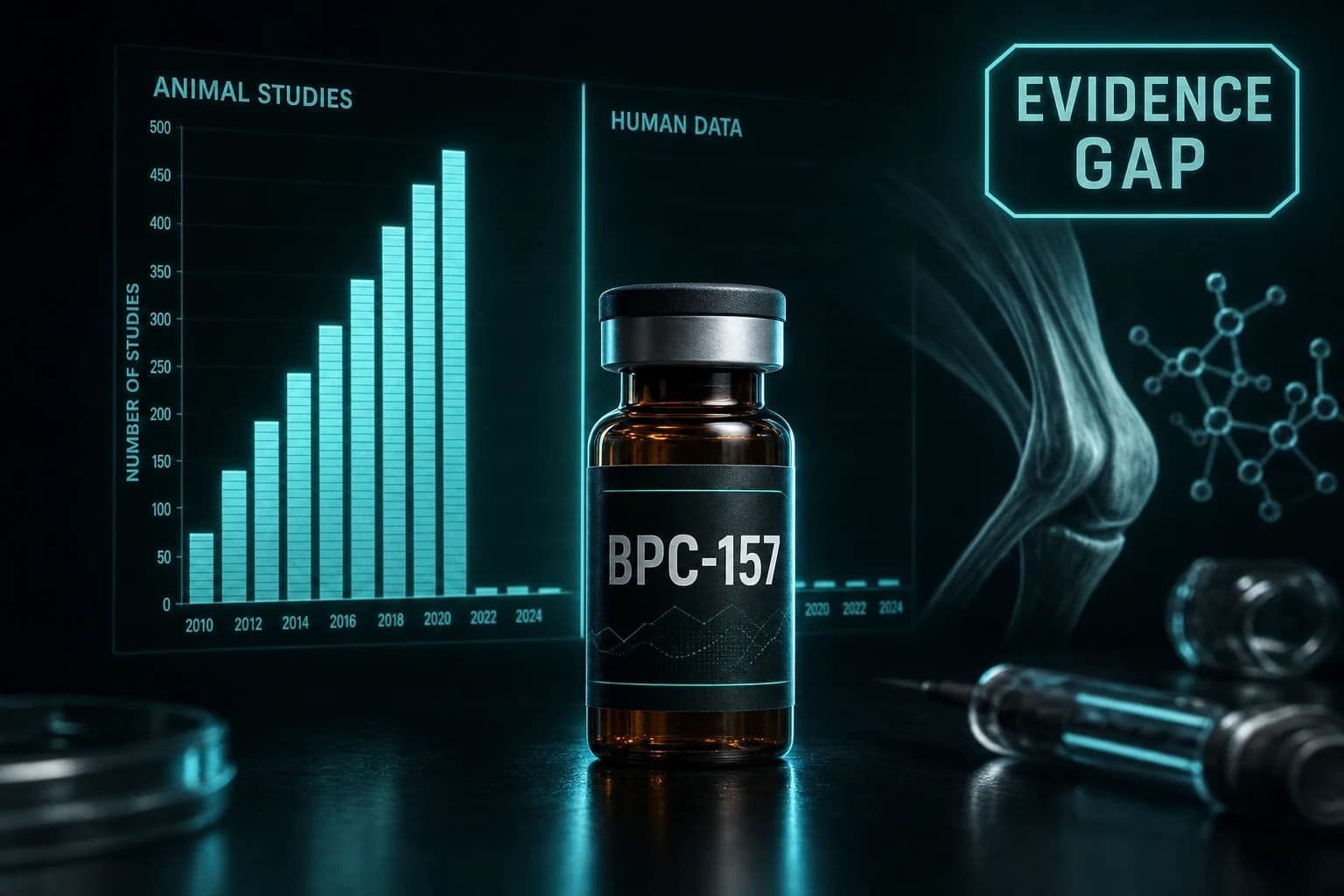
- 40+ animal studies, but no published human dose-finding trial exists
- The standard 250 mcg dose comes from peptide websites, not human trials
- Tendon and angiogenesis effects were replicated by independent groups outside Croatia
- Only 1 of 544 screened articles was clinical (Vasireddi et al. 2025, HSS J)
- Tumor-vascularization risk is theoretical, not demonstrated in humans
BPC-157 has more than 40 published studies behind it. Almost none are in humans. That gap is the whole story, and most peptide guides skip past it because the animal data looks so good that the missing human data feels like a technicality. It is not a technicality.
On the June 2026 Huberman Lab episode with Dr. Abud Bakri, Bakri made a point that rarely shows up on vendor pages: the popular "200 to 250 mcg" BPC-157 dose did not come from a human dose-finding trial. It came from peptide websites. He also noted that the bulk of the animal literature traces back to a single research group in Croatia. Both claims are correct, and neither one means BPC-157 does nothing. They mean the evidence is lopsided in a specific, knowable way.
This piece lays out exactly what the animal data establishes, what it does not, why the human trials never happened, and how to think about the angiogenesis question that makes some researchers cautious. No hype, no fear-mongering. Just where the evidence actually sits.
What BPC-157 actually is
BPC-157 is a synthetic peptide of 15 amino acids. The name stands for Body Protection Compound, and the sequence is a partial fragment of a protein found in human gastric juice. People call it the "stable gastric pentadecapeptide" because, unlike most peptides, it survives stomach acid. That stability is why oral dosing is even discussed for gut-related goals.
It does not bind one clean receptor. That is the core of how Bakri framed peptides on the podcast: some have a known receptor, which makes their effects predictable, and some are pleiotropic, which makes them less predictable. GLP-1 drugs sit in the first camp. BPC-157 sits firmly in the second. It nudges several pathways at once: vascular endothelial growth factor signaling, nitric oxide production, growth-hormone receptor expression on damaged tissue, and pathways that govern cell migration.
That breadth is the appeal and the problem. A compound that touches many systems can help many tissues. It can also produce effects nobody has mapped, because nobody has run the trials that would map them.
The strongest animal evidence, tissue by tissue
The animal work is genuinely substantial, and dismissing it would be as dishonest as overselling it. Here is what holds up.
Tendon healing is the most replicated result. In the foundational transection study, BPC 157 accelerated recovery of fully cut rat Achilles tendons across biomechanical, functional, and microscopic endpoints, and it stimulated tendon-cell growth in culture (Staresinic et al. (2003), J Orthop Res). The treated tendons regained load-to-failure and elasticity faster than saline controls.
The mechanism got filled in later. A separate group in Taiwan showed BPC 157 drives tendon fibroblast outgrowth, survival under oxidative stress, and migration, and that the migration effect runs through activation of the FAK-paxillin pathway in a dose-dependent way (Chang et al. (2011), J Appl Physiol). The same lab later found BPC 157 increases growth-hormone receptor expression on tendon fibroblasts at the mRNA and protein level, which would make damaged tissue more responsive to circulating growth hormone (Chang et al. (2014), Molecules). That second point matters for the concentration concern below, because Chang's group is not the Croatian group.
Gut healing is the second strong pillar, which fits the peptide's origin in gastric juice. In a short bowel syndrome model, rats given 10 mcg/kg or even 10 ng/kg, orally or by injection, gained weight above preoperative values and showed improved villus architecture and stronger intestinal anastomoses, while untreated rats deteriorated (Sever et al. (2009), Dig Dis Sci). The wide dose range that worked here, from micrograms down to nanograms per kilo, is part of why human dose-finding is genuinely unclear.
Angiogenesis ties the healing results together. BPC 157 modulates blood-vessel formation during repair by upregulating VEGF expression in injured muscle and tendon, and the effect tracks the healing process rather than appearing in resting cell cultures (Brcic et al. (2009), J Physiol Pharmacol). A later mechanistic study pinned the vascular effect on VEGFR2: BPC 157 raised VEGFR2 expression and activated the VEGFR2-Akt-eNOS cascade in human endothelial cells, accelerating blood-flow recovery in a rat hind-limb ischemia model (Hsieh et al. (2017), J Mol Med). Notably, that study used human endothelial cells in vitro, and the authors were not the Croatian group either.
| Tissue or endpoint | Animal evidence strength | Human evidence |
|---|---|---|
| Tendon healing | Strong, replicated across groups | None (no controlled human trial) |
| Gut and intestinal repair | Strong, plus the original human IBD program | Two small unpublished phase trials |
| Angiogenesis / VEGFR2 | Strong mechanistic and in vivo data | None directly measured in humans |
| Ligament, bone, muscle | Moderate, mostly one group | None |
| Nerve and brain injury | Early, mostly one group | None |
Note: The "10 mcg/kg in rats" figure is the most-cited animal dose, and allometric scaling from it lands somewhere around 100 to 450 mcg for a 70 kg adult depending on assumptions. That scaling math is real. What it is not is a human dose-finding study. We walk through the calculation in the BPC-157 dosing protocol guide.
The human-data reality
Here is the part vendor pages bury. There has never been a published human dose-finding trial for BPC-157.
The closest thing to human clinical work came from the Croatian pharmaceutical company Pliva, which developed BPC-157 under the code PL-14736 for inflammatory bowel disease. A phase 1 safety study in healthy male volunteers (Veljaca et al., 2003) and a phase 2 placebo-controlled study of a PL-14736 enema in mild-to-moderate ulcerative colitis (Ruenzi et al.) were both run. Neither full dataset was ever published in a peer-reviewed journal. We have conference abstracts and a stated safety signal, not a paper you can read and check.
That is the entire human record for the injectable, systemic, tissue-healing use that most people actually want it for: essentially nothing. The two reviews that catalog this are blunt about it. A 2019 review concluded BPC 157 shows consistent healing across soft-tissue models in animals but that "the efficacy of BPC 157 is yet to be confirmed in humans" (Gwyer et al. (2019), Cell Tissue Res). A 2025 systematic review in orthopaedic sports medicine screened 544 articles and found exactly one clinical study met inclusion criteria; the other 35 were preclinical animal models. That single clinical entry was a retrospective look at 12 patients given intra-articular BPC-157 for chronic knee pain, 7 of whom reported subjective improvement (Vasireddi et al. (2025), HSS J).
One retrospective dozen-patient series with subjective outcomes. That is the state of the human evidence in 2025.
Bottom line: The animal evidence for BPC-157 is real and, for tendon and gut, replicated by independent groups. The human evidence is two unpublished phase trials and a 12-person retrospective series. Anyone who tells you the human dose is "settled" is repeating a number from a website.
Where the 250 mcg number came from
So why does almost every protocol say 250 mcg? Bakri's answer on the podcast was direct: the figure propagated through peptide websites, not human trials. The honest version is slightly more nuanced and worth understanding.
The 250 mcg dose is a community convention back-calculated from the rat literature. Take the most-cited 10 mcg/kg rat dose, apply standard body-surface-area scaling to a human, and you get a range that brackets 250 mcg. Vendors and forums converged on the round number at the middle of that range, and it stuck. It is not arbitrary, and it is not validated either. No trial ever gave humans 250 mcg, measured an endpoint, and compared it to 125 or 500.
That distinction matters when you read dosing advice. The range has a rational basis in animal scaling. The specific number is convention. Both things are true, and conflating them is how "250 mcg, once daily" got treated like a clinically established dose when it is really a best guess that everyone copied.
The single-research-group concern
Bakri's second point: most of the BPC-157 literature comes from one group, led by Predrag Sikiric at the University of Zagreb. Independent tallies back this up, with the large majority of indexed BPC-157 records linked to that group, often using a single dose per experiment and rarely testing higher, repeated, or long-term exposure.
Why does that matter? Replication across independent labs is how science catches artifacts, bias, and effects that only appear under one group's exact conditions. When one team produces most of the data, even careful work carries more uncertainty, because the usual error-correction has not run.
The fair counterpoint, and the reason this is not a debunking: the most important results have been replicated outside Zagreb. The tendon-cell and growth-hormone-receptor mechanism work came from Chang's group in Taiwan. The VEGFR2 angiogenesis mechanism, tested in human endothelial cells, came from Hsieh's group. So the tendon and angiogenesis signals are not single-lab artifacts. The breadth of claims across nerve, brain, and organ systems, though, still leans heavily on one source, and that is where skepticism is warranted.
Tip: When you evaluate any BPC-157 claim, check whether the specific effect has been shown by more than one lab. Tendon healing and angiogenesis clear that bar. "Heals everything" does not.
The angiogenesis double-edge
The same mechanism that makes BPC-157 interesting for healing is the one that makes some people cautious about running it when nothing is injured.
BPC-157 promotes new blood-vessel growth through VEGFR2, as Hsieh's group demonstrated. New blood supply is exactly what a healing tendon or gut lining needs. The theoretical concern is that tumors also recruit blood vessels to grow, a process called tumor angiogenesis, and a compound that broadly encourages vascularization could in principle feed an undiagnosed tumor.
On the podcast, Huberman described his own practice of avoiding BPC-157 when he is not injured, citing this theoretical tumor-vascularization risk. That is a personal risk-management choice, not a documented harm. To be precise about the evidence: VEGFR2 upregulation by BPC-157 is real and measured. There is no human study showing BPC-157 promotes tumor growth. The concern is mechanistic and theoretical, which is a real reason for caution and not a reason for alarm.
Warning: The tumor-vascularization risk for BPC-157 is theoretical, not demonstrated. The mechanism (VEGFR2-driven angiogenesis) is documented; harm in humans is not. If you have a personal or family history of cancer, this theoretical risk is worth discussing with a physician before using an angiogenic compound for non-healing purposes.
Why people use it anyway
Knowing all of this, plenty of people still run BPC-157. The reasoning is not crazy, and pretending otherwise would fail the test of taking the reader seriously.
The animal safety profile is clean across a wide dose range, including the original human IBD safety signal. The tendon and gut results are consistent and independently replicated. The peptide has a very short plasma half-life yet effects that persist, which limits accumulation concerns. And for someone with a stubborn tendon or gut issue who has exhausted conventional options, the risk-to-evidence tradeoff can look acceptable even without a human trial.
That is a defensible bet, as long as it is made with eyes open. It is a bet on extrapolated animal data, not a clinically proven therapy. If you make it, the sourcing question becomes the dominant safety variable, because the gray market produces batch-to-batch quality that ranges from pharma-grade to garbage. We cover vendor vetting and certificate-of-analysis reading in where to buy BPC-157 with a verified COA, and if you are going to run it anyway, buying lot-tested material matters more than the brand name. The injectable is available from Ascension Peptides with 50% off using code ENHANCED, with per-batch COAs published on each lot.
For the practical mechanics once you have decided, the reconstitution calculator converts your vial size and target dose into exact units on the syringe, and the BPC-157 dosing protocol guide covers timing and cycle length. If you are comparing it to the other popular recovery peptide, the BPC-157 vs TB-500 breakdown is the head-to-head, and the Wolverine stack covers the combined protocol people run for soft-tissue repair.
The honest bottom line
BPC-157 is a pleiotropic peptide with strong, partly independently replicated animal evidence for tendon and gut healing, a documented angiogenesis mechanism, and essentially no published human dose-finding data. The "250 mcg" dose is a website convention scaled from rat studies, not a clinical standard. Most of the broader literature comes from one Croatian group, though the core tendon and vascular findings have been reproduced elsewhere. The angiogenesis that drives healing is also the source of a theoretical, unproven tumor concern that leads some researchers to avoid it when uninjured.
If that sounds like an honest "promising but unproven," that is the correct read. The compound earns its reputation in animals and has not earned it in humans yet, because the trials that would settle the question were never published.
Frequently Asked Questions
Is there any published human clinical trial on BPC-157?
Not a complete one. A phase 1 safety study and a phase 2 ulcerative-colitis study were run on the PL-14736 form by Pliva, but neither full dataset was published in a peer-reviewed journal. The only clinical entry in the 2025 systematic review was a retrospective 12-patient knee-pain series with subjective outcomes (Vasireddi et al. (2025)).
Where did the standard 250 mcg dose come from?
From peptide websites and forums, back-calculated from the most-cited 10 mcg/kg rat dose using body-surface-area scaling. The scaling math is legitimate and lands in a range around 250 mcg, but no human trial validated that specific number.
Why are there so many animal studies but no human ones?
Two reasons. BPC-157 is a known peptide sequence with no strong patent position, so there is little commercial incentive to fund expensive human trials. And its regulatory status as a non-approved compound keeps it out of the standard drug-development pipeline. The original IBD program at Pliva stalled before publishing full data.
Is the cancer risk from BPC-157 real?
It is theoretical, not demonstrated. BPC-157 promotes angiogenesis through VEGFR2 (Hsieh et al. (2017)), and tumors also use angiogenesis to grow, so the mechanistic concern is legitimate. No human study has shown BPC-157 causes or accelerates cancer. People with a cancer history often avoid angiogenic compounds when not actively healing as a precaution.
Does BPC-157 only work where you inject it?
No. Animal studies show systemic effects regardless of injection site, and oral dosing works for gut targets because the peptide survives stomach acid. Localized injection near an injury is common but not required for systemic healing signals in the animal data.
Disclaimer
This article is for research and informational purposes only and is not medical advice. BPC-157 is not approved by the FDA for human use. Nothing here is a recommendation to purchase or administer any compound. Consult a qualified physician before making any health decision.