At a glance
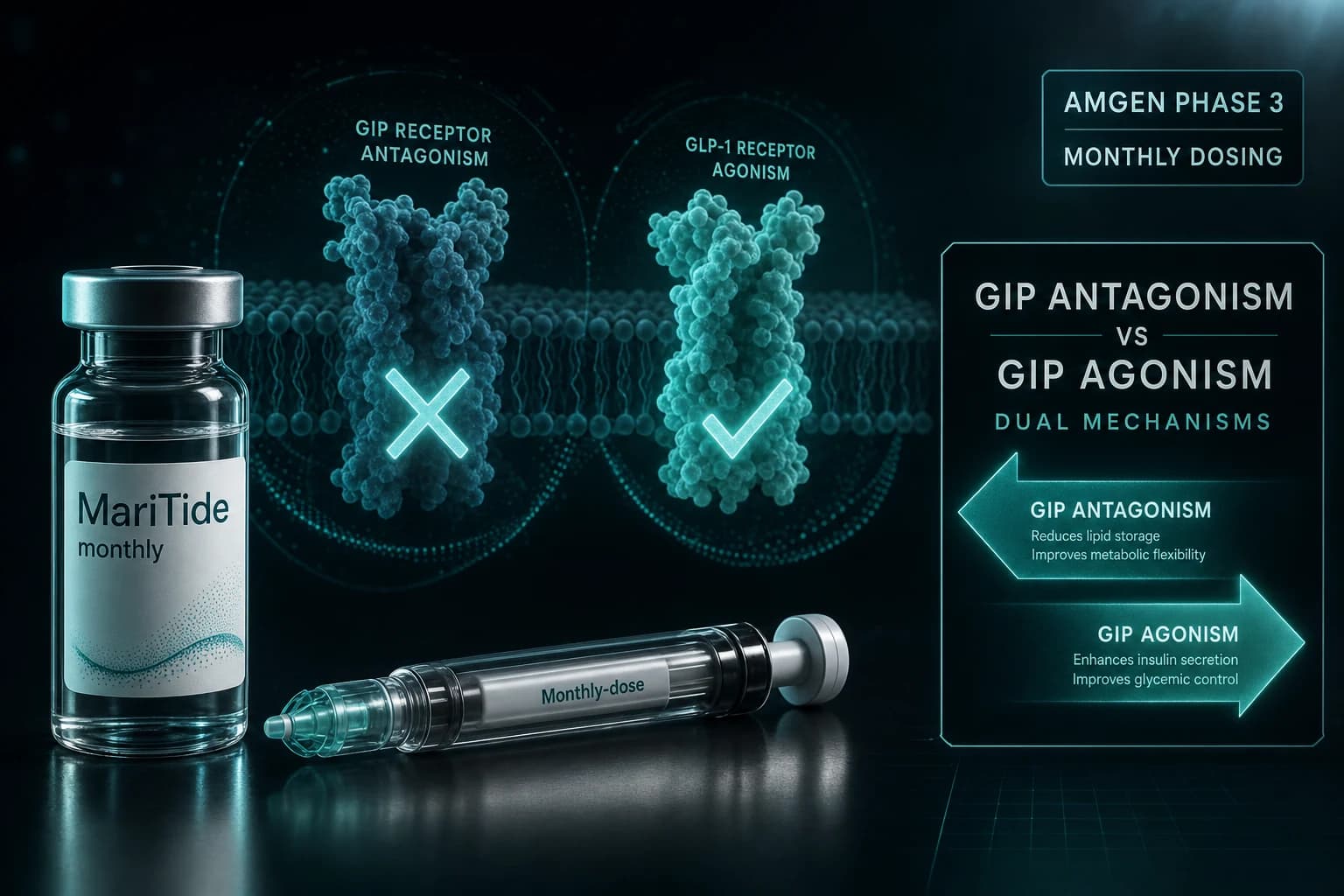
- MariTide (maridebart cafraglutide) is Amgen's GIP receptor antagonist combined with GLP-1 receptor agonist; once-monthly subcutaneous injection
- Phase 2 data showed approximately 20% mean weight loss at 52 weeks at the top dose, putting it close to tirzepatide's published efficacy
- The mechanism puzzle: blocking GIP produces weight-loss effects similar to activating GIP (as tirzepatide does); both approaches are pro-weight-loss
- Two competing mechanism theories: (1) chronic GIP antagonism resets adipocyte sensitivity, (2) GIP antagonism reduces fat storage signaling specifically
- Phase 3 program (MARITIME) started in 2026; monthly dosing is the practical differentiator that distinguishes MariTide from weekly GLP-1 competitors
MariTide is the obesity drug with the most paradoxical mechanism in the GLP-1 class. Amgen's compound combines GLP-1 receptor agonism (the conventional weight-loss mechanism) with GIP receptor antagonism. The puzzle: tirzepatide produces ~22% weight loss by activating GIP, and MariTide produces ~20% weight loss by blocking GIP. Both directions work. This is one of the most-discussed open questions in the obesity pipeline, and the resolution will reshape how the field understands GIP signaling.
This article covers the MariTide molecule and dosing, what the Phase 2 data showed, the two competing theories for why GIP antagonism produces weight loss, how MariTide compares to tirzepatide and the rest of the class, and what the Phase 3 MARITIME program is designed to answer.
What MariTide actually is
MariTide is the development name for maridebart cafraglutide, Amgen's investigational obesity therapy. Structurally, it is a single bispecific molecule that combines:
- A modified GLP-1 receptor agonist component
- A GIP receptor antagonist component (an anti-GIP-receptor antibody fragment)
The result is one injection that simultaneously activates GLP-1 signaling and blocks GIP signaling. The combination is unique in the obesity class.
| Property | MariTide value |
|---|---|
| Format | Bispecific molecule (GLP-1 agonist + anti-GIP antibody fragment) |
| Dosing | Once monthly subcutaneous |
| Half-life | Long (engineered for monthly dosing) |
| Receptor targets | GLP-1 R (agonist) + GIP R (antagonist) |
| Stage | Phase 3 (MARITIME program 2026) |
| Developer | Amgen |
The monthly dosing is the most practical operational distinction from competitors. Semaglutide (Wegovy/Ozempic) is weekly. Tirzepatide (Zepbound/Mounjaro) is weekly. Retatrutide (in Phase 3) is weekly. MariTide is once-monthly, which is mechanistically possible because the antibody fragment component gives the molecule a very long half-life.
For broader context on the GLP-1 dosing landscape, see the GLP-1 dosing comparison 2026.
Phase 2 results: about 20% weight loss
The Phase 2 trial of MariTide reported approximately 20% mean weight loss at the top dose over 52 weeks in adults with obesity. The detailed results have been previewed publicly through Amgen Q1/Q2 2024 disclosures and 2025 follow-up data.
The headline numbers:
| Parameter | Phase 2 trial |
|---|---|
| Duration | 52 weeks |
| Top-dose mean weight loss | ~20% |
| Placebo arm | ~3-4% |
| Dose schedule | Monthly subcutaneous |
| Tolerability | GI side effect profile consistent with GLP-1 class |
The 20% weight loss number puts MariTide:
- Below tirzepatide (22.5% at 72 weeks in SURMOUNT-1)
- Above semaglutide 2.4 mg (14.9% at 68 weeks in STEP 1)
- Roughly equivalent to semaglutide 7.2 mg / Wegovy HD (20.7% at 72 weeks in STEP UP)
- Below CagriSema (22.7% at 68 weeks in REDEFINE-1) and retatrutide (24.2% Phase 2 at 48 weeks)
The MariTide 52-week timeframe is somewhat shorter than the SURMOUNT-1 and STEP comparisons (72 weeks), which complicates direct head-to-head reading. Phase 3 will resolve duration questions.
For deeper context on each competitor, see the Wegovy HD 7.2 mg STEP UP trial guide, the CagriSema REDEFINE Phase 3 guide, and the retatrutide vs tirzepatide vs semaglutide head-to-head.
The GIP-paradox: why blocking GIP works
GIP (Glucose-Dependent Insulinotropic Polypeptide) is one of the two main incretin hormones, along with GLP-1. Native GIP is involved in postprandial insulin release, glucose homeostasis, and lipid metabolism in adipose tissue.
The puzzle:
- Tirzepatide activates GIP R (along with GLP-1 R) and produces 22.5% weight loss
- MariTide blocks GIP R (along with activating GLP-1 R) and produces ~20% weight loss
Both approaches produce substantial weight loss. The mechanism question is how opposite directions on the same receptor can both reduce body weight.
Theory 1: GIP antagonism resets adipocyte sensitivity. Chronic high GIP signaling in obesity may produce adipocyte resistance to lipolysis. Blocking GIP receptors chronically may restore lipolytic responsiveness. The mechanism is similar to how blocking ghrelin signaling (anti-ghrelin antibodies) reduces appetite chronically.
Theory 2: GIP antagonism reduces fat storage specifically. GIP receptor activation in adipose tissue drives fat storage signals. Blocking the receptor reduces this fat-storage drive, producing net weight loss through reduced storage rather than increased loss.
Theory 3 (combined): Acute GIP signaling supports glucose homeostasis (good), while chronic excessive GIP signaling drives obesity (bad). Tirzepatide may produce intermittent strong GIP signaling that resets the system, while MariTide chronically blocks the bad chronic signaling. Both intervene on the dysfunctional chronic GIP signaling but through different windows.
The published literature does not yet have a definitive answer. Phase 3 trials and longer follow-up data will help characterize the mechanism more precisely.
Bottom line: Both GIP agonism and GIP antagonism produce substantial weight loss. This is the most surprising finding in the obesity drug class in 2024-2026, and the mechanism resolution is still pending. For practical drug development, the result is that two opposite strategies both work, expanding the field rather than narrowing it.
How MariTide compares to the field
The 2026 obesity class lineup including MariTide:
| Compound | Mechanism | Top weight loss | Duration | Dosing | Stage |
|---|---|---|---|---|---|
| Retatrutide 12 mg | GIP + GLP-1 + glucagon agonist | -24.2% | 48 wk | Weekly | Phase 3 |
| CagriSema 2.4/2.4 mg | Amylin + GLP-1 | -22.7% | 68 wk | Weekly | Filed |
| Tirzepatide 15 mg | GIP + GLP-1 agonist | -22.5% | 72 wk | Weekly | Approved |
| Wegovy HD 7.2 mg | GLP-1 mono | -20.7% | 72 wk | Weekly | Approved |
| MariTide | GIP antagonist + GLP-1 agonist | ~-20% | 52 wk | Monthly | Phase 3 |
| Mazdutide 9 mg | GLP-1 + glucagon | ~-15% | 48 wk | Weekly | Phase 3 |
| Survodutide 4.8 mg | GCG + GLP-1 | -16.6% | 46 wk | Weekly | Phase 3 |
MariTide's positioning:
- Not the highest efficacy. Retatrutide and CagriSema lead the published numbers.
- Monthly dosing is the differentiator. No other Phase 3 obesity therapy is monthly. For patients who tolerate injections but prefer less-frequent dosing, MariTide is unique.
- Unique mechanism. GIP antagonism + GLP-1 agonism is not replicated by any other compound in development.
If approved and the monthly dosing convenience holds in clinical practice, MariTide carves a distinctive market segment rather than competing head-to-head on efficacy with tirzepatide or retatrutide.
For coverage of the GLP-1 amylin pathway alternatives, see the GLP-1 amylin combination pipeline 2026 and the MariTide Phase 2 evidence article for the trial-specific deep dive.
Phase 3 MARITIME program
Amgen launched the Phase 3 MARITIME program for MariTide in 2026. The program covers:
- MARITIME-1: Obesity adults without type 2 diabetes
- MARITIME-2: Obesity adults with type 2 diabetes
- Additional MARITIME arms for specific patient populations
The trial design typically follows the SURMOUNT and STEP precedent: 72 weeks, primary endpoint of body weight change vs placebo, secondary endpoints including HbA1c (for T2D arm), cardiometabolic markers, and quality-of-life measures.
Approval timeline depends on Phase 3 outcomes. If results align with Phase 2, MariTide approval likely targets 2028-2029 in the US, similar to recent GLP-1 development timelines.
What clinicians and patients should know
For 2026 clinical practice, MariTide is not yet available. The compound is in Phase 3, with approval expected late-decade. The relevance for current decision-making:
For patients on weekly GLP-1s: Monthly MariTide will be a future option to consider when it reaches market. The 52-week 20% weight loss number is competitive with current Wegovy HD (which delivers similar magnitude at weekly dosing).
For patients struggling with weekly injection adherence: Monthly dosing is the practical differentiator. Patients who have considered discontinuing weekly therapy due to injection burden may find monthly dosing meaningfully better.
For physicians considering pipeline: MariTide is one of several Phase 3 obesity therapies advancing through 2026-2029. The class is expanding rapidly. For long-term treatment planning, awareness of the pipeline matters.
For broader context on the dosing landscape and pipeline, see the GLP-1 dosing comparison 2026 and the Wegovy HD 7.2 mg STEP UP trial guide.
Research-grade implications
MariTide is not a research-grade compound and is not available through peptide vendors. The bispecific molecule structure requires manufacturing infrastructure not accessible to typical research-peptide synthesis. Researchers interested in the GIP antagonism mechanism specifically would need to work through Amgen-affiliated trials or related programs.
For research-grade compounds in the broader GLP-1 / GIP / glucagon pathway, see the retatrutide where-to-buy guide and the GLP-1 dosing comparison 2026.
FAQ
What is MariTide?
MariTide (maridebart cafraglutide) is Amgen's investigational obesity therapy. It is a bispecific molecule combining a GLP-1 receptor agonist with a GIP receptor antagonist (anti-GIP antibody fragment). It is dosed once monthly subcutaneously and is currently in Phase 3 (MARITIME program).
How does MariTide work?
MariTide simultaneously activates GLP-1 signaling (which suppresses appetite and slows gastric emptying, the conventional GLP-1 weight-loss mechanism) and blocks GIP signaling. The GIP antagonism component is the unique part: most other obesity drugs that engage GIP do so as agonists (like tirzepatide).
Why does blocking GIP produce weight loss if activating GIP also does?
This is the central mechanism puzzle in the 2024-2026 obesity drug pipeline. Both GIP agonism (tirzepatide) and GIP antagonism (MariTide) produce substantial weight loss. The leading theories involve chronic GIP signaling driving adipose tissue dysfunction in obesity, with both intervention directions resetting the system through different mechanisms. The Phase 3 MARITIME program will help characterize this further.
How much weight loss does MariTide produce?
The Phase 2 trial reported approximately 20% mean weight loss at 52 weeks at the top dose. This is below retatrutide (24.2%), CagriSema (22.7%), and tirzepatide (22.5%), but matches Wegovy HD (20.7%) at similar timeframes.
Is MariTide approved?
No. MariTide is in Phase 3 development (MARITIME program). Approval is expected late-decade (2028-2029 in the US) if Phase 3 outcomes align with Phase 2.
Why monthly dosing instead of weekly?
The bispecific molecule's antibody fragment component (which provides the GIP antagonism) has an inherently long half-life that supports monthly dosing. Amgen engineered the molecule for monthly dosing as a practical differentiator from weekly GLP-1 competitors.
Will MariTide replace tirzepatide?
Unlikely to replace it directly. Tirzepatide's 22.5% top weight loss with weekly dosing is unlikely to be surpassed by MariTide's 20% with monthly dosing. The likely market positioning is parallel rather than replacement: tirzepatide for patients prioritizing maximum efficacy, MariTide for patients prioritizing monthly dosing convenience.
Further reading
- MariTide Phase 2 evidence
- GLP-1 dosing comparison 2026
- Wegovy HD 7.2 mg STEP UP trial guide
- CagriSema REDEFINE Phase 3 guide
- GLP-1 amylin combination pipeline 2026
- Tirzepatide vs Semaglutide 2026 head-to-head
- Retatrutide vs Tirzepatide vs Semaglutide
- Orforglipron Phase 3 evidence
This article is for educational and research purposes only. MariTide (maridebart cafraglutide) is in Phase 3 clinical development and is not approved by the FDA or any other major health authority as of May 2026. None of the content above constitutes medical advice. Consult a qualified clinician for individual medical questions about weight management therapy.