At a glance
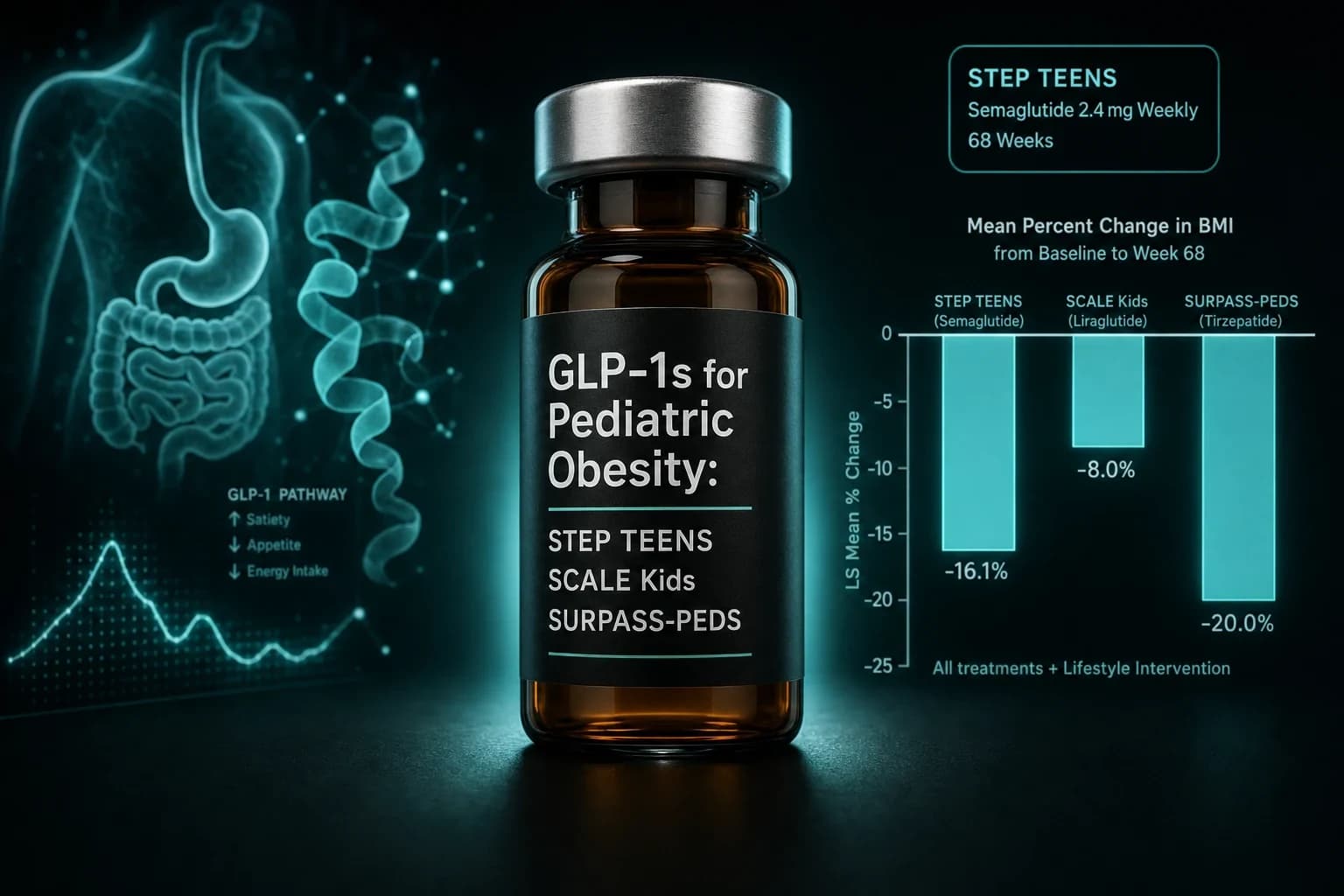
- STEP TEENS (NEJM 2022): semaglutide 2.4 mg cut BMI 16.1% vs +0.6% on placebo at 68 weeks
- SCALE Teens (NEJM 2020): liraglutide 3.0 mg reduced BMI SDS by 0.22 vs placebo at 56 weeks
- SCALE Kids (NEJM 2024): liraglutide 3.0 mg cut BMI 5.8% in 6 to 11 year olds vs +1.6% placebo
- SURPASS-PEDS (Lancet 2025): tirzepatide cut HbA1c roughly 2.2% in youth-onset T2D age 10 to 17
- Wegovy approved for ages 12+ in 2022; Saxenda for 12+ in 2020; SCALE Kids label expansion to ages 6-11 pending
Four trials, three drugs, and the pediatric obesity question
A decade ago, the answer to "what works for severe pediatric obesity besides surgery?" was effectively nothing the literature could defend. By June 2026, four randomized Phase 3 trials anchor the conversation: STEP TEENS for semaglutide in adolescents (Weghuber et al., NEJM 2022, PMID 36947475), SCALE Teens for liraglutide in adolescents (Kelly et al., NEJM 2020, PMID 32233338), SCALE Kids for liraglutide in 6 to 11 year olds (Fox et al., NEJM 2024, PMID 39258838), and SURPASS-PEDS for tirzepatide in youth-onset type 2 diabetes (SURPASS-PEDS Investigators, Lancet 2025, PMID 40975112). Each one took the adult playbook into a younger population. Each one produced effect sizes that look closer to bariatric surgery than to lifestyle counseling.
That changes the policy conversation, but it does not settle it. Pediatric GLP-1 use is the most contested corner of the obesity-medicine debate right now, with serious questions about growth, puberty, mental health, off-label drift to younger children, and the long-run consequences of starting a drug at age 12 that probably has to be continued for life. This article walks the four trials honestly: what they measured, what they showed, what they did not show, and what an informed reader, clinician, or parent should take away.
Bottom line: Semaglutide in teens (STEP TEENS), liraglutide in teens (SCALE Teens), and liraglutide in younger children (SCALE Kids) all produced statistically significant, clinically meaningful BMI reductions over roughly a year. SURPASS-PEDS extended the class into pediatric type 2 diabetes with tirzepatide. None of these trials answered the multi-year safety or durability questions that matter most for kids.
How we got here: the AAP guideline and the 2022 FDA approvals
The pediatric GLP-1 era is recent enough to date by month. In December 2022, the FDA approved once-weekly semaglutide 2.4 mg (Wegovy) for adolescents 12 years and older with obesity, based on STEP TEENS. The week before, the New England Journal of Medicine published the STEP TEENS results. A month later, in January 2023, the American Academy of Pediatrics published its first clinical practice guideline for pediatric obesity (Hampl et al., Pediatrics 2023, PMID 36622115), formally recommending that clinicians offer pharmacotherapy to patients 12 years and older when intensive lifestyle therapy has been insufficient.
The guideline broke with the longer "watchful waiting" tradition in U.S. pediatrics. It told clinicians to combine intensive health behavior and lifestyle treatment with adjunctive pharmacotherapy in patients age 12+ at BMI at or above the 95th percentile, and to consider referral to metabolic and bariatric surgery in adolescents with severe obesity. GLP-1 receptor agonists are the most prescribed drug class in that adjunctive bucket.
The downstream prescribing data tells the story. A U.S. CDC analysis of adolescent obesity-medication dispensing showed that GLP-1 receptor agonist prescriptions to teens grew roughly five- to six-fold from 2020 to 2023, and semaglutide jumped from a small minority share of obesity prescriptions to more than a quarter of new starts after the AAP guideline. Pediatric GLP-1 prescribing is no longer rare or experimental in U.S. practice. It is increasingly the standard adjunct to lifestyle therapy in adolescents who qualify.
STEP TEENS: semaglutide 2.4 mg in adolescents 12 to under 18
STEP TEENS was a double-blind, randomized, placebo-controlled trial that enrolled 201 adolescents (12 to under 18) with obesity, or overweight with at least one weight-related comorbidity. Participants were randomized 2:1 to once-weekly subcutaneous semaglutide 2.4 mg or placebo, on top of lifestyle intervention, for 68 weeks (Weghuber et al., NEJM 2022, PMID 36947475).
The headline result is the one that drove FDA approval and reshaped the AAP recommendation. From baseline to week 68, mean BMI change was -16.1% with semaglutide and +0.6% with placebo, a treatment difference of about 17 percentage points. Mean body weight change was -15.3 kg with semaglutide versus +2.4 kg with placebo. The proportion of participants reaching 5% or greater weight loss was 73% on semaglutide versus 18% on placebo. The proportion reaching 20% or greater weight loss was 37% on semaglutide versus 3% on placebo.
Cardiometabolic markers moved in parallel: waist circumference, HbA1c, total cholesterol, LDL, triglycerides, and ALT all improved more on semaglutide. Insulin sensitivity improved meaningfully, which a follow-up Diabetes Care analysis explored in more detail.
Safety in STEP TEENS tracked the adult Phase 3 STEP profile. Gastrointestinal adverse events were the dominant signal: nausea, vomiting, diarrhea, constipation. Most were mild to moderate and concentrated during dose escalation. Serious adverse events were uncommon and not concentrated on semaglutide. Cholelithiasis was reported in a small number of semaglutide-treated participants. No new safety signals unique to adolescents emerged in the trial, but 68 weeks is a short window for a drug that, if prescribed for chronic disease, will likely be continued for years.
Note: STEP TEENS did not measure final adult height, bone mineral density at skeletal maturity, or pubertal hormone trajectories with the resolution needed to rule out a small effect. Adult Phase 3 trials are not designed to detect those endpoints, and the pediatric extensions inherit the gap.
SCALE Teens: liraglutide 3.0 mg in adolescents 12 to under 18
SCALE Teens predated STEP TEENS and was the trial that brought the first GLP-1 receptor agonist into the adolescent obesity indication (Kelly et al., NEJM 2020, PMID 32233338). It enrolled 251 pubertal adolescents 12 to under 18 with obesity who had a poor response to lifestyle therapy alone, then randomized them 1:1 to once-daily subcutaneous liraglutide 3.0 mg (or maximum tolerated dose) or placebo, plus lifestyle therapy, for 56 weeks.
The primary endpoint was change in BMI standard deviation score (BMI SDS), which is the appropriate pediatric metric because raw BMI naturally drifts with age and growth in this population. The mean change in BMI SDS at week 56 was -0.22 with liraglutide and -0.00 with placebo, an estimated treatment difference of -0.22 (95% CI roughly -0.37 to -0.08). Mean percentage BMI change was -4.64 percentage points greater with liraglutide than with placebo. The proportion of participants achieving a BMI reduction of at least 5% was 43.3% on liraglutide versus 18.7% on placebo.
A few details matter for interpretation. First, the effect size on BMI SDS, while statistically significant, is roughly a quarter of what STEP TEENS reported on absolute BMI change with semaglutide. That mirrors the adult STEP 8 head-to-head in which semaglutide outperformed liraglutide for body weight reduction. Second, in the 26-week off-treatment follow-up period after liraglutide was stopped, BMI SDS drifted back up, foreshadowing the weight regain pattern that adult trials would later document more rigorously. Third, gastrointestinal adverse events were common (65% on liraglutide versus 37% on placebo) and consistent with the adult Saxenda profile.
The FDA approved Saxenda (liraglutide 3.0 mg) for chronic weight management in adolescents 12 and older in December 2020, based primarily on SCALE Teens.
SCALE Kids: liraglutide in children 6 to under 12
SCALE Kids is the youngest-population GLP-1 obesity trial published to date and the one that has generated the most ethical and methodological debate (Fox et al., NEJM 2024, PMID 39258838). The Phase 3a multicenter trial enrolled 82 children 6 to under 12 with obesity and randomized them 2:1 to once-daily subcutaneous liraglutide 3.0 mg (or maximum tolerated dose) or placebo, plus lifestyle interventions, for 56 weeks of treatment followed by a 26-week off-treatment follow-up.
The primary endpoint at week 56 was percent change in BMI. Mean BMI change was -5.8% with liraglutide and +1.6% with placebo, an estimated treatment difference of -7.4 percentage points (95% CI -11.6 to -3.2; P < 0.001). The proportion of children with a BMI reduction of at least 5% was 46.2% on liraglutide versus 8.7% on placebo. Body weight change was -1.6% with liraglutide versus +10.0% with placebo, reflecting the fact that healthy children should be gaining weight as they grow taller.
The week 82 off-treatment data are the more clinically interesting part. In the 26 weeks after liraglutide was stopped, BMI drifted back toward the placebo trajectory. The implication, consistent with adult data on every GLP-1 trial that has run a withdrawal arm, is that stopping the drug returns body weight to roughly the trajectory it would have followed without treatment, on a timeline of months rather than years.
Safety in SCALE Kids did not produce major surprises versus adult Saxenda data. Gastrointestinal adverse events were higher with liraglutide (80.4% vs 53.8% placebo), driven by nausea, vomiting, and diarrhea. Serious adverse events were uncommon. The trial reported no adverse effects on growth velocity or pubertal development over the trial window, but 56 weeks of treatment plus 26 weeks of follow-up is not the time horizon that meaningful growth or puberty signals would necessarily emerge over.
As of June 2026, the FDA has not granted a pediatric label expansion of Saxenda to children 6 to under 12. The SCALE Kids data are the regulatory submission that would support that expansion, but no approval has been issued. Liraglutide is approved for children 12 and older only.
Warning: Off-label use of Saxenda or compounded liraglutide in children younger than 12 is not supported by an FDA approval. SCALE Kids is a single Phase 3a trial with 82 participants, which is informative but small, and which has not yet translated into a regulatory action.
SURPASS-PEDS: tirzepatide in pediatric type 2 diabetes
SURPASS-PEDS is the first Phase 3 GLP-1/GIP dual-agonist trial in pediatrics (SURPASS-PEDS Investigators, Lancet 2025, PMID 40975112). It enrolled 99 participants 10 to under 18 with youth-onset type 2 diabetes inadequately controlled on metformin, basal insulin, or both, and randomized them to tirzepatide 5 mg, tirzepatide 10 mg, or placebo for 30 weeks, followed by a 22-week open-label extension in which all participants received tirzepatide.
The primary endpoint was HbA1c change at week 30. Tirzepatide reduced HbA1c by roughly 2.2 percentage points compared with placebo. BMI declined meaningfully in tirzepatide-treated participants and increased in the placebo arm. The proportion of participants reaching HbA1c below 7.0% was substantially higher with tirzepatide. No severe hypoglycemia was reported in tirzepatide-treated participants. Discontinuation rates due to adverse events were low.
SURPASS-PEDS extends a tirzepatide pediatric story that previously had to be inferred from adult SURPASS and SURMOUNT trials. It is not an obesity trial. The obesity-focused tirzepatide pediatric trial, SURMOUNT-ADOLESCENTS (NCT06075667), is active but not yet recruiting as of June 2026 and has not reported results. Tirzepatide is not FDA-approved for pediatric obesity. The current pediatric tirzepatide story is youth-onset T2D, and SURPASS-PEDS is the trial that supports a regulatory submission there.
The clinically useful read is that GLP-1/GIP dual-agonist pharmacology produces in adolescents the same scale of glycemic and weight effects it produces in adults, with no novel safety signal in the trial window. The pediatric-specific gaps (height, puberty, mental health, long-term cardiovascular outcomes) are unanswered here too.
Cross-trial comparison
The four trials are not directly comparable. They differ in drug, age range, primary endpoint, comparator, and duration. The table below puts the key endpoints on one canvas with that caveat in mind.
| Trial | Drug, dose | Age | N | Duration | Primary endpoint | Result vs placebo |
|---|---|---|---|---|---|---|
| STEP TEENS | Semaglutide 2.4 mg/wk SC | 12 to <18 | 201 | 68 wks | BMI %change | -16.1% vs +0.6% (diff ~ -16.7 pp) |
| SCALE Teens | Liraglutide 3.0 mg/day SC | 12 to <18 | 251 | 56 wks | BMI SDS change | -0.22 vs -0.00 (diff -0.22) |
| SCALE Kids | Liraglutide 3.0 mg/day SC | 6 to <12 | 82 | 56 wks | BMI %change | -5.8% vs +1.6% (diff -7.4 pp) |
| SURPASS-PEDS | Tirzepatide 5/10 mg/wk SC | 10 to <18 (T2D) | 99 | 30 wks + 22 OLE | HbA1c change | ~-2.2 pp HbA1c on tirzepatide |
A few patterns worth naming. Semaglutide produced the largest BMI effect in adolescents. Liraglutide is the only drug with published RCT data in children under 12 with obesity. Tirzepatide is the only GLP-1/GIP dual agonist tested in pediatrics, and the indication tested is T2D, not obesity. Sample sizes shrink as age decreases, which matters when reasoning about safety. None of these trials are powered to detect rare adverse events.
What none of these trials answered
Four trials in roughly 600 participants over a maximum follow-up of 68 weeks is the entire evidence base for chronic pediatric GLP-1 pharmacotherapy as of June 2026. The structural limits are real.
Long-term safety remains undefined past two years of continuous exposure in any pediatric population. STEP TEENS, SCALE Teens, SCALE Kids, and SURPASS-PEDS together cover roughly one year of treatment plus short off-drug follow-up. Adult Phase 3 trials of semaglutide and tirzepatide have extended that window to 3 to 5 years for some endpoints, but the adult experience does not translate directly into a population that is still growing and going through puberty.
Final adult height has not been adequately measured in any of these trials. SCALE Kids reported no impact on growth velocity over the trial window. STEP TEENS, SCALE Teens, and SURPASS-PEDS did not address skeletal maturity. None of the trials followed participants to final adult height, which is the endpoint that would resolve the concern.
Pubertal trajectory is partially addressed but not definitively. The trials tracked pubertal staging and did not report adverse signals, but the window is short and the populations are heterogeneous. A small effect on the timing or completion of puberty would not necessarily emerge in a 68-week trial.
Mental health signals are an open question. The U.S. FDA has reviewed pharmacovigilance data on GLP-1 receptor agonists and adolescent suicidal ideation and self-harm, and to date has not concluded that the class causes those outcomes. The trial-level data in pediatrics is too thin to settle the question. Our GLP-1 mental health evidence review covers the adult signal in more depth.
Weight regain after discontinuation looks like it works the same in kids as in adults. SCALE Kids showed BMI drift back toward placebo in the 26-week off-drug window. STEP TEENS did not report a long off-drug extension. Our stopping GLP-1s review walks through the adult withdrawal trials and how they apply to maintenance decisions.
Comparative effectiveness is not established. No published Phase 3 trial has compared semaglutide directly with tirzepatide in adolescents, or compared liraglutide head-to-head against semaglutide in children. Inference across trials, given the differences in age, baseline BMI, and trial duration, is not the same as a head-to-head RCT.
Equity and access concerns are real. The 2023 AAP guideline recommends pharmacotherapy at age 12 and older for adolescents at BMI 95th percentile or above, but private insurance coverage of pediatric GLP-1s is uneven and Medicaid coverage varies state by state. The downstream prescribing rise has happened mostly in commercially insured populations.
Practical questions parents and clinicians actually ask
The following framework summarizes how the trial-level data tracks against the questions families bring to a pediatric weight-management visit.
Is my child eligible? The AAP guideline and current FDA labeling converge on age 12+ with BMI at or above the 95th percentile, in conjunction with intensive health behavior and lifestyle therapy. For semaglutide 2.4 mg (Wegovy), the FDA label specifically references this population. For liraglutide 3.0 mg (Saxenda), the label is similar. SURPASS-PEDS supports tirzepatide for pediatric T2D 10+, not pediatric obesity.
How long does my child have to stay on the drug? The adult literature is unambiguous: weight loss from GLP-1 receptor agonists requires ongoing treatment. The pediatric off-treatment data in SCALE Kids points in the same direction. Treating pediatric obesity with a GLP-1 should be discussed as a chronic decision, not a 56-week cycle. The clinician conversation is closer to chronic disease management than to a course of antibiotics.
Will this affect my child's growth or puberty? No trial-level signal has emerged in the published data, but no trial has followed participants to final adult height. The honest answer is that the existing data is not designed to detect a small effect.
What about mental health? No causal link between GLP-1 receptor agonists and adolescent suicidal ideation has been established by FDA review or by the published pediatric trials. Trial-level adverse event reporting in STEP TEENS, SCALE Teens, and SCALE Kids did not flag a class signal, but those trials are not powered for rare psychiatric events.
Is compounded semaglutide a reasonable option for my teenager? No. Compounded GLP-1 products for adults exist in a complex regulatory setting that our compounded tirzepatide guide covers in depth. None of that infrastructure was built or quality-controlled for pediatric dosing. The Phase 3 evidence anchoring the pediatric indication is for branded Wegovy and branded Saxenda, not for compounded analogs.
A note on research-use peptides and pediatric questions
Research-grade peptide vendors operate in an adult, research-use market. The injectable GLP-1 products available through Ascension Peptides (50% off with code ENHANCED) and the oral analogs through Limitless Biotech (code ENHANCED) are labeled for adult research applications, not for use in minors. Nothing in the STEP TEENS, SCALE Teens, SCALE Kids, or SURPASS-PEDS evidence base supports translating adult research-grade dosing into a pediatric setting outside a clinical trial or a licensed clinician's care. Pediatric obesity pharmacotherapy is a prescription pathway in the United States, and the evidence base above is the evidence base for the prescription pathway.
Frequently asked questions
Is Wegovy approved for teenagers?
Yes. The U.S. FDA approved once-weekly semaglutide 2.4 mg (Wegovy) for chronic weight management in patients 12 years and older with obesity (BMI at or above the 95th percentile for age and sex) in December 2022. The approval was based on the STEP TEENS Phase 3 trial.
Is Saxenda approved for children?
Saxenda (liraglutide 3.0 mg) is approved for adolescents 12 years and older with obesity. It is not currently approved for children 6 to under 12, despite the positive SCALE Kids results published in NEJM in 2024. A label expansion submission is the expected next step.
Is tirzepatide (Zepbound, Mounjaro) approved for adolescents?
Not for obesity as of June 2026. The SURMOUNT-ADOLESCENTS trial is testing tirzepatide for adolescent obesity but has not reported results. SURPASS-PEDS supported the case for tirzepatide in pediatric type 2 diabetes, not pediatric obesity, and the regulatory pathway for that indication is separate.
How much weight loss can adolescents expect on semaglutide 2.4 mg?
In STEP TEENS, adolescents on semaglutide 2.4 mg saw a mean BMI reduction of 16.1% over 68 weeks, versus a 0.6% increase on placebo. About 73% achieved 5% or greater weight loss; about 37% achieved 20% or greater. Individual results vary; trial averages are not personalized expectations.
What happens if a teenager stops taking the medication?
The adult literature consistently shows that body weight drifts back up after GLP-1 discontinuation. The SCALE Kids off-treatment data shows the same pattern in younger children. Stopping the drug means weight is likely to return to roughly the trajectory it would have followed without treatment. For more, see our GLP-1 discontinuation review.
Are GLP-1s safe for growing children?
The published trials did not detect adverse effects on growth velocity or pubertal staging over 56 to 68 weeks. They were not designed to detect long-term effects on final adult height or skeletal maturity, and the pediatric exposure window remains short relative to the likely duration of chronic therapy. The honest summary is "no signal in trial data, no trial powered to rule out a small effect."
How does pediatric GLP-1 prescribing fit alongside lifestyle therapy?
The 2023 AAP Clinical Practice Guideline frames pharmacotherapy as an adjunct to intensive health behavior and lifestyle treatment, not a replacement. All four Phase 3 trials in this review were designed that way: drug or placebo, plus lifestyle intervention. The combined approach is what was tested and what was approved.
Where does this fit with adult GLP-1 evidence?
Pediatric GLP-1 evidence is a small but meaningful subset of a much larger adult literature. Our GLP-1 dosing comparison, tirzepatide vs semaglutide head-to-head review, and GLP-1 muscle loss evidence cover the adult context that informs pediatric extrapolation.
This article is for educational and research purposes only and is not medical advice. Pediatric obesity pharmacotherapy is a clinical decision that depends on a child's medical history, growth trajectory, comorbidities, and family context. Semaglutide (Wegovy), liraglutide (Saxenda), and tirzepatide (Zepbound, Mounjaro) are prescription pharmaceuticals regulated by the FDA, with pediatric indications limited to specific age ranges and conditions. Off-label use in younger children or with compounded products is outside the trial evidence reviewed here. Consult a qualified pediatric clinician before making any treatment decision.