At a glance
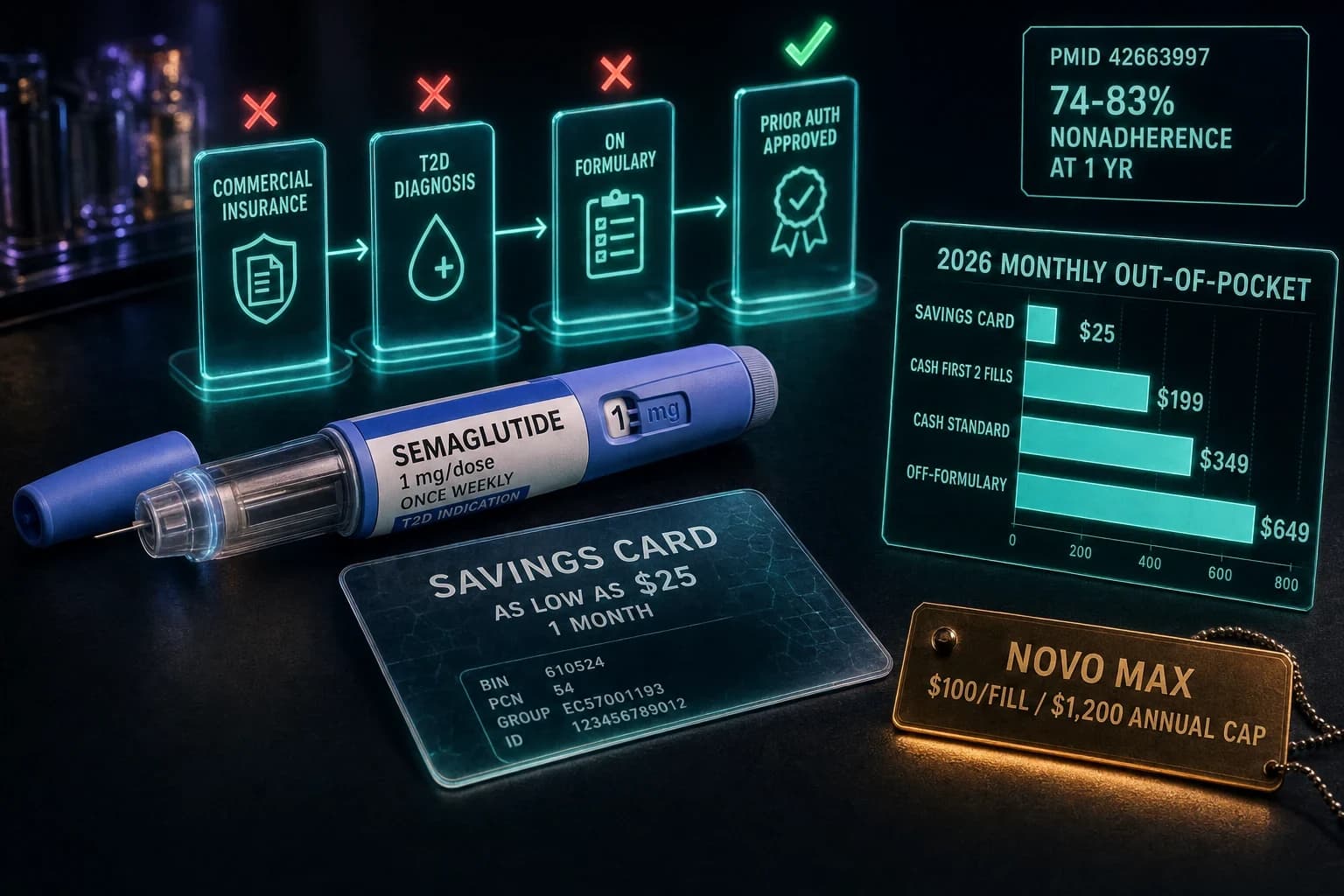
- Ozempic Savings Card caps at $100 per fill, so the $25 quote assumes your plan pays the rest.
- Eligibility gates: commercial insurance, T2D diagnosis, Ozempic on formulary, prior authorization approved.
- Medicare, Medicaid, TRICARE, and VA disqualify you regardless of income or willingness to pay cash.
- NovoCare Self-Pay runs $199 for the first two fills, then $349 monthly through December 2026.
- Cost was cited in 14.4% of real-world GLP-1 discontinuations; a lane you can sustain beats a $25 lane you drop.
"How do I get Ozempic for $25 a month" is a specific search, and the number itself is real. Novo Nordisk advertises it. Pharmacy techs quote it. What the ad copy skips is the four-step eligibility screen behind it and the $100 monthly benefit cap that decides whether $25 turns into $199 or $649 at the counter.
This is a plain read of the 2026 Ozempic Savings Offer, who actually clears every gate, and what the fallback lanes look like when one of the gates closes.
What the $25 quote actually pays for
The Ozempic Savings Card is a manufacturer copay-assistance program from Novo Nordisk. It applies against the branded semaglutide 0.25 mg, 0.5 mg, 1 mg, and 2 mg pens sold under the Ozempic label, which is FDA-approved only for type 2 diabetes and, since 2020, cardiovascular risk reduction in adults with T2D and established cardiovascular disease.
In 2026 the exact program terms are:
| Field | 2026 value |
|---|---|
| Advertised patient pay | as low as $25 per one-month supply |
| Maximum Novo pays per one-month fill | $100 |
| Maximum Novo pays per 60-day fill | $200 |
| Maximum Novo pays per 90-day fill | $300 |
| Annual manufacturer cap | $1,200 per calendar year |
| Activation window | up to 48 months from enrollment |
The math is straightforward. Novo picks up the first $100 of your plan's copay each month. If your plan's after-adjudication copay is $125, you owe $25. If it is $200, you owe $100. If your plan denies Ozempic entirely, Novo pays nothing and the card never touches your bill.
That $25 headline is what a patient pays when their commercial plan has already covered most of the drug's cost. It is not a discount you can apply to a $997 cash sticker to land at $25. The card is a coupon that layers on top of insurance coverage, not a stand-alone price.
The four eligibility gates most people fail
Any one of these four checks can zero out the card. Miss one gate and the $25 number does not exist for you.
1. Commercial or private insurance. Anyone enrolled in Medicare (any part), Medicaid, TRICARE, VA benefits, DoD coverage, or any other federal or state-funded plan is ineligible. The rule holds even if you offer to opt out of insurance and pay cash: Medicare beneficiaries specifically cannot use manufacturer copay cards under federal Anti-Kickback Statute interpretations. Anyone on a government plan lands on the Medicare GLP-1 bridge or the Patient Assistance Program lane instead, not the $25 card.
2. Type 2 diabetes diagnosis on file. Ozempic's FDA label covers T2D plus the CV-risk-reduction indication for adults with T2D and established CVD. Off-label prescribing for weight loss alone, without a T2D diagnosis, fails prior authorization at almost every commercial plan, and the savings card follows the plan's decision. The molecule is the same as Wegovy, but the label the prescription is written under is not.
3. Ozempic on the plan's formulary. Most commercial plans list Ozempic at Tier 2 or Tier 3, which typically produces a $30 to $80 copay before the card layers on. Plans that exclude Ozempic in favor of a preferred GLP-1 (Trulicity, Mounjaro, or Wegovy on some plans) send the card to a $0 payout because there is no covered claim to attach to. A commercially insured patient whose plan carves Ozempic out entirely and prefers Trulicity will not see $25 no matter how correctly they fill out the card enrollment.
4. Prior authorization approved. Roughly 80% of Medicare Part D plans and a growing share of commercial plans required prior authorization for GLP-1s by late 2024, up from below 15% a year earlier (Changes in Semaglutide Fills Following Expanded FDA and Medicare Policies, PMID 42640207). PA typically demands a documented T2D diagnosis, a hemoglobin A1c that meets the plan's threshold (often 7.0% or higher), and a failed trial of metformin. A well-run prescriber office handles PA in five to fifteen business days; a slower office adds a month.
Activating and using the card, step by step
If all four gates clear, activation is quick:
- Text BEGIN to 21848, or visit ozempic.com and click "Savings & Support."
- Enter your prescriber's information, your date of birth, and confirmation of commercial insurance.
- Novo issues a digital card plus a Bin, PCN, and Group number.
- Show the digital card at pickup so the pharmacy's billing system runs your plan first, then the card as a secondary payer.
Activation is instant. What is not instant is your plan's prior authorization: a new T2D patient starting Ozempic typically waits five to fifteen business days for the initial approval, then reauthorizes every twelve months. Missing a reauthorization silently flips the pharmacy claim to "not covered" and the card to $0, which is where the surprise $649 tickets come from at pickup.
When the $25 quote turns into $199 or $649
The most common surprise: you activated the card, ran a January fill at $25, then refilled in February and got hit for $200. Two mechanisms explain it.
- Plan copay changed tier. If your plan moves Ozempic from Tier 2 to Tier 3 mid-year, or if the deductible resets in January and the plan bills the full negotiated rate for the first fill of the year, the copay before the card can jump from $125 to $250 or more. Novo still pays its $100 cap. You pay the remainder.
- Plan dropped Ozempic entirely. Formulary changes are annual, and 2026 saw multiple large PBM formularies favor tirzepatide products over semaglutide for T2D. Once Ozempic is off-formulary the claim adjudicates at rejection, the card has no covered claim to attach to, and you pay the plan's out-of-formulary rate (frequently $549 to $649) or the pharmacy's cash price.
The $1,200 annual manufacturer cap sets the outer limit on how much Novo will pay across twelve monthly fills. In practice a commercially insured T2D patient who clears all four gates every month contributes their $25 twelve times ($300 total) and Novo contributes $100 each fill up to that $1,200 ceiling. Anyone whose monthly copay before the card exceeds $125 will exhaust the annual cap before December, and the last one to three fills of the year revert to full plan copay.
Ranked fallbacks when the card does not work
The order below reflects what actually costs less on 2026 pricing, not what any single telehealth ad promises.
Fallback 1: Wegovy switch, if you qualify. Wegovy is the same molecule (semaglutide) at a higher weekly ceiling dose (2.4 mg vs. Ozempic's 2.0 mg cap), FDA-approved for chronic weight management in adults with BMI ≥ 30, or ≥ 27 plus a weight-related comorbidity, and since 2024 for cardiovascular risk reduction in adults with obesity plus established CVD. Some commercial plans that decline Ozempic for weight loss will cover Wegovy under the cardiovascular indication after the SELECT trial data (Lincoff et al. 2023, PMID 37952131) showed a 20% relative reduction in major adverse cardiovascular events in patients with obesity and prior CVD. The Wegovy Savings Card runs on similar $0 to $225 copay mechanics. Our Ozempic vs Wegovy comparison walks the FDA-label difference in detail.
Fallback 2: NovoCare Self-Pay through Novo Nordisk directly. For patients without commercial coverage, Novo runs a self-pay lane at $199 per month for the first two fills of any strength (offer valid through December 31, 2026), then $349 per month for the 0.25 mg, 0.5 mg, or 1 mg pen and $499 per month for the 2 mg pen. This is a branded Ozempic pen filled through NovoCare Pharmacy at flat cash pricing, not a copay-card assist. It is honest branded access, and it is nowhere near $25, but it is a real fill of a real pen with the manufacturer's warranty of authenticity attached. The step-by-step per-mg math against generic and compounded options lives in our cheapest semaglutide breakdown and the broader GLP-1 cheapest lanes hub.
Fallback 3: Compounded semaglutide through a US-licensed telehealth clinician. The FDA declared the semaglutide shortage resolved on February 21, 2025, and the enforcement discretion period for 503A pharmacies ended shortly after. On April 30, 2026 the FDA proposed removing semaglutide from the 503B outsourcing-facility bulks list. A 503A pharmacy may still compound semaglutide for an individual patient when the prescriber documents a clinically significant difference from the commercial pen, and FDA has stated it will not pursue a pharmacy filling four or fewer prescriptions of a compounded formulation per calendar month.
The legitimate pricing that survives after those changes is not the $49 microdose that dominates search ads. Clinician-supervised programs cluster in the $139 to $329 per month range depending on dose tier and plan length. Bodybuilding Health+ publishes compounded semaglutide from $139/mo on the annual plan, is US-licensed and LegitScript-verified, and is the primary telehealth CTA we route to on the GLP-1 side. Yucca Health sits in the same tier at $206/mo on the 6-month plan. Both send prescriptions through 503A pharmacies operating within their state licenses, which is the pathway that survives the post-shortage rules. The compounded semaglutide online lane walks provider-by-provider pricing.
Fallback 4: Oral semaglutide (Rybelsus). Novo's oral semaglutide tablet, FDA-approved in 2019 for T2D. Same molecule, different delivery. Rybelsus copay-card mechanics are close to Ozempic's, and formulary coverage tends to be similar. Rybelsus is not equivalent for weight loss: oral bioavailability is under 1% versus the injectable's roughly 89%, so its weight-loss data land closer to placebo than to STEP-1's 14.9% mean body-weight reduction at 68 weeks (Wilding et al. 2021, PMID 33567185). For a T2D patient who genuinely cannot inject and whose plan will cover the oral, it is a reasonable move. Our Rybelsus vs Ozempic breakdown is the deeper read.
Fallback 5: Patient Assistance Program. Novo's PAP provides free Ozempic for uninsured patients whose household income falls below 400% of the federal poverty level. Enrollment is annual, application-based, and takes four to six weeks. It is the actual $0 lane, but only for people who fit both the uninsured and income criteria and who have a prescribing physician willing to fax the enrollment packet. Anyone on Medicaid is routed to Medicaid coverage rules, not the PAP.
Whether $25 a month is the right target
Cost is the single largest determinant of whether patients stay on GLP-1 therapy long enough to see benefit. A JAMA Health Forum cohort study of commercially insured adults initiating semaglutide for obesity found nonadherence rates of 73.9% to 83.4% at one year, with a threshold pattern: adherence dropped sharply in the highest cost-share quintiles (Out-of-Pocket Costs and Adherence to Semaglutide for Obesity, PMID 42663997).
Real-world discontinuation studies point the same direction. A 2026 analysis of 1,374 GLP-1 initiators found 31.7% discontinued within the follow-up window, and the top three reasons were adverse drug reactions (26.8%), cost concerns (14.4%), and non-adherence (11.2%) (Van Laren et al. 2026, PMID 41713959). Patients who quit at three months capture almost none of the STEP-1 weight curve or the SUSTAIN-6 cardiovascular curve (Marso et al. 2016, PMID 27633186): both separate from placebo after month six, not month two. The cardiovascular benefit accrues over years, not fills.
Bottom line: The $25 Ozempic price is real for commercially insured T2D patients whose plans cover Ozempic and clear prior authorization; the card fills a $100 monthly gap and no more. Everyone outside that box lands on NovoCare's $199 to $349 self-pay lane, a Wegovy switch under the SELECT cardiovascular indication, a legitimate 503A compounded semaglutide program at $139 to $329 monthly, or Novo's income-based Patient Assistance Program.
The point is not to chase the $25 quote at the expense of the drug itself. It is to pick the lane you can afford to run for a year, take the shot every week on schedule (the standard semaglutide dosing chart covers titration timing), and refill on time. A steady $199 self-pay lane you actually stick with produces more weight loss and more cardiovascular benefit than a $25 lane you drop after two months because the paperwork burned you out.
Disclaimer
This article summarizes public 2026 program terms, published clinical trial data, and current FDA guidance for research and educational purposes only. It is not medical advice, prescribing guidance, or a substitute for consultation with a licensed healthcare provider. Manufacturer program terms, formulary status, and coverage rules change without notice; verify eligibility and pricing directly with Novo Nordisk, your health plan, and your prescriber before enrolling.