At a glance
- SOUL randomized 9,650 T2D adults with ASCVD or CKD to once-daily oral semaglutide 14 mg or placebo, mean follow-up 47.5 months
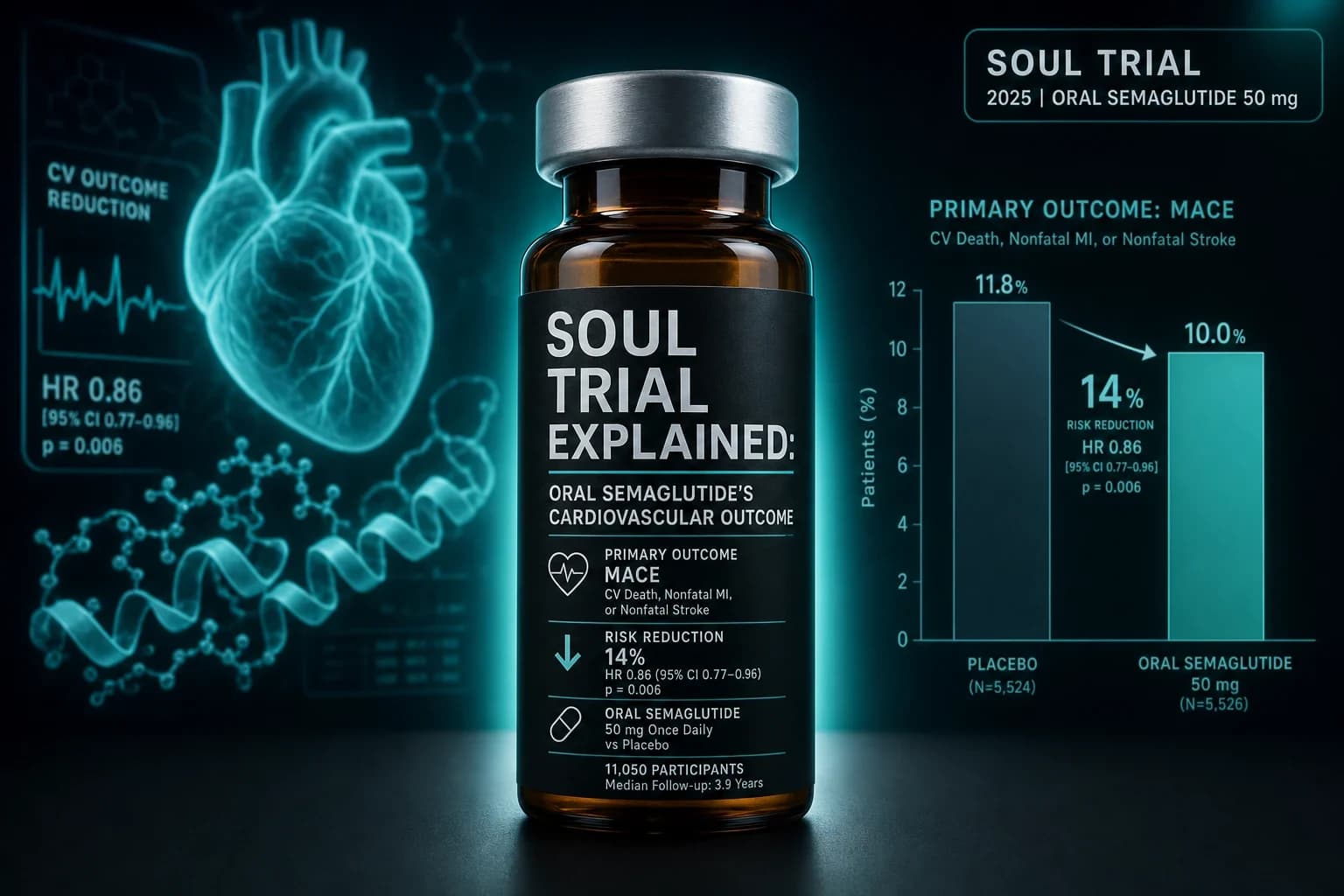
- Primary 3-point MACE: 12.0% vs 13.8%, hazard ratio 0.86 (95% CI 0.77 to 0.96), p=0.006
- Nonfatal MI drove the result: 26% relative reduction; nonfatal stroke 12%; CV death 7%
- Composite kidney secondary outcome did not reach statistical significance
- Discontinuation for adverse events: 15.5% on oral semaglutide vs 11.6% on placebo
For most of the GLP-1 cardiovascular story, the headline trials have used a needle. SUSTAIN-6 (Marso et al., NEJM 2016, PMID 27633186), SELECT (Lincoff et al., NEJM 2023, PMID 37952131), and the FLOW kidney program all enrolled patients on subcutaneous semaglutide. The oral version, Rybelsus, sat in a different lane: approved for glycemic control in 2019, with a smaller cardiovascular safety trial behind it, but no superiority result to anchor an MACE indication.
SOUL closed that gap. McGuire and colleagues randomized 9,650 adults with type 2 diabetes and either atherosclerotic cardiovascular disease, chronic kidney disease, or both, to once-daily oral semaglutide titrated to 14 mg or matching placebo, on top of standard care (McGuire et al., NEJM 2025, PMID 40162642). Over a mean follow-up of 47.5 months, the trial hit its primary endpoint with a 14 percent relative reduction in three-point MACE, and the FDA expanded the Rybelsus label to include cardiovascular risk reduction on October 17, 2025.
This piece walks through what SOUL actually measured, what drove the result, where it fell short, how it lines up with PIONEER 6 and SELECT, and what changes for someone choosing between an oral and an injectable GLP-1 in 2026. For broader context, see the SELECT cardiovascular outcomes breakdown, the tirzepatide SURPASS-CVOT review, and the oral semaglutide vs orforglipron comparison.
Bottom line: Oral semaglutide 14 mg cut three-point MACE by 14 percent versus placebo in high-risk type 2 diabetes (HR 0.86, 95% CI 0.77 to 0.96, p=0.006). Nonfatal MI drove the result. The kidney composite did not reach significance, the GI discontinuation rate ran higher than placebo, and the benefit in people already on an SGLT2 inhibitor was not statistically significant.
What SOUL actually tested
It was a phase 3b, multicenter, double-blind, placebo-controlled superiority trial run at 444 sites across 33 countries. Patients had to be 50 or older, have type 2 diabetes with HbA1c 6.5 to 10.0 percent, and carry established atherosclerotic cardiovascular disease, chronic kidney disease, or both. Both conditions counted as long as the entry criteria were met; this was not an obesity trial like SELECT and not a primary-prevention trial.
Randomization assigned 4,825 patients to oral semaglutide and 4,825 to matching placebo, both on top of standard cardiovascular and glycemic care. The semaglutide arm titrated through 3 mg and 7 mg to a target of 14 mg once daily, taken on an empty stomach with up to 120 mL of water per the standard Rybelsus instructions. Background therapy was not constrained, which is why the SGLT2 inhibitor subgroup ends up mattering later.
Primary endpoint was time to first three-point MACE: cardiovascular death, nonfatal myocardial infarction, or nonfatal stroke. Confirmatory secondary endpoints included a five-point composite kidney outcome (CV death, death from renal disease, persistent 50 percent or greater eGFR decline, persistent eGFR under 15 mL/min/1.73m², or chronic renal replacement therapy) and a limb-ischemia composite. The trial was event-driven, designed to accumulate enough MACE events to test superiority rather than just non-inferiority.
| Trial element | SOUL specification |
|---|---|
| Population | T2D, age ≥50, HbA1c 6.5-10.0%, established ASCVD and/or CKD |
| N randomized | 9,650 (4,825 sema / 4,825 placebo) |
| Intervention | Oral semaglutide titrated to 14 mg daily |
| Comparator | Matching placebo on top of standard care |
| Sites | 444 sites, 33 countries |
| Follow-up | Mean 47.5 ± 10.9 months, median 49.5 months |
| Primary endpoint | 3-point MACE: CV death, nonfatal MI, nonfatal stroke |
| Powered for | Superiority |
Note two design choices before reading the results: this is a high-risk T2D population, not obesity without diabetes (that was SELECT), and the comparator is placebo on standard care rather than another active glucose-lowering drug.
The primary outcome, in plain numbers
Over the trial, a primary MACE event was reported in 579 of 4,825 patients on oral semaglutide (12.0 percent) versus 668 of 4,825 on placebo (13.8 percent). The hazard ratio was 0.86 with a 95 percent confidence interval of 0.77 to 0.96, p=0.006 (McGuire et al., NEJM 2025, PMID 40162642).
In absolute terms, a 14 percent relative reduction translates to roughly 1.8 percentage points over 4 years, or about one MACE event prevented for every 55 to 60 patients treated for that duration. Whether that looks impressive depends on the comparator you have in mind. It is smaller than SUSTAIN-6's 26 percent relative reduction on subcutaneous semaglutide (Marso et al., NEJM 2016, PMID 27633186) but on a larger denominator with longer follow-up, and it sits in roughly the same range as SELECT's 20 percent reduction in obesity without diabetes (Lincoff et al., NEJM 2023, PMID 37952131).
Clinical significance flips once you walk into a cardiology clinic and try to choose between an oral and an injectable GLP-1 in a patient on six other medications. The result is not "oral semaglutide matches injectable head-to-head" because SOUL did not test that comparison. It is "oral semaglutide produces an MACE benefit versus placebo in T2D + ASCVD/CKD, of a size that fits inside the broader GLP-1 class effect."
What drove the result
Any three-point MACE composite is only as informative as its components. SOUL's reduction was not evenly distributed.
| MACE component | Relative reduction |
|---|---|
| Nonfatal myocardial infarction | ~26% |
| Nonfatal stroke | ~12% |
| Cardiovascular death | ~7% |
Nonfatal MI is the dominant signal. The stroke and CV death components moved in the same direction but did not individually reach statistical significance in this trial. That pattern is consistent with the broader GLP-1 cardiovascular literature, where the strongest and most reproducible signal across SUSTAIN-6, LEADER, REWIND, and SELECT has been on atherothrombotic events rather than all-cause cardiovascular mortality at the trial-population level.
In plain reading, SOUL's MACE benefit is straightforwardly: SOUL's MACE benefit is mostly an MI-prevention story, layered onto a population that already has either documented ASCVD or significant CKD. It is not a mortality trial in the way SUSTAIN-6 came close to being, and it is not designed to settle the stroke question on its own.
Note: The MACE result is driven by nonfatal MI. Reading SOUL as a generic "cardiovascular protection" trial risks overstating the stroke and CV-death signals, which moved in the right direction but did not reach component-level significance.
Where the trial fell short
Several pieces of SOUL did not deliver clean wins, and they are the parts skimmed past in most coverage.
First is the kidney composite. SOUL prespecified a five-point composite kidney outcome that combined CV death, death from renal disease, persistent 50 percent eGFR decline, persistent eGFR under 15, and initiation of chronic renal replacement therapy. The secondary confirmatory analysis on this composite was not statistically significant, which closed the hierarchical testing chain and left all further secondary outcomes as exploratory rather than confirmatory. A separate Diabetes Care publication of the full kidney-outcome analyses (Tuttle et al., Diabetes Care 2026, PMID 41380027) explores the kidney subcomponents in more detail; the headline is that SOUL did not deliver a SOUL-equivalent of FLOW. For the dedicated kidney result on subcutaneous semaglutide, see the FLOW Phase 3 CKD evidence breakdown.
Beyond the kidney miss sits the SGLT2 inhibitor subgroup question. A prespecified analysis published in Circulation looked at outcomes in patients who were already on an SGLT2i at baseline versus those who were not (Sattar et al., Circulation 2025, PMID 40156843). Among baseline SGLT2i users, 143 of 1,296 in the semaglutide arm and 158 of 1,300 in the placebo arm had a primary event, yielding a hazard ratio of 0.89 (95% CI 0.71 to 1.11). Among non-users, the corresponding numbers were 436 of 3,529 versus 510 of 3,525 for a hazard ratio of 0.84 (95% CI 0.74 to 0.95). The interaction was not reported as statistically significant in the formal subgroup test, but the patient-level absolute numbers tell their own story: the CI on the SGLT2i-baseline subgroup crosses 1.0.
That does not mean stacking a GLP-1 on an SGLT2i is pointless; the trial was not powered to declare interaction. It does mean the cleanest cardiovascular signal in SOUL is in patients who were not yet on an SGLT2i, and clinicians who already have a patient stable on empagliflozin or dapagliflozin should not assume adding oral semaglutide will deliver a guaranteed incremental MACE benefit of the size advertised in the overall trial.
Safety, GI side effects, and discontinuation
Serious-adverse-event rates in SOUL were lower in the semaglutide arm than in placebo, which is consistent with the rest of the class. The "high-risk T2D population" had more underlying events than the drug added.
GI tolerability followed the predictable class pattern. Nausea, constipation, and diarrhea were the dominant tolerability complaints. The trial-reported gastrointestinal disorders that met serious-AE threshold ran at 5.0 percent in oral semaglutide versus 4.4 percent in placebo, a modest absolute gap. The clinically relevant number is discontinuation: 15.5 percent of patients on oral semaglutide stopped the drug for adverse events, versus 11.6 percent on placebo, a 3.9-percentage-point excess that almost entirely tracks to GI intolerance.
Warning: A 15.5 percent AE discontinuation rate over 4 years is real-world relevant. The MACE benefit accrues in patients who stay on therapy; titration tolerance is a meaningful contributor to whether any individual patient ever realizes the trial-level effect.
Gallbladder events, pancreatitis, and the other class-level safety signals tracked their expected directions but are best read against dedicated reviews. For depth on those, see the GLP-1 gallbladder risk evidence breakdown and the GLP-1 pancreatitis evidence review.
Heart failure outcomes from a secondary analysis published in JAMA Internal Medicine (Verma et al., JAMA Intern Med 2026, PMID 41627802) explored hospitalization for heart failure and related composites; the heart-failure benefit pattern in SOUL is best read alongside SUMMIT and STEP-HFpEF rather than as a stand-alone result, given the trial's exclusion criteria. See the tirzepatide HFpEF SUMMIT review for the dedicated HFpEF data.
SOUL versus PIONEER 6, SELECT, and SUSTAIN-6
Reading SOUL in isolation overstates the novelty. The trial sits inside a four-trial semaglutide cardiovascular story that is worth seeing at once.
| Trial | Drug + route | Population | N | Follow-up | Result |
|---|---|---|---|---|---|
| SUSTAIN-6 (Marso 2016, PMID 27633186) | Subcut semaglutide 0.5/1.0 mg | T2D + high CV risk | 3,297 | 2.1 y | 3pt MACE -26% (HR 0.74) |
| PIONEER 6 (Husain 2019, PMID 31185157) | Oral semaglutide 14 mg | T2D + high CV risk | 3,183 | 1.3 y | 3pt MACE -21%, non-inferior; all-cause mortality HR 0.51 |
| SELECT (Lincoff 2023, PMID 37952131) | Subcut semaglutide 2.4 mg | Obesity + CVD, no T2D | 17,604 | 3.3 y | 3pt MACE -20% (HR 0.80) |
| SOUL (McGuire 2025, PMID 40162642) | Oral semaglutide 14 mg | T2D + ASCVD/CKD | 9,650 | 4.0 y | 3pt MACE -14% (HR 0.86) |
Three patterns are worth flagging.
First, the oral and subcutaneous results sit in the same family. Subcutaneous formulations have produced larger point estimates, but SOUL's confidence interval overlaps SUSTAIN-6 and SELECT meaningfully. The bioavailability gap that makes the oral pill require a 14 mg dose to roughly approximate a 0.5 to 1.0 mg subcutaneous dose has not erased the underlying cardiovascular signal.
Second pattern: PIONEER 6 was the predecessor that hinted at the answer SOUL confirmed. It was non-inferiority-powered with about a third of SOUL's enrollment and a quarter of its follow-up. Its primary-endpoint point estimate (HR 0.79) was directionally identical to SOUL; the failure to declare superiority was a power problem, not a signal problem.
Third, the populations matter. SOUL is high-risk T2D. SELECT is obesity with established CVD but without diabetes. These are separate evidence bases for separate clinical questions, and the FDA labeled them as such: Rybelsus now carries a cardiovascular indication in T2D, while Wegovy carries one in obesity with CVD without diabetes. For practical dose comparisons across this class, see the GLP-1 dosing comparison 2026.
What this changes in practice
SOUL did three things at once for the clinical conversation.
One, it gave Rybelsus a cardiovascular indication. On October 17, 2025, the FDA expanded the oral semaglutide 7 mg and 14 mg label to include reduction of MACE in adults with T2D and established cardiovascular disease, making oral semaglutide the first oral GLP-1 receptor agonist with an MACE indication. Patients who could not or would not inject now have an oral pathway to a guidelines-tier cardiovascular benefit in T2D.
Two, it complicated the SGLT2i conversation in a useful way. The honest reading is that the strongest SOUL signal sits in patients not already on an SGLT2i, and the smaller, non-significant point estimate in those already on one means clinicians should not assume the benefit stacks linearly with empagliflozin or dapagliflozin background therapy. The combination is biologically reasonable and worth pursuing for many patients; SOUL does not promise a clean incremental MACE result on top of an SGLT2i.
Three, it set a comparator for the oral GLP-1 pipeline. Orforglipron, danuglipron, and the next wave of oral GLP-1 agonists will be measured against SOUL's HR of 0.86 for MACE in T2D, not against PIONEER 6's non-inferiority result. For where orforglipron sits today, see the orforglipron Phase 3 evidence review and the oral semaglutide vs orforglipron comparison.
Limits and open questions
As a large, well-powered T2D cardiovascular trial, SOUL is not a universal "GLP-1 prevents heart attacks" study.
Enrollment was high-risk T2D with either documented ASCVD or CKD. Patients with HbA1c outside 6.5 to 10 percent, those under 50, those without qualifying cardiometabolic disease, and those with severe heart failure at baseline are not represented. Extrapolating SOUL's HR 0.86 to a 45-year-old patient with newly diagnosed T2D and no vascular disease is an extrapolation, not a SOUL finding.
Second, the composite kidney outcome did not hit statistical significance, which closed the formal hierarchical testing and left the kidney subcomponents descriptive. Pre-existing FLOW data on subcutaneous semaglutide remains the cleaner kidney signal in this class.
Third, the SGLT2i subgroup interaction is not formally interaction-significant, but the absolute numbers leave a real possibility that the MACE benefit attenuates on top of an SGLT2i. Whether that reflects mechanistic overlap or simply lower baseline event rates in patients well-managed enough to be on an SGLT2i will not be resolved without dedicated comparative trials.
Finally, the population was largely T2D in the diabetes range. The next obvious question is whether oral semaglutide produces a SOUL-shaped result in T2D without established vascular disease, or in pre-diabetic populations at high cardiometabolic risk. That trial has not been done and would meaningfully change the indication conversation if it ever is.
Where this leaves a careful clinician
Boiled down, SOUL confirmed what PIONEER 6 hinted at: oral semaglutide, in a population that already qualifies for guideline-tier glycemic and cardiometabolic therapy, modestly reduces MACE versus placebo, with the benefit concentrated in nonfatal MI and attenuated in patients already on an SGLT2i. The kidney composite did not deliver and the GI discontinuation pattern is the realistic limit on real-world translation.
For research-grade injectable formulations, semaglutide and the broader GLP-1 family are available from Ascension Peptides with 50% off using code ENHANCED, and oral GLP-1 formulations sit at Limitless Biotech with code ENHANCED. The clinical Rybelsus product behind SOUL is a prescription pharmaceutical and not interchangeable with research-use products; if cardiovascular risk reduction is the goal, that is a prescription decision with a clinician, not a research-vendor decision. For the broader GLP-1 cardiovascular literature, see the SELECT cardiovascular review and the SURPASS-CVOT tirzepatide review. For dosing math and reconstitution, the reconstitution calculator handles the unit-conversion side once a vial is in hand.
Frequently Asked Questions
How big was SOUL's cardiovascular benefit in absolute terms?
Relative 14 percent MACE reduction translates to an absolute risk reduction of roughly 1.8 percentage points over 4 years (12.0 percent vs 13.8 percent). That maps to about one MACE event prevented per 55 to 60 patients treated for four years in this high-risk population. Patients outside the SOUL entry criteria (no established vascular disease, no CKD, younger age, lower HbA1c) do not have a comparable absolute estimate from this trial.
Does SOUL show oral semaglutide is equivalent to injectable Ozempic or Wegovy?
No. SOUL did not compare oral semaglutide to injectable semaglutide. It compared oral semaglutide 14 mg to placebo. Cross-trial point estimates suggest the subcutaneous formulations have produced larger relative reductions (SUSTAIN-6 26 percent, SELECT 20 percent), but the confidence intervals overlap with SOUL's 14 percent, so the trials are best read as members of the same evidence family rather than as head-to-head comparisons.
Why is the benefit smaller in patients already on an SGLT2 inhibitor?
A prespecified Circulation subgroup analysis reported HR 0.89 (95% CI 0.71 to 1.11) in SGLT2i baseline users versus HR 0.84 (95% CI 0.74 to 0.95) in non-users (Sattar et al., Circulation 2025, PMID 40156843). The interaction was not formally significant, but the CI in the SGLT2i subgroup crosses 1.0. SOUL was not designed or powered to declare an interaction. Mechanistic overlap, lower baseline event rates in better-controlled patients, and statistical power all plausibly contribute. The honest read is that the additive cardiovascular benefit on top of an SGLT2i is not established by SOUL.
Did SOUL show a kidney benefit?
No. The five-point composite kidney outcome was a confirmatory secondary endpoint and did not reach statistical significance, which closed the hierarchical testing chain. A separate Diabetes Care analysis (Tuttle et al., Diabetes Care 2026, PMID 41380027) explored the kidney subcomponents in more detail. For the cleaner semaglutide kidney result, the dedicated trial is FLOW on subcutaneous semaglutide 1.0 mg; see our FLOW evidence breakdown.
Is Rybelsus 14 mg now FDA-approved for cardiovascular risk reduction?
Yes. On October 17, 2025, the FDA expanded the Rybelsus 7 mg and 14 mg label to include reduction of major adverse cardiovascular events in adults with type 2 diabetes and established cardiovascular disease, based on the SOUL data. Oral semaglutide is the first oral GLP-1 receptor agonist with that indication.
How does SOUL fit with PIONEER 6?
PIONEER 6 was the predecessor cardiovascular safety trial of oral semaglutide, with 3,183 patients followed for a median of 16 months and powered for non-inferiority (Husain et al., NEJM 2019, PMID 31185157). Its primary-endpoint point estimate was HR 0.79, directionally identical to SOUL, but it lacked the power to declare superiority. SOUL was designed specifically to deliver the superiority result that PIONEER 6 was not built for.
This article is for educational and research purposes only and is not medical advice. Cardiovascular risk decisions in type 2 diabetes are clinical decisions that depend on the patient's full history, current medications, and laboratory values. Oral semaglutide (Rybelsus) is a prescription pharmaceutical regulated by the FDA, and the SOUL cardiovascular indication applies only within the trial-defined population. Consult a qualified healthcare professional before making any decision about GLP-1 therapy.