At a glance
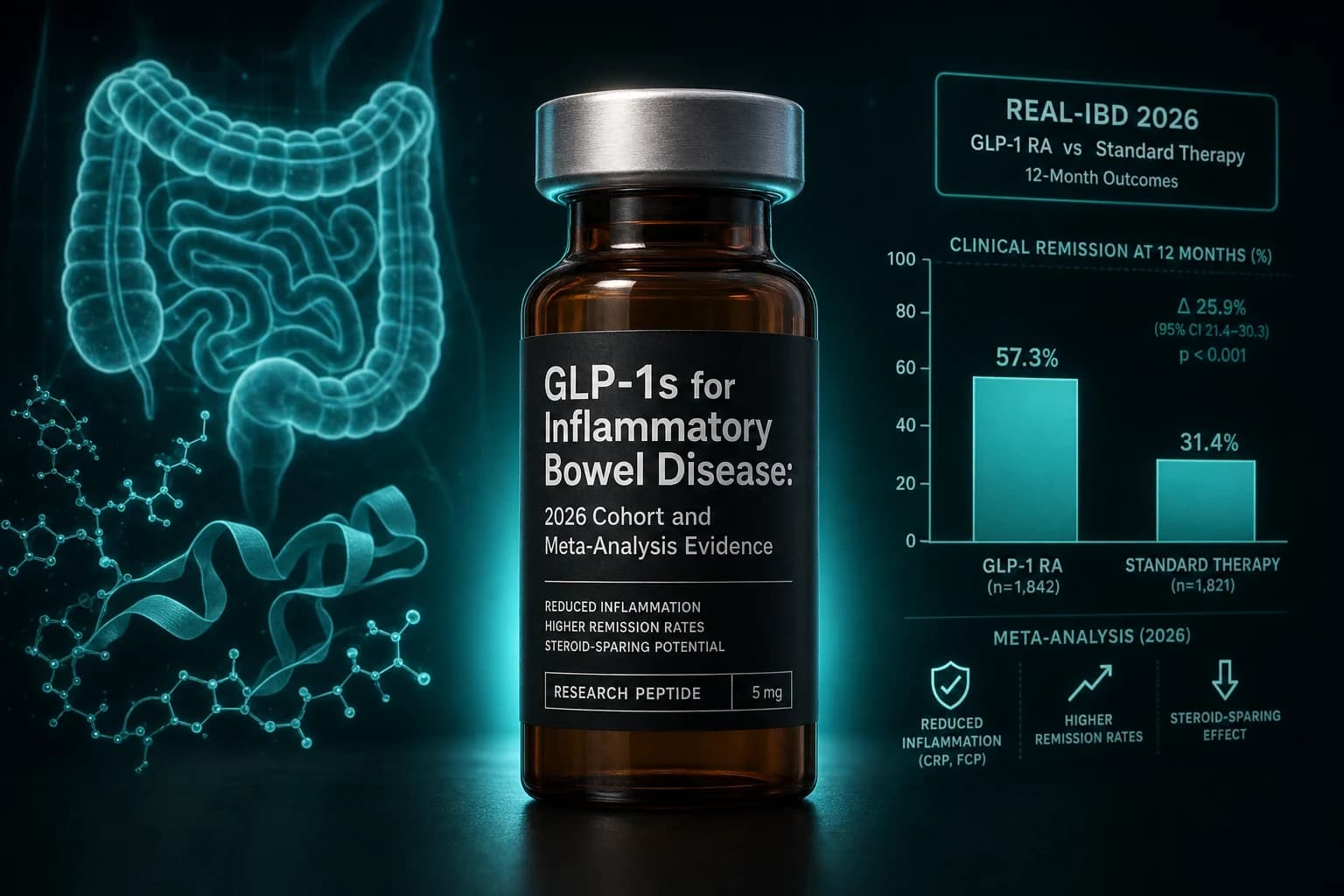
- Desai 2024 (PMID 38938071, TriNetX, 2,270 IBD + T2D patients): GLP-1 RA use cut colectomy in UC (aHR 0.37, 95% CI 0.14 to 0.97) and IBD-related surgery in CD (aHR 0.55, 95% CI 0.36 to 0.84) over 3 years.
- Epi-IIRN nationwide Israeli cohort (PMID 39441993, 3,737 IBD + T2D patients, 633 GLP-1 users, 24,338 patient-years): GLP-1 analog use linked to better composite disease course in the obesity subgroup.
- Bayoumy 2025 meta-analysis (PMID 41071055, 11 studies, 16,242 patients): GLP-1 RAs produced meaningful weight loss in IBD and reduced surgery; hospitalization risk fell in the obesity subset.
- Yang 2025 SR/MA (Front Med 2025, 6 studies, 8 effect estimates): pooled estimate for IBD-related surgery on GLP-1 RAs was 0.45 (95% CI 0.35 to 0.59).
- Desai 2025 (Inflamm Bowel Dis 31:696-705, izae090): semaglutide produced -7.26 kg mean weight loss in IBD + obesity between 6 and 15 months, matching non-IBD comparators with no excess IBD-specific adverse events.
- No randomized trial of any GLP-1 RA in IBD has reported. Every clinical signal above is observational and subject to confounding by indication.
Why GLP-1s in IBD became a serious question
Inflammatory bowel disease used to sit in a separate clinical lane from obesity. The pediatric IBD textbook image of a thin, undernourished Crohn's patient still anchors a lot of clinician intuition, and most major trials of biologics and small molecules in ulcerative colitis and Crohn's disease excluded high-BMI strata or never reported BMI subgroup outcomes. That picture has shifted. In current Western IBD cohorts, about a third of patients carry a BMI of 30 or higher, post-induction weight gain on advanced therapies adds to the trend, and IBD-specific outcomes look worse in the obese subset on every endpoint clinicians track: hospitalization, surgery, steroid-free remission, and biologic discontinuation.
Once IBD specialists started prescribing semaglutide and tirzepatide for the obese-IBD subgroup off-label around 2022, two empirical questions surfaced. Does the GLP-1 actually deliver IBD-population weight loss at the magnitude the obesity Phase 3 trials produced. And does it perturb IBD disease activity in either direction. Through 2026, the answer to both questions has tightened. Three large propensity-matched cohorts, one nationwide Israeli registry, and three systematic reviews now point in the same direction: GLP-1 RAs in IBD with obesity or T2D associate with lower surgery, lower hospitalization in the obese subset, no excess flares, and weight loss matching non-IBD comparators.
Bottom line: Across Desai 2024 (PMID 38938071), the Epi-IIRN Israeli registry (PMID 39441993), and the Bayoumy 2025 meta-analysis (PMID 41071055), GLP-1 receptor agonist use in IBD is associated with lower IBD-related surgery and hospitalization in obese or T2D subsets, with no signal of increased disease activity. None of this is randomized trial data. The pattern is consistent enough to inform individual prescribing decisions in obese-IBD patients, but the field still needs a controlled trial before GLP-1 RAs can be positioned as IBD-modifying therapy.
The mechanistic case behind the cohort signal
Before reading the cohort data, it helps to know what receptors and pathways are actually in play. Colwill and colleagues published the first dedicated mechanistic review of GLP-1 RAs in IBD in the Journal of Crohn's and Colitis in 2025 (Colwill et al., J Crohns Colitis 2025, PMID 40972535). Three threads of preclinical biology line up with the observational human signal.
First, GLP-1 receptor activation raises intracellular cAMP, which activates protein kinase A and inhibits NF-kB activation downstream of T cell receptor engagement. The practical effect in T cells is reduced TCR-driven cytokine production. In animal colitis models, this translates to attenuated IFN-gamma and TNF-alpha output and a polarization shift toward Th2 and regulatory phenotypes.
Second, GLP-1 acts on innate immune cells. Macrophage polarization shifts toward the M2 anti-inflammatory phenotype on GLP-1 RA exposure, with higher IL-10 output and lower IL-6 and TNF. Intraepithelial lymphocyte cytotoxicity drops. Crypt cell apoptosis is reduced in DSS and TNBS colitis models.
Third, GLP-1 has direct effects on the epithelium and microbiome. Enterocyte proliferation rises, mucin output from Brunner's glands increases, and the gut microbiome composition in murine models shifts toward a less colitogenic profile under chronic GLP-1 RA exposure.
| Pathway | Effect on IBD biology |
|---|---|
| cAMP / PKA / NF-kB inhibition in T cells | Lower IFN-gamma and TNF output, reduced TCR signaling |
| Macrophage M2 polarization | Higher IL-10, lower IL-6 and TNF in lamina propria |
| Intestinal epithelial cell proliferation | Better mucosal healing in DSS and TNBS colitis models |
| Mucin output via Brunner's glands | Reinforced mucus barrier |
| Microbiome modulation | Shift away from colitogenic taxa in animal models |
| Reduced IEL cytotoxicity | Less crypt apoptosis |
None of this proves GLP-1 RAs treat IBD. It does mean that the cohort signals do not arrive from nowhere. The mechanism is plausible at the cell-signaling level, supported in colitis animal models, and consistent with the direction of the observational human data.
Note: Mechanistic plausibility is necessary but not sufficient for clinical claims. Biologics that look anti-inflammatory in mice frequently underperform in human IBD trials. The reason cohort data on GLP-1 RAs in IBD matters more than the animal mechanism is that the cohorts capture the actual clinical phenotype in actual patients, even with the confounders that come with observational design.
The Desai 2024 T2D plus IBD cohort
The largest propensity-matched cohort to date is the Desai 2024 study published in Alimentary Pharmacology and Therapeutics (Desai et al., Aliment Pharmacol Ther 2024, PMID 38938071). The investigators used the TriNetX multi-institutional database to assemble two propensity-matched cohorts: 1,130 ulcerative colitis patients with type 2 diabetes on GLP-1 RAs matched to 1,130 UC + T2D patients on oral hypoglycemic agents, and 1,140 Crohn's disease patients with T2D on GLP-1 RAs matched to 1,140 CD + T2D patients on oral hypoglycemics. The primary outcomes were IBD-related surgery and hospitalization requiring intravenous steroids over a 3-year follow-up window.
The surgery signal was the cleanest result. In the UC cohort, GLP-1 RA exposure was associated with a 63 percent lower colectomy rate (aHR 0.37, 95% CI 0.14 to 0.97). In the CD cohort, IBD-related surgery was 45 percent lower (aHR 0.55, 95% CI 0.36 to 0.84). On subgroup analysis, the CD surgery effect was concentrated in patients on semaglutide specifically. Other endpoints went in the same direction but with weaker statistical signal. The risk of hospitalization requiring IV steroids was not significantly reduced versus oral hypoglycemic comparators, and fecal calprotectin levels were numerically lower in GLP-1 users without reaching significance.
The strength of this cohort is the active comparator design. Comparing GLP-1 RAs to oral hypoglycemics instead of to "no GLP-1" eliminates a lot of the channeling bias that affects head-to-head obesity outcome cohorts. Both arms are patients clinicians chose to escalate beyond metformin. The weakness is the standard observational caveat: prescriber selection still operates, and 3-year follow-up is short for endpoints that develop over a decade in this population.
The Epi-IIRN Israeli nationwide cohort
The Epi-IIRN registry covers essentially every IBD patient in Israel through the country's universal health system. The 2024 analysis published in the Journal of Crohn's and Colitis (Epi-IIRN study, J Crohns Colitis 2025, PMID 39441993) restricted to IBD patients with type 2 diabetes and recorded GLP-1 analog exposure of at least 6 months as the exposure variable. The cohort included 3,737 IBD + T2D patients contributing 24,338 patient-years of follow-up, with 633 patients exposed to a GLP-1 analog at some point during follow-up.
The primary outcome was a composite of poor disease course defined as steroid dependence, initiation of advanced IBD therapy, IBD-related hospitalization, IBD-related surgery, or death. Time-varying Cox proportional hazards modeling was used to handle the variable exposure windows. The headline finding was that GLP-1 analog use was associated with improved disease course, and the effect concentrated in the obese subgroup.
This is the most important subgroup signal in the IBD literature. The Israeli registry captures a population in which prescription decisions are heavily standardized through national health funds, which limits the across-clinician selection bias that haunts US claims-based work. The 6-month minimum exposure cuts out single-dose discontinuation noise. The composite outcome captures the spectrum of "this patient is doing badly" that any IBD clinician would treat as meaningful.
The same caveat applies to this signal that applies to every observational IBD outcome paper: the obese subgroup was not randomized. Patients who maintain a GLP-1 RA for 6 months are likely more adherent, more engaged with their care, and more responsive to standard IBD therapy than those who do not. The effect estimate is the upper bound under those assumptions, not the point estimate under causality.
Semaglutide weight loss in IBD with obesity
A separate question that surfaces in any clinical conversation about GLP-1 RAs in IBD is whether the weight loss magnitude matches what the obesity Phase 3 trials produced. The Desai 2025 weight loss cohort answered this directly (Desai et al., Inflamm Bowel Dis 2025, 31(3):696-705, DOI 10.1093/ibd/izae090). The investigators used TriNetX to identify IBD patients with obesity who initiated semaglutide between June 2021 and December 2023, and compared their total body weight trajectory to non-IBD obesity controls matched on age, sex, BMI, and comorbidities.
Mean total body weight change from baseline between 6 and 15 months on semaglutide was -16 pounds (-7.26 kg), a 5 to 6 percent total body weight reduction. The IBD cohort tracked the non-IBD comparator on weight loss within the noise of the estimate. Anti-obesity medication comparators except tirzepatide produced less weight loss than semaglutide in the IBD population. IBD-specific adverse events were not increased on semaglutide versus comparators.
The clinical read is that the weight loss magnitude generalizes from the obesity Phase 3 population to the IBD population without an apparent IBD-specific penalty. Semaglutide in an IBD patient produces semaglutide-typical weight loss. The disease activity outcomes from the Desai 2024 T2D cohort and the Epi-IIRN registry suggest the IBD course is not worsened by the weight loss trajectory, with most cohort estimates pointing toward modest improvement.
Tip: Most IBD specialists who initiate a GLP-1 RA in obese-IBD patients titrate slower than the obesity-indication protocol. The reason is that nausea, vomiting, and diarrhea overlap with the symptom profile clinicians track for IBD flares, and the early titration weeks generate the most confusion at clinic visits. The published cohorts dominantly used standard obesity titration, but the practical recommendation in the post-titration discussions of these papers is 16 weeks rather than 8 weeks to maintenance dose.
The 2025 meta-analyses
Three systematic reviews published in 2025 pooled the cohort literature. Two of them pooled IBD-related endpoints; one focused on metabolic outcomes.
The Bayoumy meta-analysis published in the Journal of Crohn's and Colitis (Bayoumy et al., J Crohns Colitis 2025, PMID 41071055) is the largest pooled analysis to date. The authors included 11 studies and 16,242 IBD patients exposed to GLP-1 RAs and assessed weight loss, BMI change, HbA1c, lipid panel, hospitalization, surgery, corticosteroid use, and advanced therapy initiation. Pooled estimates showed significant weight loss across studies and a significant reduction in IBD-related surgery. Hospitalization risk was reduced in the obesity subgroup but not significantly different in the overall pooled population.
The Yang meta-analysis published in Frontiers in Medicine (Yang et al., Front Med 2025, 12:1621958) focused on IBD-related surgery and complications in IBD patients with metabolic comorbidities. Six included studies contributed eight effect estimates. The pooled estimate for IBD-related surgery on GLP-1 RAs was 0.45 (95% CI 0.35 to 0.59) with low heterogeneity (I-squared 38.1 percent). Half the included studies were conference abstracts rather than peer-reviewed full papers, which the authors flag as a limitation.
The Frontiers in Immunology metabolic-and-inflammation review (2025, doi 10.3389/fimmu.2025.1610368) synthesizes the cohort data with the preclinical mechanism evidence. The conclusion across all three reviews is consistent: the signal is favorable, observational, and not yet randomized.
| Source | Design | Sample | Primary IBD endpoint result |
|---|---|---|---|
| Desai 2024 (PMID 38938071) | Propensity-matched cohort, TriNetX | 2,270 IBD + T2D | UC colectomy aHR 0.37 (0.14-0.97); CD surgery aHR 0.55 (0.36-0.84) |
| Epi-IIRN 2024 (PMID 39441993) | Nationwide registry, time-varying Cox | 3,737 IBD + T2D, 633 GLP-1 users | Improved composite disease course in obesity subgroup |
| Desai 2025 (izae090) | Propensity-matched cohort, TriNetX | IBD + obesity vs non-IBD obesity | -7.26 kg at 6-15 months on semaglutide; no excess IBD events |
| Bayoumy 2025 (PMID 41071055) | Systematic review, meta-analysis | 11 studies, 16,242 IBD patients | Significant pooled weight loss; lower IBD-related surgery; lower hospitalization in obesity subset |
| Yang 2025 (Front Med 2025) | Systematic review, meta-analysis | 6 studies, 8 effect estimates | Pooled IBD-related surgery 0.45 (0.35-0.59), I-squared 38.1% |
| Colwill 2025 (PMID 40972535) | Narrative mechanism review | n/a | Synthesis: anti-inflammatory and epithelial-protective in colitis models |
What the data does not show
Three claims are not yet supported by the published cohort and meta-analysis evidence, and confusing them with what is supported is the easiest way to overreach.
First, no randomized controlled trial of any GLP-1 RA in IBD has reported. Every clinical signal above is observational. Confounding by indication, channeling bias, and survivor effects in the longer-follow-up registries are all standard caveats that randomization would address and cohort design cannot.
Second, the data is dominated by IBD patients with comorbid type 2 diabetes or obesity. Whether a GLP-1 RA has anything to offer a normal-BMI IBD patient without T2D is an open question with essentially no usable evidence. The Israeli registry was T2D-restricted by design. The TriNetX cohorts required either obesity or T2D as the GLP-1 RA prescribing indication.
Third, the magnitude estimates on surgery reduction (aHR 0.37 to 0.55, pooled estimate 0.45) are large in a way that should be read skeptically. Effect sizes of that magnitude in observational research routinely shrink toward 0.8 or 0.9 in subsequent randomized trials, and the existing biologic and small molecule classes in IBD do not produce 50-percent surgery reductions in head-to-head trials. The most defensible reading is that GLP-1 RAs in obese-IBD patients improve IBD outcomes by a meaningful but smaller amount than the unadjusted cohort effect sizes suggest, and the bulk of the benefit may come through weight loss rather than direct anti-inflammatory action.
Warning: The Mounjaro and Wegovy labels do not include IBD as an indication or a contraindication. Initiating a GLP-1 RA in a patient with active IBD is off-label in either direction. Active disease, especially Crohn's with stricturing or fistulizing complications, was not the population in any of the cohorts above. Concomitant active flare management remains the IBD specialist's domain. The cohort signals do not authorize starting a GLP-1 RA during an active flare or in place of standard IBD therapy.
A practical framework for 2026
The pattern across the published evidence supports a tiered approach for the obese-IBD patient considering a GLP-1 RA. The framework below mirrors what most IBD groups are doing in practice and aligns with the post-evidence discussion in the Bayoumy and Colwill papers.
-
Obese IBD patient in remission with T2D or pre-T2D. GLP-1 RA is a defensible second-line agent after metformin. The Desai 2024 and Epi-IIRN signals are strongest in this population. Standard titration extended to 16 weeks limits early-titration GI confusion against the IBD symptom baseline.
-
Obese IBD patient in remission without T2D, seeking weight loss. Reasonable on the Desai 2025 weight loss data and the Epi-IIRN obesity subgroup signal. Disease activity monitoring at 3 and 6 months catches any unmasked flare. Calprotectin tracking is the cleanest objective marker.
-
Active IBD flare, regardless of BMI. Off-evidence. Manage the flare first with standard IBD therapy. The cohorts above were dominated by remission or quiescent patients. Initiating a GLP-1 RA during active disease is not supported.
-
IBD patient on weight-losing therapy already (low-dose naltrexone, semaglutide history from a non-IBD prescriber). Continue with standard IBD monitoring. The cohort data does not support escalation or discontinuation purely on IBD grounds.
-
IBD patient with active stricturing Crohn's, recent obstruction, or gastroparesis history. Use special caution. GLP-1-induced delayed gastric emptying compounds the obstruction risk profile. The cohort papers did not isolate this subgroup. Most IBD prescribers in this population choose tirzepatide or alternative weight-loss options over semaglutide, but the evidence base is thin.
-
Pre-surgery in obese IBD. Follow the GLP-1 before surgery aspiration risk guidelines for elective procedures. The SAGES and ASA guidance applies regardless of IBD status. IBD-specific surgical timing belongs to the colorectal surgery team.
The open questions for 2026 and 2027
Three lines of evidence will move this field decisively in the next 18 months.
A randomized controlled trial of semaglutide for active mild-to-moderate ulcerative colitis is in pre-trial discussion stages at multiple academic IBD centers. The early conference abstracts at DDW 2026 included a 993-patient prospective signal of clinical remission improvement on GLP-1 RA at 3 months that has not yet been peer-reviewed at the level of a published paper. A controlled trial would close the inference gap that cohort data cannot.
The dual and triple GLP-1 agonists (tirzepatide, survodutide, mazdutide, retatrutide) have essentially no published IBD cohort data. Whether the GIP and glucagon co-agonism reinforces or attenuates the IBD signal is unknown. The mechanistic case for glucagon agonism in gut inflammation cuts both ways: glucagon receptors are expressed in lamina propria immune cells, and the receptor biology is not characterized at the level the GLP-1 receptor is.
The interaction with muscle preservation and sarcopenia in chronic IBD is the next question opening up. IBD patients are already at elevated sarcopenia risk from chronic inflammation, malabsorption, and steroid exposure. Whether GLP-1 RA weight loss accelerates IBD-related sarcopenia in a way that hurts long-term outcomes is the question that nutrition-focused IBD researchers are now asking, and the answer is not yet in the literature.
Sourcing for researchers tracking the IBD endpoint set
Researchers tracking the GLP-1 IBD endpoint set typically follow semaglutide, tirzepatide, and the dual agonist pipeline. For the injectable research compounds with lot-level certificate of analysis, Ascension Peptides covers the catalog with code ENHANCED for 50 percent off. For the oral GLP-1 research analogs and nasal-format peptide research tools, Limitless Biotech is the matched source with code ENHANCED. Neither sourcing channel is appropriate for any IBD patient outside of an IRB-controlled research setting. Active disease management belongs to a gastroenterologist, and none of the cohort data above is a basis for self-protocol decisions in IBD.
For the adjacent endpoints and the broader safety map in this population, the GLP-1 dosing comparison 2026, the GLP-1 cirrhosis and liver transplant evidence, the GLP-1 muscle loss research review, the GLP-1 gallbladder risk evidence, and the semaglutide MASH ESSENCE Phase 3 evidence cover the surrounding evidence base. For the oral peptide line that has the longest IBD-specific research history, the KPV oral peptide gut inflammation review is the cleanest read.
This article is for educational and research purposes only and is not medical advice. No GLP-1 receptor agonist is FDA-approved for the treatment of inflammatory bowel disease, ulcerative colitis, or Crohn's disease. All IBD-specific evidence summarized above derives from observational cohort studies, registry data, and propensity-matched real-world analyses, all of which are subject to confounding by indication, channeling bias, and exposure misclassification. The signal across cohorts is consistent in direction but the magnitude estimates likely overstate true effect size because randomization has not yet adjudicated. Active IBD management, induction therapy choice, biologic selection, surgical timing, and immunosuppression decisions belong to the patient and the gastroenterology, colorectal surgery, and IBD-specialty teams, not to a general-audience review article. Do not start, switch, stop, or self-source any GLP-1 receptor agonist on the basis of this article, especially during active disease. Consult a qualified gastroenterologist about your individual circumstances before acting on any information here.