At a glance
- Zepbound is a prescription-only drug in every state; any site offering it without a prescription is unlicensed or counterfeit.
- FDA label eligibility is BMI 30+, or BMI 27+ with a weight-related condition (hypertension, dyslipidemia, T2D, OSA, or CVD).
- LillyDirect self-pay is the cheapest brand path: $299 (2.5 mg), $399 (5 mg), $449 (7.5 to 15 mg) as of Dec 2025.
- Telehealth add-on fees range from $39 (GoodRx) to roughly $199 per month (WeightWatchers Clinic) on top of the drug.
- The FDA declared the tirzepatide shortage resolved on Dec 19, 2024; 503A compounded tirzepatide is no longer a routine backup.
Zepbound is prescription-only in every US state, so the actual question is not whether you can get it online. The question is which lane you should stand in. There are five, they cost between $299 and $1,899 a month before any visit fee, and they resolve to the same molecule (tirzepatide) manufactured by Eli Lilly.
This guide maps all five, prices them end to end, and shows what happens on the intake form. It also explains why the compounded tirzepatide path narrowed sharply after the FDA declared the shortage resolved, and what the actual trial data says the drug does when you get on it.
What Zepbound actually is
Zepbound is Eli Lilly's brand name for tirzepatide indicated for chronic weight management. It is a once-weekly subcutaneous injection that activates both the GIP and GLP-1 receptors, which is why it outperformed injectable semaglutide 1 mg on both A1C and weight in the SURPASS-2 head-to-head (Frías et al., NEJM 2021; PMID 34170647). The obesity indication reached the market on the back of SURMOUNT-1, where the 15 mg dose produced a mean 22.5% body-weight reduction at 72 weeks in adults with obesity or overweight (Jastreboff et al., NEJM 2022; PMID 35658024).
The molecule is the same whether it ships in a KwikPen or a single-dose vial. The vials are the piece the online access story pivots on: they are LillyDirect exclusive, they undercut every telehealth cash program on drug cost, and they only exist because Lilly wants a direct-to-patient self-pay channel that bypasses the pen supply chain.
Who qualifies on paper
The FDA-approved indication for Zepbound is adults with a body mass index of 30 kg/m² or higher, or a BMI of 27 kg/m² or higher with at least one weight-related condition: hypertension, dyslipidemia, type 2 diabetes, obstructive sleep apnea, or cardiovascular disease. Any legitimate telehealth intake will ask for height, weight, and comorbidities, then decline patients who fall outside those bounds. If a service does not gate on BMI, that is a sign it is not operating as a licensed medical practice.
Some telehealth platforms are stricter than the label. WeightWatchers Clinic reportedly requires BMI 27+ with a comorbidity or BMI 30+ standalone. Others accept the FDA minimum but require a prior weight-loss attempt. Almost all require you to be in a state where they hold licensure and where audio-video visits meet local telehealth rules, which we return to below.
Bottom line: If your BMI is under 27, the label does not cover Zepbound and a compliant prescriber will not write it. That does not stop unregulated shops; it should stop you.
The five real access lanes in 2026
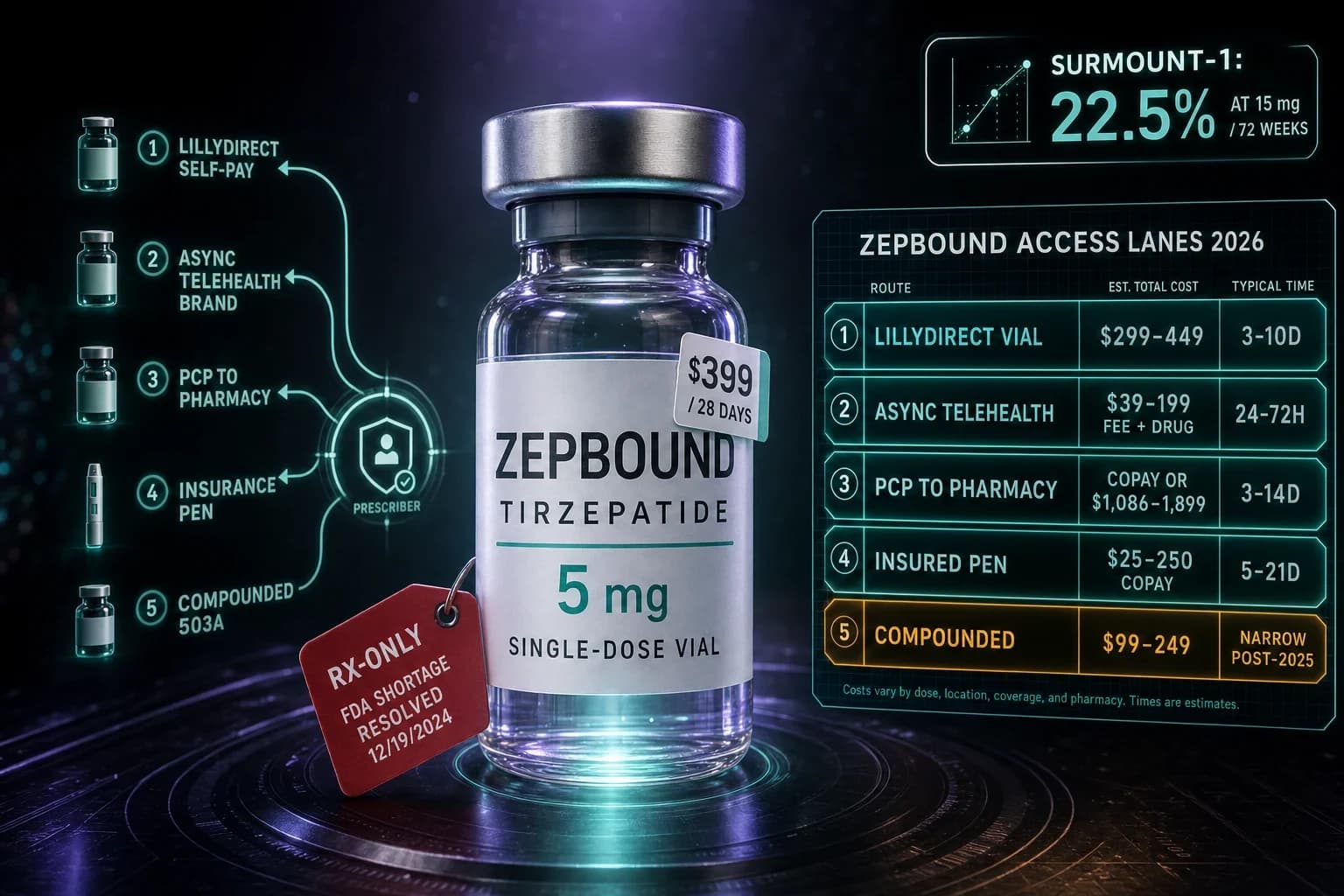
There are five ways an adult in the US can legitimately end up with tirzepatide in the fridge. Each has a different trade-off on speed, cost, and what happens the first time you have a question at 9 pm on a Sunday.
| Lane | Drug cost per month | Visit or platform fee | Format | Time to first shipment |
|---|---|---|---|---|
| LillyDirect self-pay vials | $299 (2.5 mg) to $449 (7.5 to 15 mg) | None | Single-dose vials | 3 to 10 days |
| Async telehealth for the brand | Same LillyDirect vial price passthrough or full brand price | $39 (GoodRx) to $199 (WW Clinic) | Vial or pen | 24 to 72 hours |
| Traditional PCP to any pharmacy | Insurance copay or full brand price ($1,086 to $1,899) | Regular office visit | Pen | 3 to 14 days |
| Insurance-covered pen | Copay, often $25 to $250 with a savings card | Standard prior-auth work | Pen | 5 to 21 days |
| Compounded tirzepatide (narrow post-2025 use) | $99 to $249 | $99 to $199 subscription | Multi-dose vial | 3 to 10 days |
Prices reflect the LillyDirect Self Pay Journey Program pricing announced in late 2025 and the visit-fee schedules the major platforms publish on their pricing pages. The compounded lane is now a narrow exception rather than a mass-market alternative; the reason is regulatory, not economic, and we explain it in the compounded section below.
Lane 1: LillyDirect self-pay vials
LillyDirect ships Zepbound single-dose vials at $299 for 2.5 mg, $399 for 5 mg, and $449 for 7.5, 10, 12.5, and 15 mg. Each monthly prescription contains four once-weekly vials, delivered directly or picked up at Walmart. You still need a prescription; LillyDirect does not prescribe. Options for the prescription are your own doctor writing to LillyDirect Self Pay Pharmacy Solutions, or a telehealth service willing to route the script to LillyDirect (Ro and Sesame both offer this, sometimes with a modest fee reduction because there is no pen fulfillment on their side).
This is the cheapest legitimate brand path in America right now. There is no coupon, no rebate treadmill, and no 45-day quantity trap that catches self-pay pen buyers. The one catch is inventory: single-dose vials have periodically run tight, and the 7.5 and 12.5 mg strengths sometimes lag the more common doses. Lilly began adding new vial strengths through 2025, but back-order gaps are the reason many patients still pair this with a compounded fallback if one is available in their state.
Lane 2: Async telehealth for the brand
Ro, Sesame, Walgreens, and WeightWatchers Clinic all prescribe brand Zepbound. The intake is asynchronous where state law permits (some states require an audio-video encounter). Approval times are 24 to 72 hours, and the prescription can be routed either to a national pharmacy (retail or mail order) or to LillyDirect for the vial pricing.
Platform fees are the differentiator. Ro publishes $149 a month for the weight-loss program, Sesame lists a $99-per-month membership option, GoodRx Care ranges around $39 a visit, and Walgreens virtual weight loss lists $49 per visit. WeightWatchers Clinic is the highest at roughly $199 a month, and that fee bundles behavioral coaching and clinical follow-up, so the direct comparison to a $39 visit is not apples to apples.
If you already know you want vials, the cheapest configuration is to pay Sesame or GoodRx Care for a low-fee visit and have the script sent to LillyDirect. That drops you to roughly $299 to $449 in drug plus a modest monthly platform charge. If you prefer the pen and do not need coaching, the same math applies with your pharmacy of choice.
Lane 3: Traditional PCP to any pharmacy
Your own primary care doctor can send a Zepbound script to any pharmacy in the country. This is the slowest lane on the intake side, because you need an appointment, but it is the only one where an established clinical relationship is doing the prescribing. Cash pen price at retail runs $1,086 to $1,899 depending on chain, and coupons rarely land you below LillyDirect vial pricing. The only reason to run this lane at retail is either insurance coverage or clinical preference for the pen.
Lane 4: Insurance-covered pen
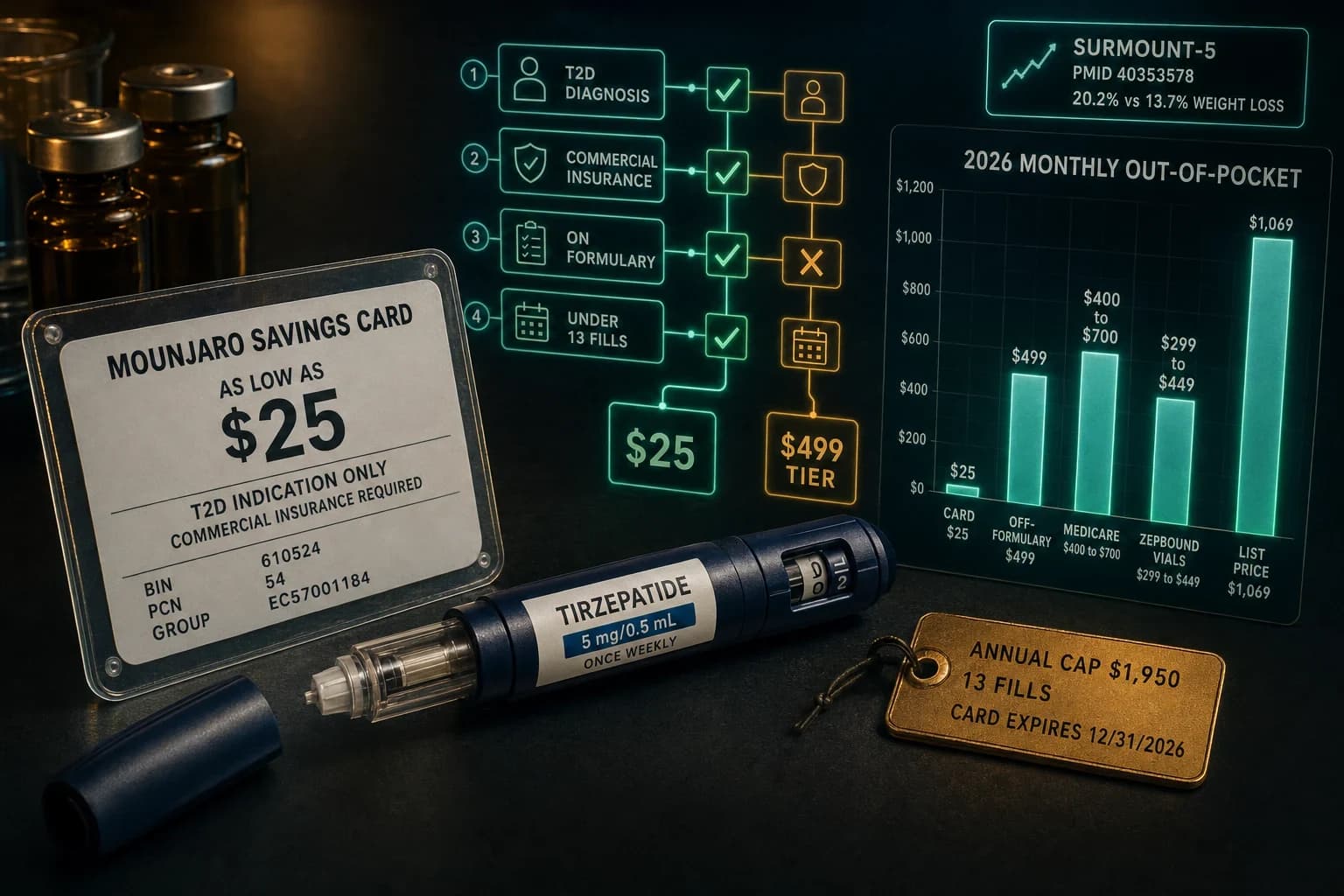
If your plan covers Zepbound, this is the cheapest lane, full stop. Manufacturer savings cards can drop commercial copays to $25 for eligible plans. The friction is prior authorization, which typically requires documented BMI, comorbidities, and a prior weight-loss attempt (nutrition counseling, a documented diet, or a prior GLP-1). Some plans require step therapy through semaglutide first. Patience gets you a low copay.
Lane 5: Compounded tirzepatide (a narrow post-2025 lane)
This one is not what it was in 2024. On December 19, 2024, the FDA declared the tirzepatide shortage resolved, and the enforcement-discretion window that let 503A pharmacies compound copies of tirzepatide ended February 18, 2025 (503B outsourcing facilities had until March 19, 2025). After those dates, a 503A pharmacy can only compound a personalized formulation for a specific patient's clinically documented need, not mass-market the drug. Any telehealth service still selling "compounded tirzepatide" as a routine offering is either using a technicality (adding B12 or another ingredient), operating in a legally contested space, or breaking the rules.
That does not mean the option no longer exists. A telehealth clinic that documents a specific patient need can still compound, and some do. What changed is that this stopped being a mass-market cheap-brand substitute and became a personalized-clinical exception. Our full walkthrough of that regulatory turn is in our compounded tirzepatide 2026 legal access guide, and our vetting map of the vendors that navigated it responsibly is at compounded tirzepatide online.
What the intake form actually asks
Every legitimate telehealth Zepbound intake will collect a version of the same information:
- Height, current weight, weight history, BMI calculation
- Comorbidities (hypertension, type 2 diabetes, dyslipidemia, OSA, CVD)
- Personal or family history of medullary thyroid cancer or MEN 2 (a black-box contraindication)
- Personal history of pancreatitis
- Current medications, especially insulin, sulfonylureas, or other GLP-1 receptor agonists
- Kidney and liver history, pregnancy status, gallbladder history
- Prior weight-loss attempts (many platforms require this to justify medical necessity)
You upload a photo ID, sometimes a face photo for identity verification, and lab work if you have it. Labs are helpful but not required at most platforms; if you want the tightest safety net, running a fasting metabolic panel, HbA1c, lipid panel, and thyroid screen ahead of time speeds the clinical decision. Our peptide lab test guide walks through the sensible starter panel for anyone starting a GLP-1.
State-by-state visit type rules
Federal law does not require an in-person visit before prescribing a non-controlled substance like tirzepatide, so all 50 states allow telehealth prescribing of Zepbound. What varies is whether the state accepts a purely asynchronous intake (a form with clinician review) versus requiring a live audio-video visit for the first prescription.
California, Texas, and Florida all reportedly require audio-video visits for the initiating GLP-1 encounter, with periodic follow-ups every 90 days in year one and every 6 months thereafter. Florida additionally requires BMI 30+ (stricter than the federal 27+ with a comorbidity). A handful of other states have moved in the same direction over the past 18 months. Our state-by-state telehealth peptide prescription legality guide tracks which states currently accept async intake and which require video.
If your state requires video, you will book a live consult during the platform's clinic hours. If it allows async, you can complete the intake at 11 pm on a Sunday and hear back within 24 to 72 hours. Neither model changes what your prescriber checks. It only changes the encounter format.
What the drug does when you get on it
Zepbound is unusually well characterized for a weight-management drug because Eli Lilly ran a full Phase 3 program.
- SURMOUNT-1 (2022): 2,539 adults with obesity or overweight, 72 weeks. Mean weight reduction of 15.0%, 19.5%, and 20.9% at 5, 10, and 15 mg, with a top-dose subgroup reaching 22.5% (Jastreboff et al., NEJM 2022; PMID 35658024).
- SURMOUNT-4 (2023): Withdrawing tirzepatide after 36 weeks led to a mean 14% weight regain over the next 52 weeks, while continued treatment produced an additional 6.7% loss (Aronne et al., JAMA 2024; PMID 38078870). Discontinuation reverses most of the metabolic gains within a year.
- SURMOUNT-OSA (2024): In adults with moderate-to-severe obstructive sleep apnea and obesity, tirzepatide reduced the apnea-hypopnea index, hypoxic burden, hsCRP, and systolic blood pressure, and up to 51.5% of the top-dose group met the criteria for OSA disease resolution (Malhotra et al., NEJM 2024; PMID 38912654). This is the strongest cardiometabolic case in the file.
The safety picture is consistent with the GLP-1 receptor class. Gastrointestinal effects (nausea, diarrhea, vomiting, constipation) dominate, cluster in the dose-escalation phase, and are mostly mild to moderate. Any prescriber running the intake will walk the standard titration ladder (2.5 mg for the first 4 weeks, then 5, 7.5, 10, 12.5, 15 as needed and tolerated), and our Zepbound dosage chart tracks the schedule side by side with insurance and self-pay quantity limits. Weight regain after stopping is the drug's biggest hidden cost: SURMOUNT-4 is the trial to bring up with any prescriber pitching a short course.
Red flags on "online Zepbound"
Zepbound is Schedule-free but Rx-only. Any site that sells Zepbound without a prescription or without collecting the intake data above is not a licensed pharmacy. The FDA has flagged multiple online sellers claiming to ship real tirzepatide vials with no prescription; some ship counterfeit product, some ship underdosed research-grade tirzepatide, and some ship nothing at all. Our long-form audit of the gray-market supply chain (including the JMIR-style purity findings on compounded and unregulated tirzepatide) is at peptide gray-market sourcing truth.
Three tells worth naming:
- No BMI intake. A licensed prescriber cannot write Zepbound for someone with BMI 22. If a site takes your money without asking, it is not medical.
- "Research use only" label with weight-loss messaging. Research chemicals are not Zepbound and cannot be legally prescribed for weight loss.
- Foreign shipping origin. Legitimate Zepbound distribution goes through Lilly-authorized pharmacies inside the US.
If you are trying to compare vetted platforms, our best tirzepatide compounding pharmacy piece is the closest thing this site has to a shortlist for people who want a compounded fallback while brand supply catches up.
Which lane fits which person
Tip: If your only constraint is cost and you have no insurance coverage, the LillyDirect vial routed through a low-fee telehealth intake (Sesame or GoodRx Care) is the best combination in America right now. You spend $99 to $149 on the visit, $299 to $449 on the drug, and skip both the pen premium and the compounded regulatory gray zone.
The short version of the decision looks like this:
- Best cost, brand quality: LillyDirect vials, script from your PCP or a low-fee telehealth intake.
- Best convenience, cash-pay: Async telehealth with the platform of your choice, script routed to LillyDirect.
- Best cost, insured: Ask your prescriber to run a prior auth for the pen; use the manufacturer savings card.
- Best fit if you need clinical hand-holding: WeightWatchers Clinic or Ro's higher-touch program.
- Only if a compliant clinician documents personalized need: Compounded tirzepatide via a vetted 503A source. This is no longer a routine consumer product.
For semaglutide comparison shoppers, our head-to-head of the two molecules is at tirzepatide vs semaglutide 2026, and the cheapest end-to-end price map is at cheapest way to get zepbound without insurance. Anyone weighing telehealth partners against direct-to-patient options can start with our Bodybuilding Health+ review and Yucca Health review.
The disclaimer
This article is for research and educational purposes only. It is not medical advice, a prescription, or an endorsement of any specific telehealth platform. Zepbound is a prescription-only drug in the United States; obtaining it without a prescription is illegal and unsafe. Any decision about starting, changing, or stopping a GLP-1 receptor agonist should involve a licensed clinician who has reviewed your personal and family history. Prices, platform fees, and state telehealth rules cited above are current as of the publication date and change frequently. Confirm current pricing and eligibility directly with the platform before acting.