At a glance
- Telehealth peptide prescription legality is determined at the state level; federal reclassification of peptides did not directly change state telehealth prescribing rules
- Most states permit telehealth peptide prescriptions for non-controlled substances when the clinician is licensed in the patient's state
- Restrictive states (notably some northeastern and west-coast jurisdictions) require in-person evaluation before initial peptide prescription
- Peptides themselves are not controlled substances under federal law; the Ryan Haight Act's in-person requirement does not directly apply
- Compounded GLP-1 telehealth prescriptions face the most state-level scrutiny as of 2026, with multiple states actively reviewing telehealth-prescribed compounded weight loss therapies
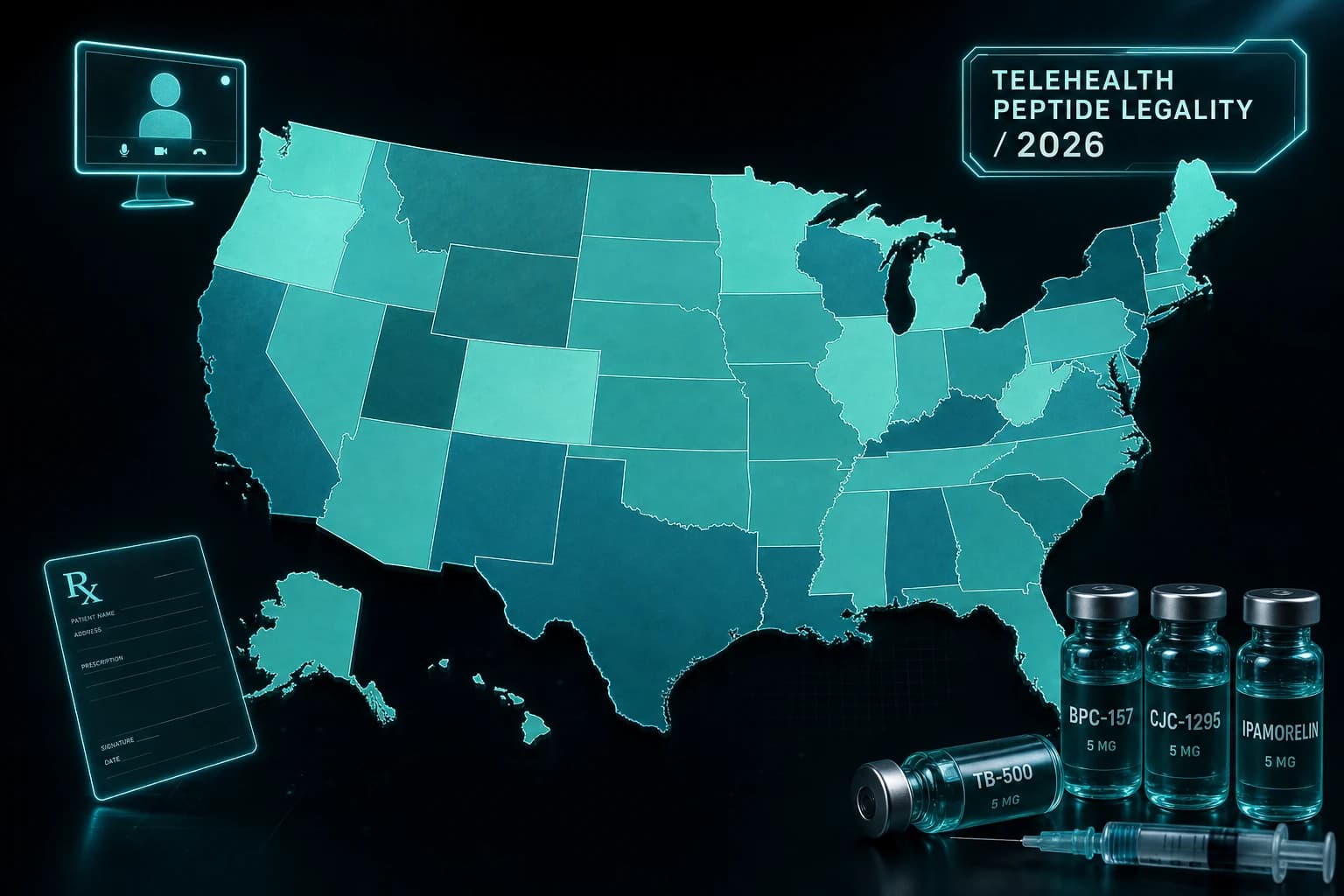
Telehealth peptide prescribing is a state-by-state patchwork in 2026. The Feb 27, 2026 federal reclassification restored 14 peptides to legal compoundability, but the actual question of whether you can get a peptide prescription via video call instead of in-person evaluation is determined separately by each state's medical board and pharmacy practice rules. The result: in some states, telehealth peptide therapy is straightforward; in others, you need an in-person evaluation first.
This article covers the federal-vs-state regulatory framework, how each state typically approaches telehealth peptide prescribing, the specific edge cases (compounded GLP-1s, controlled substance interactions), and the practical patient pathway through the state-by-state variation.
Federal vs state regulatory layers
Three federal regulatory layers and one state layer interact with telehealth peptide prescribing:
| Layer | Authority | Applies to |
|---|---|---|
| FDA Category designation | Federal | Whether compound can be legally compounded |
| Ryan Haight Act (2008) | Federal | Requires in-person evaluation before controlled-substance prescription |
| DEA scheduling | Federal | Determines whether Ryan Haight applies |
| State medical practice rules | State | When clinician can prescribe via telehealth in that state |
| State pharmacy practice rules | State | When pharmacy can dispense based on telehealth prescription |
Peptides like BPC-157, TB-500, semaglutide, and tirzepatide are not controlled substances under federal law. The Ryan Haight Act's in-person requirement does not directly apply to non-controlled-substance prescribing.
What does apply: each state's medical board has the authority to set rules about when telehealth visits can establish the physician-patient relationship necessary to write a prescription. These rules vary substantially.
The state-by-state landscape
Categorizing states by general approach to telehealth peptide prescribing:
Permissive states. Most states permit telehealth peptide prescriptions when the clinician is licensed in the patient's state and a legitimate physician-patient relationship is established via the telehealth visit. The majority of the US population lives in jurisdictions in this category.
| Permissive states (representative) | Notable features |
|---|---|
| Texas, Florida, Arizona | High volume of telehealth peptide practice; established prescribers |
| Colorado, Nevada, Wyoming | Functional medicine and longevity clinic activity |
| Indiana, Ohio, Tennessee | Mid-volume; permitted with standard licensure |
| Most Midwest and South states | Generally permissive baseline |
Restrictive states. A smaller group of states either explicitly require in-person evaluation before initial peptide prescription or have rules that effectively require it through stricter physician-patient relationship establishment requirements.
| Restrictive states (representative) | Notable features |
|---|---|
| California | Strict telehealth rules, particularly for compounded products |
| New York | Restrictive on compounded weight-loss therapies in particular |
| Massachusetts | Generally cautious approach to telehealth-only prescription |
| Some northeastern jurisdictions | In-person preferred or required |
Mixed states. Some states permit telehealth prescriptions for certain peptides but restrict others, or permit telehealth for follow-up visits but require initial in-person evaluation.
The specific designations change frequently. State medical boards periodically issue advisories that effectively shift their position. The categorization above is a representative snapshot as of May 2026 and patients should verify current state rules at the time of seeking care.
Bottom line: Most US states permit telehealth peptide prescriptions when the clinician is licensed in the patient's state. The restrictive states are mostly concentrated in the Northeast and on the West Coast, with California being the most-discussed restrictive jurisdiction.
How clinician licensure interacts with state rules
A critical detail: the prescribing clinician must be licensed in the patient's state, not in the clinician's own state. A physician licensed only in Texas cannot legally prescribe peptides to a patient in California via telehealth.
The interstate medical licensure compact (IMLC) has streamlined multi-state licensure for many physicians, making interstate telehealth practice operationally feasible. But the requirement still applies: at the moment of prescribing, the clinician must hold an active license in the patient's state.
Practical implications:
- Multi-state telehealth platforms typically employ clinicians licensed in many states. Patients should confirm their assigned clinician is licensed in their state.
- DEA registration is separate from medical licensure. Even for non-controlled-substance peptides, some pharmacies require DEA-registered prescribers.
- State residency vs visit location. If you are physically in a state at the time of the telehealth visit, the prescription generally must comply with that state's rules (not your residence state's rules).
Compounded GLP-1s: the most-scrutinized category
The compounded semaglutide and tirzepatide telehealth market grew rapidly through 2023-2025 driven by GLP-1 supply shortages and the price gap between branded and compounded products. Several states have actively reviewed telehealth-prescribed compounded GLP-1s through 2025-2026:
Areas of state scrutiny:
-
Dose accuracy. Compounded GLP-1 products dosed in atypical concentrations relative to branded formulations have produced patient confusion and occasional dosing errors. State pharmacy boards have flagged this.
-
Physician-patient relationship establishment. Some states have argued that a brief telehealth visit primarily oriented toward writing a GLP-1 prescription does not constitute the relationship required for legitimate prescribing.
-
Compounded product specifications. State pharmacy boards have inspected compounded GLP-1 products from several telehealth-aligned 503A pharmacies, with mixed findings on dosing accuracy and labeling clarity.
The pattern: states are not categorically restricting compounded GLP-1 telehealth, but they are increasingly demanding that the underlying physician-patient relationship, the prescription justification, and the compounded product quality all meet conventional standards. Telehealth-first GLP-1 platforms have had to professionalize substantially to operate sustainably.
For our coverage of the GLP-1 dosing landscape including compounded options, see the GLP-1 dosing comparison 2026 and the Wegovy HD 7.2 mg STEP UP trial guide.
The practical patient pathway
For a patient interested in telehealth peptide therapy, the typical pathway is:
-
Verify your state permits telehealth peptide prescription. Check the state medical board's website or a current state telehealth policy reference.
-
Find a multi-state telehealth platform that includes your state. Several established peptide telehealth services maintain clinician panels licensed across most US states.
-
Initial telehealth consultation. Standard fee range $150-$400 for initial peptide-focused consultation. Some platforms include the consultation in a monthly membership.
-
Verify clinician licensure in your state. Confirmation should be explicitly provided.
-
Lab work if required. Some clinicians require baseline labs before prescribing. Lab orders are typically routed to standard commercial labs accessible to patients.
-
Prescription transmission to compounding pharmacy. The clinician sends the prescription electronically to the patient's chosen pharmacy. Some telehealth platforms have established pharmacy partnerships.
-
Pharmacy preparation and shipment. Standard 5-10 business days for established compounding pharmacies. Cold-chain shipping where appropriate.
-
Follow-up. Most clinicians require a follow-up at 4-12 weeks. Subsequent prescriptions typically can be issued telehealth even in states requiring in-person initial evaluation.
For the broader compounding pharmacy access framework, see the compounding pharmacy peptide access guide 2026.
What does NOT apply to peptide telehealth
Several federal regulatory frameworks affect controlled-substance telehealth prescribing but do not apply to peptide telehealth:
Ryan Haight Act (2008) in-person requirement. This applies to controlled substances scheduled under the Controlled Substances Act. Most research peptides are not scheduled. The Ryan Haight requirement that a controlled-substance prescription be preceded by an in-person evaluation does not apply.
DEA telehealth flexibilities. The COVID-era DEA flexibilities allowing controlled-substance telehealth prescribing without an in-person visit are scheduled to end through 2025-2026 transition rules. These apply to controlled substances, not to non-controlled peptides.
State controlled-substance Prescription Drug Monitoring Program (PDMP) reporting. Peptide prescriptions are typically not subject to PDMP reporting because the compounds are not controlled.
The clean takeaway: federal controlled-substance frameworks largely do not apply to peptide telehealth. State medical practice rules are the relevant authority for most peptide telehealth questions.
How the Enhanced Games and FDA reclassification context affects state rules
The February 27, 2026 FDA reclassification did not directly modify any state telehealth rules. What it did was establish that the most-prescribed peptides are now legal at the federal level for compounding pharmacy use, removing the regulatory uncertainty argument that some states had used to justify additional telehealth restrictions.
Several states have indicated they are revisiting their position on peptide telehealth in light of the federal reclassification. The trend through Q2 2026 has been toward more permissive state rules, not less. The Enhanced Games visibility has reinforced this trend by demonstrating that high-profile peptide use is now occurring in legitimate clinical channels rather than gray-market ones.
For broader context, see the FDA peptide reclassification February 2026 complete breakdown and the Enhanced Games May 24 article.
FAQ
Can I get a peptide prescription via telehealth in my state?
Most US states permit telehealth peptide prescriptions when the clinician is licensed in your state and a legitimate physician-patient relationship is established via the telehealth visit. The restrictive states (concentrated in the Northeast and on the West Coast) may require in-person evaluation first. Check your specific state's current rules before scheduling.
Does the Ryan Haight Act apply to peptide telehealth?
No, for the most-prescribed peptides. The Ryan Haight Act requires in-person evaluation before controlled-substance prescribing. Most research peptides (BPC-157, TB-500, CJC-1295, Ipamorelin, GHK-Cu, KPV, semaglutide, tirzepatide) are not controlled substances and are not subject to the Ryan Haight in-person requirement.
Which states are most permissive for telehealth peptide prescriptions?
The Midwest, South, and Mountain West states generally have permissive baseline rules. Texas, Florida, Arizona, Colorado, Nevada, Tennessee, and Ohio are representative examples where established peptide telehealth practice operates. The specific designations change; patients should verify current state rules.
Which states are most restrictive?
California, New York, and Massachusetts are the most-discussed restrictive jurisdictions for telehealth peptide and compounded-product prescribing as of May 2026. Some other northeastern states have stricter physician-patient relationship establishment requirements that effectively require in-person initial evaluation.
What about compounded GLP-1 telehealth?
Compounded semaglutide and tirzepatide telehealth has faced the most state-level scrutiny of any peptide category in 2025-2026. Several states have actively reviewed dose accuracy, physician-patient relationship establishment, and compounded product quality from telehealth-aligned pharmacies. Patients should choose accredited 503A pharmacies and verify dose specifications carefully.
Does my clinician need to be in my state?
The clinician must be licensed in your state at the time of prescribing. The clinician may physically be elsewhere, but their medical license must be active in your state. The interstate medical licensure compact (IMLC) has streamlined multi-state licensure for many physicians, making telehealth across state lines operationally feasible when the clinician maintains the necessary licenses.
Can I get peptides via telehealth without a clinical evaluation?
No legitimate pathway exists for receiving prescription peptides without a clinical evaluation. The research-grade retail channel (without prescription, with research-use disclosures) is a separate option but is not a substitute for prescribed therapy and does not involve clinical oversight. Patients seeking clinician-managed peptide therapy should expect at least a baseline telehealth or in-person evaluation.
Further reading
- FDA peptide reclassification February 2026 complete breakdown
- Compounding pharmacy peptide access guide 2026
- Generic semaglutide patent expiry timeline 2026
- GLP-1 dosing comparison 2026
- Wegovy HD 7.2 mg STEP UP trial guide
- Enhanced Games May 24 2026 opening-day stacks and stakes
This article is for educational and informational purposes only. The state-by-state telehealth peptide prescription landscape changes frequently; patients should verify current state rules at the time of seeking care. None of the content above constitutes legal or medical advice. Patients interested in telehealth peptide therapy should consult a qualified clinician licensed in their state and verify the pathway with their specific clinical provider.