At a glance
- Testosterone is literally an anabolic androgenic steroid and a Schedule III controlled substance in the US.
- The real dividing line is dose: 125 mg weekly produced 542 ng/dL, while 600 mg weekly produced 2,370 ng/dL (Bhasin et al. 2001).
- Replacement restores normal physiology. A cycle deliberately exceeds it. Same molecule, different pharmacology.
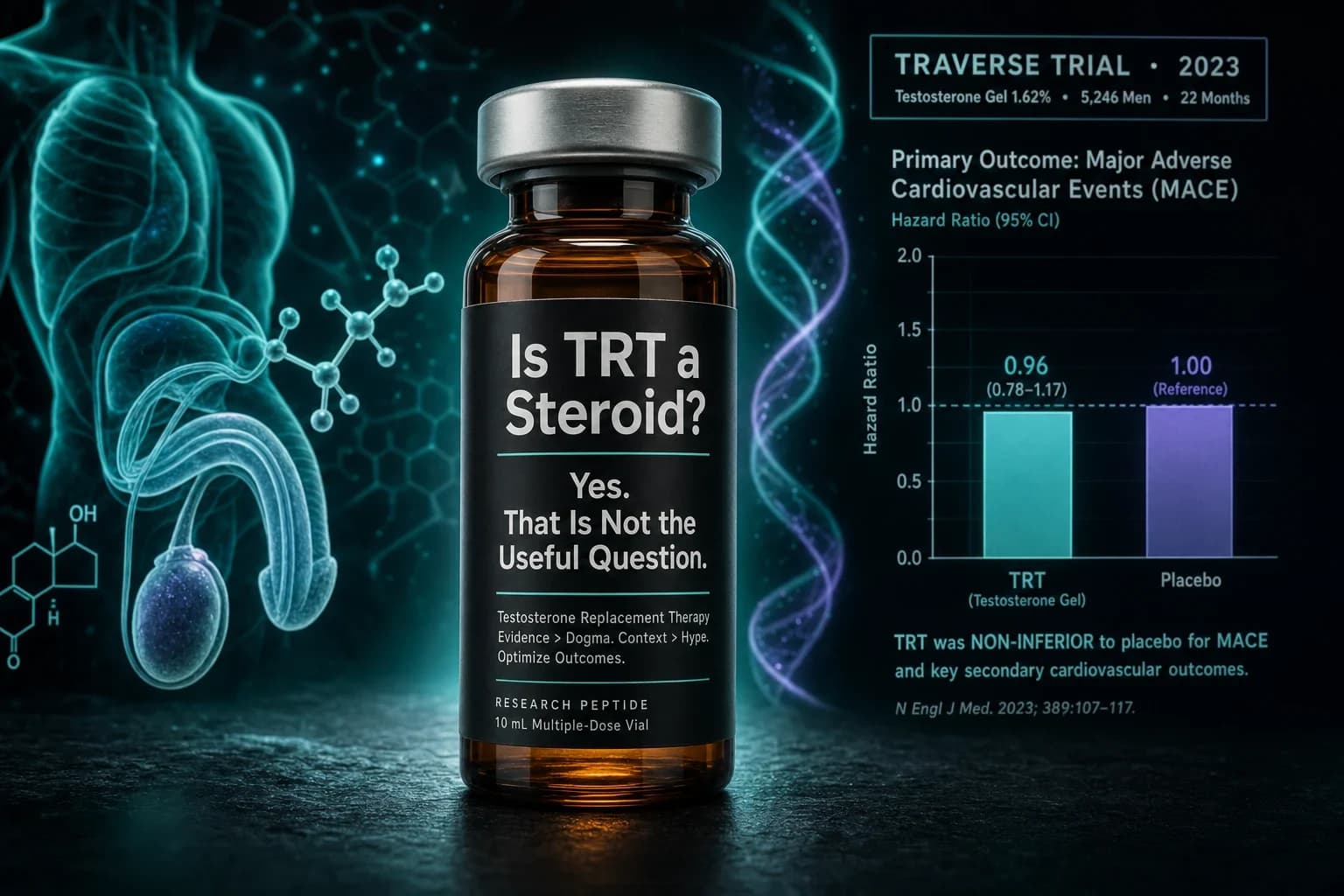
- TRAVERSE, 5,246 men over a mean 33 months, found TRT noninferior to placebo for major adverse cardiac events (Lincoff et al. 2023).
- Both suppress your own production. Recovery after non-prescribed steroid use often needs hCG-based therapy.
Yes. Testosterone is an anabolic androgenic steroid. It is the reference compound the entire class is named after and measured against, and in the United States it sits on Schedule III of the Controlled Substances Act alongside the compounds people mean when they say "steroids."
Most clinic pages answering this question dodge it. They write something about how TRT is "medically supervised hormone optimization, not steroid abuse," which is marketing, not pharmacology. Your androgen receptor cannot read a prescription.
The honest answer is that the molecule is identical and the dose is not, and the dose is where every meaningful difference lives.
The pharmacological line, with numbers
Bhasin and colleagues built the dataset that settles this. They suppressed endogenous production in 61 healthy men with a GnRH agonist, then administered weekly testosterone enanthate at 25, 50, 125, 300, or 600 mg for 20 weeks (Bhasin et al. Am J Physiol Endocrinol Metab 2001, PMID 11701431).
| Weekly dose | Testosterone achieved | Fat-free mass change | Category |
|---|---|---|---|
| 25 mg | 253 ng/dL | Not significant | Below replacement |
| 50 mg | 306 ng/dL | Not significant | Low replacement |
| 125 mg | 542 ng/dL | +3.4 kg | Replacement |
| 300 mg | 1,345 ng/dL | +5.2 kg | Supraphysiologic |
| 600 mg | 2,370 ng/dL | +7.9 kg | Supraphysiologic |
A normal reference range tops out around 1,000 ng/dL. So the line is not fuzzy, it is roughly between the 125 mg and 300 mg rows.
Replacement puts a deficient man back inside the range his own body would produce. A cycle deliberately takes a man past it. That is the entire distinction, and it is a real one, because effects scale with concentration.
Bottom line: Same molecule, same receptor, different dose, different pharmacology. TRT is steroid use in the literal sense and physiological restoration in the clinical sense, and both statements are true at once.
What supraphysiologic dosing does that replacement does not
The 1996 trial in the same lab gave 43 men 600 mg weekly or placebo, with or without supervised lifting, for 10 weeks. Testosterone plus exercise produced 6.1 kg of fat-free mass. Testosterone without any exercise still beat placebo on triceps and quadriceps cross-sectional area and on bench press and squat strength (Bhasin et al. N Engl J Med 1996, PMID 8637535).
Men who train have known that for decades. What is less appreciated is the flip side from the dose-response trial: HDL cholesterol fell as dose rose, and hemoglobin climbed with it. Erythropoiesis in particular scales linearly with dose and does so more steeply in older men (Coviello et al. J Clin Endocrinol Metab 2008, PMID 18160461).
Benefits scale with dose. So do the costs. Nothing about the receptor changes when a doctor writes the script.
The cardiovascular question, finally answered at replacement doses
For a decade the honest answer to "is TRT bad for your heart" was that nobody had run the trial. Now someone has.
TRAVERSE randomized 5,246 men aged 45 to 80 with hypogonadism and either existing cardiovascular disease or high risk for it, to daily 1.62% testosterone gel titrated to 350 to 750 ng/dL, or placebo. Mean treatment ran 21.7 months with 33 months of follow-up.
A primary cardiovascular event occurred in 182 testosterone patients (7.0%) versus 190 placebo patients (7.3%), hazard ratio 0.96, meeting the prespecified noninferiority margin (Lincoff et al. N Engl J Med 2023, PMID 37326322).
Read the whole finding, though. The trial also reported higher incidences of atrial fibrillation, acute kidney injury, and pulmonary embolism in the testosterone group. Noninferior for heart attack and stroke is not the same as harmless, and it says nothing about doses several times higher.
"Steroids" usually means other molecules entirely
Part of why this question is confused is that the word gets used for a category, and the category is not uniform. When people picture steroid harm, they are usually picturing compounds that are not testosterone.
The main culprit is a chemical modification. Adding a 17-alpha-alkyl group lets a steroid survive first-pass metabolism and therefore be taken orally, but the slower hepatic clearance is exactly what makes those compounds hepatotoxic. Documented consequences include elevated transaminases, acute cholestatic syndrome, chronic vascular injury, hepatic tumors, and fatty liver disease (Niedfeldt, Curr Sports Med Rep 2018, PMID 29521706).
Injectable testosterone esters are not 17-alpha-alkylated and do not carry that liver profile. Oral stanozolol, oxymetholone, and methandrostenolone do. Grouping them under one word is how a real risk gets attached to the wrong molecule and a real risk elsewhere gets ignored.
Long-term illicit use does show cardiac consequences, though, and the best imaging study is uncomfortable reading. Baggish and colleagues compared 86 weightlifters with at least two years of cumulative lifetime AAS use against 54 non-using weightlifters using echocardiography and coronary CT angiography. Users showed reduced left ventricular systolic function, mean ejection fraction 52% versus 63%, and reduced diastolic function, with the effect more pronounced in men currently on (Baggish et al. Circulation 2017, PMID 28533317).
Note what that cohort is: years of cumulative supraphysiologic use, typically stacking multiple compounds. It is not a study of 100 mg weekly under monitoring, and it should not be read as one. It is, however, the clearest available picture of where the dose-response curve goes if you keep walking up it.
The Endocrine Society's scientific statement on performance-enhancing drugs covers the broader picture, including the psychiatric and dependence dimensions that dose-response tables leave out (Pope et al. Endocr Rev 2014, PMID 24423981).
Where TRT and a cycle behave identically
Suppression. Exogenous testosterone shuts down LH and FSH through negative feedback, and it does not care about your intent.
Testicular volume falls. Sperm production falls, often to azoospermia. Both happen on 125 mg weekly under a doctor's care and on 600 mg weekly from a source, differing in degree rather than kind.
Recovery is where the two paths diverge in practice, mostly because of duration and dose. Anabolic steroid-induced hypogonadism can persist well after discontinuation and depends on dose, duration, and compound used, with management typically requiring judicious testosterone, hCG, and selective estrogen receptor modulators (Rahnema et al. Fertil Steril 2014, PMID 24636400).
The recovery numbers are encouraging when treated properly. Among 49 men with azoospermia or severe oligospermia from exogenous testosterone, hCG-based combination therapy restored or improved sperm production in 47 of them, averaging 4.6 months (Wenker et al. J Sex Med 2015, PMID 25904023).
Unaided recovery is slower and less certain. That is the practical argument for hCG or gonadorelin alongside a protocol rather than after it, which we cover in HCG vs gonadorelin.
The legal answer, since it is usually the real question
In the United States, testosterone and its esters are Schedule III controlled substances. Possession without a valid prescription is a federal offense regardless of the dose or the reason.
A prescription does not change the molecule's classification. It changes your legal position and gives you monitoring. Those are not small things, but they are legal and clinical facts rather than pharmacological ones.
Warning: Because testosterone is Schedule III, "research grade" or "for research use only" testosterone sold online is not a legal workaround. It is the same scheduled substance. This differs from genuinely unscheduled research peptides, which is why the two categories should not be reasoned about the same way.
So what should you actually ask
Not "is it a steroid." Ask these instead:
- Is my testosterone actually low? Two separate morning draws plus consistent symptoms is the diagnostic standard (Bhasin et al. J Clin Endocrinol Metab 2018, PMID 29562364).
- Why is it low? Secondary hypogonadism in a 32-year-old often has a reversible cause. Primary testicular failure does not.
- Do I want children? This decision is much harder to reverse than to make.
- What dose puts me mid-range? Mid-normal, not top-of-range. See our mg-to-mL dosage breakdown and run it through the dose calculator.
- Could restoration work instead of replacement? For secondary hypogonadism, HPG-axis compounds raise your own production instead of replacing it.
For younger men with an intact axis, that last question is the one worth the most and gets asked the least. Kisspeptin-10 and gonadorelin are available from Ascension Peptides with 50% off using code ENHANCED, and every batch we reference has a published certificate of analysis.
Bottom line: TRT is a steroid. It is also, at replacement doses in genuinely deficient men, one of the better-studied endocrine interventions in medicine. Both facts fit on the same page. Anyone who needs one of them to be false is selling you something.
This article is for informational and educational purposes only and is not medical advice. Testosterone is a Schedule III controlled substance in the United States and requires a valid prescription. Consult a licensed physician regarding diagnosis, treatment, and monitoring.