At a glance
- Only HPG-axis compounds raise testosterone: kisspeptin-10, gonadorelin, and hCG. GH secretagogues do not.
- Kisspeptin-10 infused at 1.5 mcg/kg/h raised mean LH from 5.2 to 14.1 IU/L in healthy men (George et al. 2011).
- Ipamorelin, CJC-1295, sermorelin, and MK-677 act on growth hormone. In swine, ipamorelin changed LH and FSH by nothing at all.
- hCG mimics LH directly and maintained sperm production in 12 of 13 hypogonadotropic men for up to 24 months (Depenbusch et al. 2002).
- Enclomiphene matched testosterone gel on total testosterone but, unlike gel, kept sperm counts in the normal range (Kim et al. 2016).
Search "peptides for testosterone" and you will get a list. Ipamorelin. CJC-1295. Sermorelin. Maybe MK-677 and tesamorelin. Nearly every clinic page ranking for that phrase sells you those five.
Four of them do not raise testosterone. Not a little. Not indirectly. They act on an entirely different hormonal axis, and the studies that established their pharmacology specifically measured LH and FSH and found no change.
That is the single most useful thing to know before you spend money here. Only a small set of compounds actually reaches the machinery that makes testosterone, and they work by pushing on the pituitary rather than replacing the hormone itself.
The two axes, and why the distinction decides everything
Your body runs growth hormone and testosterone on separate control loops that happen to share a neighborhood in the brain.
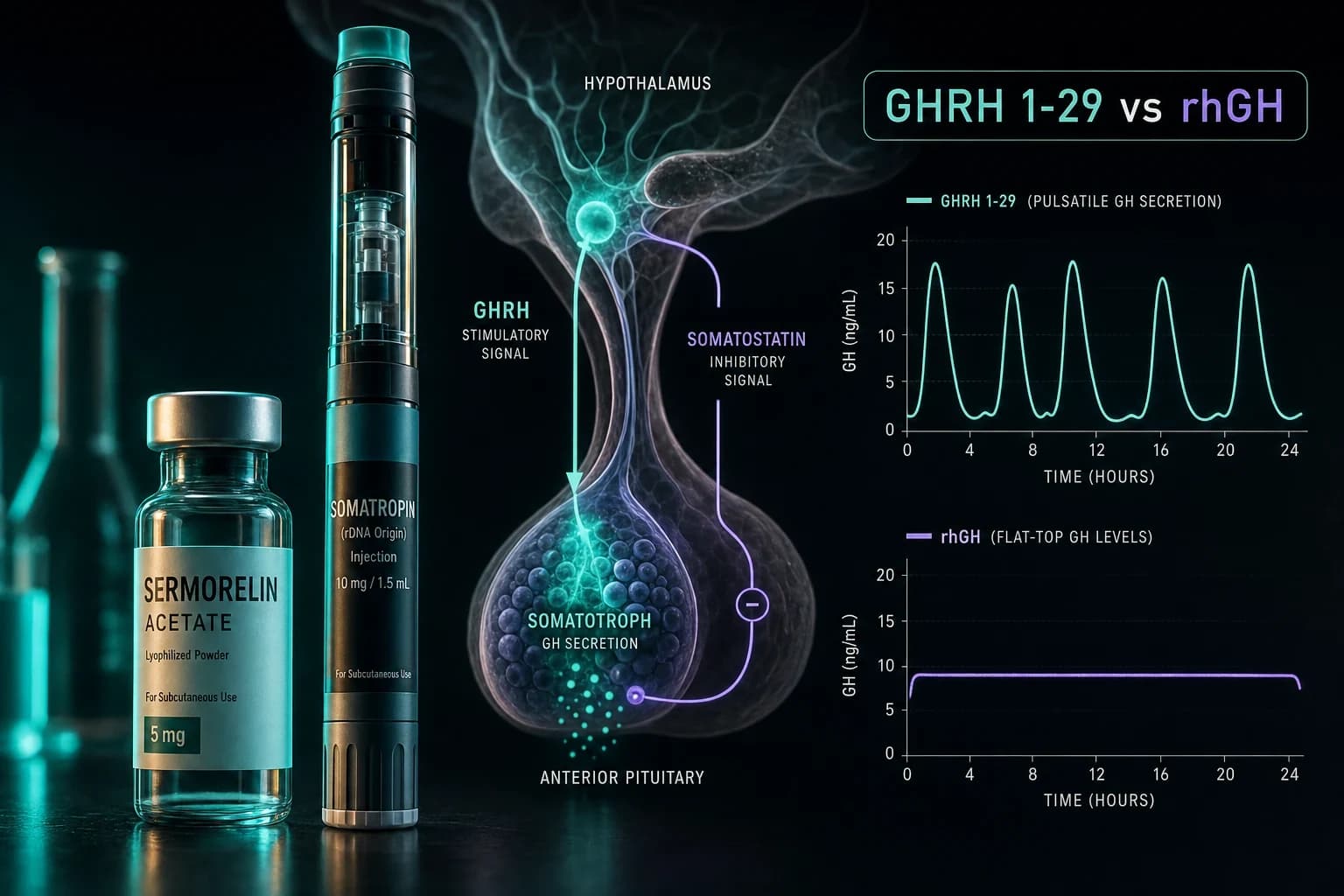
The GH axis runs hypothalamus (GHRH) to pituitary (growth hormone) to liver (IGF-1). Ipamorelin, CJC-1295, sermorelin, tesamorelin, and MK-677 all act here. They are growth hormone secretagogues.
The HPG axis runs hypothalamus (GnRH) to pituitary (LH and FSH) to testes (testosterone). Kisspeptin, gonadorelin, and hCG act here. These are the only ones that end with more testosterone.
Pushing the GH axis harder does not spill over into the HPG axis. The original ipamorelin characterization paper tested this directly in conscious swine and reported that none of the GH secretagogues studied affected FSH, LH, prolactin, or TSH plasma levels (Raun et al. Eur J Endocrinol 1998, PMID 9849822). Ipamorelin was singled out as remarkably clean: it did not even move ACTH or cortisol at doses more than 200-fold above the ED50 for GH release.
Bottom line: If a page sells you ipamorelin or CJC-1295 as a testosterone peptide, it is selling you a growth hormone product with a testosterone headline. Those compounds have real uses. Raising testosterone is not one of them.
Kisspeptin-10: the furthest upstream lever
Kisspeptin sits above GnRH. It is the switch that tells GnRH neurons to fire, which is why it draws the most research interest of anything in this category.
The human dose-response work is unusually clean. George and colleagues gave healthy men intravenous bolus doses from 0.01 to 3.0 mcg/kg and measured the LH response. Serum LH rose from 4.1 to 12.4 IU/L at 30 minutes, with maximal stimulation at 1 mcg/kg (George et al. J Clin Endocrinol Metab 2011, PMID 21632807).
Two details in that paper matter more than the headline.
First, more was worse. The 3 mcg/kg bolus produced a smaller response than 1 mcg/kg. That is a genuine inverted dose-response, not a plateau, and it is the opposite of how most people dose research compounds.
Second, continuous infusion worked. At 4 mcg/kg/h for 22.5 hours, LH went from 5.4 to 20.8 IU/L and testosterone rose from 16.6 to 24.0 nmol/L. A lower 1.5 mcg/kg/h infusion raised mean LH from 5.2 to 14.1 IU/L and, importantly, increased LH pulse frequency from 0.7 to 1.0 pulses per hour. Pulse frequency is the variable the HPG axis actually reads.
Full protocol detail sits on our kisspeptin dosage chart and the kisspeptin compound page.
Gonadorelin: pulsatile GnRH, one step lower
Gonadorelin is synthetic GnRH. It skips the kisspeptin layer and hits the pituitary directly.
The catch is pharmacokinetic, not theoretical. GnRH has a serum half-life measured in minutes, and the pituitary responds to pulses. Continuous GnRH exposure does the reverse of what you want: it downregulates the receptor and shuts the axis down. That is not a side effect, it is the entire mechanism behind GnRH agonist therapy used to suppress testosterone in prostate cancer.
So gonadorelin's usefulness depends on dosing frequency in a way that most compounds do not. We covered the full evidence and how it stacks against hCG in HCG vs gonadorelin for fertility on TRT. Compound detail is on the gonadorelin page.
hCG: the blunt instrument that works
hCG is not subtle and it is not new. It binds the LH receptor on Leydig cells directly, bypassing the hypothalamus and pituitary entirely. Long half-life, no pulsatility requirement.
The maintenance data is old and solid. Depenbusch and colleagues followed 13 men with hypogonadotropic hypogonadism who had spermatogenesis induced by GnRH or hCG/hMG, then switched them to hCG alone for 3 to 24 months. Sperm remained present in every patient except one, and testicular volume held at 87% of what combination therapy had achieved (Depenbusch et al. Eur J Endocrinol 2002, PMID 12444893).
For men who already suppressed themselves, the recovery data is more striking. Wenker and colleagues reviewed 49 men with azoospermia or severe oligospermia from exogenous testosterone, all placed on 3,000 IU hCG subcutaneously every other day plus an adjunct (clomiphene, tamoxifen, anastrozole, or FSH). Sperm returned or improved in 47 of 49 men, 95.9%, at an average of 4.6 months with a mean first density of 22.6 million/mL (Wenker et al. J Sex Med 2015, PMID 25904023).
That is the highest-confidence number in this entire article. See the hCG compound page for handling and reconstitution notes.
Enclomiphene is not a peptide, and it is the honest comparison
If your actual goal is "raise my testosterone without shutting down my testes," the best-evidenced option is not a peptide at all.
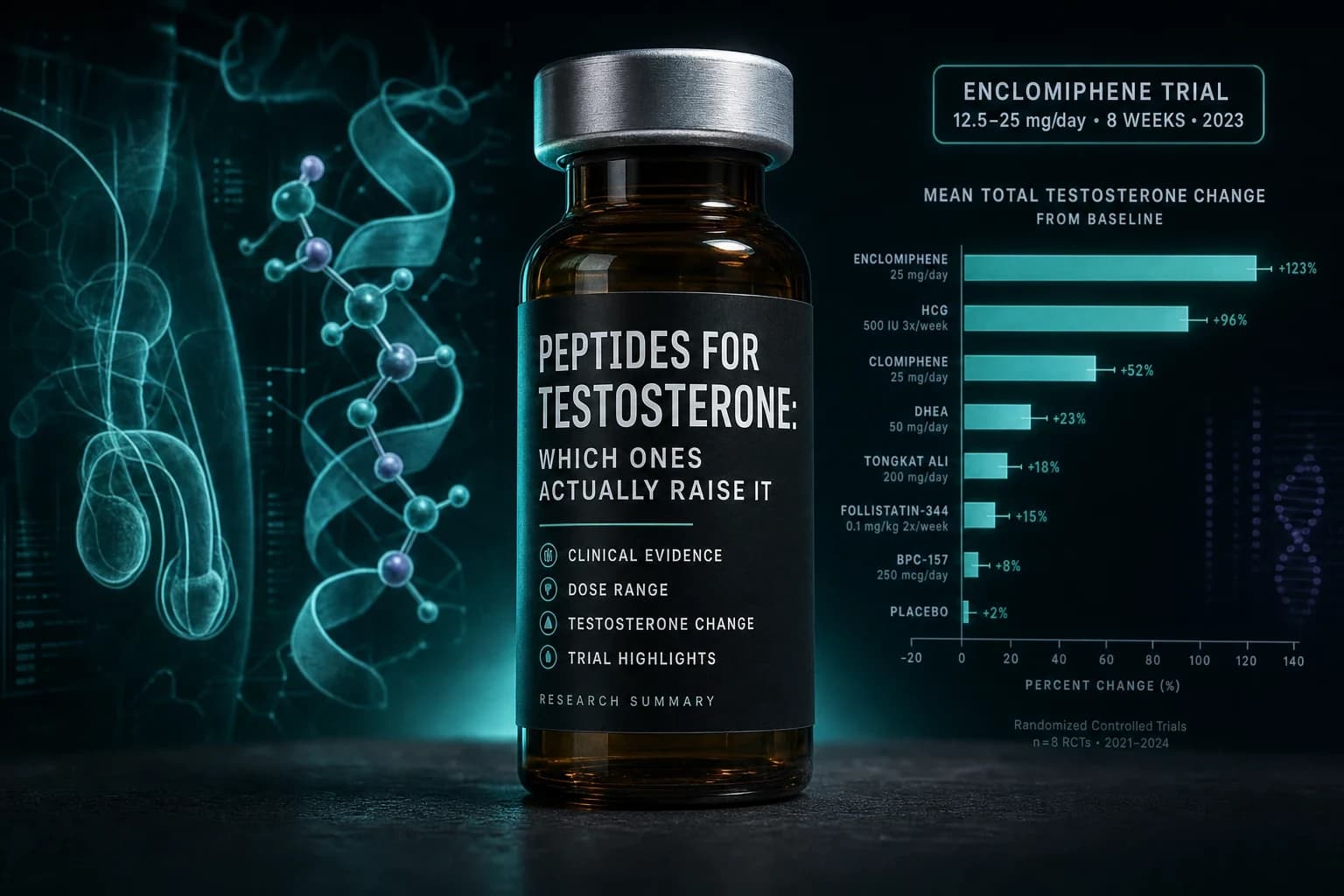
Enclomiphene is an estrogen receptor antagonist taken orally. Kaminetsky and colleagues ran it head to head against topical testosterone in men with secondary hypogonadism. At 6 months both groups sat around the same total testosterone. Only the enclomiphene group showed increased LH and FSH, and only enclomiphene raised sperm counts, in 7 of 7 men at 3 months and 6 of 6 at 6 months, with concentrations in the 75 to 334 million/mL range. The gel failed to push counts above 20 million/mL in all five men at 3 months (Kaminetsky et al. J Sex Med 2013, PMID 23530575).
Two later phase III trials in overweight men found the same split: enclomiphene raised total testosterone, LH, and FSH and held sperm concentration in the normal range, while testosterone gel raised testosterone and markedly reduced spermatogenesis (Kim et al. BJU Int 2016, PMID 26496621).
Restoration versus replacement. That framing is the paper's own, and it is the right one.
What each compound actually does
| Compound | Axis | Raises LH? | Raises testosterone? | Best human evidence |
|---|---|---|---|---|
| Kisspeptin-10 | HPG (above GnRH) | Yes, dose-dependent | Yes, on infusion | George 2011, n=6 dose-response |
| Gonadorelin | HPG (GnRH) | Yes, if pulsatile | Yes, if pulsatile | Mechanistic, thin outcome data |
| hCG | Bypasses to LH receptor | No, mimics it | Yes | Wenker 2015, 95.9% recovery |
| Enclomiphene (oral) | HPG (via estrogen receptor) | Yes | Yes | Kim 2016, two phase III trials |
| Ipamorelin | GH | No | No | Raun 1998, no LH/FSH change |
| CJC-1295 | GH | No | No | GHRH analog, no HPG action |
| Sermorelin | GH | No | No | GHRH 1-29, no HPG action |
| MK-677 | GH (oral ghrelin mimetic) | No | No | No LH/FSH effect |
If you are already on testosterone
The axis is already suppressed. Adding kisspeptin or gonadorelin on top of exogenous testosterone is pushing on a door that testosterone is holding shut through negative feedback, which is why the fertility literature reaches for hCG rather than upstream agents in that population.
The TRT hub covers the replacement side in full. The Endocrine Society guideline is explicit that clinicians should discuss fertility suppression before starting testosterone in men who want children (Bhasin et al. J Clin Endocrinol Metab 2018, PMID 29562364). Most men are not told. If you are weighing this decision, read our breakdown of what actually changes on TRT and when first.
Warning: None of these compounds are approved for raising testosterone in healthy men. Kisspeptin-10 and gonadorelin are sold for research use only. Suppressed testosterone has causes that range from trivial to serious, and a pituitary tumor does not care how good your peptide protocol is. Get bloodwork and a real diagnosis before you get a vial.
Why secondary hypogonadism is the population that matters here
Every compound above works by asking the testes to produce more. That only works if the testes can.
Primary hypogonadism means the testicular tissue itself has failed. LH and FSH are already high because the pituitary is shouting and nothing is answering. Kisspeptin, gonadorelin, and hCG all shout louder at a gonad that cannot respond, and none of them will help.
Secondary hypogonadism is the opposite. The testes are fine, the signal is low. LH and FSH come back low or inappropriately normal alongside low testosterone. This is the population where restoration works, and it is disproportionately younger men, men carrying excess body fat, and men recovering from suppression.
The diagnostic split costs one blood draw. Order LH and FSH alongside total testosterone and the picture resolves immediately:
| Pattern | LH and FSH | Interpretation | Do HPG-axis compounds help? |
|---|---|---|---|
| Low testosterone, high LH/FSH | Elevated | Primary, testicular failure | No |
| Low testosterone, low or normal LH/FSH | Low or mid | Secondary, signal problem | Plausibly yes |
| Low testosterone, suppressed LH/FSH, exogenous use | Undetectable | Induced suppression | hCG path only |
Men skip this test constantly, start a protocol, see nothing, and conclude the compound is fake. Sometimes the compound was fine and the axis was never the problem.
Sourcing, because purity decides the experiment
Every number above assumes the compound in the vial is the compound on the label at the stated mass. For research peptides that is an assumption, not a given. Check the batch certificate of analysis before you dose anything, and cross-reference against our independent COA library.
Kisspeptin-10, gonadorelin, and hCG are all available from Ascension Peptides with 50% off using code ENHANCED. Run your mg-to-mL math on the reconstitution calculator before you draw, because these are low-dose compounds where a decimal error is the whole dose.
Bottom line: If you want testosterone to go up, look at kisspeptin-10, gonadorelin, hCG, or enclomiphene. If someone sells you ipamorelin for testosterone, they are either not reading the pharmacology or counting on you not to.
This article is for research and educational purposes only. It is not medical advice. Kisspeptin-10 and gonadorelin are research chemicals not approved for human use. hCG and enclomiphene are prescription products in the United States. Consult a licensed physician before beginning, changing, or stopping any hormone protocol.