At a glance
- Rogan credits BPC-157 with healing nagging tendon and joint pain; Huberman is far more cautious
- Huberman's core caveat: there is essentially zero human clinical trial data on BPC-157
- The healing evidence is genuinely strong but almost entirely in rats (Chang 2011, Gwyer 2019)
- BPC-157 promotes VEGF-driven angiogenesis, which is the basis for the theoretical cancer concern
- Huberman advises cycling rather than continuous use and sourcing from a tested, COA-backed supply
Joe Rogan talks about BPC-157 like it rebuilt his body. Andrew Huberman, sitting across the table, keeps adding the same quiet asterisk: we have almost no human data on this thing. Both of them are right, and the gap between those two positions is the most useful part of the whole conversation.
In JRE #2195 (August 2024) and across their earlier sit-downs, the two keep circling back to peptides, and BPC-157 is the one that comes up most. Rogan is the enthusiast. Huberman is the scientist who clearly likes the mechanism but will not pretend the human evidence exists. Here is what each of them actually says, and what the published research backs up.
What Rogan and Huberman actually say
Rogan is the testimonial. He has credited BPC-157 with clearing up stubborn tendon and joint pain from years of grappling and lifting, and he describes the kind of fast relief that makes listeners open a new browser tab.
Huberman is more careful. He has acknowledged using BPC-157 subcutaneously and felt it accelerated his own healing, but he immediately wraps that in the caveats most influencers skip. Pulled together, his repeated position runs like this:
- The human clinical trial data is essentially nonexistent.
- The animal data, by contrast, is real and fairly deep.
- There is a theoretical cancer concern tied to how the peptide works.
- If you use it, cycle it rather than running it continuously.
- Source matters enormously, because the gray market is full of mislabeled or contaminated product.
Bottom line: Rogan is the testimonial. Huberman is the fine print. For a compound with this little human data, the fine print is the part that protects you.
"Basically zero human data" is the real headline
Strip out the enthusiasm and Huberman's central, repeated point is simple: the human evidence for BPC-157 is close to nonexistent. There are no large randomized controlled trials in people. Almost everything we know comes from rodent studies, plus a large pile of anecdote.
That is not Huberman being a buzzkill. It is an accurate description of the literature. We wrote a whole breakdown of exactly this gap in the BPC-157 human clinical data gap explainer, and the short version is that the compound has been studied for decades in animals and barely at all in humans. Anyone telling you BPC-157 is "clinically proven" in people is selling something.
The animal evidence is genuinely strong
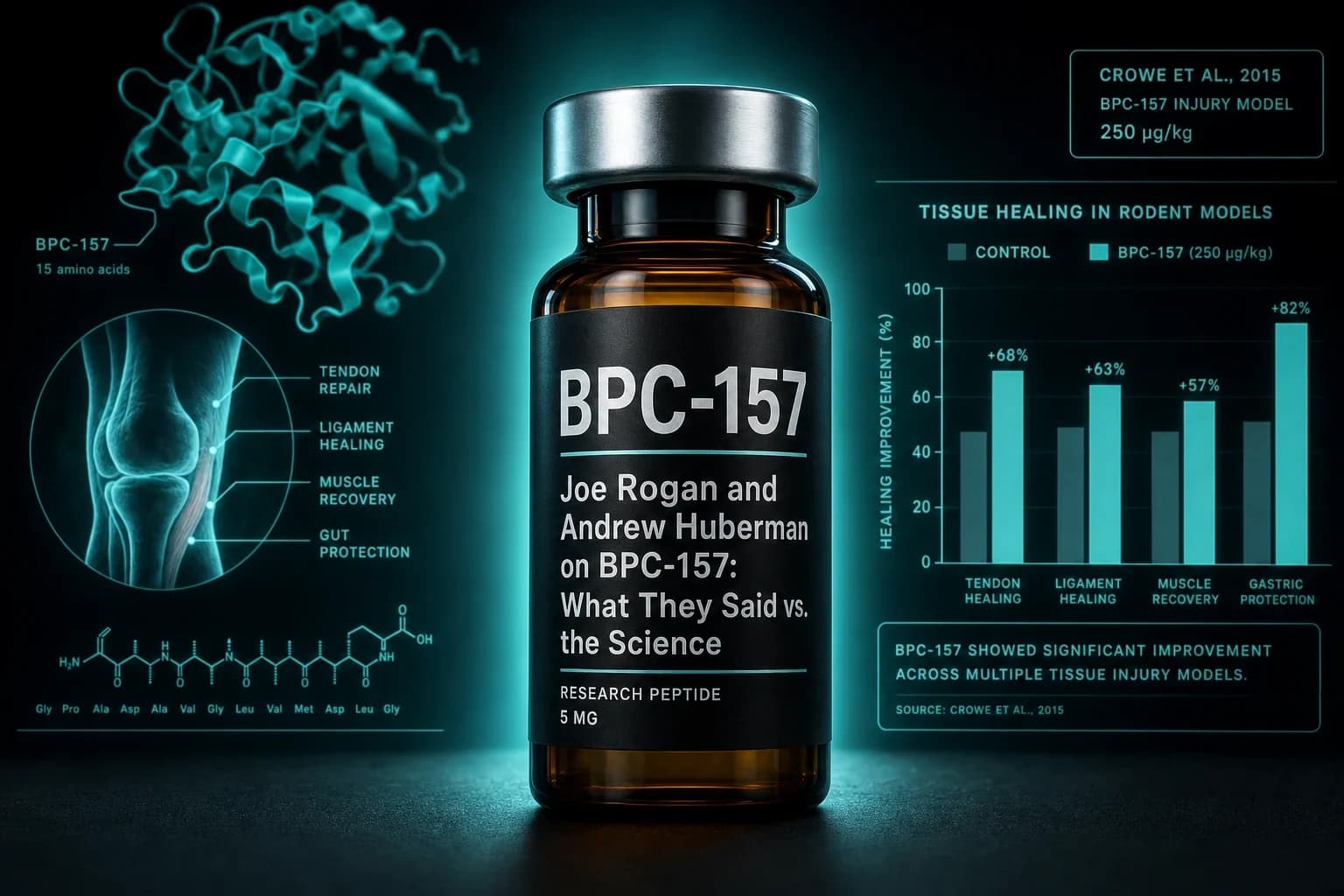
Where Huberman gives BPC-157 credit is the preclinical record, which is unusually consistent for a research peptide. This is the part that makes the hype understandable, even if it does not transfer cleanly to humans.
| Study | Model | Finding |
|---|---|---|
| Chang et al. (2011) | Rat tendon, in vitro | Accelerated tendon fibroblast outgrowth, survival, and migration |
| Chang et al. (2014) | Tendon fibroblasts | Increased growth hormone receptor expression, a plausible healing pathway |
| Gwyer et al. (2019) | Review, soft tissue | Consistent tendon, ligament, and muscle healing across rodent models |
| Seiwerth et al. (2014) | Review, vasculature | Pro-angiogenic and wound-healing effects via new blood vessel formation |
| Sikiric et al. (2022) | Broad therapeutic review | Gut, tendon, and nerve repair signals across many animal studies |
A big part of the mechanism is angiogenesis. BPC-157 upregulates VEGF signaling and promotes new blood vessel growth, which is plausibly why injured tendon, muscle, and gut tissue heal faster in these models. The full mechanism is in our BPC-157 compound guide. The honest caveat: a rat tendon healing faster in a lab is a real result, not a human outcome.
The cancer question, handled straight
The same property that makes BPC-157 interesting for healing is the basis for Huberman's main safety caveat. Tumors need a blood supply to grow. A compound that systemically encourages angiogenesis is, in theory, the last thing you want circulating if you have an undiagnosed or existing cancer.
Two things need to be true at once here. There is no human evidence that BPC-157 causes or accelerates cancer. And the mechanistic concern is still legitimate enough that a careful person flags it. That is exactly why Huberman raises it, and why anyone with a personal or family history of cancer should talk to a physician before going near it. Precaution is not the same as proof, but with this little human data, precaution is the rational default.
Warning: If you have a personal or family history of cancer, BPC-157's pro-angiogenic mechanism is a real reason to talk to a doctor first. The risk is theoretical, not demonstrated, but the human safety data that would rule it out does not exist.
Sourcing: the part our readers should not skip
Huberman's most practical point is the one least likely to get clipped into a viral short: a lot of what gets sold as BPC-157 is not what the label claims. Underdosed, mislabeled, or contaminated product is common in the research-chemical gray market, and you cannot evaluate a compound whose identity you cannot trust.
This is where the testimonial-versus-evidence debate gets concrete. The single best filter is a per-batch certificate of analysis: an independent HPLC purity number tied to the exact lot in your hand. We track those for BPC-157 in our lab-tests database, and the full pre-purchase checklist is in the where to buy BPC-157 with a COA guide.
For injectable BPC-157 with public per-batch COAs, Ascension Peptides is our standing pick, and code ENHANCED takes 50% off (that is an affiliate link). The point is not which logo is on the vial; it is that the lot is tested and the purity is published before you draw anything into a syringe.
What to actually do with all this
- Match your expectations to the evidence. Strong in rats, unproven in humans. Treat it as research, not medicine.
- If you proceed, cycle it the way Huberman suggests rather than running it indefinitely.
- Buy only against a per-batch COA. Verify the lot before you open it.
- If you have any cancer history, talk to a physician first. Do not freelance this one.
- Remember the context. BPC-157 is most discussed alongside TB-500 for recovery; the pairing is covered in our Wolverine stack protocol, and a newer analog gets its own writeup in the pentadeca arginate research.
For the broader picture of which peptides actually have human data behind them, our Huberman peptides episode breakdown and the best legit peptide vendors 2026 ranking are the next two reads.
FAQ
Does Andrew Huberman recommend BPC-157?
Not as a blanket endorsement. He has said he used it and felt it helped his own recovery, but he consistently frames it with heavy caveats: essentially no human data, a theoretical cancer concern, cycle rather than run continuously, and source carefully. That is closer to "interesting and use-at-your-own-risk" than "recommended."
Did Joe Rogan say BPC-157 healed his injuries?
Rogan has repeatedly credited BPC-157 with resolving stubborn tendon and joint pain. It is a personal anecdote, not a clinical result, and it is exactly the kind of single-person testimonial Huberman counterbalances with the data caveat.
Is there human clinical data on BPC-157?
Essentially none of the high-quality kind. There are no large randomized controlled trials in humans. The evidence base is overwhelmingly preclinical (rodent), which is why "basically zero human data" is the accurate summary. See our human data gap explainer.
Is BPC-157 safe?
In animal studies its safety profile looks favorable, but human safety is genuinely unknown, and the pro-angiogenesis mechanism creates a real theoretical concern for anyone with cancer risk. Unknown is not the same as dangerous, but it is also not the same as safe.
This article is for educational and research purposes only. BPC-157 is not approved by the FDA for human use and is not for human consumption. It summarizes publicly available statements by Joe Rogan and Andrew Huberman and the published preclinical literature; it is not medical advice and does not represent the views of either individual. Nothing here is a recommendation to use BPC-157. Links to Ascension Peptides are affiliate links (code ENHANCED) on which we earn a commission; the editorial position would be the same without it. Talk to a qualified physician before starting any compound, especially if you have a personal or family history of cancer.