At a glance
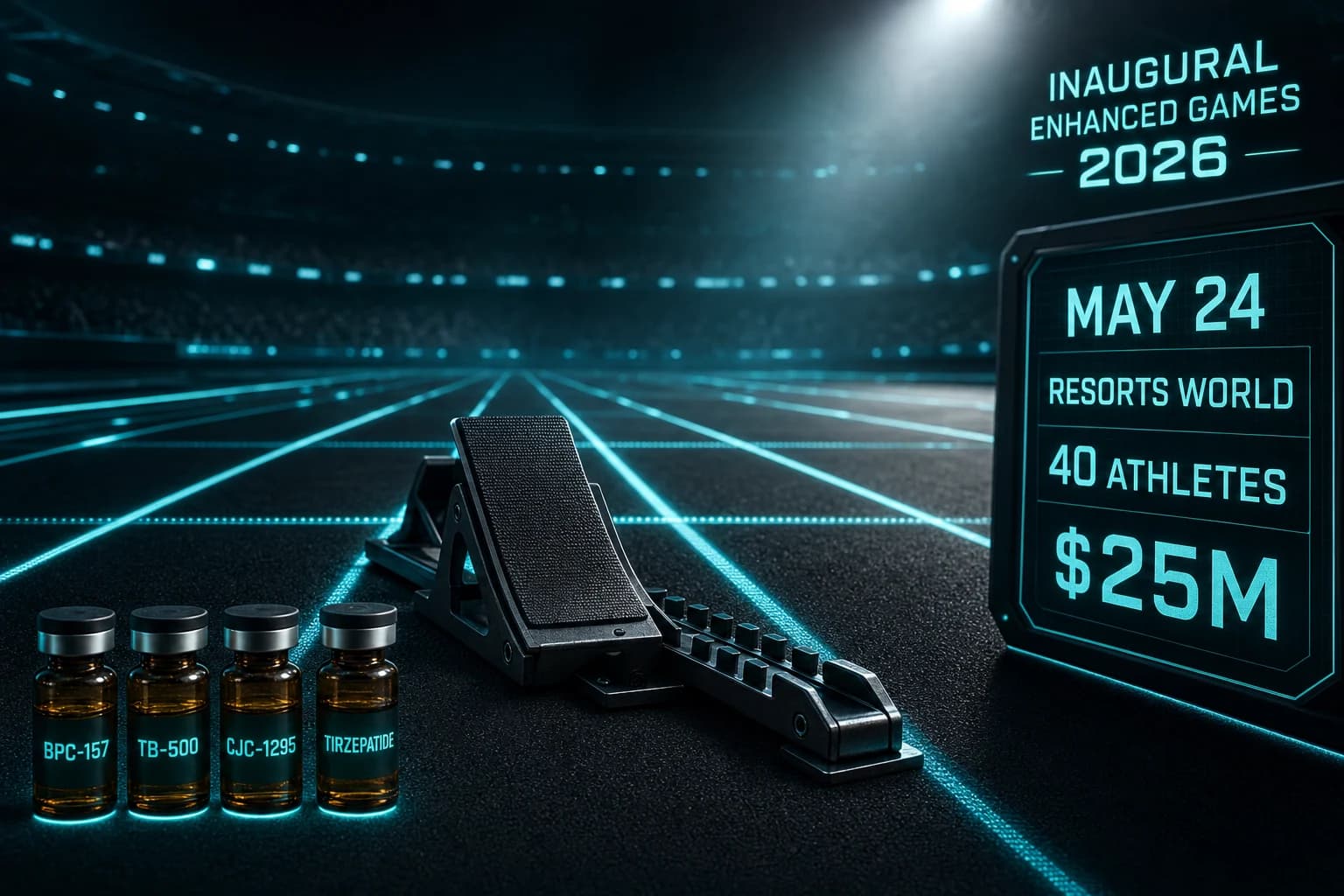
- Inaugural Enhanced Games run May 21-24, 2026 at Resorts World Las Vegas across swimming, athletics, weightlifting
- 40 elite athletes compete for a $25 million total prize pool; spectators are invite-only at 2,500 seats
- Lead disclosed athletes include Fred Kerley (US sprint), Ben Proud (UK swim), James Magnussen (AUS swim)
- The Games arrive 10 weeks after HHS Secretary RFK Jr's Feb 27, 2026 announcement moving 14 of 19 peptides from FDA Category 2 back to Category 1, restoring legal compounding-pharmacy access
- Most disclosed athlete protocols pair injectable recovery peptides (BPC-157, TB-500) with growth-hormone secretagogues (CJC-1295 + Ipamorelin) and a testosterone base
The inaugural Enhanced Games are now ten days out. The competition runs May 21-24, 2026 at Resorts World Las Vegas, with 40 elite athletes competing for $25 million in total compensation across swimming, athletics, and weightlifting. The peculiar fact about the Enhanced Games is that the headline athletes have publicly disclosed their performance-enhancing protocols, which means the event is effectively a live demonstration of what FDA-approved peptides, anabolic steroids, and stimulants produce in elite performers when stacked openly rather than concealed.
This article covers what to expect from opening day, who is competing in what events, the disclosed stacks the top names are running, and the regulatory backdrop that has shifted dramatically in the last 12 weeks with the HHS peptide reclassification.
For broader background on the Enhanced Games as a concept, see the Enhanced Games 2026 peptides & PEDs primer.
Schedule and venue
Resorts World Las Vegas built a custom competition complex for the event. The format is invite-only spectator (2,500 seats) with the bulk of audience reach coming through livestream and broadcast distribution. Memorial Day Weekend is the deliberate slot. Aron D'Souza's pitch to broadcasters and sponsors has consistently emphasized prime-time slot, prime-time talent.
The disciplines are concentrated, not Olympic-broad:
- Swimming (50m and 100m freestyle, with at least one stroke event)
- Athletics (100m sprint, with a published target of breaking the 100m world record)
- Weightlifting (clean and jerk, snatch)
The event slate is the smallest in the broader Olympic-format space. The targeting reflects what the founders consider tractable: events where peptide-and-PED protocols produce the largest measurable performance differential against the WADA-tested baseline.
The headline athletes
Three names anchor the marketing and the betting markets:
Fred Kerley. US sprinter, 2022 World Championships 100m silver medalist, 2021 Tokyo Olympics 100m silver medalist. Kerley's signed deal made him the biggest Olympic-bona-fides athlete to cross the line into Enhanced Games competition. His publicly disclosed protocol includes growth hormone, testosterone, and a stimulant component. He is the favorite for the 100m sprint event.
Ben Proud. British swimmer, 2024 Paris Olympics 50m freestyle silver medalist, multiple-time world champion in the 50m freestyle. Proud announced his Enhanced Games participation in late 2025. He is the favorite for the 50m freestyle event and has publicly indicated his protocol focuses on testosterone optimization and recovery stacks.
James Magnussen. Australian swimmer, 2012 London Olympics 100m freestyle silver medalist. Magnussen was the first Olympic-bona-fides athlete to publicly commit to the Enhanced Games and remains one of its most-discussed competitors. His disclosed protocol includes the Wolverine Stack (BPC-157 + TB-500), the FIT Stack (CJC-1295 + Ipamorelin), and a testosterone base.
Beyond the headliners, the 40-athlete roster includes weightlifting and athletics specialists who have less name recognition but more aggressive disclosed protocols. The full roster has been rolled out incrementally through Q1 and Q2 2026 marketing.
Bottom line: The headline names are real Olympic-level talent. Kerley, Proud, and Magnussen all have podium hardware from the WADA-tested system. Whether their performances at the Enhanced Games meaningfully exceed their WADA-tested bests is the central data point the event will produce.
What the disclosed stacks actually contain
The disclosed athlete protocols cluster around three families of compounds.
Recovery peptides. Most disclosed protocols include BPC-157 and TB-500, typically as the pre-mixed Wolverine Stack. Standard dosing is 2.5 mg of each compound twice weekly during loading, dropping to 2.5 mg weekly maintenance. The mechanism case is angiogenesis, cell migration, and tissue repair acceleration. The published evidence is preclinical-heavy.
Growth hormone secretagogues. CJC-1295 and Ipamorelin together (the FIT Stack) drive endogenous growth hormone pulses without raising baseline GH. Standard dosing pairs 100 mcg CJC-1295 with 100 mcg Ipamorelin three times daily, or once nightly. The body composition and recovery rationale is real; the muscle hypertrophy magnitude in healthy athletes is modest.
Testosterone base. Most male athletes in the Enhanced Games disclose testosterone as the foundational compound, typically administered at supraphysiological doses (250-500 mg weekly). This is the largest direct contributor to lean mass and recovery in most published anabolic-androgenic-steroid literature.
The full disclosed protocols also include compound-specific additions: aromatase inhibitors to manage estrogen conversion, hCG to maintain testicular function, and various ancillary support compounds. The peptide layer is the lowest-risk and most-modular part of the protocol.
For a deeper analysis of how Magnussen's protocol maps to the published literature on each compound, the original Enhanced Games coverage walks through the mechanism case in detail.
The FDA peptide reclassification backdrop
The Enhanced Games arrive 10 weeks after a major regulatory shift in the United States peptide market. On February 27, 2026, Health and Human Services Secretary Robert F. Kennedy Jr. announced that 14 of the 19 peptides previously restricted under the FDA's Category 2 list would be moved back to Category 1, restoring legal compounding-pharmacy access through licensed compounding agents.
The peptides moved back to Category 1 include:
- BPC-157
- TB-500 (Thymosin Beta-4)
- CJC-1295
- Ipamorelin
- Several growth hormone secretagogues and recovery peptides
This is the largest restoration of US peptide compounding access in over a decade. The practical implication: athletes can now obtain BPC-157, TB-500, and the growth-hormone secretagogues through licensed compounding pharmacies with a prescription, rather than navigating the gray market.
The timing matters for the Enhanced Games. Most of the disclosed athlete protocols rely on peptides that are now legitimately compoundable through licensed pharmacies. The regulatory narrative for the event has shifted from "athletes using gray-market compounds" to "athletes using FDA-recognized compounds dispensed under medical supervision."
For the broader regulatory context, see the FDA 503A peptide compounding review. The July 2026 PCAC vote will further determine which compounds remain compoundable long-term, but the February reclassification has already changed the practical landscape.
Bottom line: The peptide layer of Enhanced Games athlete stacks is no longer in regulatory limbo. Most of what athletes have disclosed is now legally compoundable through prescription pathways. The headline stacks have effectively been validated by regulatory normalization in parallel with the competition.
What the broadcasts will reveal
Three data points the event will produce that the WADA-tested ecosystem cannot:
1. Performance ceilings without testing constraints. What does a 50m freestyle look like when the swimmer has been openly running testosterone, growth hormone, and peptide recovery stacks? Ben Proud's pre-Enhanced personal best is 21.11 seconds. The Enhanced Games target for the same event is reportedly under 20.8 seconds. The gap is the measurable data the event is engineered to produce.
2. Real-time biomarker disclosure. Several Enhanced Games athletes have agreed to publish their pre-event biomarker panels: testosterone levels, IGF-1, hematocrit, and other indicators that WADA would treat as red flags. The transparency contrasts sharply with the WADA framework's adversarial testing structure.
3. Recovery-window mechanics. The athletes have been running their disclosed protocols for months before the event. The pre-event taper, recovery profile, and competition-day performance map to a different physiological state than peak WADA-tested athletes. Coaches and physiologists will be watching how the protocols translate to in-event performance.
The downside conversation
Not all of the Enhanced Games narrative is favorable to the participants.
Long-term cardiovascular risk. Sustained supraphysiological testosterone, particularly combined with growth hormone, carries documented cardiovascular risk in the bodybuilding literature. The Enhanced Games athletes are running short-term protocols (typically 6-12 months of pre-event preparation) and the long-term implications of post-event continuation are not characterized.
Adoption among non-elite athletes. The Enhanced Games openly demonstrate what peptide-and-PED protocols can produce. The signal that careless adoption by recreational athletes is producing more frequent cardiac events in fitness-adjacent populations is real. The Games are likely to accelerate this rather than reverse it.
Anti-doping testing infrastructure pressure. WADA's response to the Enhanced Games has been to reaffirm its testing framework. The detection windows for compounds like BPC-157 and TB-500 are validated in equine testing labs but the human-athlete enforcement is uneven. Enhanced Games normalization may increase competitive pressure on WADA labs to update detection methods.
For research-grade understanding of what these compounds do in published trials, see the Wolverine Stack BPC-157 + TB-500 recovery protocol, the CJC-1295 + Ipamorelin stack protocol, and the TB-500 dosage guide.
How to follow the event
Memorial Day Weekend, May 21-24. The opening ceremony and weightlifting begin on May 21. Athletics runs on May 22-23. Swimming and the headline 100m sprint run on May 24. Distribution will be through Enhanced Games' own broadcast partners; specific carrier details have rolled out across Q2 2026.
The headline events to flag:
- May 22: 100m sprint (Kerley vs the field, with the target of pressuring the 9.58 world record)
- May 23: Mens 100m freestyle (the event Magnussen and Proud are most associated with)
- May 24: 50m freestyle final (Proud's stronghold)
- May 21 evening: First weightlifting medals
For peptide research context on each event's underlying compound mechanism, the BPC-157 dosing protocol guide and the growth hormone secretagogue coverage at /peptides/cjc-1295 provide the depth.
FAQ
When does the Enhanced Games start?
May 21-24, 2026, Memorial Day Weekend, at Resorts World Las Vegas. The opening events are weightlifting on May 21. The headline 100m sprint runs May 22. The 50m freestyle final runs May 24.
Who are the favorite athletes?
Fred Kerley (US sprint, 100m), Ben Proud (UK swim, 50m freestyle), and James Magnussen (AUS swim, 100m freestyle) are the headline Olympic-bona-fides competitors. The full 40-athlete roster includes weightlifting and athletics specialists with less mainstream name recognition but more aggressive disclosed protocols.
What stacks are the athletes running?
The disclosed protocols typically combine three families: recovery peptides (BPC-157 and TB-500, often as the Wolverine Stack), growth hormone secretagogues (CJC-1295 + Ipamorelin, often as the FIT Stack), and a testosterone base at supraphysiological doses. Aromatase inhibitors, hCG, and event-specific stimulants round out the protocols depending on athlete and sport.
How did the FDA peptide reclassification affect the Enhanced Games?
The February 27, 2026 HHS announcement moved 14 of 19 peptides (including BPC-157, TB-500, CJC-1295, Ipamorelin) from FDA Category 2 back to Category 1, restoring legal compounding-pharmacy access. The peptide layer of Enhanced Games athlete protocols is now legitimately accessible through prescription pathways rather than gray-market sourcing. This shifted the regulatory narrative for the event meaningfully in the 10 weeks before opening day.
Are Enhanced Games athletes subject to drug testing?
No standard drug testing in the WADA sense. The Enhanced Games policy requires that performance-enhancing substances used by athletes be FDA-approved and administered under medical supervision. The model is openness rather than concealment. Pre-event biomarker panels are disclosed publicly by several participating athletes.
Will the Enhanced Games actually break records?
Performance targets the event has publicly stated include breaking the men's 100m world record (currently 9.58 seconds, Bolt 2009) and producing 50m freestyle times under 20.8 seconds. Whether either target is reached is the central performance question the event will answer in real-time on May 22-24.
What does this mean for the peptide market?
The Enhanced Games combined with the FDA reclassification creates a meaningful demand signal for peptides like BPC-157, TB-500, and growth-hormone secretagogues. Compounding pharmacies are scaling up to meet demand. Research-grade peptide vendors are seeing increased traffic. The legal access pathways and the public visibility of athlete protocols are converging in the same window.
Sourcing context
For research-grade injectable peptides with public per-batch COAs, Ascension Peptides ships with 50% off using code ENHANCED. The Wolverine Stack (BPC-157 + TB-500), FIT Stack (CJC-1295 + Ipamorelin), and individual compound vials are all in the catalog. For oral and nasal formats, Limitless Biotech ships with code ENHANCED.
For broader vendor analysis, see the best legit peptide vendors 2026 ranking.
Further reading
- Enhanced Games 2026 peptides & PEDs primer
- Wolverine Stack BPC-157 + TB-500 recovery protocol
- FIT Stack CJC-1295 + Ipamorelin GH protocol
- TB-500 dosage guide
- BPC-157 dosing protocol guide
- FDA 503A peptide compounding review July 2026
- Best legit peptide vendors 2026
This article is for educational and informational purposes only. None of the compounds discussed in disclosed Enhanced Games athlete protocols are described here as recommendations. Use of testosterone, growth hormone, anabolic steroids, and research peptides carries documented health risks including cardiovascular, hepatic, and endocrine complications. Consult a qualified clinician before considering any of the protocols described. Research-grade peptides are sold under research-use disclosures and not for human consumption.