At a glance
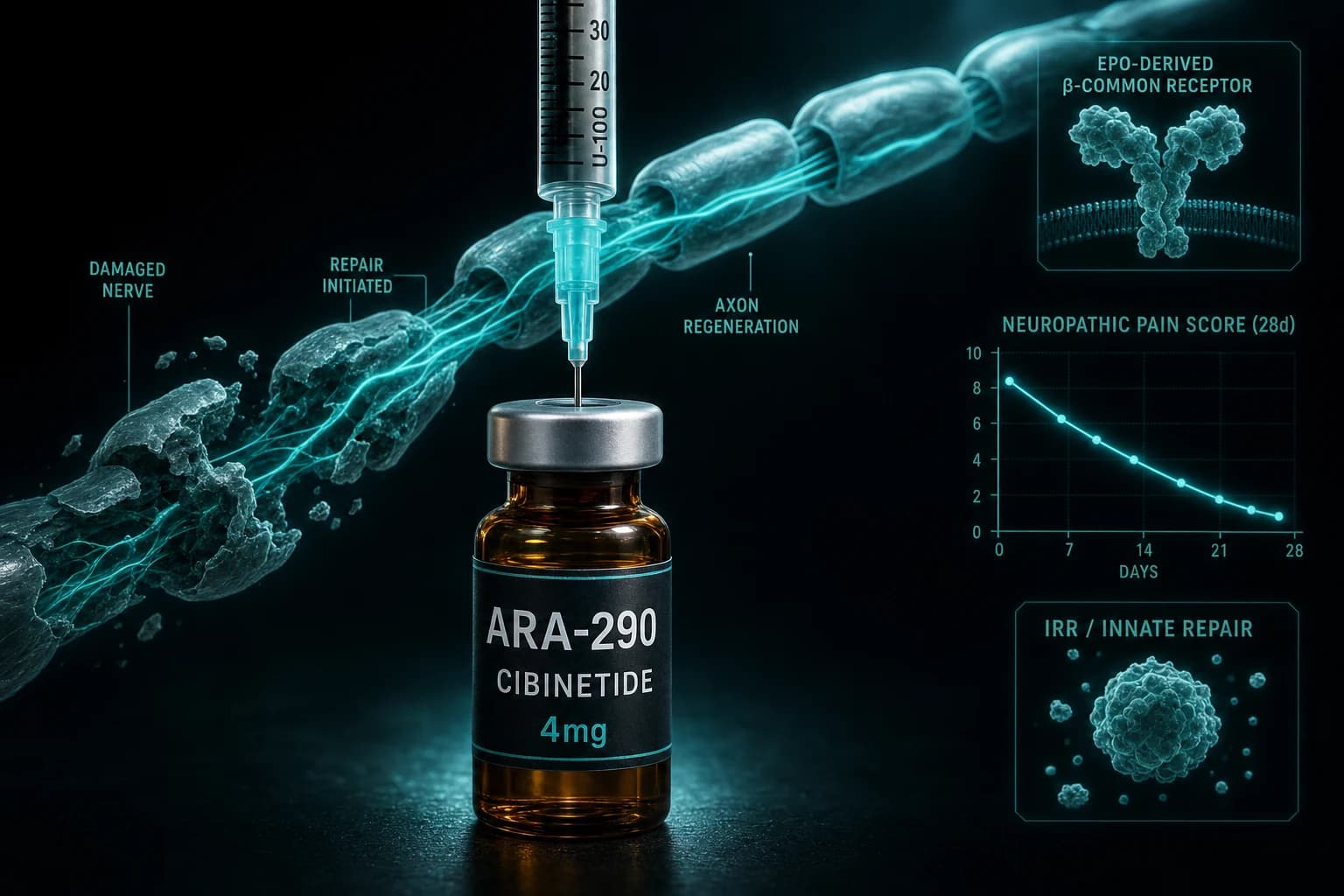
- ARA-290 (cibinetide) is an 11-amino-acid peptide engineered from the tertiary structure of erythropoietin (EPO) that retains tissue-protective activity without stimulating red blood cell production
- Standard research dose: 4 mg subcutaneous daily for 28 days in published human trials (sarcoidosis and T2D neuropathy)
- Phase 2 trials reported significant improvement in neuropathic pain scores and increased corneal nerve fiber density (Heij et al., 2012; Brines et al., 2014; Dahan et al., 2014)
- Mechanism: activates the Innate Repair Receptor (IRR), a heterodimer of EPO receptor and β-common receptor, suppressing inflammation and supporting nerve repair
- ARA-290 does not bind the homodimeric EPO receptor that drives erythropoiesis, so it produces no rise in hematocrit or red blood cell counts
ARA-290 is the rare peptide where the engineering rationale is more interesting than the marketing claim. Erythropoietin (EPO) has long been known to have tissue-protective effects beyond its red-blood-cell-production role, but using EPO for tissue repair carries serious cardiovascular risk because of the hematocrit rise. ARA-290 was specifically engineered to separate the two functions: keep the tissue-protective action, drop the erythropoietic action. The Phase 2 trials in sarcoidosis-associated and diabetic neuropathy demonstrated the design worked.
This article covers what ARA-290 is at the molecule level, the Innate Repair Receptor mechanism that distinguishes it from EPO, the published Phase 2 human trial data, the standard research dose protocol, and where ARA-290 fits as a research compound in 2026.
What ARA-290 actually is
ARA-290 (also called cibinetide) is an 11-amino-acid peptide derived from the helix B sequence of erythropoietin. The tertiary structure of EPO was analyzed to identify the surface region responsible for tissue-protective signaling, and ARA-290 was engineered to mimic that specific functional domain without retaining the residues that engage the homodimeric EPO receptor.
The result is a peptide that binds the Innate Repair Receptor (IRR), a heterodimer composed of the EPO receptor and the β-common receptor (βcR). IRR activation drives anti-inflammatory and tissue-protective effects throughout the body. ARA-290 does not bind the homodimeric EPO receptor that drives red blood cell production.
| Property | ARA-290 (cibinetide) | EPO |
|---|---|---|
| Source | Helix B sequence of EPO | Full glycoprotein |
| Length | 11 amino acids | 165 amino acids |
| Receptor | Innate Repair Receptor (IRR) only | EPO receptor + IRR |
| Erythropoiesis effect | None | Strong |
| Tissue-protective effect | Yes | Yes |
| Approved | No (research) | Yes (anemia) |
The mechanistic separation is the engineering achievement. Patients who would benefit from EPO's neuroprotective and anti-inflammatory effects but cannot tolerate the hematocrit rise (because of cardiovascular risk) are the population ARA-290 was designed for.
The original animal characterization came from Swartjes et al., Mol Pain, 2011, which demonstrated long-term neuropathic pain relief in rat models through β-common receptor signaling. β-common receptor knockout mice did not respond to ARA-290, confirming the receptor specificity.
What the Phase 2 trial data shows
ARA-290 has been studied in two patient populations with small fiber neuropathy: sarcoidosis-associated neuropathy and type 2 diabetes with neuropathy.
Sarcoidosis small fiber neuropathy (pilot trial). Heij et al., Mol Med, 2012 ran the original pilot study in 22 sarcoidosis patients with documented small fiber neuropathy. The randomized, double-blind, placebo-controlled trial used 28 days of daily subcutaneous ARA-290 versus placebo. Pain scores and quality-of-life measures improved significantly in the ARA-290 arm.
Sarcoidosis follow-up. Heij et al., 2014 extended the work with additional sarcoidosis patient cohorts, confirming the original pilot results. The decrease in pain scores on validated questionnaires was consistent across the study population.
Corneal nerve fiber density. Brines et al., 2014 demonstrated ARA-290 increased corneal nerve fiber density in sarcoidosis-associated small nerve fiber loss. This is one of the cleanest measurable endpoints for nerve regeneration and provided objective evidence that the peptide drives actual nerve fiber regrowth, not just symptom relief.
Type 2 diabetes with neuropathy. Dahan et al., Mol Med, 2014 tested ARA-290 in patients with type 2 diabetes and small fiber neuropathy. The PainDetect questionnaire showed significant improvement in the ARA-290 arm. Patients with abnormal baseline corneal nerve fiber density showed increases in CNFD compared to no change in placebo, mirroring the sarcoidosis findings.
Mechanism elaboration. Pulman et al., Pain, 2013 showed ARA-290 reverses mechanical allodynia in the rat neuritis model, providing mechanistic detail on the anti-inflammatory and pain-modulating effects.
| Trial | Population | Duration | Dose | Outcome |
|---|---|---|---|---|
| Heij 2012 pilot | Sarcoidosis SFN | 28 days | 4 mg SC daily | Pain ↓, QoL ↑ |
| Heij 2014 | Sarcoidosis SFN | 28 days | 4 mg SC daily | Pain ↓ confirmed |
| Brines 2014 | Sarcoidosis SFN | 28 days | 4 mg SC daily | CNFD ↑ (nerve regrowth) |
| Dahan 2014 | T2D + SFN | 28 days | 4 mg SC daily | Pain ↓, CNFD ↑ in low-baseline subset |
The dose convergence across all four trials at 4 mg subcutaneous daily for 28 days is the most consistent published research protocol. Larger or longer studies have not been published as of May 2026.
Bottom line: ARA-290 has measurable Phase 2 efficacy in small fiber neuropathy for both sarcoidosis and T2D populations. The cleanest endpoint (CNFD) showed objective nerve regeneration, not just symptomatic relief. Phase 3 has not been run.
The standard research protocol
Based on the published trial protocols and forum-documented research-use applications, the convergent dose is 4 mg subcutaneous daily for 28 days.
| Phase | Dose | Frequency | Duration |
|---|---|---|---|
| Loading | 4 mg | Once daily, SC | Weeks 1-4 |
| Optional maintenance | 2 mg | Once daily, SC | Weeks 5-8 |
| Repeat cycle | 4 mg | Once daily, SC | After 4-week break |
The 28-day loading aligns with all four Phase 2 trial protocols. The maintenance and repeat-cycle protocols are based on extrapolation from the trial design rather than direct published data.
For reconstitution math, most research-grade ARA-290 ships as 4 mg or larger lyophilized vials. A 4 mg vial reconstituted with 1 mL bacteriostatic water produces 4 mg/mL concentration. A 1 mL draw on a U-100 insulin syringe delivers exactly 4 mg.
For the broader reconstitution mechanics, the reconstitution calculator handles arbitrary vial sizes and the peptide reconstitution complete guide covers the underlying math.
ARA-290 vs other neuropathy-targeting peptides
ARA-290 is positioned in a relatively unpopulated research space. Most "neuropathy peptides" lack direct human RCT data. ARA-290 is one of the few with published Phase 2 trials specifically for small fiber neuropathy endpoints.
| Compound | Mechanism | Best published data | Status |
|---|---|---|---|
| ARA-290 (cibinetide) | Innate Repair Receptor (EPO-derived) | Phase 2 SFN trials (4 trials) | Research; no approval |
| Cerebrolysin | Mixture of ~70 neuropeptides | Phase 3 stroke trials | Approved EU/Asia |
| Dihexa | Hepatocyte growth factor mimetic | Animal-only | Research |
| Selank | Tuftsin analog | Phase 2 anxiety/cognition | Research |
| BPC-157 | Growth factor upregulation | Animal-heavy | Research |
ARA-290's distinction is the receptor-targeted mechanism with documented human Phase 2 data. The trial designs were small (22-50 patients) but the endpoints (corneal nerve fiber density) are objective and reproducible across labs.
Safety profile
In the published Phase 2 trials, ARA-290 was well-tolerated. The most-reported observations:
No erythropoietic effects. Hematocrit, hemoglobin, and red blood cell counts did not change meaningfully versus placebo. This was the central safety claim the engineering was designed to achieve, and the trial data supported it.
Localized injection site reactions. Mild and transient.
No major adverse events reported. The 28-day exposure window in the trials may underrepresent longer-term effects. The published safety database does not cover multi-cycle use or use beyond 28 days.
The trials enrolled patients with serious underlying conditions (sarcoidosis, T2D with diabetic neuropathy). The favorable tolerability profile in these populations is part of why ARA-290 has continued to attract research interest despite the lack of Phase 3 development.
Combining ARA-290 with other research peptides
ARA-290 has not been formally studied in stack protocols. The mechanistic case for combinations:
-
ARA-290 + SS-31: Both peptides target tissue protection but through different pathways (IRR for ARA-290, mitochondrial protection for SS-31). For mitochondrial-plus-inflammation research, the combination is mechanistically reasonable. See the SS-31 (Elamipretide) FDA-approved mitochondrial peptide article.
-
ARA-290 + BPC-157: Nerve repair plus general tissue repair through complementary mechanisms. Useful for post-injury or post-surgical research where both nerve and connective tissue are involved.
-
ARA-290 + MOTS-c: Mitochondrial-targeted plus IRR-mediated. For metabolic-plus-inflammatory research lanes.
None of these combinations have published trial data. Mechanism extrapolation is the rationale.
Bottom line: For research targeting small fiber neuropathy specifically, ARA-290 has cleaner human Phase 2 evidence than any other peptide currently available. The 28-day protocol is well-defined; the stack combinations are extrapolation.
How ARA-290 fits the 2026 regulatory landscape
ARA-290 was not included in the February 27, 2026 HHS peptide reclassification. The compound remains a research peptide without compounding pharmacy access in most US jurisdictions. The clinical development by Araim Pharmaceuticals has produced Phase 2 data but no Phase 3 program has been announced as of May 2026.
For research-grade applications, ARA-290 is available through retail peptide vendors with research-use disclosures.
Sourcing
For research-grade injectable ARA-290, Ascension Peptides ships injectable vials with public per-batch COAs and 50% off using code ENHANCED.
For our broader sourcing analysis, see the best legit peptide vendors 2026 ranking.
FAQ
What is ARA-290?
ARA-290 (cibinetide) is an 11-amino-acid synthetic peptide derived from the helix B sequence of erythropoietin (EPO). It activates the Innate Repair Receptor (a heterodimer of EPO receptor and β-common receptor) to drive anti-inflammatory and tissue-protective effects. Unlike EPO, ARA-290 does not stimulate red blood cell production.
What is the standard ARA-290 research dose?
4 mg subcutaneous daily for 28 days. This dose convergence comes from all four published Phase 2 trials in sarcoidosis-associated and diabetic small fiber neuropathy.
Does ARA-290 raise hematocrit?
No. The compound was specifically engineered to dissociate the tissue-protective effects of EPO from the erythropoietic effects. In published Phase 2 trials, hematocrit, hemoglobin, and red blood cell counts did not differ meaningfully from placebo at the 4 mg daily dose.
Is ARA-290 approved?
No. As of May 2026, ARA-290 has not received approval from any major regulatory authority for any indication. Phase 2 trials have been completed in sarcoidosis and T2D-associated small fiber neuropathy; Phase 3 has not been announced.
What conditions has ARA-290 been studied in?
The most-published indications are sarcoidosis-associated small fiber neuropathy and small fiber neuropathy in type 2 diabetes. Additional preclinical work has covered diabetic kidney disease, neuritis, and inflammation-driven tissue damage in various animal models.
How does ARA-290 compare to SS-31 or MOTS-c?
ARA-290 acts through the IRR receptor pathway and is most-studied for nerve fiber regeneration and inflammation suppression. SS-31 (Elamipretide) targets mitochondrial cardiolipin and is most-studied for mitochondrial dysfunction in heart and skeletal muscle. MOTS-c is a mitochondrial-derived peptide with metabolic and exercise mimetic effects. The three peptides target different mechanisms and could theoretically be stacked, though no published trial data covers combinations.
Why is ARA-290 not better known?
The Phase 2 trials were small (22-50 patients per study), positive but not population-scaled. The development sponsor (Araim Pharmaceuticals) has not advanced to Phase 3. The compound has accumulated steady research interest in the small fiber neuropathy community but has not received the marketing or regulatory pathway that scales other peptides into mainstream awareness.
Further reading
- SS-31 (Elamipretide) FDA-approved mitochondrial peptide
- MOTS-c mitochondrial exercise peptide guide
- BPC-157 compound guide
- LL-37 cathelicidin antimicrobial peptide guide
- Reconstitution Calculator
- Best legit peptide vendors 2026
This article is for educational and research purposes only. ARA-290 (cibinetide) is sold under research-use disclosures and is not approved by the FDA for any indication. None of the content above constitutes medical advice. Consult a qualified clinician for individual medical questions about neuropathy or related conditions.