At a glance
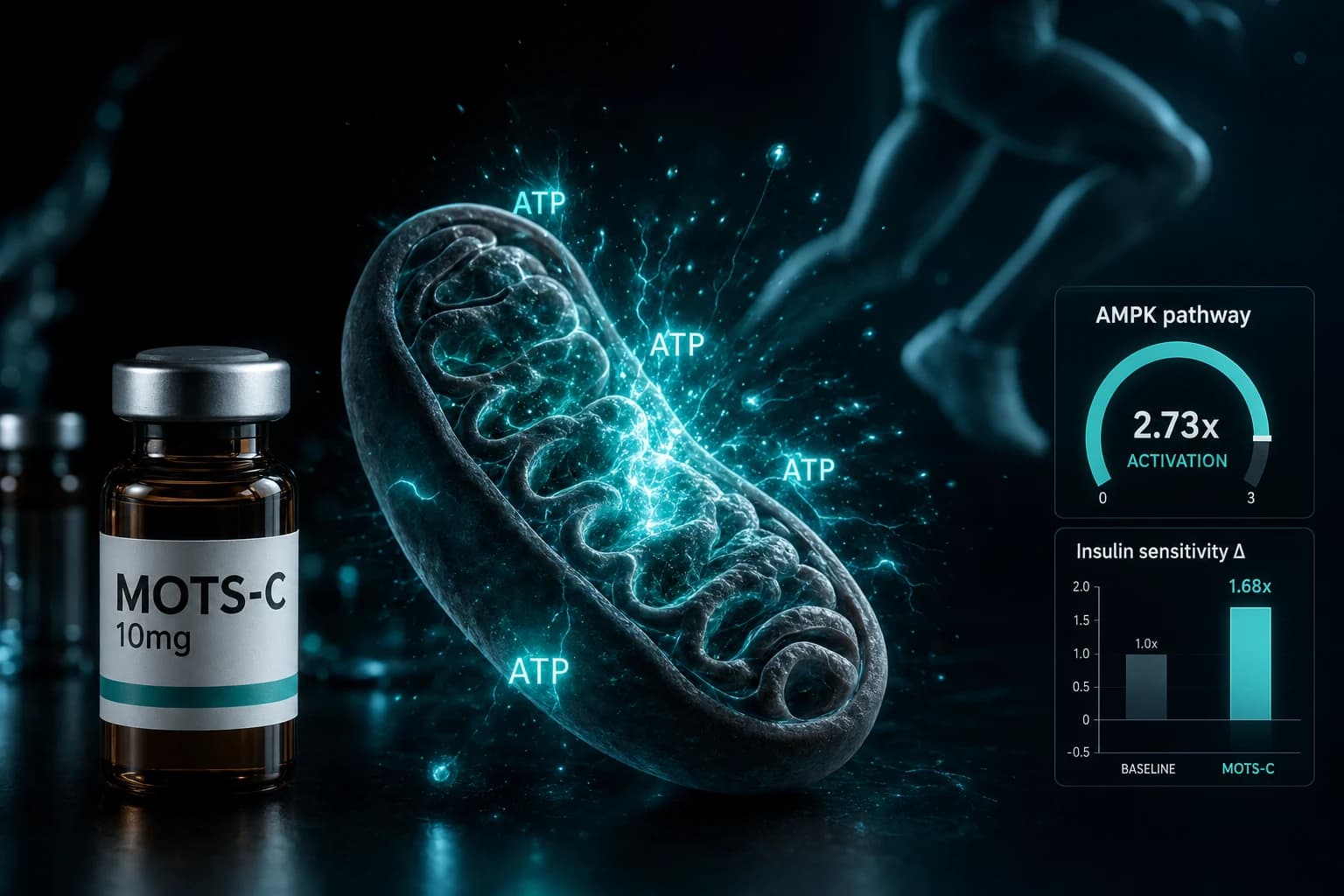
- MOTS-c doubled treadmill endurance in 22-month-old mice (Reynolds et al. 2021)
- 0.5 mg/kg/day prevented diet-induced obesity in high-fat-fed mice
- Activates AMPK via folate cycle inhibition, not energy depletion
- Research dose: 5-10 mg subcutaneous, 2-3x per week
- WADA-prohibited since 2025 under S4 metabolic modulators
Your mitochondria make a hormone. Most people have never heard of it.
MOTS-c is a 16-amino-acid peptide encoded directly by mitochondrial DNA. Not nuclear DNA. Your mitochondria, the organelles that generate ATP in every cell of your body, carry their own small genome with 37 genes. Tucked inside the 12S ribosomal RNA gene is a short open reading frame that produces MOTS-c. It was discovered in 2015 by Changhan Lee's lab at USC, and the first publication landed in Cell Metabolism with a striking result: mice treated with MOTS-c at 0.5 mg/kg/day for 8 weeks on a 60% high-fat diet gained dramatically less weight and showed a 30% increase in whole-body insulin sensitivity compared to controls (Lee et al., 2015).
That paper reframed a basic assumption about mitochondria. They are not just power plants. They are endocrine organs, secreting peptide hormones into circulation that regulate metabolism system-wide. MOTS-c is the best-studied of these mitochondrial-derived peptides (MDPs), and the data that followed the 2015 paper has only gotten more interesting.
How MOTS-c activates AMPK (without draining your cells of energy)
Most AMPK activators work by creating an energy crisis. Metformin partially inhibits Complex I. Exercise depletes ATP directly. The cell senses a rising AMP:ATP ratio, and AMPK switches on.
MOTS-c takes a different route. It inhibits the folate cycle and the connected de novo purine biosynthesis pathway in skeletal muscle. This blockade causes endogenous AICAR (an AMP analog) to accumulate inside the cell. AICAR then activates AMPK without requiring actual ATP depletion (Lee et al., 2015). Think of it as tripping the metabolic alarm without pulling the plug on the generator.
Why does this matter? Because AMPK is the master switch for metabolic adaptation. When AMPK activates, it triggers:
- Increased glucose uptake in skeletal muscle
- Enhanced fatty acid oxidation
- Mitochondrial biogenesis via PGC-1alpha
- Suppression of anabolic pathways that drive fat storage
These are the same metabolic shifts that happen during vigorous exercise. That is why MOTS-c gets called an "exercise mimetic," and it is also why WADA added it to the prohibited list in 2025 under category S4 (metabolic modulators).
The nuclear translocation discovery
In 2018, the same USC group published a finding that changed the field's understanding of how mitochondria communicate with the nucleus. Under metabolic stress (glucose restriction, serum deprivation, or oxidative stress), MOTS-c physically moves from the cytoplasm into the nucleus within 30 minutes. Once inside, it regulates the expression of genes containing antioxidant response elements (AREs) by interacting with the transcription factor NRF2 (Kim et al., 2018).
This was the first evidence of a mitochondrial-encoded peptide directly regulating nuclear gene expression. Mitochondria do not just send chemical signals (like ROS or metabolite ratios). They send a physical messenger, a peptide that walks into the nucleus and turns genes on.
For longevity research, this creates a compelling picture. MOTS-c is a stress-response peptide: when cells face metabolic challenges, MOTS-c ramps up protective gene expression. And exercise is, fundamentally, metabolic stress. Which brings us to the Reynolds study.
Old mice ran twice as far after MOTS-c treatment
The 2021 Reynolds et al. paper in Nature Communications tested MOTS-c across three age groups: young (2 months), middle-aged (12 months), and old (22 months) mice (Reynolds et al., 2021). The results were dramatic.
Old mice treated with MOTS-c (15 mg/kg, IP) and placed on an accelerating treadmill ran significantly farther than untreated controls. The difference was stark: P = 0.000002. They also performed better on rotarod balance tests, and the improvements extended across all three age groups.
Here is the part that made headlines: late-life intermittent MOTS-c treatment (started at 23.5 months, roughly equivalent to a human in their late 60s) improved physical capacity and extended healthspan. Three injections per week were enough.
The researchers also confirmed that exercise itself increases endogenous MOTS-c. In humans, MOTS-c levels rose in both skeletal muscle and plasma after exercise. The peptide is part of the exercise signaling cascade, meaning supplemental MOTS-c may amplify what physical activity already does.
The metabolic data: obesity, insulin, and glucose
The strongest preclinical data for MOTS-c comes from metabolic studies. Here is a summary of the key findings across the published literature:
| Study | Model | Intervention | Key Result |
|---|---|---|---|
| Lee et al. 2015 | CD-1 mice, HFD (60% fat) | 0.5 mg/kg/day IP, 8 weeks | Prevented diet-induced obesity; 30% higher glucose infusion rate |
| Kim et al. 2019 | DIO C57BL/6 mice | 5 mg/kg/day IP, 7 days | Altered sphingolipid, monoacylglycerol, and dicarboxylate metabolism; improved insulin sensitivity |
| Reynolds et al. 2021 | Young, middle, old mice | 15 mg/kg IP (acute + intermittent) | Doubled treadmill endurance in old mice; improved rotarod performance across all ages |
| Kim et al. 2018 | HEK293 cells | Metabolic stress challenge | Nuclear translocation within 30 min; NRF2/ARE gene regulation |
Bottom line: MOTS-c consistently improves insulin sensitivity and exercise capacity in animal models. It prevents diet-induced obesity when given alongside a high-fat diet, and it restores physical performance in aged mice. No other single mitochondrial-targeted compound has this breadth of metabolic data.
MOTS-c levels decline with age (and that might matter)
Plasma MOTS-c concentrations drop as you get older. D'Souza et al. (2020) showed that while circulating MOTS-c decreases, skeletal muscle MOTS-c actually increases with age, possibly as a compensatory mechanism. The muscle tries to hold onto what the bloodstream is losing.
This age-related decline mirrors what happens with NAD+, another critical metabolic cofactor that drops with aging. Both compounds support mitochondrial function, but through different mechanisms. NAD+ restores the cofactor pool. MOTS-c restores regulatory signaling. Researchers studying longevity often pair them for this reason.
The implication: supplemental MOTS-c in middle-aged and older adults might replenish a signaling molecule that the body is naturally losing. That is speculative for humans (no large-scale human trials exist yet), but the preclinical logic is straightforward.
Dosing protocols from published research
MOTS-c is not FDA-approved. No standardized human dosing protocol exists. All protocols below are derived from published animal research, extrapolated pharmacokinetic estimates, and the research community's current usage patterns.
| Parameter | Details |
|---|---|
| Research dose range | 5-10 mg per injection |
| Frequency | 2-3 times per week (subcutaneous) |
| Cycle length | 8-12 weeks, with optional extension to 16 weeks |
| Reconstitution | Bacteriostatic water; standard reconstitution protocol |
| Storage | Lyophilized: -20C long-term, 2-8C short-term. Reconstituted: 2-8C, use within 14-30 days |
| Half-life | Estimated 4-6 hours (based on plasma clearance data) |
| Timing | Morning administration is most common, often before or after exercise |
Tip: MOTS-c is extremely unstable in solution. Plasma levels drop 85-90% within 2-3 hours at room temperature. Once reconstituted, keep the vial refrigerated and draw doses immediately before injection.
The Reynolds study used a 3x/week intermittent protocol in aging mice, which maps reasonably well to the human research community's standard pattern of 5-10 mg two to three times per week. Some protocols use a daily low-dose approach (200-1,000 mcg), but the intermittent higher-dose pattern has stronger preclinical support.
Side effects and safety considerations
Published human data on MOTS-c safety is limited. Short-term pilot studies show favorable tolerability with no serious adverse events, no liver or kidney toxicity markers, and no hematologic abnormalities across protocols lasting up to 16 weeks.
Reported effects from self-experimenters (per USADA documentation) include:
- Increased heart rate or palpitations
- Injection site irritation
- Mild nausea
- Temporary flushing
- Occasional headache
- Insomnia (when dosed in the evening)
Warning: No formal dose-escalation toxicology study has been published for MOTS-c. No LD50, no maximum tolerated dose. Long-term safety in humans is entirely unknown. The peptide is WADA-prohibited. If you are a competitive athlete, MOTS-c will flag a drug test.
How MOTS-c compares to other mitochondrial and longevity peptides
If you are building a longevity-focused research protocol, MOTS-c sits alongside several other compounds with overlapping but distinct mechanisms.
SS-31 (elamipretide) binds cardiolipin on the inner mitochondrial membrane and stabilizes the electron transport chain from the structural level. It has FDA approval for Barth syndrome. MOTS-c works upstream, at the metabolic signaling level via AMPK. They target different pieces of mitochondrial dysfunction.
Epithalon activates telomerase and addresses replicative senescence. Different mechanism entirely, but often run in the same longevity-focused cycles.
NAD+ replenishes the cofactor pool that mitochondria need for oxidative phosphorylation. MOTS-c and NAD+ are complementary: one restores the fuel, the other restores the regulatory signal. Research protocols commonly run both during the same cycle, typically MOTS-c 5-10 mg SC 2-3x/week alongside NAD+ injection protocols.
For a complete breakdown of MOTS-c compound data, dosing references, and related peptides, see the compound page.
Where to source MOTS-c
MOTS-c is available as a lyophilized injectable from Ascension Peptides with 50% off using code ENHANCED. Standard vial sizes are 10 mg. Because MOTS-c degrades rapidly in solution, source quality and cold-chain handling matter more here than with most peptides. Look for third-party COAs confirming 98%+ purity.
For those who prefer non-injectable formats, oral peptide options exist for some compounds, though MOTS-c is currently available only as an injectable.
Related reading:
- MOTS-c Compound Guide
- SS-31 (Elamipretide) Guide
- NAD+ Injection Protocol
- Reconstitution Calculator
- Injectable vs. Oral Peptides
This article is for educational and informational purposes only. MOTS-c is not approved by the FDA for human use and is classified as a prohibited substance by WADA. All dosing information is derived from published preclinical research and is intended for research purposes only. Consult a qualified healthcare professional before making any decisions about peptide research or supplementation.