At a glance
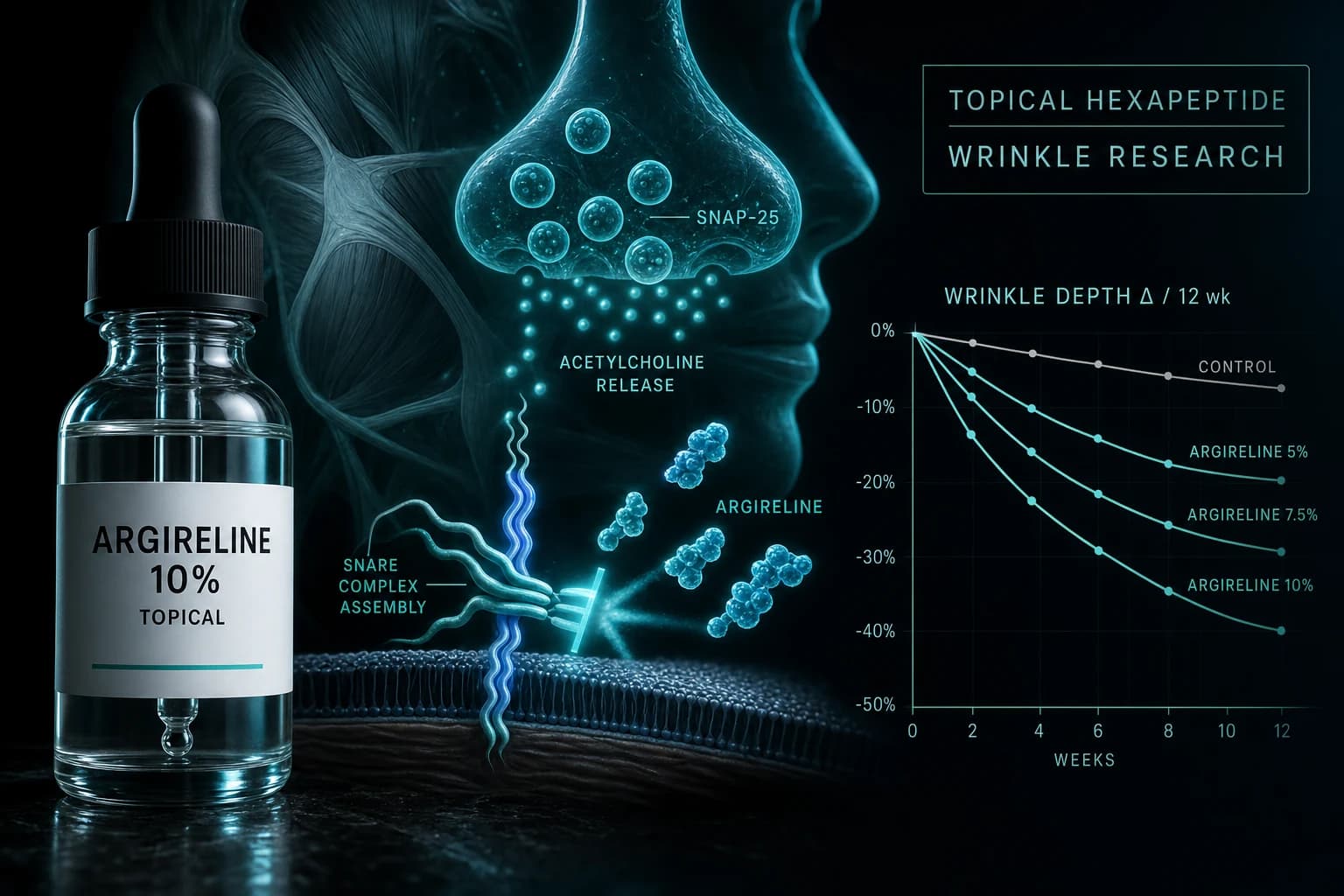
- Argireline (acetyl hexapeptide-3, Ac-Glu-Glu-Met-Gln-Arg-Arg-NH2) is a synthetic hexapeptide developed by Lipotec that inhibits SNAP-25, a SNARE complex protein required for neurotransmitter release
- The mechanism mimics botulinum toxin (Botox) at the molecular level but with vastly lower potency; topical penetration is the limiting factor
- Standard topical concentration: 5-10% in serums; published evidence supports measurable wrinkle depth reduction at 12 weeks
- Effect size is meaningful for cosmetic research but smaller than Botox by orders of magnitude; positions as a topical maintenance therapy, not Botox replacement
- Skin penetration is the bottleneck; vehicle formulation (liposomal, nanoparticle, penetration enhancers) substantially affects efficacy
Argireline is the cosmetic peptide that established a category. Developed by Lipotec in the late 1990s, the synthetic hexapeptide acetyl hexapeptide-3 (also called acetyl hexapeptide-8 or AH-8 depending on naming convention) targets the same SNARE complex machinery that botulinum toxin disrupts, producing localized reduction of muscle contraction at the application site. The molecular target is identical to Botox; the magnitudes differ dramatically because topical peptide delivery cannot achieve the concentrations that injected Botox does.
This article covers what Argireline actually is, the SNARE complex mechanism and how it compares to Botox, the published topical efficacy evidence, the formulation factors that determine real-world results, and how to evaluate Argireline-containing skincare products.
What Argireline actually is
Argireline is a synthetic hexapeptide with the sequence Ac-Glu-Glu-Met-Gln-Arg-Arg-NH2 (acetylated N-terminus, amidated C-terminus). The peptide is developed and trademarked by Lipotec (now part of Lubrizol Life Science).
| Property | Argireline value |
|---|---|
| Sequence | Ac-Glu-Glu-Met-Gln-Arg-Arg-NH2 |
| Length | 6 amino acids |
| Class | Synthetic cosmetic peptide |
| Developer | Lipotec / Lubrizol |
| Mechanism | SNAP-25 inhibition (SNARE complex) |
| Application | Topical (cosmetic) |
| Standard concentration | 5-10% in serums |
| Approval | INCI-listed cosmetic ingredient |
The peptide is named for its central arginine residues. The trademark name "Argireline" is used in cosmetic marketing; the scientific name "acetyl hexapeptide-3" appears in INCI listings; some sources use "acetyl hexapeptide-8" (these refer to the same molecule with different numbering conventions).
For broader cosmetic peptide context, see the GHK-Cu compound guide, the where to buy GHK-Cu peptide 2026, and the Argireline compound guide.
The SNAP-25 mechanism
Argireline targets SNAP-25 (Synaptosomal-associated protein 25 kDa), one of the three core proteins of the SNARE complex that mediates synaptic vesicle fusion. The mechanism:
- Acetylcholine release at the neuromuscular junction requires SNARE complex assembly (SNAP-25 + syntaxin + VAMP)
- Argireline mimics the N-terminal of SNAP-25, competing for the assembly site
- Reduced SNAP-25 incorporation = reduced acetylcholine release
- Reduced acetylcholine = reduced muscle contraction
- Reduced muscle contraction at the application site = reduced expression-line formation
This is the same molecular pathway botulinum toxin targets. Botox cleaves SNAP-25 enzymatically, producing strong and sustained SNARE disruption. Argireline binds competitively, producing weak and transient disruption.
The potency difference is enormous: Botox produces measurable muscle paralysis at picogram doses delivered by injection. Argireline at 5-10% topical concentrations produces measurable but much smaller reductions in muscle activity.
Bottom line: Argireline's mechanism is real and matches Botox's pathway, but the magnitude is much smaller. Argireline is not a Botox replacement; it is a topical maintenance therapy that produces modest measurable wrinkle reduction over weeks of consistent application.
The published efficacy evidence
Argireline has been studied in cosmetic research for over two decades.
Original efficacy work. Blanes-Mira et al., Int J Cosmet Sci, 2002 characterized the SNAP-25 inhibition mechanism and demonstrated cellular efficacy at micromolar concentrations.
Clinical efficacy. Multiple cosmetic research studies have shown topical Argireline at 5-10% concentration reduces visible wrinkle depth at 12 weeks. The effect is most pronounced at expression lines (forehead, around the eyes) where active muscle contraction drives wrinkle formation.
Comparison to other cosmetic peptides. Reddy et al., 2017 reviewed multiple cosmetic peptide approaches including Argireline, finding modest but consistent effects on wrinkle measures.
Combination with other peptides. Cosmetic formulations often combine Argireline with Matrixyl (palmitoyl pentapeptide-3) and other cosmetic peptides for additive effects across multiple wrinkle mechanisms.
Formulation factors that matter
The key challenge for Argireline is skin penetration. The molecule is hydrophilic (carries multiple charges from glutamic acid and arginine residues) and does not readily cross the stratum corneum.
Formulation strategies to improve penetration:
| Strategy | Mechanism | Effect on efficacy |
|---|---|---|
| Liposomal encapsulation | Penetration via lipid carriers | Improved penetration |
| Nanoparticle delivery | Sustained release + penetration | Improved efficacy |
| Penetration enhancers | Stratum corneum disruption | Improved penetration; tolerability concerns |
| Microneedle pretreatment | Mechanical penetration bypass | Substantial improvement |
| Iontophoresis | Electric-field-driven delivery | Substantial improvement |
Standard topical Argireline serums without these enhancements achieve modest penetration. Liposomal and microneedle approaches substantially improve delivery to deeper skin layers.
The concentration alone is not the full story. A 10% Argireline serum in a standard aqueous vehicle may produce less efficacy than a 5% Argireline in a well-formulated liposomal carrier.
Standard topical research protocol
The most common Argireline research protocol:
| Phase | Concentration | Application | Frequency | Duration |
|---|---|---|---|---|
| Conservative | 5% serum | Apply to affected expression-line areas | Once or twice daily | 12-24 weeks |
| Standard | 10% serum | Apply to affected expression-line areas | Once or twice daily | 12-24 weeks |
| With penetration support | 5% liposomal | Apply to affected areas | Once daily | 12-24 weeks |
| Microneedle-supported | 5-10% post-microneedling | Apply post-treatment | Per microneedle protocol | 8-12 weeks |
Application typically targets:
- Forehead horizontal lines (most responsive)
- Crow's feet (around the eyes)
- Glabella (between brows) (less responsive due to deeper musculature)
- Other expression-line areas as needed
Visible improvements typically require 12-24 weeks of consistent application. Microneedle-supported protocols may show effects faster (8-12 weeks).
How to evaluate Argireline products
Five factors to consider when evaluating Argireline-containing skincare:
1. Concentration. 5-10% Argireline is the standard for products targeting wrinkle reduction. Products with significantly lower concentrations (1-3%) may produce minimal effects.
2. Formulation. Liposomal or nanoparticle delivery substantially improves penetration. Look for explicit mention of these in product descriptions.
3. Other actives. Argireline combines well with hyaluronic acid (hydration), niacinamide (skin barrier), peptides like GHK-Cu and Matrixyl (complementary mechanisms), and antioxidants. Products that combine effectively-formulated multiple actives tend to outperform single-active products.
4. Vehicle (cream vs serum vs gel). Different vehicles affect both stability and penetration. Liposomal serums are typically the best penetration profile.
5. Manufacturer track record. Cosmetic peptide research is technically demanding. Established manufacturers with formulation history typically deliver better-quality products than newer brands.
Comparison to Botox
| Factor | Botox (injection) | Argireline (topical) |
|---|---|---|
| Mechanism | SNAP-25 cleavage | SNAP-25 competitive inhibition |
| Effect magnitude | Substantial muscle paralysis | Modest activity reduction |
| Onset | Days | Weeks |
| Duration | 3-4 months per treatment | Until topical application stops |
| Cost per treatment area | $200-$800 per session | $50-$150 per month of serum |
| Procedure | Medical injection | At-home topical |
| Side effects | Bruising, temporary asymmetry | Minimal (local) |
Argireline is best positioned as a topical maintenance therapy rather than a Botox replacement. For patients who want significant rapid wrinkle reduction, Botox remains the more effective option. For patients who want gradual cosmetic improvement, daily maintenance, and avoidance of injection, Argireline is a reasonable approach.
For broader cosmetic peptide research context including GHK-Cu, see the GHK-Cu for hair loss research protocol and GLOW Blend GHK-Cu BPC-157 TB-500 skin recovery.
Stacking with related cosmetic peptides
Argireline is commonly combined with other cosmetic peptides in skincare formulations:
- Argireline + Matrixyl (palmitoyl pentapeptide-3). Argireline reduces dynamic wrinkles (from muscle activity); Matrixyl supports collagen synthesis. Combined, addresses both wrinkle mechanisms.
- Argireline + GHK-Cu. Argireline reduces wrinkle formation; GHK-Cu supports overall skin health, collagen, and matrix remodeling.
- Argireline + Hyaluronic Acid. HA provides hydration that supports Argireline's stability and skin-surface effects.
- Argireline + Niacinamide. Both address different aspects of skin aging; combination is well-tolerated.
- Argireline + Retinol. Cosmetic skincare often combines these; the mechanisms are distinct but complementary.
Safety profile
Topical Argireline has been well-tolerated across decades of cosmetic use:
- Mild local irritation in some users at higher concentrations
- No systemic effects from topical use at typical concentrations
- Pregnancy/breastfeeding caution as standard for cosmetic products
- No documented neurotoxic effects at topical doses (the systemic doses needed to affect the neuromuscular junction at scale are not achievable through topical application)
The theoretical concern about Argireline affecting systemic muscle function through skin absorption has not materialized in clinical or cosmetic safety surveillance. Topical delivery does not achieve systemic concentrations remotely close to those needed to affect skeletal muscle function.
Sourcing
Argireline-containing skincare products are widely available across cosmetic brands at various price points and quality levels. The cosmetic peptide market is well-established and consumer-accessible.
For research-grade Argireline (for compounding pharmacy or research applications), the compound is available through specialty cosmetic raw material suppliers.
For our broader cosmetic peptide vendor analysis, see the where to buy GHK-Cu peptide 2026 and the best legit peptide vendors 2026 ranking.
FAQ
Does Argireline really work?
Yes, at modest effect sizes. Published cosmetic research shows topical Argireline at 5-10% concentration reduces visible wrinkle depth at 12 weeks of consistent application. Effects are smaller than Botox by orders of magnitude but real and consistent across multiple studies.
Is Argireline a Botox replacement?
No. Argireline targets the same SNAP-25/SNARE complex pathway as Botox but with much lower potency. Argireline is best positioned as a topical maintenance therapy for gradual cosmetic improvement, not as a replacement for injected Botox treatments. Patients wanting significant rapid wrinkle reduction should consider Botox; patients wanting daily maintenance can use Argireline.
What concentration of Argireline should I look for?
5-10% in serum formulations is the standard research-supported range. Products with significantly lower concentrations (1-3%) may produce minimal effects. Concentration alone is not the full story; the vehicle (liposomal, nanoparticle) substantially affects penetration and efficacy.
How long until I see results?
12-24 weeks of consistent daily application typically produces visible wrinkle depth reduction. Microneedle-supported protocols may show effects faster (8-12 weeks). The effect develops gradually as the SNARE inhibition accumulates over repeated applications.
Can I combine Argireline with other peptides?
Yes, this is a standard cosmetic formulation strategy. Common combinations include Argireline + Matrixyl (collagen synthesis), Argireline + GHK-Cu (skin health), and Argireline + hyaluronic acid (hydration). The mechanisms are complementary and combined products tend to outperform single-active products.
Is Argireline safe?
Topical Argireline has been well-tolerated across decades of cosmetic use. The theoretical concern about systemic neuromuscular effects through skin absorption has not materialized; topical delivery does not achieve concentrations that affect skeletal muscle systemically.
Where can I get Argireline?
Argireline is widely available in cosmetic skincare products at various concentrations and quality levels. Cosmetic skincare stores, online retailers, and dermatology-oriented brands all offer Argireline-containing products. The 5-10% concentration range is what to look for in serum products targeting wrinkle reduction.
Further reading
- Argireline compound guide
- GHK-Cu compound guide
- GHK-Cu for hair loss research protocol
- Where to buy GHK-Cu peptide 2026
- GLOW Blend GHK-Cu BPC-157 TB-500 skin recovery
- Best legit peptide vendors 2026
This article is for educational and research purposes only. Argireline is an INCI-listed cosmetic ingredient widely used in skincare products. None of the content above constitutes medical advice. Consult a qualified clinician or dermatologist for individual medical questions about wrinkle reduction or skin treatment.