At a glance
- GLOW = Wolverine Stack (BPC-157 + TB-500) plus GHK-Cu for matrix rebuilding
- GHK-Cu modulates 4,000+ genes for tissue remodeling and collagen synthesis
- Three layers: vascularization (BPC-157), cell migration (TB-500), structural repair (GHK-Cu)
- GHK-Cu plasma levels drop 60% between young adulthood and age 60
- 4-6 week daily cycles; solution may have a slight blue tint from copper
What GLOW actually is
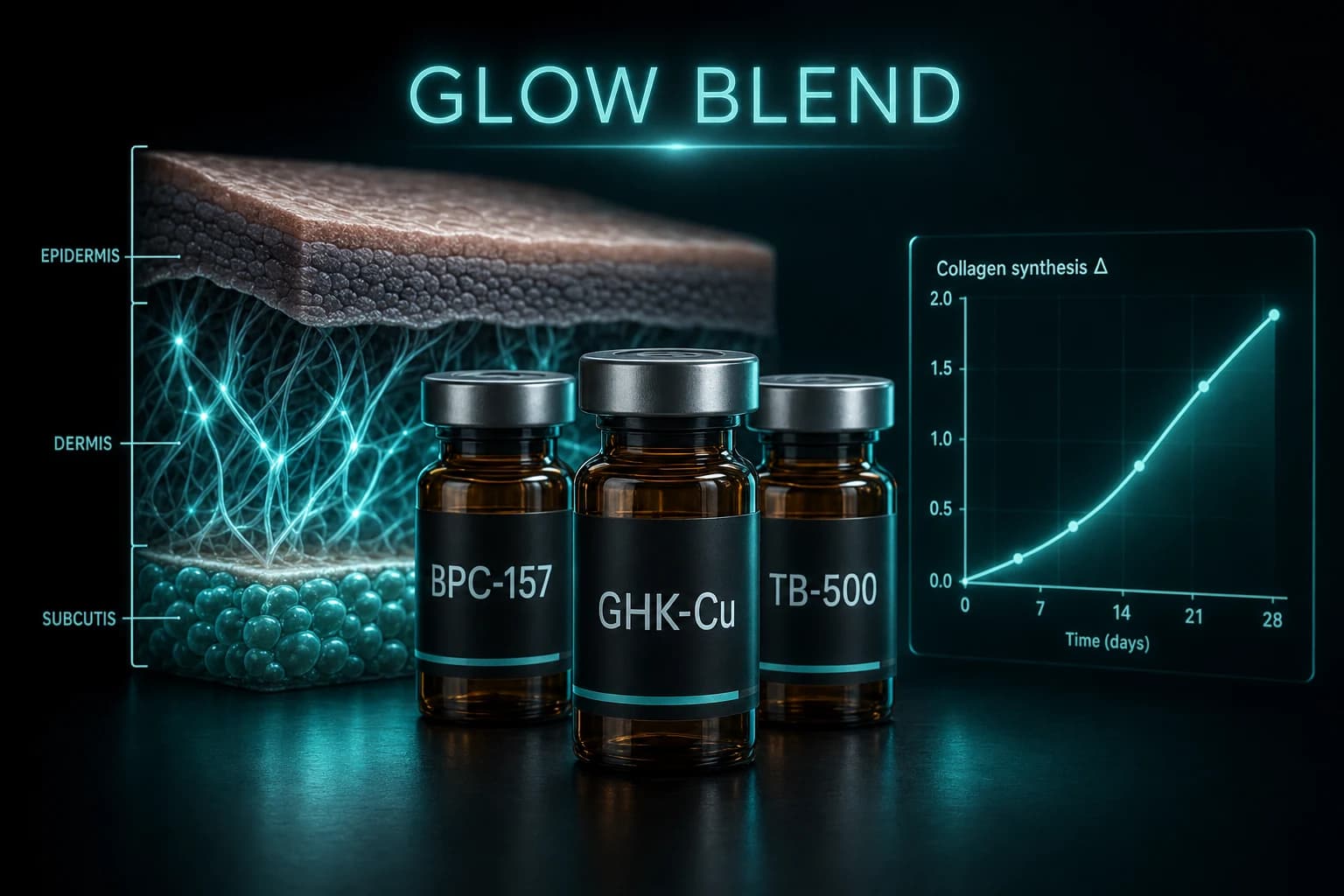
The GLOW Blend is three peptides in one pre-mixed vial: GHK-Cu, BPC-157, and TB-500. If you know the Wolverine Stack (BPC-157 + TB-500), GLOW is the Wolverine with GHK-Cu added on top. One vial, one reconstitution, three distinct mechanisms.
The pitch is straightforward. BPC-157 and TB-500 are the two most-researched recovery peptides in the literature. GHK-Cu is the most-researched skin peptide. Combining them gives you a stack that handles tissue repair (tendons, ligaments, muscle, gut) AND extracellular matrix remodeling (collagen, elastin, skin quality) in a single daily injection.
This article covers the specific mechanisms, the synergy between the three compounds, the practical protocol, and who should consider upgrading to the KLOW Blend instead.
GHK-Cu: the third compound
GHK-Cu (glycyl-L-histidyl-L-lysine copper complex) is a naturally occurring tripeptide first identified by Loren Pickart in 1973. It circulates in human plasma at roughly 200 ng/mL in young adults and drops to approximately 80 ng/mL by age 60. That 60% decline correlates with visible aging markers: thinner skin, slower wound healing, reduced collagen density.
What makes GHK-Cu relevant to a recovery stack is its mechanism. It doesn't just "boost collagen" in a vague way. The research identifies specific pathways:
TGF-beta signaling. GHK-Cu upregulates TGF-beta (transforming growth factor beta), which is the master regulator of extracellular matrix production. TGF-beta drives fibroblasts to produce collagen type I and type III, the two structural collagens that give skin its tensile strength and elasticity. Maquart et al. (1988, FEBS Letters) demonstrated that GHK-Cu at 10^-9 M stimulated collagen synthesis in fibroblast cultures by 70% compared to controls.
Decorin production. GHK-Cu increases decorin, a proteoglycan that regulates collagen fibril assembly. Without adequate decorin, collagen fibrils form irregularly, producing weak or scarred tissue. Decorin is also a natural TGF-beta regulator, preventing the overproduction that leads to fibrosis. This self-regulating loop is one of the reasons GHK-Cu promotes organized tissue rebuilding rather than scar tissue.
Gene expression breadth. Pickart and Margolina (2018, International Journal of Molecular Sciences) showed that GHK-Cu modulates the expression of 4,000+ human genes. Of those, 1,584 genes were upregulated (wound healing, antioxidant defense, collagen synthesis) and 747 were downregulated (inflammation, tissue destruction). No other tripeptide has documented effects on this scale.
Copper delivery. The Cu2+ ion in GHK-Cu isn't decorative. Copper is a required cofactor for lysyl oxidase, the enzyme that cross-links collagen and elastin fibers. Without copper, even freshly synthesized collagen remains weak and disorganized. GHK-Cu delivers copper directly to the tissue compartment where it's needed.
How the three mechanisms layer
Each compound in the GLOW Blend operates at a different level of the tissue repair cascade. This is not three variations on the same theme; it's three genuinely different systems.
Layer 1: Local repair (BPC-157)
BPC-157 drives local tissue healing through VEGF upregulation and angiogenesis. In damaged tissue (especially hypovascular tissue like tendons), the rate-limiting step is blood supply. BPC-157 promotes new blood vessel formation directly at the injury site, accelerating the delivery of oxygen, nutrients, and immune cells. The Sikiric lab has published over a decade of rodent data demonstrating accelerated healing in Achilles tendons, MCL tears, muscle injuries, and GI lesions.
Think of BPC-157 as the construction crew that builds roads to the worksite.
Layer 2: Systemic healing (TB-500)
TB-500 (synthetic Thymosin Beta-4) works systemically through actin regulation. It sequesters G-actin monomers, which promotes cell migration throughout the body. Cells that need to reach a repair site (fibroblasts, immune cells, endothelial cells) move there faster when TB-500 is present. It also reduces NF-kB-mediated inflammation, which clears the inflammatory debris that would otherwise slow tissue remodeling.
TB-500 is the logistics network that gets the right cells to the right place.
Layer 3: Matrix rebuilding (GHK-Cu)
GHK-Cu operates after the initial repair signals are in motion. Once BPC-157 has established blood supply and TB-500 has mobilized repair cells, GHK-Cu drives the structural rebuilding. Collagen I/III synthesis, elastin production, decorin assembly, and cross-linking via copper-dependent lysyl oxidase. This is the layer that determines whether repaired tissue ends up strong, organized, and functional versus weak and scarred.
GHK-Cu is the architect that ensures the rebuilt structure is sound.
The synergy in practice
The three compounds don't just coexist. They cover each other's gaps:
- BPC-157 is excellent at initiating repair but doesn't specifically rebuild the extracellular matrix. GHK-Cu fills that gap.
- TB-500 reduces inflammation and mobilizes cells but doesn't drive angiogenesis the way BPC-157 does. BPC-157 fills that gap.
- GHK-Cu drives structural rebuilding but doesn't address the upstream logistics of getting repair cells to the site. TB-500 fills that gap.
The result is coverage across the full repair timeline: vascularization (days 1-7), cell migration and inflammation resolution (days 3-14), and structural matrix rebuilding (days 7-30+).
GLOW vs standalone GHK-Cu
This is the question most researchers ask first: "Why not just run GHK-Cu by itself for skin?"
You can. Standalone GHK-Cu has solid research support for skin quality improvement, wound healing, and hair growth. Topical GHK-Cu (1-3% in serums) is one of the most popular cosmetic peptide applications. Injectable GHK-Cu at 1-3 mg daily subcutaneous is the systemic research approach.
But standalone GHK-Cu only addresses one layer. If your skin quality concerns exist alongside recovery needs (joint issues, muscle injuries, gut healing, post-surgical recovery), adding GHK-Cu to BPC-157 and TB-500 is more efficient than running three separate vials and three separate reconstitutions.
The pre-mixed format also solves a practical problem: GHK-Cu's plasma half-life is approximately 2-3 hours, similar to BPC-157's ~4 hours and TB-500's ~2-3 hours. All three compounds benefit from daily dosing, so a single daily injection from a combined vial is both more convenient and protocol-consistent.
If your research is purely skin/cosmetic with no recovery component, standalone topical GHK-Cu may be sufficient. For anything beyond that, the blend earns its place.
GLOW vs the Wolverine Stack
The Wolverine Stack (BPC-157 + TB-500, 20 mg pre-mixed) is the recovery baseline. It covers local repair and systemic healing. Most researchers studying tendon injuries, muscle tears, post-surgical recovery, or general tissue repair start here.
The GLOW Blend adds GHK-Cu to that foundation. The practical differences:
| Feature | Wolverine Stack | GLOW Blend |
|---|---|---|
| BPC-157 | Yes | Yes |
| TB-500 | Yes | Yes |
| GHK-Cu | No | Yes |
| Primary use | Musculoskeletal recovery | Recovery + skin/matrix |
| Collagen synthesis | Indirect (via BPC healing) | Direct (GHK-Cu + BPC) |
| Anti-aging dimension | No | Yes |
| Extracellular matrix | Not targeted | Targeted |
Upgrade to GLOW if: you care about skin quality, scar remodeling, anti-aging, or hair alongside your recovery research. Or if you're already running the Wolverine Stack and want to add GHK-Cu without managing a separate vial.
Stay with Wolverine if: your research is purely musculoskeletal recovery and you have no skin or anti-aging interest.
The practical protocol
Reconstitution
Add 3 mL of bacteriostatic water to a 70mg 50/10/10 GLOW vial. Inject the water slowly along the inside wall of the vial. Do not spray directly onto the powder. Swirl gently until dissolved. The solution may have a slight blue tint from the copper in GHK-Cu. This is normal. A 2mg GHK-Cu daily draw is then 12 IU on a U-100 syringe. See the GLOW peptide dosage chart for the week table.
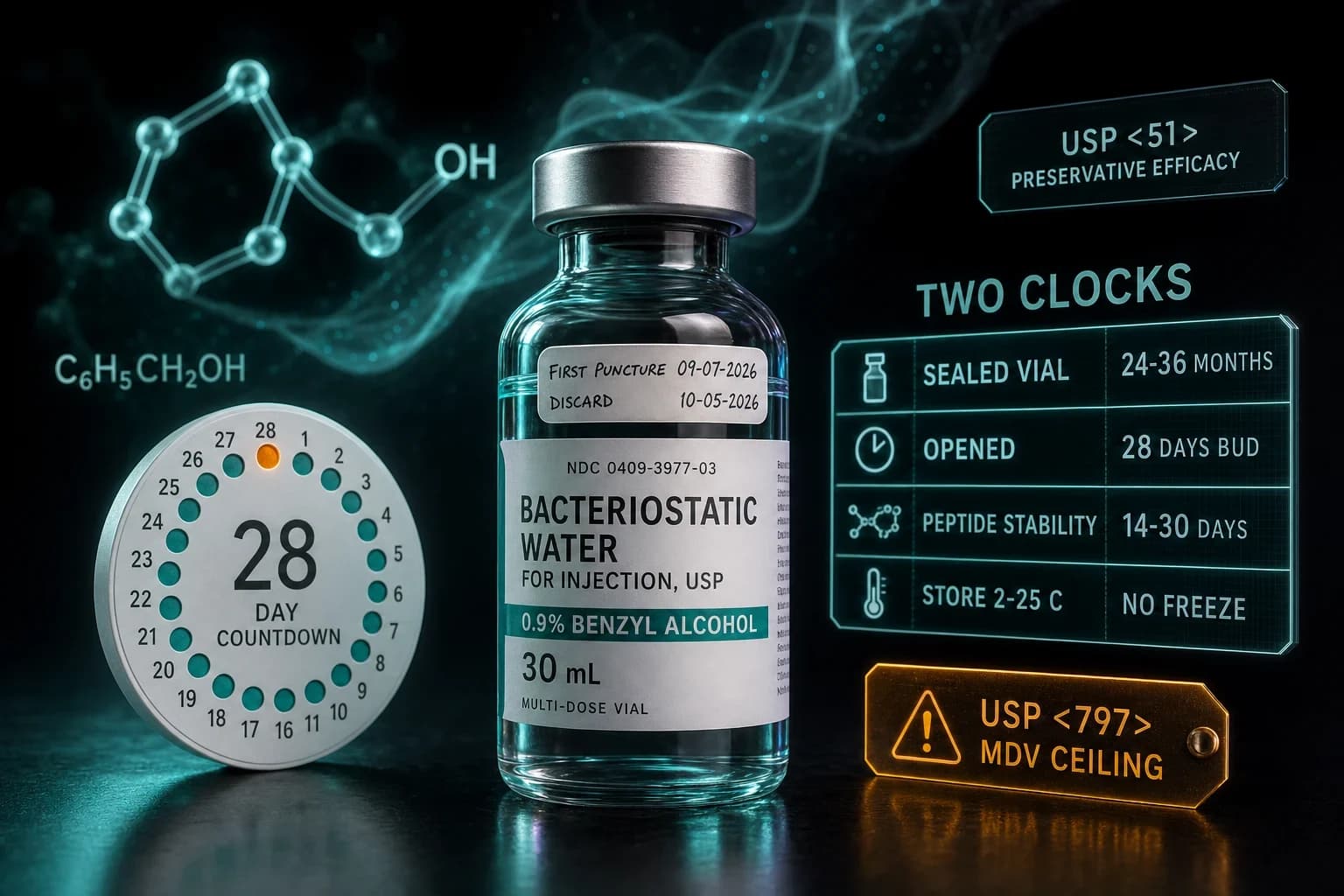
Do not shake. Refrigerate immediately. Use within 21-28 days.
Verify your specific concentration and draw volume with the reconstitution calculator.
Dosing
Standard research protocol: one subcutaneous injection daily. Draw volume depends on the specific vial formulation and total compound mass. Consult the vial label for per-compound breakdown and calculate your draw accordingly.
For localized injury research, inject subcutaneously within a few centimeters of the target tissue. The BPC-157 component benefits from local placement, while TB-500 and GHK-Cu act systemically regardless of injection site.
For general recovery + skin research, abdominal subcutaneous injection is standard.
Cycle structure
- Weeks 1-6: Daily subcutaneous injection
- Weeks 7-10: Off period. Assess endpoints (skin quality, injury recovery markers, subjective improvements)
- Repeat: If endpoints warrant a second cycle
Extended use beyond 8 weeks is common in the research community but not well studied in formal trials. The cycle-and-assess approach gives you data points to evaluate actual progress.
Timing
No specific fasting requirement (unlike GH peptides). Inject at a consistent time daily. Morning or evening are both common. Some researchers prefer evening injection under the hypothesis that overnight repair processes benefit from peak compound availability during sleep.
Storage
- Lyophilized (before reconstitution): -20C long-term, 2-8C short-term
- Reconstituted: 2-8C (refrigerator), use within 21-28 days
- Light: Protect from prolonged light exposure (GHK-Cu is light-sensitive due to the copper complex)
- Do not freeze reconstituted solution
Who should upgrade to KLOW
The KLOW Blend adds a fourth compound: KPV, an anti-inflammatory tripeptide derived from alpha-MSH. KLOW is GLOW + KPV.
Consider KLOW over GLOW if:
- Gut inflammation is part of your research. KPV has specific IBD and intestinal inflammation data via NF-kB pathway inhibition. Neither BPC-157's gut effects nor TB-500's anti-inflammatory action specifically targets this pathway.
- You're researching the gut-skin axis. Chronic gut inflammation drives systemic inflammatory signals that degrade skin quality. KPV addresses the gut inflammation directly; GHK-Cu addresses the skin downstream. Together they cover both ends of the axis.
- Inflammatory skin conditions are the primary endpoint. KPV's anti-inflammatory mechanism targets skin inflammation more specifically than TB-500's broader systemic action.
If none of those apply, GLOW provides the full recovery + skin protocol without the additional complexity (and cost) of the fourth compound.
For a complete breakdown of the KLOW Blend, see KLOW Blend: 4-Peptide Skin, Gut, and Recovery Protocol.
What the research supports (and what it doesn't)
Supported:
- GHK-Cu stimulates collagen I and III synthesis in fibroblast cultures (Maquart et al., 1988)
- GHK-Cu modulates 4,000+ genes related to tissue remodeling (Pickart & Margolina, 2018)
- BPC-157 accelerates tendon, ligament, and gut healing in rodent models (Sikiric lab, 2010-2020)
- TB-500 promotes cell migration and reduces inflammation systemically (actin sequestration literature)
- The three mechanisms are non-overlapping and complementary
Not supported:
- "Permanent" skin rejuvenation from a single cycle. Effects are present during administration and persist for a period after, but ongoing use is required for ongoing benefit.
- Human clinical trial data for the combined blend. Each compound has individual preclinical support, but the three-compound combination has not been tested in a formal trial.
- Topical equivalence. The GLOW Blend is formulated for subcutaneous injection. Topical application of the reconstituted blend is not validated.
Research access
The GLOW Blend is available from Ascension Peptides with 50% off using code ENHANCED. Component lots are indexed in the lab-tests library.
- GLOW Blend product page →
- GHK-Cu research guide →
- BPC-157 research guide →
- TB-500 research guide →
- Wolverine Stack →
- KLOW Blend (GLOW + KPV) →
- Reconstitution calculator →
Disclaimer
This article is provided for research and educational purposes only. The GLOW Blend compounds are not approved for general human use. Nothing here is medical advice. Consult a qualified healthcare professional before any decision to self-administer.