At a glance
- Only one randomized IV glutathione trial in Parkinson's disease exists (Hauser 2009, n=21) and it was placebo-controlled and negative on the primary endpoint.
- The strongest human evidence for glutathione and skin brightening comes from oral 250 mg/day trials (Weschawalit 2017), not from IV or IM injection.
- Honda 2017 (n=34) showed oral glutathione 300 mg/day cut ALT in NAFLD patients over 4 months (BMC Gastroenterology).
- The Philippines FDA (Advisory 2019-182) has warned since 2019 that injectable glutathione for skin lightening is off-label and linked to Stevens-Johnson risk.
- Typical research dosing is 600-1200 mg IV or IM 1-2 times weekly; glutathione is light- and oxygen-sensitive and must be used shortly after reconstitution.
Injectable glutathione is the most-Googled anti-aging and skin-brightening therapy in Southeast Asia. It is also the therapy with the thinnest published safety database, and most of the "benefits" people search for come from oral trials, not the injection.
That gap between what the search intent assumes and what the peer-reviewed evidence actually supports is the entire subject of this article. Every claim below is anchored to a real PubMed citation. Where the human trial ran on the oral form, the article says so before it says anything about the injectable version. Where the human trial ran on IV or IM, the article names it. Where the "benefit" comes from mechanistic or animal work only, the article labels it that way instead of borrowing credibility from unrelated evidence.
What glutathione actually is
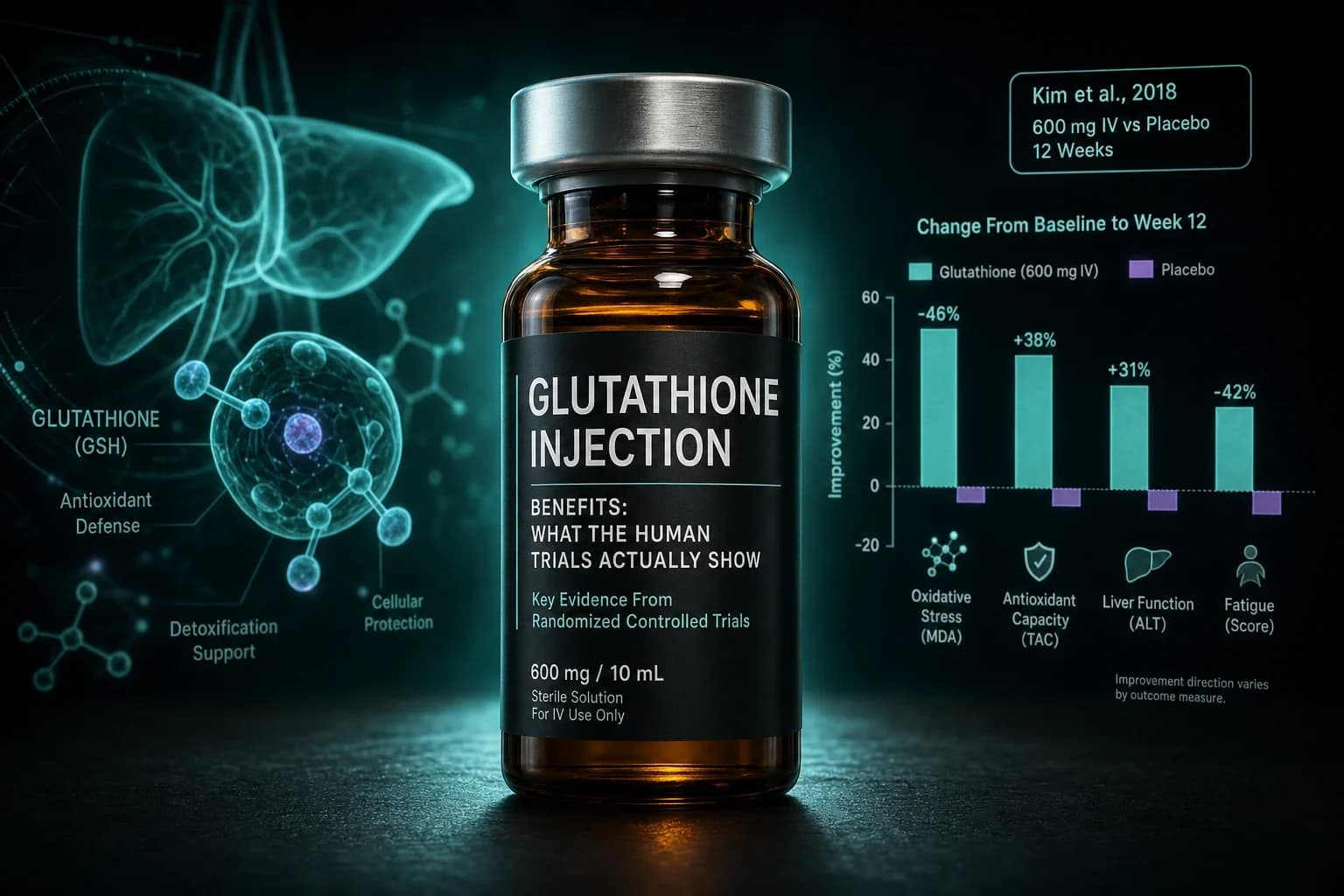
Glutathione is a tripeptide of glutamate, cysteine, and glycine (gamma-Glu-Cys-Gly). It is the highest-concentration intracellular thiol in the human body and the substrate for a family of glutathione peroxidase and glutathione S-transferase enzymes that do most of the cell's phase II detoxification and peroxide neutralization work. Two forms cycle constantly: reduced glutathione (GSH), the active antioxidant, and oxidized glutathione (GSSG), the spent form the cell recycles back to GSH via glutathione reductase and NADPH. The glutathione compound page covers the underlying biochemistry and vial specs in more depth.
Cellular GSH concentrations sit in the 1-10 mM range in liver, kidney, and lymphocytes. Plasma is a rounding error by comparison, typically 2-20 uM. That intracellular-vs-plasma gradient is why "supplementing glutathione" is not the same as "raising tissue glutathione" and why the delivery route matters more than most vendor marketing admits.
The plasma half-life of injected glutathione is roughly 10 minutes. It gets filtered, broken down at the brush border into constituent amino acids, and reassembled inside cells that need it. The injection does not deliver an intact protein to tissue; it delivers a bolus of substrate that has to be dismantled and rebuilt.
Injection vs oral: the bioavailability truth
Vendor marketing frames it as a binary: oral glutathione is destroyed in the gut, so only injection works. The published human data are messier than that.
Richie et al. 2015 ran a double-blind placebo-controlled trial (n=54 non-smoking adults, Eur J Nutr) that tested oral GSH at 250 mg/day and 1,000 mg/day for 6 months against placebo. At 6 months, blood glutathione rose ~30-35% in erythrocytes, plasma, and lymphocytes at the higher dose. Buccal-cell GSH rose 260%. Oxidative stress markers dropped in a dose-dependent pattern. Oral glutathione at gram-level doses can raise body stores over months. It just does it slowly.
Injection bypasses the gut but pays a different cost. Plasma peaks fast, plasma decays fast, and the fraction that actually reaches intracellular compartments in tissues of interest (brain, retina, dermal fibroblasts) is small. A single IV push of 600-1200 mg produces a large transient plasma spike and a much smaller sustained intracellular effect.
The comparison matters because most of the "glutathione injection benefits" claims in circulation reference oral trials. Weschawalit's skin-lightening data ran on the oral form. Honda's NAFLD data ran on the oral form. Extrapolating those endpoints to the injectable version assumes the delivery route is interchangeable, which the pharmacokinetics do not support.
Skin brightening: what the randomized trials actually show
Skin lightening is the highest-volume search intent behind "glutathione injection benefits," so it gets the closest look. The mechanism proposed since the 1990s is that glutathione shifts melanocyte output from darker eumelanin toward lighter pheomelanin by inhibiting tyrosinase activity, chelating copper at the tyrosinase active site, and interfering with intracellular trafficking of melanogenic enzymes.
The best-designed human trial on record is the Weschawalit et al. 2017 randomized double-blind placebo-controlled study in Clin Cosmet Investig Dermatol. Sixty healthy Thai women were randomized to oral GSH 250 mg/day, oral GSSG 250 mg/day, or placebo for 12 weeks. Melanin index and UV spot counts trended lower in both glutathione arms across most anatomic sites. Wrinkle scores improved significantly in the GSH arm. Skin elasticity trended up. No serious adverse events.
Two features of that trial matter for anyone considering the injectable form. First, the effective dose was oral 250 mg/day. Second, the effect size was modest and required 12 weeks. Marketing that claims IV glutathione produces visible skin lightening in 4-6 sessions is extrapolating far past the actual evidence.
The Davids et al. 2016 review in South African Medical Journal went looking for randomized safety and efficacy data on IV glutathione specifically for skin lightening. They found none. Two small controlled trials existed at that point (oral capsule; 2% GSSG lotion) plus a case series on lozenges. Zero were on IV. The review's conclusion was blunt: there are no published trials of IV glutathione for skin lightening and no data on long-term IV safety for any indication.
Ten years later that conclusion has softened only marginally. Clinics run IV glutathione protocols worldwide. The peer-reviewed database of randomized IV skin-lightening trials is still essentially empty.
Warning: The Philippines FDA issued Advisory 2019-182 explicitly warning against injectable glutathione for skin lightening. The advisory cites reports of Stevens-Johnson syndrome, toxic epidermal necrolysis, and hepatic, renal, and nervous-system toxicity, and notes that the only Philippine-approved injectable glutathione indication is as an adjunct to cisplatin chemotherapy. Non-sterile compounding by non-medical practitioners has also been linked to HIV and hepatitis transmission.
Parkinson's disease: an early positive open-label, one negative RCT
Parkinson's disease is the second-largest research question in the glutathione literature, and it is the cleanest case study in why open-label data does not survive contact with a placebo arm.
The Sechi et al. 1996 pilot in Prog Neuropsychopharmacol Biol Psychiatry treated nine untreated Parkinson's patients with 600 mg IV glutathione twice daily for 30 days. Motor disability improved by about 42% on the Northwestern University Disability Scale and the effect persisted for 2-4 months after treatment stopped. That report generated most of the interest in IV glutathione for PD that still drives clinic demand today.
Thirteen years later, Hauser et al. published a randomized double-blind placebo-controlled trial in Movement Disorders that tested the actual hypothesis. Twenty-one patients whose motor symptoms were not adequately controlled on standard therapy were randomized to IV glutathione 1,400 mg three times weekly or matched placebo for 4 weeks. Primary outcome was change in Unified Parkinson's Disease Rating Scale. Result: no statistically significant difference between groups. Both arms improved modestly, consistent with a placebo response.
Later work has explored intranasal glutathione (which is not the same delivery route as IV or IM), most notably the Mischley phase IIb, which also failed to separate from placebo on the primary UPDRS endpoint. The intranasal route does raise brain glutathione measured by magnetic resonance spectroscopy, which is a real pharmacological signal; it just has not translated into a positive motor-symptom trial yet.
The read-through for the injectable form: one small placebo-controlled trial in the highest-relevance disease exists. It was negative. That does not prove IV glutathione has no role in Parkinson's research; it does show that the enthusiasm from the 1996 open-label study did not survive a proper controlled design. A researcher interested in this indication should read both papers before assuming clinical utility.
Liver disease: the Honda NAFLD pilot
Non-alcoholic fatty liver disease is a plausible indication for glutathione because hepatic glutathione depletion is a documented feature of NAFLD progression and glutathione peroxidase activity limits hepatocyte lipid peroxidation. The strongest human trial to date used the oral form.
The Honda et al. 2017 open-label pilot in BMC Gastroenterology enrolled 34 NAFLD patients across multiple Japanese centers. All ran 3 months of lifestyle intervention (diet plus exercise) first. Then they added oral glutathione 300 mg/day for 4 months. Median ALT dropped significantly from baseline (from 51.9 U/L to 39.6 U/L, p=0.0011). Triglycerides, non-esterified fatty acids, and ferritin also declined. Liver fat by controlled attenuation parameter did not change significantly, so the signal was on inflammation and injury markers rather than steatosis per se.
Real limitations sit alongside that signal. Open label, no placebo arm, no biopsy endpoint, single dose tested. The signal is a hypothesis for a larger controlled trial, not a finished efficacy claim. As of mid-2026 that larger trial has not been published.
For an IV or IM protocol, no equivalent NAFLD trial exists. Extrapolating the Honda 300 mg oral finding to an injectable dose that would produce the same tissue-level effect requires assumptions the pharmacokinetics do not support.
The antioxidant story, honestly
Glutathione is a genuine antioxidant. It is the substrate for the enzymes that neutralize hydrogen peroxide and lipid peroxides intracellularly, and low tissue glutathione is a real marker in a long list of diseases (Parkinson's, NAFLD, chronic viral infections, ICU sepsis, oxidative stress-driven aging phenotypes). None of that is controversial.
The controversial jump is from "low glutathione is a marker" to "raising glutathione by injection is a therapy." Marker and mechanism are not the same thing. A tissue can have low glutathione because the disease is consuming it, not because glutathione deficiency is causing the disease. Injecting substrate into that setting does not necessarily correct the underlying imbalance.
Every case where the marker-vs-mechanism question has actually been tested with a randomized trial (Parkinson's, ARDS, skin lightening) failed to deliver the effect sizes the observational data predicted. That does not disprove the antioxidant hypothesis. It does argue for humility about what the injectable form can be expected to do in an indication without a supporting trial.
Dosing conventions and the practical realities
Research-use IV and IM glutathione typically runs 600-1200 mg once or twice weekly, drawn from a reconstituted vial. Ascension supplies glutathione as a lyophilized 1500 mg vial. The reconstitution math and sterile-technique fundamentals sit in the reconstitution calculator and the peptide reconstitution guide.
Two handling details matter more for glutathione than for most research peptides. Glutathione is highly light-sensitive and oxidizes to GSSG on contact with air. A vial exposed to room light or repeatedly punctured over days loses its active reduced-form fraction. Reconstituted glutathione should be used within a short window (a single session or same-day) and kept protected from light. This is why practitioners often draw and administer in the same visit rather than reconstituting in advance.
| Delivery | Typical research dose | Frequency | Where the human trials sit |
|---|---|---|---|
| Oral (capsule / lozenge) | 250-1000 mg/day | Daily | RCTs for skin (Weschawalit 2017) and NAFLD (Honda 2017); Richie 2015 for tissue stores |
| Oral gamma-glutamylcysteine | ~200 mg/day | Daily | Small trials, mechanistic |
| Intravenous | 600-1400 mg | 1-3x weekly | One RCT (Hauser 2009 in PD, negative); Sechi 1996 open-label |
| Intramuscular | 600-1200 mg | 1-2x weekly | No randomized trials in adults for skin or metabolic endpoints |
| Intranasal | 200 mg | 3x weekly | Mischley phase IIb in PD, negative on primary |
| Nebulized / inhaled | Varies | Study-specific | Cystic fibrosis, small trials |
Precursor supplementation is worth knowing about. N-acetylcysteine (NAC) is the rate-limited cysteine donor for hepatic glutathione synthesis and has more decades of human trial data than glutathione itself, especially in acetaminophen toxicity and in psychiatric research. Glycine and glutamate are the other two amino acids in the tripeptide; the GlyNAC combination has shown erythrocyte glutathione restoration in older adults in small trials. None of that is a substitute for a well-designed IV glutathione trial in a specific indication, and none of it is what "glutathione injection benefits" search intent is asking about. It is context worth having.
Safety: what the record actually says
Short-course IV glutathione at 600-1400 mg per session has a benign short-term profile in the small trials that reported adverse events. Hauser 2009 had no withdrawals for AEs in either arm. Sechi 1996 reported no dose-limiting toxicity. Honda 2017 reported no serious AEs on oral 300 mg/day.
The safety gap sits somewhere else. Long-term IV glutathione has never been studied at the durations most clinics run (weeks to months of repeated infusions for skin-lightening protocols). The Davids review flagged the absence of any long-term IV safety data in 2016 and that gap has not been filled. Regulator warnings since then focus on three risk vectors:
- Cutaneous hypersensitivity, including Stevens-Johnson syndrome and toxic epidermal necrolysis, cited in the Philippines FDA Advisory 2019-182 as reason to warn against off-label injectable use for skin lightening.
- Compounding and sterility. Non-medical practitioners running IV protocols in non-sterile facilities have been linked to bloodstream infection and viral transmission (HIV, hepatitis B and C) in the same advisory.
- Melanin-shift concerns. The proposed mechanism (eumelanin to pheomelanin shift) reduces UV protection. Long-term users in high-UV climates may have higher skin cancer risk, though the human evidence on that specific claim is still limited to theoretical concern rather than epidemiological confirmation.
For research use, the practical implication is to source honestly, verify identity via COA, use sterile technique, and treat any protocol beyond a short study window as investigational rather than routine. Our lab tests library collects per-lot COAs for peptides where the vendor supplies them, and glutathione COA verification is worth extra attention given the mixed sourcing that circulates in this space.
Adjacent research compounds worth naming
Redox-adjacent research work rarely relies on glutathione alone. Two compounds show up in the same conversations:
- NAD+ is the electron carrier for glutathione recycling (NADPH-dependent glutathione reductase converts GSSG back to GSH). NAD+ IV protocols are a separate research area with their own evidence base, not a substitute for glutathione but a complementary pathway.
- GHK-Cu covers the copper-peptide side of the skin-brightening question. Its mechanism (matrix remodeling, antioxidant response element activation) is different from glutathione's (tyrosinase inhibition, melanin shift). The copper peptides guide covers what the topical vs injectable evidence looks like for that compound family.
- Epithalon is often stacked in longevity-framed research protocols. Its mechanism (telomerase, pineal signaling) has nothing to do with glutathione redox, and combining them is a pragmatic stacking choice rather than a mechanistic synergy.
Naming these because "glutathione injection benefits" searches often lead into adjacent compound decisions, and the honest framing is that glutathione is one tool in a broader redox toolkit, not a universal antioxidant solution.
Sourcing and access
Purity, endotoxin content, and identity verification via COA determine whether the vial actually contains what the label claims. This matters more for glutathione than for most research peptides because oxidized-form contamination (GSSG in place of GSH) is invisible without analytical testing and produces none of the expected antioxidant activity.
Ascension Peptides supplies research-grade glutathione at ≥98% purity (1500 mg lyophilized vial), with COA available on request, at 50% off using code ENHANCED. Storage matters here: refrigerated 2-8°C, protected from light, and used soon after reconstitution to limit GSSG conversion. Handling shortcuts in this compound produce a vial that looks fine and does not deliver the expected pharmacology.
Bottom line: Glutathione is a real intracellular antioxidant with a legitimate biochemistry story and a much thinner injectable-form clinical trial database than the marketing suggests. The strongest human trials (skin brightening, NAFLD, tissue stores) ran on the oral form. The one randomized placebo-controlled IV trial in a target indication (Parkinson's, Hauser 2009) was negative. IV glutathione for skin lightening lacks any published randomized trial and has been the subject of explicit regulator warnings. Research-use protocols are defensible when the sourcing is verified, the delivery route matches the actual evidence, and the effect size expectation is calibrated to what the trials reported rather than to clinic marketing.
What we still do not know
Whether IV glutathione at durations longer than 4 weeks has a favorable safety profile. Whether the negative Hauser 2009 result in Parkinson's would flip in a larger trial or with a different dosing schedule. Whether skin-lightening effects seen in oral trials translate at all to injectable dosing, since no head-to-head trial has been run. Whether the theoretical UV-protection loss from melanin shift produces measurable skin-cancer risk in long-term users. Those are the honest boundaries of the current published record.
This article is for research and educational purposes only. Glutathione is approved by some regulators (Italy, Philippines) as an adjunct in cisplatin chemotherapy; it is not approved by the US FDA for skin lightening, anti-aging, Parkinson's disease, NAFLD, or general antioxidant supplementation. Nothing in this article is medical advice. Any decision about glutathione use, especially by injectable route, should involve a qualified clinician who can weigh risks in your specific context and verify sourcing.