At a glance
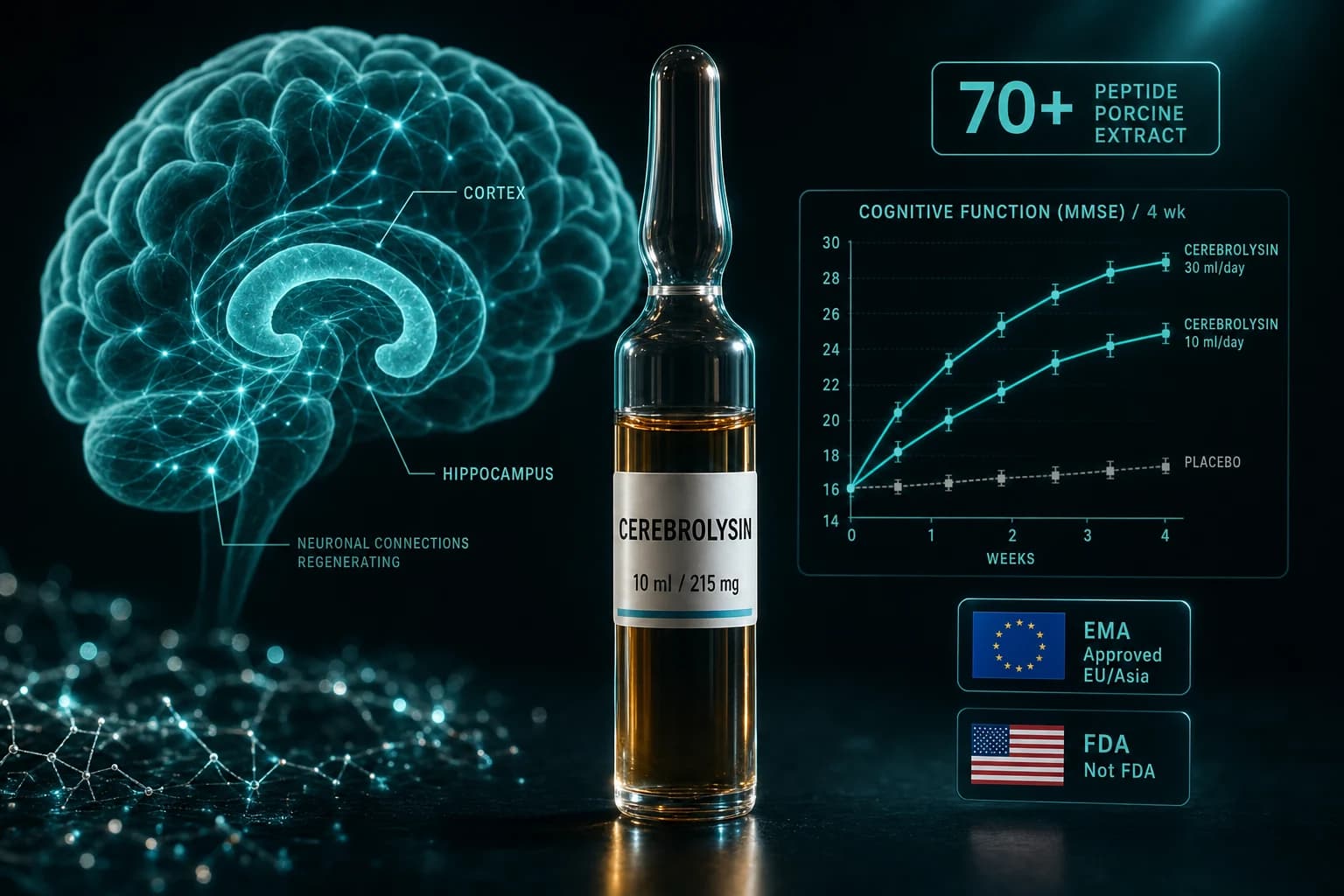
- Cerebrolysin is a complex mixture of approximately 70 low-molecular-weight peptides and amino acids derived from porcine brain tissue, produced by Ever Neuro Pharma
- Approved in EU and Asian countries for acute stroke, Alzheimer's disease, vascular dementia, and traumatic brain injury; not FDA-approved
- Standard research protocol: 10-30 mL infusion or IM injection daily for 10-20 days, often repeated in 6-12 month cycles
- Mechanism: BDNF and NGF-like neurotrophic effects, reduced excitotoxicity, anti-apoptotic effects, and neuroplasticity support
- Largest meta-analyses (Cochrane reviews) show modest but reproducible benefit in acute stroke; effect size is debated and Phase 3 quality varies
Cerebrolysin is the unusual entry in the peptide research catalog: a complex mixture of approximately 70 different low-molecular-weight peptides and amino acids derived from purified porcine brain tissue, produced by Ever Neuro Pharma (Austria). The compound has been used clinically in Europe and Asia since the 1970s for stroke, Alzheimer's, vascular dementia, and traumatic brain injury. It is not FDA-approved, and the published evidence base spans decades with meta-analyses showing modest but reproducible benefit for several neurodegenerative endpoints.
This article covers what Cerebrolysin actually is, the evidence base across major indications, the standard protocols used clinically and in research, and where the compound fits in 2026 neurodegenerative research.
What Cerebrolysin actually is
Cerebrolysin is not a single peptide. It is a manufactured complex mixture extracted from young pig brain tissue through enzymatic processing. The mixture contains:
- Approximately 70 different peptides ranging in size from small di-/tri-peptides to longer chains
- Free amino acids
- The peptide fragments are reportedly enriched for neurotrophic-active sequences
| Property | Cerebrolysin value |
|---|---|
| Source | Purified porcine brain tissue |
| Composition | ~70 different peptides + amino acids |
| Manufacturer | Ever Neuro Pharma (Austria) |
| Approval status | EU, Asia, Russia (various indications); not FDA-approved |
| Concentration | 215 mg active peptide content per 10 mL ampoule |
| Routes | Intravenous infusion, intramuscular injection |
| Storage | Refrigerated (2-8°C) |
The complex mixture is the most-distinctive feature of Cerebrolysin. Most pharmaceutical peptides are single defined molecules. Cerebrolysin is a defined manufactured mixture where the specific peptide composition is proprietary to the manufacturer. This is closer in structure to a natural product or a biological extract than to a typical synthetic peptide.
For broader cognitive research peptide context, see the Selank nasal vs injection dosing guide and the Calm + Clarity cognitive stack.
Mechanism: BDNF/NGF-like neurotrophic effects
Cerebrolysin's mechanism is multi-pathway, reflecting its complex composition:
BDNF-mimetic activity. Components of the peptide mixture mimic BDNF (Brain-Derived Neurotrophic Factor) effects on neuronal survival, neuroplasticity, and synaptic function. This is the most-cited mechanism for the compound's effects in stroke recovery and neurodegenerative conditions.
NGF-mimetic activity. Similar to BDNF, components mimic NGF (Nerve Growth Factor) effects on cholinergic neurons, particularly in the basal forebrain and hippocampus. This is mechanistically relevant for Alzheimer's research.
Anti-excitotoxicity. Cerebrolysin reduces glutamate-mediated excitotoxicity in cell culture models. This is particularly relevant in acute stroke contexts where excitotoxicity contributes to expanding infarct size.
Anti-apoptotic effects. Inhibits calcium-mediated apoptotic pathways and reduces oxidative stress in neurons. Relevant to both acute neuroprotection and chronic neurodegeneration contexts.
Neuroplasticity support. Effects on neuronal sprouting and synaptic plasticity that support functional recovery after injury or in chronic neurodegeneration.
Evidence base across major indications
The Cerebrolysin clinical evidence base spans multiple indications with different evidence quality:
Acute ischemic stroke
The most-studied indication. Multiple randomized trials and meta-analyses have evaluated Cerebrolysin in acute stroke.
CASTA trial. Heiss et al., Stroke, 2012 was the largest single trial: 1,070 patients randomized to Cerebrolysin or placebo within 12 hours of ischemic stroke onset, treated for 10 days. The primary endpoint (modified Rankin Scale at 90 days) showed favorable trends but did not reach statistical significance in the overall population. Subgroup analyses suggested benefit in patients with more severe baseline stroke.
Cochrane review. Ziganshina et al., Cochrane Database Syst Rev, 2017 systematic review concluded the evidence is insufficient to determine routine clinical use, with risk of bias and trial quality variation limiting confident effect-size estimates.
Subsequent meta-analyses. Bornstein et al., 2018 and others have found modest but reproducible favorable effects on functional outcomes, particularly in moderate-to-severe stroke. The magnitude is small but the direction of effect has been consistent across multiple trial cohorts.
Alzheimer's disease
Multiple Phase 2/3 trials of Cerebrolysin in mild-to-moderate Alzheimer's disease.
Trial program. Trials by Allegri and others (Allegri et al., 2014) showed measurable improvements in cognitive function measures (ADAS-cog, MMSE) compared to placebo over 4-6 month treatment durations.
Effect size. Magnitude is modest (similar to or smaller than donepezil) but reproducible across multiple trials.
Recent work. Continued European trials through 2020s have refined dose-response and patient selection criteria.
Vascular dementia
Smaller evidence base but consistent direction:
- Several Phase 2 trials showing cognitive improvement in vascular dementia
- The mechanism case is direct (chronic cerebrovascular insufficiency similar to chronic post-stroke recovery)
Traumatic brain injury
Most-studied of the indications in recent years:
- Multiple Phase 2/3 trials showing improvement in recovery measures after moderate-to-severe TBI
- Some trials suggest larger effect sizes than in chronic conditions
Pediatric neurological conditions
Cerebrolysin has off-label use in pediatric neurological conditions in Russia and several Asian markets, though the evidence base is smaller and lower-quality than the adult stroke literature.
Standard protocols
For the major indications, the standard Cerebrolysin protocols:
| Indication | Dose | Route | Frequency | Duration |
|---|---|---|---|---|
| Acute stroke | 30-50 mL | IV infusion | Once daily | 10 days |
| Alzheimer's | 10-30 mL | IV infusion or IM | Once daily | 20-30 days, repeated 6-monthly |
| Vascular dementia | 10-30 mL | IV infusion or IM | Once daily | 20 days, repeated as needed |
| Traumatic brain injury | 30-50 mL | IV infusion | Once daily | 10-30 days |
| General research-use cycle | 5-10 mL | IM | Once daily | 20-30 days |
Each 10 mL ampoule contains approximately 215 mg active peptide content. The compound is typically diluted in saline for IV infusion. Intramuscular injection is the most common route for outpatient or research-use protocols where IV access is impractical.
The repeated cycling pattern (e.g., 20-30 days every 6 months) is the most-common pattern in European clinical practice rather than continuous dosing.
When Cerebrolysin is appropriate
Three research contexts where Cerebrolysin specifically may be the right choice:
1. Post-stroke recovery research. The largest evidence base and most-studied indication. Researchers replicating European clinical protocols for stroke recovery should align with the established Cerebrolysin dosing.
2. Alzheimer's research where multi-mechanism intervention is the goal. The complex peptide mixture engages multiple neurotrophic and neuroprotective pathways simultaneously. For research where pleiotropic mechanisms are valued, Cerebrolysin offers more pathway coverage than single-peptide alternatives.
3. Traumatic brain injury research. Active area of clinical development with growing evidence base. Researchers in TBI recovery contexts may find Cerebrolysin's mechanism aligned with their goals.
Bottom line: Cerebrolysin is unusual: a complex porcine-derived peptide mixture with decades of European clinical use, modest but reproducible benefit in acute stroke and several neurodegenerative conditions, but never FDA-approved. For research replicating European clinical protocols, it is the appropriate tool. For research where single-peptide mechanism specificity matters, alternatives like Selank, Semax, or Dihexa may be more interpretable.
Safety profile
Cerebrolysin has decades of clinical use with a generally favorable safety profile:
Allergic reactions. Because the compound is porcine-derived, there is a small risk of allergic reaction. Skin testing before initiation is standard in European clinical protocols.
Injection site reactions. Common with IM administration; typically mild and transient.
Hypersensitivity. Reported infrequently in clinical use.
No documented dependence or tolerance. Unlike some neuro-active compounds.
The compound is contraindicated in patients with severe renal disease and during pregnancy. It is not recommended in patients with grand mal epilepsy.
How Cerebrolysin fits with other cognitive research peptides
| Compound | Source | Mechanism focus | Best evidence |
|---|---|---|---|
| Cerebrolysin | Porcine brain extract | Multi-pathway neurotrophic | Phase 2/3 stroke + AD trials |
| Selank | Synthetic tuftsin analog | GABA modulation + BDNF | Russian clinical (anxiolytic) |
| Semax | Synthetic ACTH-derived | BDNF + NGF cognitive | Russian clinical (cognition) |
| Dihexa | Synthetic HGF mimetic | Synaptic + spatial memory | Animal-only |
| Pinealon | Synthetic peptide | Anti-aging neuropeptide | Russian/Eastern European |
For research applications requiring stronger evidence base and approval status, Cerebrolysin offers the largest published clinical database among this group, though all are off-label or research-only in the US.
For coverage of the related research peptides, see the Selank nasal vs injection dosing guide, the Dihexa BDNF mimetic dosing evidence audit, and the Calm + Clarity Selank Pinealon PE-22-28 cognitive stack.
Cerebrolysin and the 2026 regulatory landscape
Cerebrolysin is not FDA-approved in the US. It is not among the peptides included in the February 27, 2026 HHS reclassification because it was not on the original FDA Category 2 list. The compound's regulatory status is complex because it is a manufactured biological mixture rather than a synthetic peptide.
For US patients seeking Cerebrolysin, the practical pathways are:
- International prescription where it is approved (EU, Asia, Russia, etc.)
- Some US compounding pharmacies have offered Cerebrolysin-like preparations under research-use disclosures
- Travel-medicine context for patients with stroke or neurodegenerative conditions
For broader regulatory context, see the FDA peptide reclassification February 2026 complete breakdown.
Sourcing
Authentic Cerebrolysin is produced by Ever Neuro Pharma (Austria) and distributed through pharmaceutical channels in approved jurisdictions. US research-grade availability is limited. For US-accessible research peptides targeting related cognitive endpoints, Ascension Peptides carries Selank, Semax, and related compounds with 50% off using code ENHANCED.
For our broader sourcing analysis, see the best legit peptide vendors 2026 ranking.
FAQ
What is Cerebrolysin?
Cerebrolysin is a manufactured complex peptide mixture extracted from purified porcine brain tissue. It contains approximately 70 different peptides plus free amino acids and is produced by Ever Neuro Pharma. The compound is approved in EU, Asia, and Russia for various neurodegenerative indications but is not FDA-approved in the US.
Does Cerebrolysin actually work for stroke?
The largest meta-analyses show modest but reproducible favorable effects on functional outcomes in acute ischemic stroke. The Cochrane review noted insufficient evidence for routine clinical recommendation but did not refute the effect. The mechanism case (BDNF-like neurotrophic effects, anti-excitotoxicity) is well-characterized.
What is the standard Cerebrolysin protocol?
For acute stroke: 30-50 mL IV infusion daily for 10 days. For Alzheimer's: 10-30 mL daily IV or IM for 20-30 days, repeated every 6 months. For traumatic brain injury: 30-50 mL daily for 10-30 days. The compound is typically used in defined cycles rather than continuous dosing.
Is Cerebrolysin FDA-approved?
No. Cerebrolysin is approved in EU, Asia (Japan, China, Korea), Russia, and several other jurisdictions but has not received FDA approval in the US. US research access is limited; some compounding pharmacies have offered Cerebrolysin-like preparations under research-use disclosures.
How does Cerebrolysin compare to Selank or Semax?
Cerebrolysin is a complex multi-peptide mixture with decades of clinical use and Phase 2/3 trials. Selank and Semax are single defined synthetic peptides developed in Russia. Cerebrolysin has broader mechanism coverage; Selank and Semax have more specific mechanism profiles. For research targeting stroke or moderate-to-severe neurodegenerative conditions, Cerebrolysin has more evidence; for research targeting specific anxiolytic or cognitive endpoints, the Russian synthetic peptides may be more practical.
Is Cerebrolysin safe?
Generally favorable safety profile across decades of European clinical use. Porcine-derived nature creates small risk of allergic reaction; skin testing is standard before initiation. Contraindicated in severe renal disease and grand mal epilepsy. Pregnancy and breastfeeding caution.
Can Cerebrolysin be combined with other cognitive peptides?
Common cognitive research stacks include Cerebrolysin + Selank, or Cerebrolysin + Semax, or Cerebrolysin alongside the Calm + Clarity stack components. Mechanistically additive; no formal trial data on combinations.
Further reading
- Selank nasal vs injection dosing guide
- Dihexa BDNF mimetic dosing evidence audit
- Calm + Clarity Selank Pinealon PE-22-28 cognitive stack
- Semax compound guide
- Selank compound guide
- FDA peptide reclassification February 2026 complete breakdown
- Best legit peptide vendors 2026
This article is for educational and research purposes only. Cerebrolysin is approved in EU, Asia, and several other jurisdictions for various neurodegenerative indications but is not FDA-approved in the US. None of the content above constitutes medical advice. Patients should consult qualified clinicians licensed in jurisdictions where Cerebrolysin is approved before considering treatment.