At a glance
- Dihexa is a synthetic hexapeptide (Hexanoic-Tyr-Ile-(6)Aminohexanoic amide) designed as a hepatocyte growth factor (HGF) mimetic for cognitive applications
- The '7 million times more potent than BDNF' claim originated from a single 2012 McCoy lab paper on synaptogenesis in vitro; this potency comparison has not been validated in human contexts
- Standard research protocol: 8-45 mg oral daily; the wide dose range reflects the absence of human dose-response data
- Published evidence is preclinical: rodent models of spatial memory, synaptogenesis, and Alzheimer's-related cognitive function
- No human clinical trial data exists as of May 2026; the compound has not advanced beyond preclinical despite over a decade of academic research interest
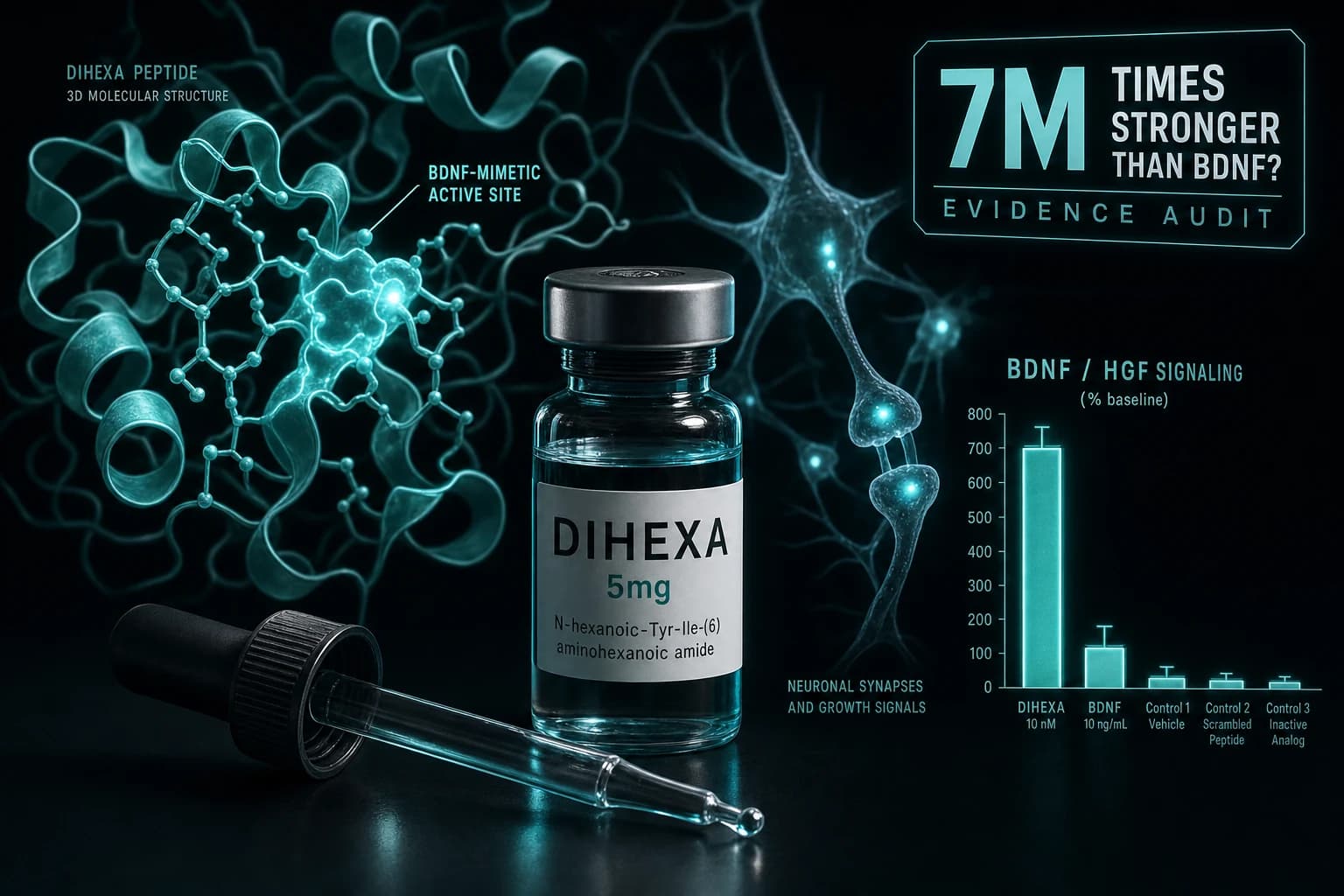
Dihexa is one of the most-discussed and least-validated peptides in the cognitive research space. The compound emerged from Joe Harding's McCoy lab at Washington State University in the early 2010s with a striking preclinical finding: in cell culture synaptogenesis assays, Dihexa was reportedly 7 million times more potent than BDNF at supporting neuronal connection formation. The headline number generated substantial attention in the nootropic and longevity research communities and continues to drive interest in the compound despite a decade-plus of preclinical-only status.
This article covers what Dihexa actually is, the 7-million-times potency claim and what it does and doesn't mean, the published evidence base, the standard research-grade dosing protocols, and how the compound fits in 2026 cognitive research.
What Dihexa actually is
Dihexa is a synthetic hexapeptide designed by the McCoy lab at Washington State University as a hepatocyte growth factor (HGF) mimetic. The full chemical name is N-hexanoic-Tyr-Ile-(6) aminohexanoic amide.
| Property | Dihexa value |
|---|---|
| Sequence | Hexanoic-Tyr-Ile-(6) aminohexanoic amide |
| Length | 2 amino acid residues + 2 non-amino acid hexanoic chains |
| Class | HGF mimetic peptide |
| Receptor target | c-Met (HGF receptor) |
| Bioavailability | Oral (peptide modifications enable oral absorption) |
| Mechanism | HGF/c-Met pathway activation → synaptogenesis |
| Developer | McCoy lab, Washington State University |
| Stage | Preclinical only |
The structural distinctive feature: Dihexa contains two non-amino acid hexanoic chain components that make it more lipophilic and orally bioavailable than typical peptides. This is the engineering achievement that distinguishes Dihexa from natural HGF, which is a large glycoprotein (90 kDa) with no oral bioavailability.
The HGF/c-Met pathway is established in neuroplasticity and synaptogenesis research. HGF normally promotes neuronal survival, axon growth, and synapse formation. Dihexa was designed to mimic these effects in a small, orally-bioavailable molecule.
For broader cognitive peptide research context, see the Selank nasal vs injection dosing guide, the Cerebrolysin neurodegenerative protocol guide, and the Calm + Clarity cognitive stack.
The 7 million times claim
The most-cited Dihexa fact is that it is "7 million times more potent than BDNF." The claim originated from Benoist et al., J Pharmacol Exp Ther, 2014 and was previewed in the 2012 McCoy lab work. The specific assay:
- Test: In vitro hippocampal neuron synaptogenesis
- Endpoint: Spinogenesis (formation of dendritic spines)
- Dihexa effective concentration: ~10⁻¹⁵ M (femtomolar range)
- BDNF effective concentration: ~10⁻⁸ M (nanomolar range, similar to natural BDNF concentrations)
- Ratio: ~10⁷ or "7 million times"
What this number does and doesn't mean:
What it means. Dihexa achieves the same in vitro endpoint at extraordinarily low concentrations in a specific synaptogenesis assay. The potency in that specific assay is genuine.
What it doesn't mean. It does not mean Dihexa is 7 million times more effective than BDNF in producing cognitive benefits in living organisms. Cognitive function depends on many mechanisms beyond synaptogenesis. In vitro potency in one assay does not translate linearly to in vivo cognitive efficacy.
What is unknown. The relationship between the in vitro potency and clinically meaningful cognitive effects in humans has never been characterized because Dihexa has not advanced to human clinical trials.
Bottom line: The "7 million times more potent than BDNF" claim is technically accurate in a specific in vitro assay but does not establish clinically meaningful potency in humans. The number is a marketing-friendly translation of a research finding that has not been validated at the clinical scale.
The published evidence base
Dihexa's evidence base is preclinical and predominantly from the McCoy lab and collaborators:
In vitro synaptogenesis. Benoist et al., 2014 established the in vitro spinogenesis effects in hippocampal neurons.
Spatial memory in rodents. McCoy et al., 2012-2017 showed Dihexa improved spatial memory in rodent models of Alzheimer's-related cognitive impairment. The Morris water maze and similar tasks were the typical endpoints.
Alzheimer's-related cognitive function. Multiple rodent studies showed Dihexa attenuated amyloid-beta-induced cognitive impairment in mouse and rat models.
Mechanism elaboration. Subsequent papers explored the c-Met receptor binding and downstream signaling that distinguishes Dihexa from natural HGF.
Comparator activity. Some studies compared Dihexa to angiotensin IV (a related research peptide with similar but weaker effects) and other HGF mimetics. Dihexa typically outperformed comparators in rodent cognitive tasks.
What the evidence base does not include: human clinical trials. Despite more than a decade of academic research interest, Dihexa has not advanced into human studies. The reasons are not entirely clear from the public record but likely involve a combination of:
- No commercial sponsor stepping forward to fund Phase 1
- The peptide research field generally being underfunded for new molecules
- Regulatory complexity of advancing a synthetic peptide for cognitive indications
- The relatively niche academic origin
Standard research protocols
Forum-documented research-use protocols for Dihexa:
| Phase | Dose | Route | Frequency | Duration |
|---|---|---|---|---|
| Conservative | 8-15 mg | Oral | Once daily | 4-6 weeks |
| Standard | 15-25 mg | Oral | Once daily | 4-6 weeks |
| Higher | 25-45 mg | Oral | Once daily | 4-6 weeks |
The dose range is wide because no human dose-response data exists. The lower end is conservative; the upper end approaches doses sometimes used in animal-to-human extrapolation calculations. Most research-use protocols start conservative and titrate up if no effect is observed.
Cycle duration is typically 4-6 weeks, mirroring the cycle structure used in rodent cognitive task studies. There is no specific safety reason for the cap, but extended cycles extrapolate well beyond the animal-study duration.
Dihexa is dosed orally because its structural modifications enable oral absorption. Subcutaneous or intranasal protocols are uncommon.
Stacking with related compounds
Dihexa is sometimes stacked with related cognitive research peptides:
Dihexa + Selank. Combines HGF-mimetic synaptogenesis support with GABA-mediated anxiolytic effects. See Selank nasal vs injection dosing guide.
Dihexa + Semax. Combines HGF mimetic activity with BDNF/NGF activity. The mechanisms are complementary; the empirical data is anecdotal.
Dihexa + Cerebrolysin. Adds multi-peptide neurotrophic effects to the single-peptide HGF mimetic. Mechanistically additive; no formal data.
Dihexa + nootropic small molecules. Some research protocols combine Dihexa with non-peptide nootropics. The interactions are not characterized.
For broader stack context, see the Calm + Clarity Selank Pinealon PE-22-28 cognitive stack.
Safety profile
Dihexa's safety profile in published animal studies has been generally favorable. Reported observations:
- No major adverse events at typical research doses in rodent studies
- No tumor-promoting effects observed in rodent studies (a theoretical concern because HGF signaling is implicated in cancer biology)
- Minimal acute side effects at standard research doses
What the safety database does not cover:
- Long-term human use at therapeutic dosing
- HGF/c-Met pathway implications in cancer-prone subjects
- Interactions with cancer screening or treatment
- Pediatric, pregnancy, and breastfeeding contexts
The theoretical cancer-risk concern deserves emphasis. HGF and its c-Met receptor are implicated in many cancer types, particularly when overexpressed or constitutively activated. Activating the c-Met pathway with Dihexa in cancer-prone subjects could theoretically promote tumor growth. The clinical evidence to support or refute this concern does not exist.
Researchers with active malignancy or strong cancer family history should not use Dihexa.
Bottom line: The published Dihexa safety profile is favorable in rodent studies, but the human safety database is essentially non-existent. Cancer-pathway concerns are theoretical but mechanism-based. Conservative use, short cycles, and avoidance in cancer-prone subjects are reasonable defaults.
Where Dihexa fits in 2026 research
The honest assessment: Dihexa is interesting research compound with strong preclinical findings but no human validation. For research applications:
1. Mechanism research. Researchers studying HGF/c-Met pathway in cognitive contexts may find Dihexa a useful tool for activating the pathway with reasonable bioavailability.
2. Animal cognitive research. The most-supported application; replicating the McCoy lab findings in similar animal models is the protocol with the strongest evidence base.
3. Self-experimentation cognitive research. Common, despite the absence of human data. Researchers in this category should expect highly variable individual responses and unknown long-term safety.
4. Clinical use. Not appropriate. The compound has not received human safety or efficacy validation through Phase 1.
For research applications with stronger human evidence, the Selank nasal vs injection dosing guide (Russian clinical anxiolytic evidence), Cerebrolysin neurodegenerative protocol guide (decades of European clinical use), and Semax compound guide (Russian cognitive evidence) offer better-validated alternatives.
Dihexa and the 2026 regulatory landscape
Dihexa is not among the peptides reclassified in the February 27, 2026 HHS announcement. It remains a research-grade compound without compounding-pharmacy access or other regulatory recognition. Research-grade retail availability through peptide vendors continues to be the practical channel.
For broader regulatory context, see the FDA peptide reclassification February 2026 complete breakdown.
Sourcing
For research-grade oral Dihexa, Limitless Biotech carries it in the oral cognitive peptide catalog with code ENHANCED. Quality verification matters more for Dihexa than for most retail research peptides because the molecule's structural complexity requires precise synthesis.
For our broader sourcing analysis, see the best legit peptide vendors 2026 ranking.
FAQ
Is Dihexa really 7 million times more potent than BDNF?
In a specific in vitro hippocampal synaptogenesis assay, yes. The potency comparison is technically accurate in that assay. It does not translate to "7 million times more cognitively effective in humans" because in vitro potency in one assay does not establish in vivo clinical efficacy. The marketing-friendly translation of the research finding overstates what the data establishes.
What is the standard Dihexa research dose?
8-45 mg oral once daily for 4-6 weeks. The wide range reflects the absence of human dose-response data. Most research-use protocols start at 8-15 mg and titrate up if no effect is observed.
Has Dihexa been tested in humans?
No published human clinical trials exist as of May 2026. Despite more than a decade of academic research interest from the McCoy lab and collaborators, Dihexa has not advanced beyond preclinical (animal and cell culture) research.
What is the cancer concern with Dihexa?
HGF and its receptor c-Met are implicated in many cancer types when overexpressed or constitutively activated. Dihexa activates the c-Met pathway as a pro-cognitive mechanism. The theoretical concern is that this activation could promote tumor growth in cancer-prone subjects. The clinical evidence to support or refute this concern does not exist. Conservative position: avoid Dihexa in subjects with active malignancy or strong cancer family history.
Is Dihexa orally bioavailable?
Yes, this is one of its design features. The structural modifications (hexanoic chain components) make Dihexa more lipophilic than typical peptides and enable meaningful oral absorption. This distinguishes Dihexa from natural HGF (which has no oral bioavailability) and from many other research peptides that require injection.
How does Dihexa compare to Selank or Semax?
Dihexa is a synthetic HGF mimetic with strong preclinical evidence but no human trials. Selank is a synthetic tuftsin analog with decades of Russian clinical use for anxiolytic indications. Semax is a synthetic ACTH-derived peptide with Russian clinical evidence for cognitive applications. For research with better-validated human evidence, Selank and Semax have stronger databases. For research specifically targeting HGF pathway mechanisms, Dihexa is the more direct tool.
Can I combine Dihexa with other cognitive peptides?
Common research stacks combine Dihexa with Selank, Semax, or Cerebrolysin. The mechanisms are complementary; the empirical data on combinations is anecdotal. Researchers running stacks should expect highly variable individual responses and should not assume the combined effect is additive in predictable ways.
Further reading
- Selank nasal vs injection dosing guide
- Cerebrolysin neurodegenerative protocol guide
- Calm + Clarity Selank Pinealon PE-22-28 cognitive stack
- Semax compound guide
- Selank compound guide
- FDA peptide reclassification February 2026 complete breakdown
- Best legit peptide vendors 2026
- Injectable vs oral peptides bioavailability guide
This article is for educational and research purposes only. Dihexa is sold under research-use disclosures and is not approved by the FDA for any indication. No human clinical trial data exists as of May 2026. Researchers with active malignancy or strong cancer family history should not use Dihexa due to theoretical HGF/c-Met pathway concerns. None of the content above constitutes medical advice.