At a glance
- Selank is a synthetic tuftsin analog developed in Russia; approved in Russia and CIS countries for anxiolytic indications, not FDA-approved
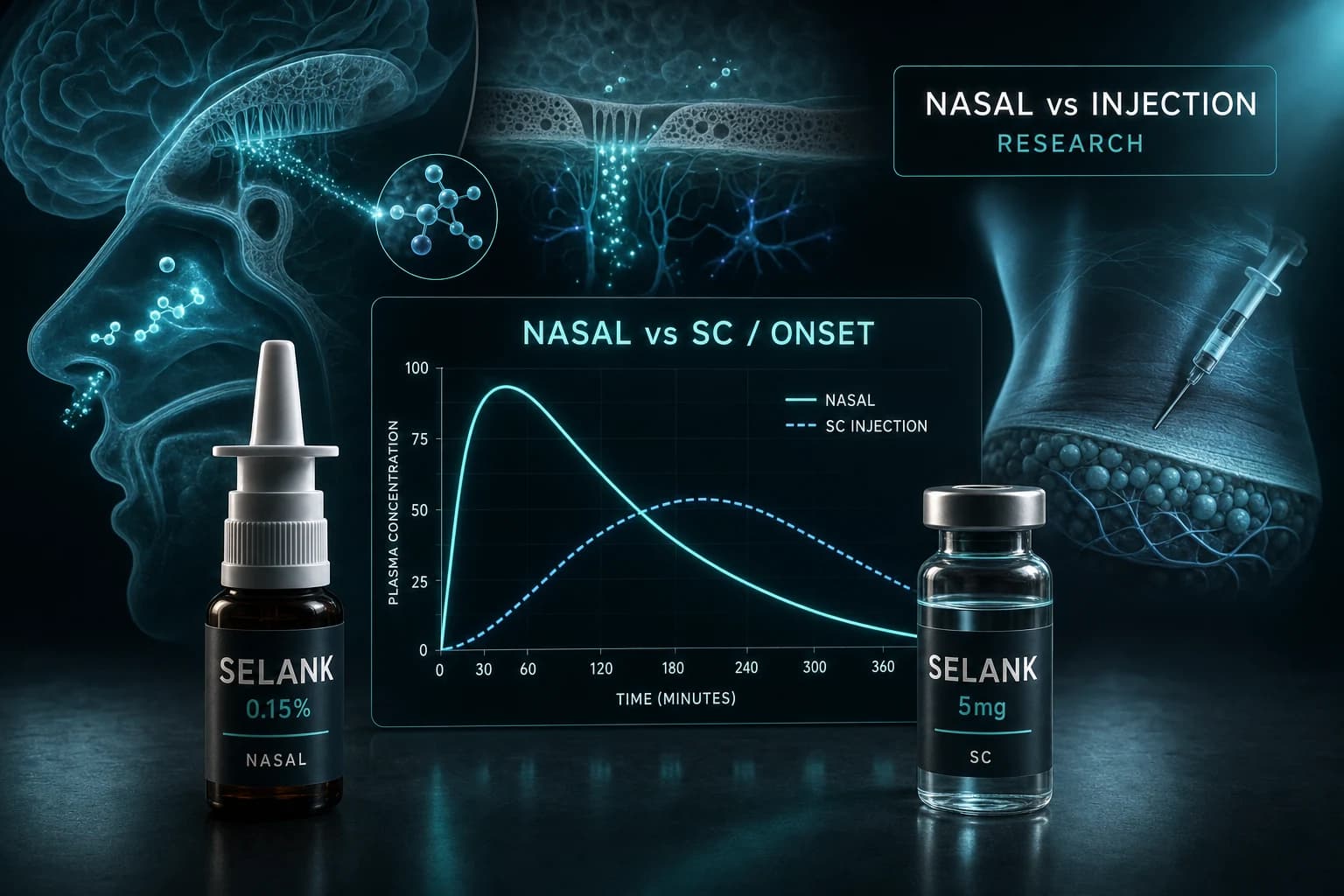
- Nasal route delivers Selank directly across the cribriform plate to CNS; faster onset (5-15 min peak) but shorter duration than injection
- Standard nasal protocol: 1-3 drops per nostril (300-900 mcg) once or twice daily; 0.15% solution is the standard concentration
- Standard injection protocol: 100-300 mcg subcutaneous daily; longer duration but slower onset of CNS effects
- Mechanism: enhances GABA-mediated anxiolytic effects; also modulates BDNF and enkephalin expression in animal studies
Selank is the synthetic tuftsin analog that earned approval in Russia for anxiety disorders and persists as one of the most-studied research peptides outside the US regulatory ecosystem. The compound has two well-established dosing routes: intranasal (the most-studied and approved route in Russia) and subcutaneous injection. Each route has distinct pharmacokinetics, onset profiles, and practical considerations.
This article covers what Selank is, why the nasal route is the standard for CNS-targeted research, the comparison between nasal and injection routes, the standard dosing protocols for each, and how Selank fits with other research peptides in cognitive and anxiolytic stacks.
What Selank actually is
Selank is a synthetic heptapeptide developed at the Institute of Molecular Genetics of the Russian Academy of Sciences. The peptide sequence is Thr-Lys-Pro-Arg-Pro-Gly-Pro (Threonyl-Lysyl-Prolyl-Arginyl-Prolyl-Glycyl-Prolyl), derived from human tuftsin (Thr-Lys-Pro-Arg) with a stabilizing C-terminal extension.
| Property | Selank value |
|---|---|
| Sequence | Thr-Lys-Pro-Arg-Pro-Gly-Pro (7 amino acids) |
| Class | Synthetic tuftsin analog |
| Approval | Russia and CIS countries (anxiolytic); not FDA-approved |
| Developer | Institute of Molecular Genetics (Russia) |
| Mechanism | GABA modulation, BDNF expression, enkephalin pathway |
| Routes | Intranasal (standard); subcutaneous (alternative) |
The mechanism of action is multi-pathway. Selank produces measurable anxiolytic effects through GABA-mediated mechanisms, with additional effects on BDNF, enkephalin expression, and serotonin metabolism in animal models. The clinical Russian work suggests anxiolytic effects comparable to benzodiazepines without dependence, sedation, or cognitive impairment.
For the broader compound context, see the Selank compound guide. For related cognitive research peptides, see the Calm + Clarity cognitive stack with Selank, Pinealon, and PE-22-28.
Why the nasal route is the standard
Selank is most-studied as an intranasal peptide. The nasal route offers specific advantages for CNS-targeted research:
Direct CNS delivery via the cribriform plate. Nasal-administered peptides can cross the cribriform plate (a thin bone region in the nasal cavity) and access olfactory bulb and forebrain regions directly. This bypasses the blood-brain barrier for a meaningful portion of the dose.
Faster onset. Peak nasal-administered Selank effect typically occurs within 5-15 minutes of dosing. Subcutaneous injection produces slower onset (30-60 minutes for circulating peptide to reach CNS through systemic circulation).
Lower systemic exposure. Nasal dosing produces lower systemic Selank concentrations than equivalent SC dosing, which may reduce off-target effects in peripheral tissues.
Practical accessibility. Nasal sprays are easier to administer than injections; this matters for compliance in research protocols spanning weeks to months.
The Russian clinical work that established Selank's anxiolytic profile used intranasal dosing predominantly. The published literature supporting Selank's effects is largely nasal-route literature. Researchers replicating this work for anxiolytic or cognitive endpoints should generally start with the nasal route.
For broader nasal peptide bioavailability context, see the nasal peptides bioavailability delivery guide and the injectable vs oral peptides bioavailability guide.
Standard nasal dosing protocol
The convergent nasal Selank protocol:
| Phase | Dose per nostril | Total dose | Frequency | Duration |
|---|---|---|---|---|
| Standard | 1-2 drops (300-450 mcg) | 300-900 mcg per dose | 1-2 times daily | 2-6 weeks |
| Higher | 2-3 drops | 600-900 mcg per dose | 2 times daily | 2-6 weeks |
| Acute anxiolytic | 1-2 drops | 300-600 mcg per use | As needed | Per-use |
Standard Selank nasal solution is 0.15% (1.5 mg/mL). One drop typically delivers approximately 150-225 mcg of Selank. The dose-per-drop varies slightly by spray bottle design and dropper accuracy.
For acute anxiolytic research applications, single-dose nasal administration produces measurable effects within 15 minutes that persist for 4-6 hours. For chronic anxiolytic protocols, daily or twice-daily dosing over 2-6 weeks produces sustained effects that often outlast the dosing window by days to weeks (consistent with the BDNF-modulating mechanism).
Standard injection dosing protocol
For subcutaneous Selank research applications:
| Phase | Dose | Frequency | Timing | Duration |
|---|---|---|---|---|
| Standard | 100-300 mcg | Once daily SC | Morning | 2-6 weeks |
| Higher | 300 mcg | Twice daily SC | AM + PM | 2-6 weeks |
The injection route has been less-studied than the nasal route in Russian clinical work. Most injectable Selank research has been mechanistic (animal studies) rather than clinical (human trials). The injection route is sometimes preferred for:
- Research protocols where precise dose control matters
- Studies comparing Selank to injectable comparator peptides
- Situations where nasal mucosa is not appropriate (cold, congestion)
Subcutaneous Selank has slower CNS onset (30-60 minutes) and longer total duration than nasal dosing. The trade-off is less acute precision in onset timing.
Comparing nasal vs injection: practical considerations
| Factor | Nasal Selank | Injection Selank |
|---|---|---|
| Onset of CNS effect | 5-15 minutes | 30-60 minutes |
| Peak effect duration | 4-6 hours | 6-12 hours |
| CNS bioavailability | Higher (direct cribriform pathway) | Lower (systemic + BBB transit) |
| Systemic peripheral exposure | Lower | Higher |
| Convenience | High (nasal spray) | Moderate (subcutaneous needle) |
| Published clinical evidence | Substantial Russian clinical work | Limited human evidence; more animal |
| Variability per dose | Higher (spray accuracy) | Lower (syringe accuracy) |
| Cost per dose | Generally lower | Generally higher |
For research targeting CNS endpoints specifically (anxiety, cognition, mood), nasal Selank is the route the published literature supports best. For research where systemic Selank effects are also relevant (immune modulation, peripheral mechanism studies), injection may be preferred.
Bottom line: Nasal Selank is the default for CNS-focused research because it maps to the most-studied route in published literature. Injection Selank is a valid alternative for specific research contexts but has less direct clinical evidence support.
Mechanism details
Selank's anxiolytic mechanism is multi-pathway:
GABA modulation. Selank enhances GABA-A receptor function indirectly, producing anxiolytic effects similar to benzodiazepines but through a different binding mechanism. The effect is mild relative to benzodiazepines but reportedly without tolerance development or dependence.
BDNF expression. Animal studies show Selank increases BDNF (Brain-Derived Neurotrophic Factor) expression in hippocampus. This is mechanistically linked to neuroplasticity, learning, and memory effects observed in cognitive research.
Enkephalin pathway. Selank affects endogenous opioid signaling through enkephalin modulation, which contributes to the anxiolytic effect and may relate to the absence of dependence/tolerance.
Cytokine and immune modulation. Selank has documented effects on cytokine balance, particularly involving interleukin-6 and other inflammatory mediators. This mechanism is distinct from the CNS effects and may be relevant for research combining anxiolytic and anti-inflammatory endpoints.
For the broader cognitive research stack context, see the Calm + Clarity Selank Pinealon PE-22-28 cognitive stack.
Stacking with other compounds
Selank is commonly stacked with related cognitive research peptides:
Selank + Semax. Semax is another Russian-developed nasal peptide with cognitive-enhancing effects. Selank tends to produce anxiolytic effects; Semax produces stimulating/nootropic effects. The combination is sometimes used for balanced cognitive support without sedation. Standard combined protocol: 300 mcg Selank + 300 mcg Semax nasal, once or twice daily.
Selank + Pinealon. Pinealon adds another neuropeptide layer to cognitive research stacks. The combination is used in some Russian-style nootropic protocols.
Selank + PE-22-28. PE-22-28 is a research peptide targeting depression/anxiety endpoints. The combination provides multiple anxiolytic mechanisms in parallel.
For our Calm + Clarity cognitive stack guide covering these combinations in detail, see that article.
Safety profile
In published Russian clinical work and forum-documented research-use protocols, Selank has been reported as well-tolerated:
No dependence or tolerance. This is the most-cited distinguishing feature versus benzodiazepines. Selank does not appear to produce tolerance with continued dosing or withdrawal symptoms on discontinuation.
No sedation. Most users do not experience the sedation common with benzodiazepines or other anxiolytics. Selank produces calm without drowsiness.
Minimal acute side effects. Mild local nasal irritation is the most common reported event with nasal route. Injection produces mild injection-site reactions.
Limited long-term safety data. Russian clinical use spans decades but the long-term safety database is not directly comparable to FDA Phase 3 data. Patients should discuss with clinicians before extended use.
Selank and the 2026 regulatory landscape
Selank is on the FDA Category 1 list after the February 27, 2026 reclassification (one of the 14 peptides moved from Category 2). The compound is now legally compoundable through licensed 503A pharmacies with a clinician prescription. Research-grade retail availability through peptide vendors is also unchanged.
For broader regulatory context, see the FDA peptide reclassification February 2026 complete breakdown.
Sourcing
For research-grade nasal Selank, Ascension Peptides carries nasal Selank in the nasal spray catalog with 50% off using code ENHANCED. For injectable Selank vials, Ascension Peptides also carries the injectable format.
For our broader sourcing analysis, see the best legit peptide vendors 2026 ranking and the nasal peptides bioavailability delivery guide.
FAQ
Should I use nasal or injection Selank?
For most CNS-targeted research applications, nasal is the default because it matches the route used in most published Russian clinical work and provides faster CNS onset. Injection is a valid alternative for research where precise systemic dosing matters or where nasal administration is impractical.
What is the standard Selank nasal dose?
1-2 drops per nostril (300-450 mcg total) once or twice daily of 0.15% solution. For higher-intensity protocols, 2-3 drops per nostril (600-900 mcg) twice daily. Most chronic protocols run 2-6 weeks per cycle.
How fast does Selank work?
Nasal Selank produces measurable CNS effects within 5-15 minutes of dosing, with peak effects 30-60 minutes after administration. Injection Selank has slower onset (30-60 minutes for peak effect) but longer duration.
Does Selank cause dependence?
Russian clinical work spanning decades has not documented dependence or tolerance with continued Selank use. This is the central distinguishing feature versus benzodiazepines. The mechanism (multi-pathway GABA modulation rather than direct GABA-A receptor binding) is thought to underlie this profile.
Can I combine Selank with Semax?
Yes, this is a common cognitive research stack. Selank tends to produce anxiolytic effects; Semax produces stimulating cognitive effects. The combination provides balanced cognitive support without sedation. Standard combined dose: 300 mcg of each nasal, 1-2 times daily.
Is Selank FDA approved?
No. Selank is approved in Russia and CIS countries for anxiolytic indications but is not approved by the FDA. Following the February 27, 2026 HHS reclassification, Selank is legally compoundable through licensed 503A pharmacies in the US with a clinician prescription. Research-grade retail availability is also unchanged.
What is the difference between Selank and Semax?
Both are Russian-developed synthetic peptides used for cognitive applications. Selank is a tuftsin analog with predominantly anxiolytic mechanism (GABA modulation, BDNF expression). Semax is an ACTH-derived peptide with predominantly stimulating/cognitive mechanism (BDNF, NGF, melanocortin pathways). The compounds are often used together for complementary effects.
Further reading
- Selank compound guide
- Semax compound guide
- Calm + Clarity Selank Pinealon PE-22-28 cognitive stack
- Cerebrolysin neurodegenerative protocol guide
- Dihexa BDNF mimetic dosing evidence audit
- Nasal peptides bioavailability delivery guide
- Injectable vs oral peptides bioavailability guide
- FDA peptide reclassification February 2026 complete breakdown
- Best legit peptide vendors 2026
This article is for educational and research purposes only. Selank is approved in Russia and CIS countries for anxiolytic indications but is not FDA-approved in the US. Following the February 27, 2026 HHS reclassification, Selank is legally compoundable through US licensed 503A pharmacies with a clinician prescription. None of the content above constitutes medical advice. Consult a qualified clinician for individual medical questions about anxiety or cognitive concerns.