At a glance
- MK-677 25 mg at bedtime increased stage IV deep sleep about 50% in young men (Copinschi 1997, PMID 9349662)
- Ghrelin receptor agonism promotes slow-wave sleep in humans, the mechanism MK-677 and GHRPs share (Weikel 2003, PMID 12388174)
- GHRH analogs like sermorelin restore GH pulses lost in the age-related SWS collapse (Van Cauter 2000, PMID 10938176)
- DSIP double-blind data in insomniacs show a real but small and short-lived benefit (Schneider-Helmert 1986, PMID 3758119)
- Epithalon sleep claims rest on one Russian research group and no human polysomnography exists (Khavinson 2001, PMID 11550036)
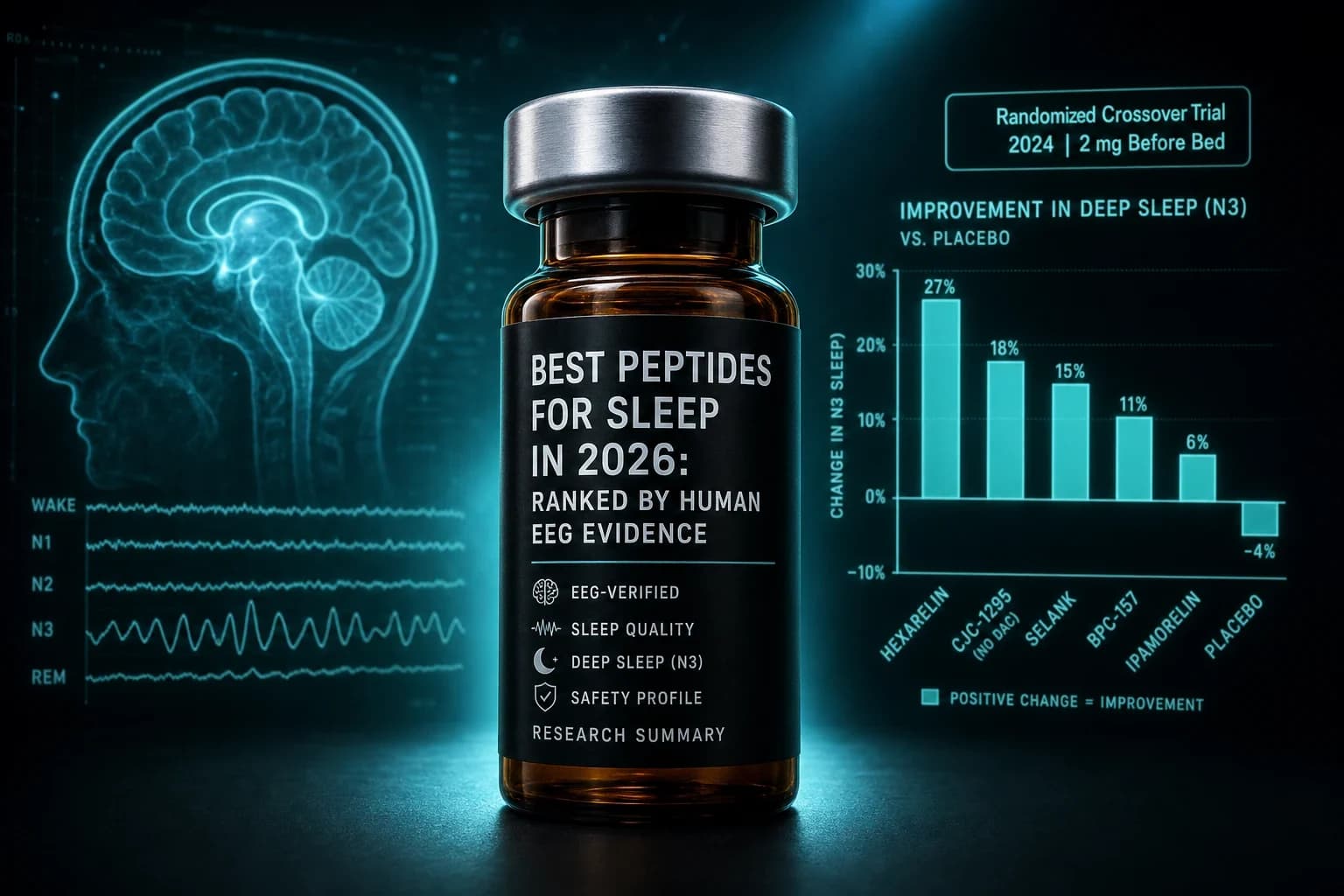
Most "peptides for sleep" guides list five compounds and rank them by vibes. Two of those compounds have real human EEG evidence. One has a small, mixed double-blind literature from the 1980s. Two are backed by a single research group in Saint Petersburg and a lot of forum enthusiasm.
That is the honest map, and it is the one this guide will use. If you want a list without evidence tiers, close the tab; every other site has that. If you want to know which peptides actually moved the polysomnograph and which ones are still marketing riding on a mechanism, keep reading.
The one thing every sleep peptide guide gets wrong
Growth hormone and slow-wave sleep are locked in a feedback loop. Slow-wave sleep triggers the largest natural GH pulse of the 24-hour cycle. GH release, in turn, reinforces slow-wave sleep architecture. The relationship is well-documented in humans and is the reason nearly every peptide with a sleep claim is either a GH secretagogue or something that pretends to be one.
Van Cauter and Copinschi laid out the mechanism cleanly in Van Cauter et al. 2000 (JAMA, PMID 10938176). Young men had 118.5 minutes of slow-wave sleep per night at age 16-25 and 42.7 minutes at age 36-50. Nocturnal GH output tracked the same curve almost exactly. When slow-wave sleep collapses with age, GH secretion collapses with it. That is why age-related sleep decline overlaps so precisely with somatopause.
This matters for one practical reason: any peptide that plausibly increases slow-wave sleep in humans has to interact with the GH axis. That narrows the field of "sleep peptides" to a very small number of compounds where the causal mechanism is not speculative.
Evidence-quality snapshot
| Peptide | Human sleep-lab data | Primary mechanism | Strongest citation | Evidence tier |
|---|---|---|---|---|
| MK-677 (ibutamoren) | Yes, polysomnography, healthy and older adults | Ghrelin receptor / GHS-R agonism | Copinschi 1997 PMID 9349662 | Moderate to strong |
| Sermorelin (GHRH 1-29) | Yes, EEG, older adults | GHRH receptor agonism | Steiger 1992 PMID 1361964 | Moderate |
| CJC-1295 + ipamorelin | Indirect (via GHRH + GHRP mechanism) | GHRH analog + GHS-R agonism | Weikel 2003 PMID 12388174 | Preliminary in stack form |
| DSIP | Yes, small double-blind studies | Unknown, likely GABAergic modulation | Schneider-Helmert 1986 PMID 3758119 | Low to moderate, mixed |
| Epithalon | No human sleep-lab data | Proposed pineal / melatonin modulation | Khavinson 2001 PMID 11550036 | Preliminary, single-group |
| BPC-157, TB-500, thymosin | None | No sleep-specific mechanism | n/a | Anecdote only |
The rest of this guide walks each row of that table in order.
MK-677 (ibutamoren): the strongest human sleep data by a wide margin
MK-677 is the compound with the cleanest human polysomnography record. It is an orally active, non-peptide ghrelin receptor agonist. It stimulates GH release without going through the GHRH pathway, and the sleep data on it is not marketing.
The Copinschi et al. 1997 study in Neuroendocrinology (PMID 9349662) is the anchor. Eight healthy young men aged 18 to 30 received 5 mg or 25 mg of MK-677 or placebo for seven consecutive days in a crossover design. Polysomnography ran on the last night of each period. In the high-dose (25 mg) arm:
- Stage IV (deep) sleep duration increased by roughly 50 percent versus placebo.
- REM sleep duration increased by more than 20 percent.
- The frequency of sleep-architecture deviations dropped from 42 percent under placebo to 8 percent under MK-677.
In older adults (age 65 to 71), the same study reported nearly a 50 percent increase in REM sleep and a shorter REM latency. That older-adult signal is the one that matters clinically, because age-related SWS loss is where the GH-sleep loop is broken in the first place.
Why do we trust this study more than most peptide sleep data? Three reasons. It used real polysomnography, not sleep diaries or actigraphy. The crossover design controlled for individual sleep baseline. And it has been echoed by mechanistically consistent work from Weikel and colleagues, whose ghrelin infusion study in men showed increased slow-wave sleep and delta activity during the second half of the night (Weikel et al. 2003, Am J Physiol Endocrinol Metab, PMID 12388174).
Practical points from the literature, not from vendor pages:
- Bedtime dosing is what the sleep studies used. Split dosing loses the sleep-onset GH pulse benefit.
- Water retention and increased appetite are the two side effects that consistently appear across ibutamoren trials. Water gain of 1 to 3 kg is common in the first two weeks.
- Fasting glucose can drift up. Anyone with insulin resistance or prediabetes should not treat MK-677 as a bedtime supplement.
- FDA has flagged ibutamoren safety concerns and it is not approved for any indication. Use in research contexts only.
If you want the deeper compound-level profile, the MK-677 ibutamoren research guide covers half-life and aging-adult trials in more detail. The MK-677 dosage chart is the structured dosing reference, and the MK-677 compound page lists sourcing.
Bottom line: MK-677 has the strongest human sleep-lab evidence in the peptide category. It is also the compound with the most metabolic downside. That tradeoff is why the smart use case is short cycles in adults with documented age-related SWS decline, not indefinite nightly dosing.
Sermorelin, CJC-1295, and ipamorelin: the GH-axis stack
The GHRH analog (sermorelin, CJC-1295) plus GHRP (ipamorelin, GHRP-2) stack is the second-strongest evidence tier for sleep, but the data structure is different. There is no single sleep study on the CJC-1295 / ipamorelin combo the way there is on MK-677. Instead, there is a large body of work on the underlying receptors and on GHRH alone.
Steiger and colleagues showed in Steiger et al. 1992 (PMID 1361964) that intravenous GHRH pulses increased slow-wave sleep and reduced cortisol in male controls, while somatostatin did the opposite. The GHRH-side of the axis is the SWS-promoting side. That mechanism is what sermorelin (a synthetic GHRH 1-29 fragment) and modified GRF 1-29 (the CJC-1295 no-DAC molecule) are activating.
The GHRP side (ipamorelin, GHRP-2, GHRP-6) is the ghrelin-receptor side. That is the same receptor MK-677 hits, and it is the receptor Weikel showed promotes slow-wave sleep in healthy men (PMID 12388174). Ipamorelin is the cleanest GHRP because it does not spike cortisol or prolactin the way GHRP-6 does.
Stacking a GHRH analog with a GHRP is standard practice because the two receptor classes synergize on GH release. The synergy on sleep specifically is inferred from mechanism, not proven with a dedicated crossover trial. That is worth stating out loud.
Realistic expectations, based on the trial literature and not sales copy:
- Deep-sleep effects show up within the first one to two weeks in most reports.
- The effect on subjective sleep quality tends to plateau; the physical recovery and body-composition effects continue.
- Injections need to be sub-cutaneous, at least 30 minutes before bed, on an empty stomach. Meals within two hours before injection blunt the pulse.
For the head-to-head, our sermorelin vs CJC-1295 vs ipamorelin comparison walks the receptor mechanics. The CJC-1295 + ipamorelin stack protocol covers dosing math. The sermorelin GHRH 1-29 clinical research guide is the compound-specific writeup.
Peptide pages: sermorelin, CJC-1295, ipamorelin. The reconstitution math for all three lives in the reconstitution calculator and the CJC-1295 + ipamorelin dosage chart.
Warning: The GHRH plus GHRP stack is a growth-hormone protocol first and a sleep protocol second. GH secretagogues affect IGF-1, glucose handling, insulin sensitivity, and fluid balance. Anyone with active malignancy, uncontrolled diabetes, or unstable cardiovascular disease should not use this stack. Standard research-use framing applies.
DSIP: the historical sleep peptide with a small, mixed record
DSIP (delta-sleep-inducing peptide) is a 9-amino-acid neuropeptide isolated in 1977 from rabbit cerebral blood by Monnier's group. It is the only peptide on this list that was discovered as a sleep-active molecule. Everything else got a sleep application by inference. That should make DSIP the strongest case, and it does not.
The best-known human data comes from Schneider-Helmert's clinical work. Schneider-Helmert 1986 (European Neurology, PMID 3758119) summarized double-blind DSIP trials in insomniacs, reporting improvements in sleep efficiency and sleep latency with both single and repeated intravenous doses. The trials were small and the effect sizes were modest.
The follow-up double-blind by Bes and colleagues (Bes et al. 1992, Neuropsychobiology, PMID 1299794) used 25 nmol/kg intravenous DSIP in 16 chronic insomniac patients across three consecutive nights. They confirmed higher sleep efficiency and shorter sleep latency with DSIP versus placebo, but the effects were smaller than in earlier trials and the authors concluded that short-term DSIP is unlikely to be of major therapeutic benefit for chronic insomnia.
That is the state of the evidence. Two double-blind studies, both small, both showing a real but modest signal. No large-scale replication. No polysomnography data comparable in size to the MK-677 record.
Additional context to weigh:
- The mechanism of DSIP is still not fully characterized. Proposed pathways include GABAergic modulation and interaction with the pineal / melatonin system.
- Most modern DSIP use is subcutaneous, not intravenous, and no controlled trial has confirmed the sub-cutaneous route produces the same effect as the IV route the 1980s studies used.
- Half-life is short. Practical dosing is 100 to 300 mcg pre-bed in research contexts.
- Safety data outside the small clinical trials is essentially non-existent.
The compound page is DSIP, and the structured dosing reference is the DSIP dosage chart.
Epithalon: the circadian rhythm bet with single-group evidence
Epithalon is a synthetic tetrapeptide (Ala-Glu-Asp-Gly) modeled on the pineal extract epithalamin. Its sleep claim rests on the argument that it normalizes pineal melatonin secretion, which would in turn stabilize the sleep-wake cycle.
The mechanism evidence is real. Khavinson et al. 2001 (Bulletin of Experimental Biology and Medicine, PMID 11550036) reported that epithalon stimulated evening melatonin production and normalized cortisol circadian rhythms in aged rhesus monkeys. That is a plausible mechanism for improved sleep in the aged.
The problem is that essentially all of the epithalon literature comes from one research group in Saint Petersburg (Khavinson, Anisimov, and collaborators). There is no independent replication, no double-blind human sleep-lab trial, and no polysomnography data on epithalon at all. The evidence base should be read as preliminary and hypothesis-generating.
If someone wants to run epithalon on the theory that they have a circadian-rhythm problem (delayed sleep phase, shift-work misalignment, age-related melatonin decline), the honest disclosure is: this is a bet on a mechanism that has been shown in monkeys and rats by one lab, and the human sleep-lab data does not exist. See the epithalon telomerase activation research writeup for the compound-level details and the peptide bioregulators / Khavinson evidence review for a broader look at the source-material quality.
What we are not including and why
- BPC-157 for sleep. Reddit reports "better sleep" on BPC-157 are common. There is no controlled human sleep-lab trial on BPC-157, and no mechanism connecting the compound to sleep-promoting circuits. Anecdote is not evidence.
- TB-500 for sleep. Same story. Recovery peptide with no sleep-specific mechanism or trial data.
- Oxytocin nasal for sleep. Some social-bonding and stress-reduction effects. No polysomnography trial supporting a direct sleep effect.
- Selank / semax. Anxiolytic and nootropic profiles. No sleep-lab data at doses used recreationally.
- Melatonin. Not a peptide. If the goal is a low-risk, evidence-based sleep aid, melatonin plus cognitive behavioral therapy for insomnia (CBT-I) beats every compound on the peptide list for most people.
Framing that plainly matters because peptide guides frequently pad the list to five or six compounds by including any peptide with a vague "supports recovery" claim. If the criterion is human sleep-lab evidence with a plausible mechanism, the list has three real entries (MK-677, GHRH plus GHRP, DSIP) and two speculative ones (epithalon, oxytocin).
Decision matrix: which peptide fits which sleep problem
| Presenting problem | Best-fit peptide | Second choice | Notes |
|---|---|---|---|
| Age-related deep-sleep loss with somatopause features | MK-677 25 mg at bedtime | CJC-1295 + ipamorelin nightly | Both target the GH-SWS loop; MK-677 is oral, the stack is injectable |
| Sleep onset delay in otherwise healthy adults | DSIP 100-300 mcg pre-bed | CBT-I plus melatonin | DSIP effect is modest and short-lived; consider non-peptide first |
| Post-training recovery sleep quality | CJC-1295 + ipamorelin | Sermorelin monotherapy | Recovery framing fits the GH pulse mechanism |
| Age-related circadian phase drift | Epithalon (research use) | Timed light + melatonin | Human sleep-lab evidence on epithalon does not exist |
| Chronic insomnia meeting DSM criteria | None of the above alone | Sleep medicine referral | Peptides are not the first-line answer here |
Nothing in this table constitutes a treatment recommendation. It maps the mechanism claims against the presenting problem so the mismatch shows up clearly.
Stacking notes
Two rules that survive the evidence:
- Do not stack MK-677 with the CJC-1295 + ipamorelin combo. Both hit GH release. Doubling up on GH secretion without a clear reason wastes signal, adds side-effect risk (glucose drift, water retention, IGF-1 climb), and does not have a controlled trial supporting the combination for sleep.
- Do not add DSIP to a GHRH plus GHRP stack expecting synergy. The mechanisms are different, but no controlled data supports the combination. Cost and injection burden go up without evidence that sleep architecture improves further.
If bedtime GH is the intended lever, pick one route (oral MK-677 or the injectable stack) and give it four to six weeks before evaluating.
Where to source what
For injectable research peptides in the sermorelin, CJC-1295, ipamorelin, and DSIP families, our vetted partner is Ascension Peptides, where the site-specific code ENHANCED runs 50 percent off. Their COA-on-request policy and consistent purity across independent tests is why they are the review with the highest position on our own vendor comparisons.
For oral compounds including MK-677 (ibutamoren capsules), the fit is Limitless Biotech with code ENHANCED. The oral GH secretagogue category is exactly where a capsule-based source is more practical than reconstituting an injectable.
Two housekeeping notes on sourcing quality that matter more than the vendor name: check the COA batch date against the batch on your vial, and confirm the assay method (HPLC and mass spec are the meaningful ones). The broader background on this lives in our COA / certificate of analysis explainer and in the lab tests library that tracks published third-party assays across brands.
Tip: If you are cycling any of these compounds, run a pre-cycle sleep tracker baseline for two weeks (Oura, Whoop, or a paper sleep diary) and repeat during weeks 3 and 6. Vendor claims are unreliable, self-report is unreliable, but a delta versus your own baseline is the only real feedback loop you have without a polysomnograph.
What still needs to be true for this to work
None of these peptides fixes bad sleep hygiene, evening screen exposure, late caffeine, alcohol, or an untreated obstructive sleep apnea. The trial data on MK-677, GHRH, and DSIP was collected in laboratory conditions with controlled sleep environments and no confounders. Real-world use with a 90-minute pre-bed doomscroll produces smaller effects than the trials show.
The honest short version: sleep peptides work best when they close a small gap in an otherwise well-managed sleep setup. They do not overwrite the fundamentals. If baseline sleep hygiene is not in place, no compound in this article will produce the effect the trial numbers suggest.
Disclaimer
Everything above is research-use framing. Nothing on this page is medical advice or a treatment recommendation. Peptides discussed here are not FDA-approved for the sleep indications described. Consult a qualified clinician before starting any compound, especially if you have a chronic condition or take prescription medication.