At a glance
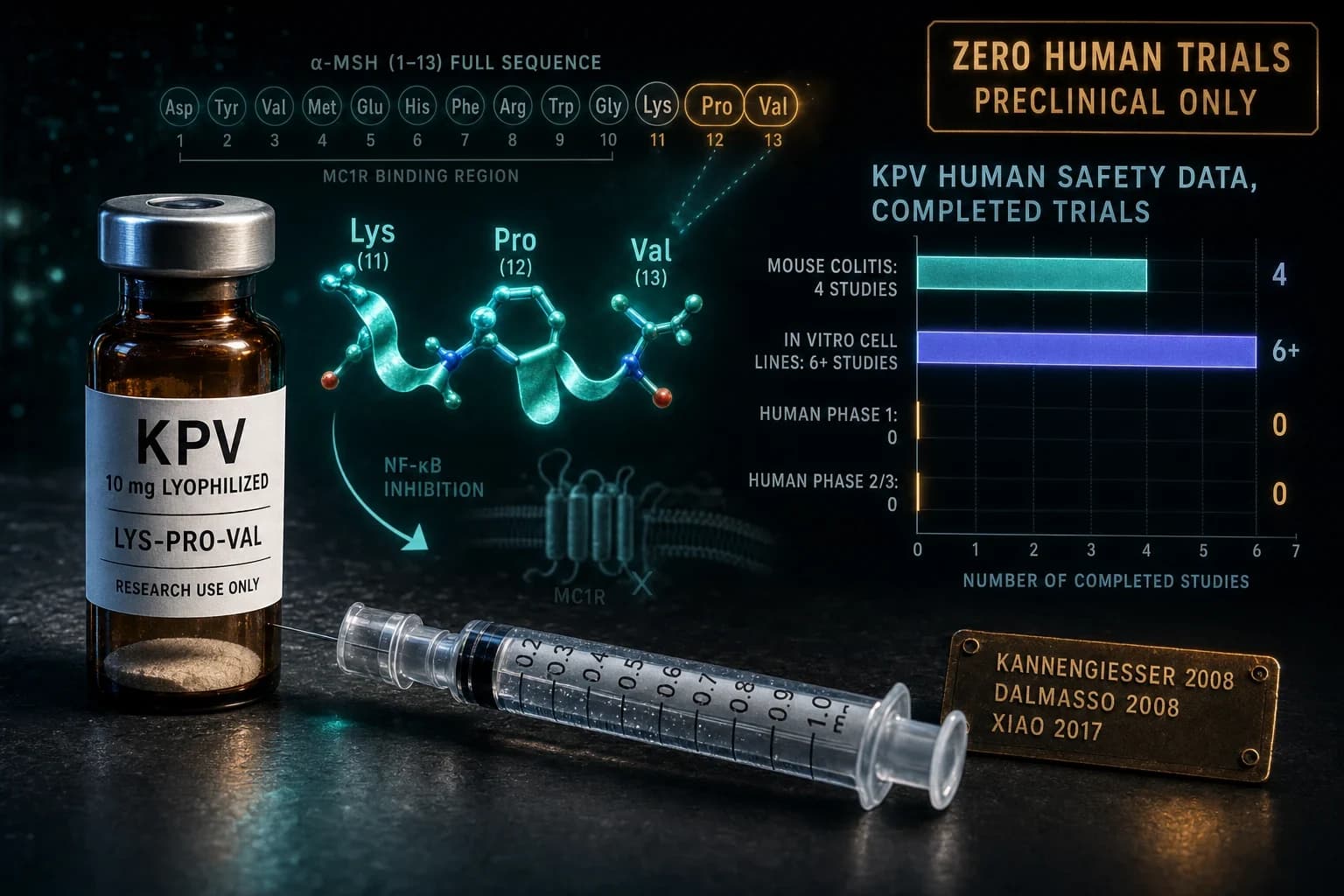
- Zero completed human clinical trials on KPV exist in the published literature. Every tolerability claim is extrapolated.
- The strongest preclinical safety signal is Kannengiesser 2008 (PMID 18092346), which reported KPV improved weight regain in DSS colitis mice.
- KPV lacks alpha-MSH's pigmentation effect because the melanocortin receptor binding is in the parent sequence, not the KPV fragment.
- Most vendor side-effect lists copy from alpha-MSH or inject-anything boilerplate; demonstrated preclinical adverse events are narrow.
- The honest answer to 'is KPV safe?' is 'preclinical findings have been reassuring, but human data do not exist.'
The claim everyone makes and the data behind it
Search "KPV side effects" and almost every result tells you the same thing: KPV is well tolerated, with occasional injection-site irritation, mild nausea, and rare hypersensitivity. The problem is that none of those pages cite a human study, because none exists. KPV has no completed human trials on ClinicalTrials.gov as of October 2026, and the published literature is entirely preclinical (reviewed in Brzoska et al. 2008).
That matters because the tolerability profile you read online was reconstructed from three different sources that get blended together: real preclinical findings in mice, properties of the parent peptide alpha-MSH that the KPV fragment does not share, and vendor marketing boilerplate that would apply to any injectable regardless of its mechanism. If you want an honest picture of what KPV can and cannot do to a research subject, you need to separate those three.
Bottom line up front: The published preclinical safety signal for KPV is unusually clean compared with most research peptides at the same evidence depth. That is encouraging. It is not the same thing as a human safety profile, and anyone presenting it that way is extrapolating well past what the data support. See our KPV gut inflammation research deep dive for the efficacy side of the same literature.
What KPV is, briefly, before talking about safety
KPV is the C-terminal tripeptide of alpha-melanocyte-stimulating hormone: lysine, proline, valine, corresponding to residues 11 through 13 of the parent 13-amino-acid sequence. The anti-inflammatory activity of alpha-MSH is largely preserved in this fragment, while the pigmentary activity (which depends on binding to the MC1R melanocortin receptor earlier in the sequence) is not. That dissociation is the entire reason the research community got interested in KPV in the first place, and it is the key fact that drives the side-effect story.
Mechanistically, Dalmasso et al. 2008 demonstrated that KPV enters colonic epithelial cells and immune cells via the PepT1 di/tripeptide transporter and inhibits NF-kB and MAP-kinase inflammatory signaling at nanomolar concentrations. Kannengiesser et al. 2008 separately showed that the effect persists in mice lacking a functional MC1R, confirming that KPV acts largely downstream of the classical melanocortin receptor system. If you want the compound-level overview, our KPV compound page covers mechanism and typical use in more depth; our KPV dosing chart walks the reconstitution math.
Sorting the "side effects" into evidence buckets
The useful thing to do with the online side-effect lists is to tag each item by where it actually came from. Four buckets cover everything you will find:
| Bucket | What it means | Example |
|---|---|---|
| Demonstrated in preclinical studies | Reported as an observation in a published mouse, rat, or in vitro study | Dose-related signaling off-target effects at high micromolar in cell culture |
| Theoretically plausible from mechanism | Not observed in a study, but follows from what KPV does at the molecular level | NF-kB-mediated immune suppression during active infection |
| Inherited from alpha-MSH | True for the parent peptide, often not demonstrated for the KPV fragment itself | Skin pigmentation, systemic cardiovascular effects |
| Boilerplate injectable risk | True for any injected substance, independent of KPV | Injection-site soreness, bruising, local reaction |
Reading the SERP with these buckets in mind reorders everything. The "nausea, dizziness, elevated liver enzymes" list that one popular blog repeats across six near-identical pages names nothing from the KPV literature. The "mild local irritation" that another source mentions is bucket four. Pigmentation changes, which show up on several poorly researched pages, are bucket three: they are an alpha-MSH property that the KPV fragment specifically lacks, which is the point of using the fragment. For a broader orientation to this family of compounds, see our peptides for gut health roundup.
What the preclinical safety data actually reports
Four papers do the real work here, and reading them is the only way to get past the vendor summaries.
Kannengiesser et al. 2008 tested KPV in two independent mouse colitis models (DSS colitis and CD45RBhi T-cell transfer colitis), with KPV administered rectally and systemically. The primary finding was efficacy, but the paper reports no treatment-emergent mortality, no body weight loss attributable to KPV (treated animals actually regained weight faster than vehicle), and no gross histopathological abnormalities outside the colitis-affected tissue. That is the single most informative safety signal in the dataset: a 20-plus-day exposure in two colitis models with no adverse signal above vehicle.
Dalmasso et al. 2008 tested KPV in Caco-2 and HT-29 colonic cells and in DSS-colitis mice. The in vitro work used nanomolar to micromolar concentrations and reported suppression of NF-kB and MAP-kinase pathways without cytotoxicity in the ranges tested. The in vivo work mirrored the Kannengiesser pattern: efficacy without an adverse-event signal distinguishable from the colitis itself.
Xiao et al. 2017 encapsulated KPV in hyaluronic-acid-functionalized nanoparticles (~272 nm, slightly negative zeta potential) for oral delivery in ulcerative colitis models. The authors explicitly reported the nanoparticles were nontoxic and biocompatible with intestinal cells, which is a safety claim for the delivery system as much as for KPV. Translational caveat: the particle vehicle itself is not what buyers of research KPV are using, so this cleanliness does not automatically extend to free KPV administered by other routes.
Viennois et al. 2016 added an oncology dimension: in an AOM/DSS colitis-associated carcinogenesis model, KPV reduced tumor burden in wild-type mice but produced no effect in PepT1-knockout mice. The safety angle is small but worth noting: in a model where the parent inflammatory state drives malignant transformation, KPV did not accelerate it. Chronic exposure data in healthy animals do not exist at that duration, and that is a limitation.
Note: None of these studies were powered to detect rare adverse events, and none ran long enough to characterize chronic-exposure safety. "No signal in a 14-to-30-day mouse study" is a floor, not a ceiling.
Side-effect profile by route, honestly
Because KPV is distributed as a research chemical rather than a prescription product, buyers encounter it in several forms: subcutaneous or intramuscular reconstituted injectable, oral capsule, nasal spray, and topical cream formulations. The published safety signal is strongest for the oral route (which is where PepT1 lives and where the colitis research has concentrated) and weakest for everything else.
| Route | What preclinical data exist | What vendor marketing claims | Honest assessment |
|---|---|---|---|
| Oral (free peptide or nanoparticle) | Mouse colitis exposure up to ~3 weeks (Xiao 2017) | "Preferred route" | PepT1-mediated absorption gives a mechanistic rationale. Human kinetics are unknown. |
| Subcutaneous injection | Mouse systemic exposure (Kannengiesser 2008) | "Standard" tolerability | Local injection-site reactions are plausible from reconstitution, not from the peptide. Reuse our reconstitution calculator to avoid overconcentration. |
| Nasal | No studies specifically on KPV via this route | Rapid onset, mucosal delivery | Mucosal irritation is a general nasal-peptide risk; no KPV data to confirm or exclude. |
| Topical | Vendor claims only; no RCT; no PMID-indexed primary study on human skin | Atopic dermatitis, wound healing | The alpha-MSH topical literature is being used as a stand-in. Not interchangeable. |
The practical reading of that table: oral and injectable both have at least some preclinical cover. Nasal and topical do not. If a vendor is marketing nasal or topical KPV for a specific skin condition, the citations they list almost certainly belong to the parent alpha-MSH peptide or to a broader melanocortin review, not to KPV itself.
Interactions and theoretical risks worth taking seriously
Mechanism-level reasoning flags a short list worth watching, even though the preclinical dataset itself is quiet.
Active infection. KPV inhibits NF-kB-mediated inflammatory signaling. NF-kB is also the pathway that mounts the innate immune response to bacterial and viral invaders. In a mouse colitis model that is a feature, in a research subject with an active undiagnosed infection it is a theoretical liability. No study tests this directly for KPV. The alpha-MSH immunosuppression literature discusses it generically.
Immune-driven cancers. Viennois 2016 showed KPV reduced tumor burden in a colitis-associated model, which suggests the inflammation-dependent carcinogenesis case is not an issue. The question of whether chronic NF-kB suppression could remove a tumor-surveillance signal in cancers driven by other pathways is open, and there is no study pointed at it.
Autoimmune conditions on biologic therapy. TNF-alpha inhibitors, JAK inhibitors, and other targeted immunosuppressants already suppress inflammatory signaling. Adding KPV layers an additional NF-kB-level suppression without any published interaction data. For buyers on biologics, this is an area where "no data" is the honest answer, not "no interaction."
Pregnancy, lactation, pediatric use. Zero studies. Zero. These are categorical no-data zones.
For an orientation to how to vet a vendor's purity claims before trusting any tolerability framing, our lab tests reference walks the testing-method hierarchy, and the vendor-side quality story is laid out in detail in our Ascension Peptides review.
What the FDA situation does and does not tell you about safety
KPV is not an FDA-approved drug. In July 2026 KPV was discussed in the FDA Pharmacy Compounding Advisory Committee process for 503A bulks-list inclusion. That is a regulatory step about allowing compounding pharmacies to compound a bulk substance; it is not an efficacy or safety approval. The committee materials highlight the thin human data as a limitation. Research-chemical KPV sold as "for research use only" sits outside both the compounding and the drug-approval tracks. Buyers who weigh "the FDA is reviewing it" as evidence of safety are reading too much into a procedural step. For the broader regulatory picture on compounded peptide access and what the 2024-2026 enforcement shift means for research peptides, our peptides legality guide handles the current state.
The research-subject safety checklist
Four practical steps keep the known risks small and the unknown ones at least observable.
- Source from vendors with third-party COAs. The dominant real-world adverse-event risk for any research peptide is contamination or misidentification, not the peptide itself. HPLC and mass spectrometry COAs from an independent lab eliminate most of the preventable fraction.
- Reconstitute conservatively and inject conservatively. Most "injection-site reactions" trace to over-concentration, buffer irritation, or technique. KPV is a small peptide with high solubility in bacteriostatic water, so there is no reason to run concentrated.
- Start with low oral doses before any chronic exposure. Even without a human dose-response curve, a staged ramp lets you catch idiosyncratic responses before they compound.
- Document everything. Observational notes on sleep, GI function, mood, and infection history are the only "trial data" that will exist for your own exposure, and the only way to notice a slow-emerging signal.
The honest version of the headline
The most accurate one-sentence answer to "what are KPV's side effects" is this: the published preclinical record is unusually clean for a research peptide at this evidence depth, the parent alpha-MSH side-effect list is partially inherited but partially not and should not be assumed to transfer wholesale, and no human clinical safety trial has ever been completed. Anyone offering a confident side-effect profile without that qualifier is either guessing or copying. The actual compound sits in the research-only zone, and buyers who treat it that way absorb the honest level of uncertainty into their decision.
Research use only. This article summarizes the published preclinical literature on KPV and is intended as a research reference. KPV is not an FDA-approved drug, is not approved for human use, and nothing above constitutes medical advice. Consult a licensed clinician before making any health decision.