At a glance
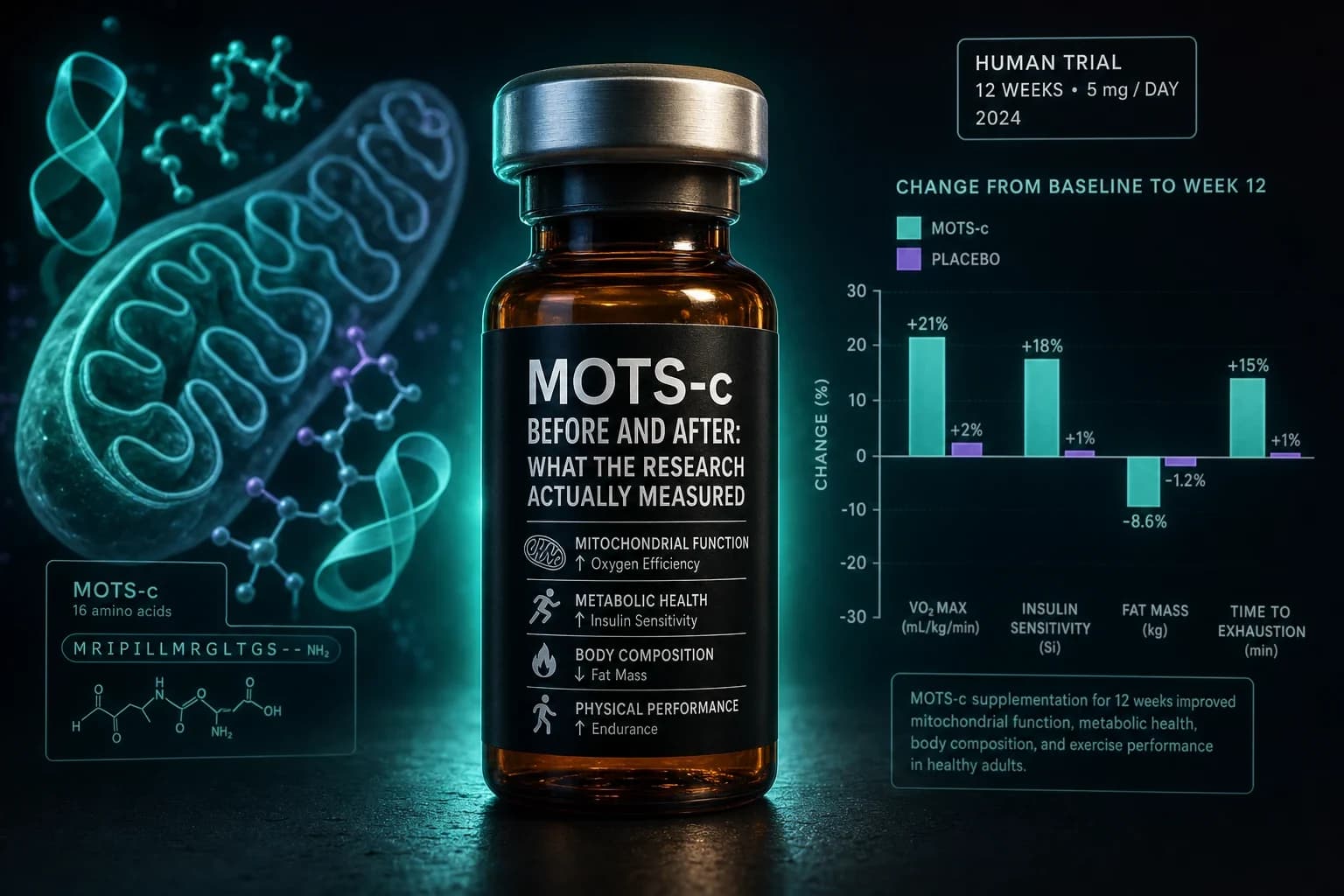
- Zero peer-reviewed human trials give exogenous MOTS-c to people. All "before and after" data is rodent or observational.
- In old mice, 5 mg/kg IP three times per week roughly doubled treadmill endurance (Reynolds et al. 2021).
- In HFD mice, 0.5 mg/kg/day for 8 weeks raised whole-body insulin sensitivity ~30% and blocked diet-induced obesity (Lee et al. 2015).
- Human plasma MOTS-c declines ~21% from young (18-30) to older (70-81) men (D'Souza et al. 2020).
- One exercise bout raised human muscle MOTS-c mRNA ~12-fold and plasma MOTS-c ~1.5-fold (Reynolds et al. 2021).
If you searched for MOTS-c before and after photos, you found marketing. The published research has actual deltas, but almost all of them come from mice. The human data is observational: what happens to your circulating MOTS-c as you age, as you train, as you develop diabetes. Nobody has run a peer-reviewed human trial giving people exogenous MOTS-c and measuring what changed at week 4 or week 12.
That gap defines what an honest "before and after" article on this compound can say. It can walk through the animal deltas that made MOTS-c famous, the observational human data that anchors the aging-and-metabolism story, and the specific research trajectory that led to the analog trials that never made it into indexed literature. It cannot promise a body-composition photo timeline, and it should not.
For the mechanism primer and dosing framework, the MOTS-c mitochondrial exercise peptide guide and the MOTS-c dosage chart cover what a research protocol looks like. This article is the honest version of the results question.
Bottom line: The strongest MOTS-c "before and after" data is a doubling of treadmill endurance in aged mice and a ~30% insulin-sensitivity improvement in high-fat-diet mice. Human data is entirely observational. No published clinical trial has administered native MOTS-c to humans.
What "before and after" means in this literature
In the peer-reviewed record, a MOTS-c "before and after" is one of three things: a delta in a mouse model that received exogenous MOTS-c, a difference in circulating MOTS-c between two human groups (young vs. old, healthy vs. diabetic, trained vs. untrained), or the change in a person's own MOTS-c level after a single exercise session. Each of those tells you something. None of them tells you what will happen if a specific person injects MOTS-c for eight weeks.
Delivery route matters here too. Every published rodent experiment used intraperitoneal (IP) injection, not the subcutaneous route most peptide researchers actually dose. Pharmacokinetics of native MOTS-c in humans are not published. Half-life estimates in circulation are short based on general peptide biology, and the doses that produced the striking rodent effects (0.5 to 5 mg/kg) would translate to substantial mg/day amounts in an adult by direct scaling, before any accounting for cross-species differences.
The evidence at a glance
| What changed | Study | Model and timeframe | How it was measured |
|---|---|---|---|
| Weight gain blocked, insulin sensitivity up ~30% | Lee et al. (2015) | HFD mice, 8 weeks, 0.5 mg/kg/day IP | Body weight, hyperinsulinemic-euglycemic clamp |
| Treadmill endurance ~doubled in 22-month-old mice | Reynolds et al. (2021) | Aged C57BL/6 mice, 5 mg/kg IP 3x/week | Time-to-exhaustion, grip strength, rotarod |
| Plasma sphingolipids, monoacylglycerols, dicarboxylates fell | Kim et al. (2019) | Aged mice, 7 days, 5 mg/kg IP | Untargeted plasma metabolomics |
| MOTS-c enters the nucleus, targets NRF2 pathway genes | Kim et al. (2018) | Cell culture, minutes to hours | Immunocytochemistry, ChIP, transcriptomics |
| Plasma MOTS-c ~21% lower in older vs. younger men | D'Souza et al. (2020) | 51 healthy men, cross-sectional | ELISA plasma + muscle biopsy |
| Serum MOTS-c lower in type-2 diabetes | Ramanjaneya et al. (2019) | 225 people, cross-sectional | Serum ELISA vs. HbA1c |
Read the table and the pattern is honest. The dramatic deltas are in mice. The human data is a photograph of population differences, not a movie of what happens when someone doses the compound.
Insulin sensitivity in high-fat-fed mice (the founding result)
The 2015 Lee paper is where MOTS-c earned its reputation. Male CD-1 mice fed a 60% high-fat diet for 12 weeks, dosed IP with 0.5 mg/kg/day MOTS-c for 8 of those weeks, gained substantially less weight than saline controls and showed a ~30% increase in whole-body insulin sensitivity by hyperinsulinemic-euglycemic clamp (Lee et al., 2015). In separate cohorts, MOTS-c reversed age-associated insulin resistance in 12-month-old mice, and in L6 myotube cell cultures it roughly doubled 2-deoxyglucose uptake through AMPK activation.
The mechanism is unusual. MOTS-c inhibits the folate cycle and de novo purine biosynthesis in skeletal muscle, which causes AICAR (an AMP analog) to accumulate. AICAR then activates AMPK without any actual drop in ATP. That is different from how metformin or exercise activate AMPK, and it is one of the reasons MOTS-c gets called an exercise mimetic.
The "before and after" here is a metabolic curve, not a photograph. Body weight tracked lower for the MOTS-c group across the eight weeks. Glucose disposal at the same insulin infusion rate came in ~30% higher. Those are real deltas in real animals. They are not a promise about human body composition.
Endurance capacity in old mice (the Reynolds paper)
The Reynolds group at USC ran the most striking physical-performance experiment in the field. In 22-month-old C57BL/6 mice (roughly equivalent to a 70-year-old human in life stage), 5 mg/kg IP MOTS-c three times per week produced roughly a doubling of treadmill running time and distance to exhaustion compared with saline controls (Reynolds et al., 2021). Rotarod balance time improved. Grip strength improved. Even when dosing was initiated at 23.5 months of age, a very late-life start, physical performance held up longer than in controls.
That is the source of most "MOTS-c anti-aging" claims. It is also the strongest single before-and-after in the literature, precisely because the comparator (a very old mouse on saline) is a stark baseline. What it does not tell you: whether a middle-aged human dosing 5 to 10 mg subcutaneously per week gets any measurable performance change. Species, dose route, dose per kg, and starting condition all differ.
The Reynolds paper matters for a second reason. It included a small human observational arm.
What one exercise session does to human MOTS-c
In the same Reynolds paper, ten sedentary young men did a single cycling bout with muscle biopsies and blood draws before and after. MOTS-c mRNA in skeletal muscle rose roughly 12-fold. Circulating plasma MOTS-c rose about 1.5-fold. Both effects were transient. That is the closest thing the field has to a human "before and after" for MOTS-c itself.
The interpretation is careful. It shows that MOTS-c is a physiological exercise signal in humans, meaning it goes up when a person trains. It does not show that injecting exogenous MOTS-c reproduces the downstream benefits of the exercise that produced the rise. Signaling molecules typically operate in context, and the context here includes shear stress, calcium flux, mechanical loading, and a hundred other AMPK-adjacent inputs that a subcutaneous injection does not deliver.
What aging does to human MOTS-c
D'Souza and colleagues measured MOTS-c in 51 healthy men across three age brackets (18-30, 45-55, 70-81) using plasma ELISA and muscle biopsy (D'Souza et al., 2020). Plasma MOTS-c dropped roughly 11% by middle age and roughly 21% in the older group compared with young men. That is the most quoted "MOTS-c declines with age" number, and it is real, but it comes with a paradox from the same paper: skeletal muscle MOTS-c protein was about 1.5-fold higher in the older men, associated with slow-fiber (Type I) composition. Circulating levels drop with age; tissue levels do not. Something about release or clearance changes.
Ramanjaneya's group added a metabolic layer. In 225 people spanning normoglycemic, prediabetic, and type-2 diabetic, serum MOTS-c was significantly lower in diabetics and correlated negatively with age, HbA1c, and fasting glucose (Ramanjaneya et al., 2019). Again, that is a cross-sectional association. It cannot tell you whether low MOTS-c is causing the metabolic dysfunction or the metabolic dysfunction is suppressing MOTS-c release. For the direct comparison with the other mitochondrial peptide people ask about, the SS-31 vs. MOTS-c head-to-head breaks down which one has the stronger case for which endpoint.
What MOTS-c changes in circulation (metabolomics)
Kim and colleagues took a different angle. They dosed aged mice with 5 mg/kg IP MOTS-c daily for 7 days and ran untargeted plasma metabolomics (Kim et al., 2019). Three pathway signatures dropped significantly: sphingolipids, monoacylglycerols, and dicarboxylate metabolism. Insulin-stimulated glucose disposal improved in the same animals.
That is a molecular "before and after" without a physical one. It matters because sphingolipid accumulation is one of the mechanistic drivers of insulin resistance, and the drop in that pathway is consistent with the insulin-sensitivity improvement. In a mouse. Over seven days. IP dosing. Every caveat still applies.
The nuclear translocation discovery (mechanism, not outcome)
In 2018, the USC group showed that under metabolic stress (glucose restriction, serum deprivation, or oxidative stress), MOTS-c physically translocates from the cytoplasm into the nucleus within 30 minutes and regulates genes containing antioxidant response elements, interacting with the transcription factor NRF2 (Kim et al., 2018). This finding is why the field treats MOTS-c as a signaling molecule with direct nuclear reach, beyond its peripheral metabolic role. It is also why the compound gets discussed alongside oxidative-stress-defense agents like SS-31.
For before-and-after purposes, this discovery is a mechanistic anchor rather than an outcome. It explains how MOTS-c could plausibly do the things the mouse experiments show. It does not add a new outcome column to the evidence table.
The one human trial (and what happened to it)
The closest thing to a human "before and after" for a MOTS-c-family molecule is CB4211, a modified MOTS-c analog developed by CohBar. A Phase 1b program in obese people with NAFLD (n=20, 25 mg subcutaneous daily for four weeks) was presented as a late-breaking poster at AASLD 2021, reporting ALT and AST reductions and a benign safety profile. The program was subsequently discontinued and the trial was never published in a peer-reviewed indexed journal. That absence matters. A conference poster with no follow-up publication is not evidence you can cite the way you can cite an indexed paper, and CohBar wound down operations shortly after.
So the honest statement is: no published clinical trial has administered native MOTS-c to humans, one small analog trial existed as a conference poster and was terminated, and every result number in this article that involved administering MOTS-c to an organism came from a mouse.
Warning: Injectable MOTS-c is a research compound. It is not approved by any regulatory body for human use. It is on the WADA prohibited list under S4 metabolic modulators. Anyone handling research-grade material should confirm identity and purity through third-party testing rather than trusting the label, and dosing accuracy for a compound with no human PK data is a serious limitation.
What realistic "before and after" looks like for a research user
For someone running MOTS-c as a research protocol, the honest expected timeline for measurable change is undefined, because no human dose-response exists in the literature. What can be measured objectively is small: fasting glucose and HbA1c over 8-12 weeks, VO2 max or submaximal endurance testing, body composition by DEXA, and (with the right lab) circulating MOTS-c by ELISA. Any of those can move for reasons that have nothing to do with the peptide, which is why a control period matters more than a photo comparison.
The compound will not reproduce a bariatric surgery weight-loss photo. It will not give a middle-aged researcher the treadmill endurance of a twenty-year-old in eight weeks. The doubled endurance in the Reynolds mice used a very old baseline and IP dosing at 5 mg/kg three times per week, which for an 80 kg person would scale to 400 mg per dose. That is not a real-world protocol, and it is not what the compound is being sold as.
For structured dosing references and a reconstitution calculator, the MOTS-c dosage chart and the reconstitution calculator are the safest way to work out concentrations. For third-party purity checks on any research-grade vial, our lab tests library is the trust asset that matters more than any vendor claim.
Where to source research-grade MOTS-c
For laboratory-use-only material, Ascension Peptides stocks MOTS-c in a 10 mg research vial with COA on file. Code ENHANCED applies at checkout for 50% off the catalog. For the full vendor breakdown and how to verify a supplier, the Ascension Peptides review covers testing history and shipping. This is sold strictly for laboratory and research use, not for human administration. Nothing in this article is medical advice or an endorsement of self-experimentation.
Disclaimer: This article is for educational and informational purposes only. MOTS-c is a research compound and is not approved by any regulatory agency for human use. It is prohibited in-competition and out-of-competition under WADA category S4. Every numeric outcome referenced above was measured in rodents, in cell cultures, or in cross-sectional human observation. None of them predict outcomes in any individual person given exogenous MOTS-c. Consult a qualified healthcare professional before making any decisions about peptide research or supplementation.