At a glance
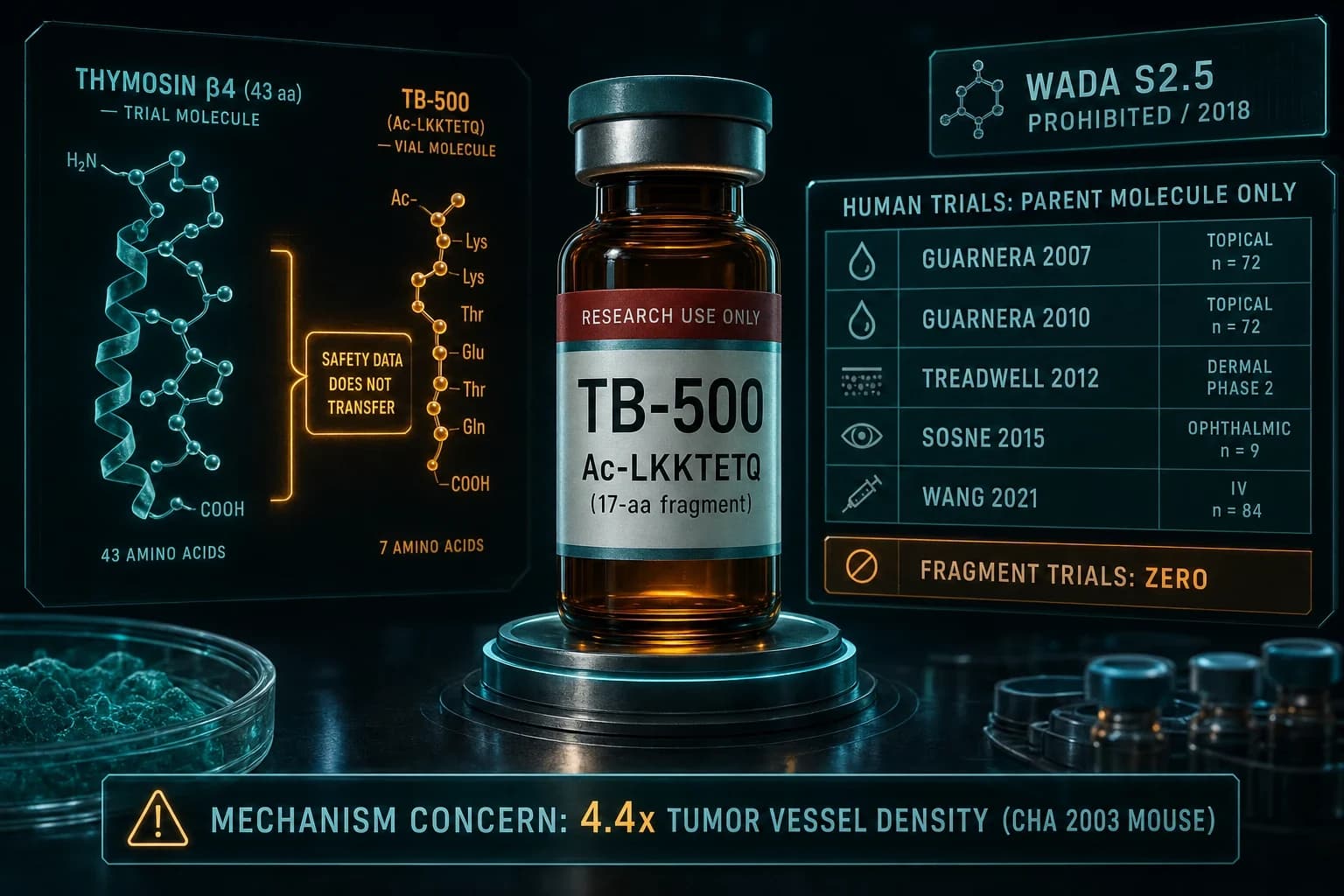
- Every human Phase 1 or Phase 2 trial cited for TB-500 safety used full-length thymosin beta-4, not the 17-amino-acid fragment sold as TB-500.
- User-reported short-cycle side effects cluster in injection-site reactions (10 to 20%), transient fatigue (10 to 15%), and mild headache (10 to 15%).
- Cha 2003 (PMID 14625258) showed a 4.4-fold rise in tumor blood vessels and higher metastasis in mice overexpressing thymosin beta-4.
- WADA added TB-500 and thymosin beta-4 derivatives to the Prohibited List in 2018 (S2.5 growth factors), banned in and out of competition.
- No long-term human safety data exists for the LKKTETQ fragment. All formal safety data covers the parent molecule at defined doses.
The Phase 1 and Phase 2 human safety data people quote when they call TB-500 "well tolerated" did not test TB-500. It tested full-length thymosin beta-4 at pharmaceutical grade, at defined doses, under FDA oversight. TB-500 is a 17-amino-acid fragment (Ac-LKKTETQ-OH) synthesized by unregulated labs and injected without dose ceilings, purity certificates, or a supervising clinician. That single distinction reshapes what "side effects" actually means for the vial in your hand.
This is a working audit of what the human trials reported, what the fragment's mechanism predicts, and what fragment users actually see. If you want dose ranges, our TB-500 dosage guide covers the injection math. This piece is only about tolerability, risk, and stopping criteria.
The molecule you are injecting is not the molecule that was studied
Thymosin beta-4 (Tβ4) is a naturally occurring 43-amino-acid peptide. TB-500 is a synthetic N-terminal-acetylated seven-residue fragment (LKKTETQ) corresponding to residues 17 to 23, the actin-binding domain. Esposito and colleagues confirmed the chemistry in 2012 when doping labs needed to characterize what was actually being sold to athletes (Esposito et al. 2012, PMID 22962027).
That is not a rounding error. Full-length Tβ4 has at least three functional domains: residues 1 to 4 carry anti-inflammatory activity, residues 1 to 15 carry anti-apoptotic activity, and residues 17 to 23 carry actin binding and cell migration. Every published clinical trial (dermal wound healing, dry eye, neurotrophic keratopathy, healthy-volunteer safety) used the full 43-mer, generally at pharmaceutical purity, under IND. The LKKTETQ fragment sold on peptide websites retains the actin-binding activity and inherits most of the mechanism concerns, but the safety endpoints do not automatically transfer.
Everything below is scored on that basis: what was measured in the trials, and what that does and does not tell you about the fragment.
Every human trial we can verify, with what it reported
| Trial | n | Route | Dose | Molecule | Adverse events reported |
|---|---|---|---|---|---|
| Guarnera 2007 (Italy/Poland) | 72 | Topical gel, up to 12 weeks | 0.01% to 0.1% | Full-length Tβ4 (RGN-137) | Safety comparable to placebo; no serious drug-related events PMID 17495250 |
| Guarnera 2010 dose-escalation | 72 | Topical, up to 84 days | Escalating dose bands | Full-length Tβ4 | Acceptable at all doses; local irritation typical of topical wound care PMID 20536470 |
| Treadwell 2012 review | 174 across dermal Phase 2 studies | Topical | Various | Full-length Tβ4 | No serious drug-related adverse events across venous stasis and pressure-ulcer trials PMID 23050815 |
| Sosne 2015 (RGN-259 dry eye) | 9 patients, 18 eyes | Ophthalmic drops, 28 days | 0.1% BID to QID | Full-length Tβ4 | 35.1% reduction in discomfort at day 56; no ocular serious adverse events; short-term ocular tolerability PMID 25826322 |
| Wang 2021 first-in-human recombinant | 84 healthy volunteers | Intravenous, single and multi-dose | 0.05 to 25.0 μg/kg, 10-day multi-dose | Recombinant Tβ4 (NL005) | Adverse events mild to moderate; no dose-limiting toxicities; no serious events (Wang et al., J Cell Mol Med, PMC8419156) |
Read the "molecule" column before you read anything else. Every result on that grid comes from full-length, IND-grade Tβ4 delivered topically, ophthalmically, or intravenously. None of it is from a subcutaneous injection of the LKKTETQ fragment out of a research-chem vial.
Two systemic conclusions do survive:
- At the doses tested, full-length thymosin beta-4 is well tolerated in humans across topical, ophthalmic, and intravenous administration.
- Nobody has published a large-scale, long-term human safety trial of the TB-500 fragment. Not a Phase 3, not a Phase 2, not a formal Phase 1. Anyone claiming "TB-500 has a great safety profile in humans" is quoting the parent molecule.
What fragment users actually report
Formal pharmacovigilance for TB-500 is nonexistent, so the tolerability picture below comes from a mix of small clinical wound-healing series and structured user reports collected through peptide forums, coaches, and vendor customer surveys. Treat the frequencies as ballpark ranges, not epidemiology.
The clustering is consistent across sources:
- Injection-site reactions (roughly 10 to 20 percent of users). Redness, small wheal, brief stinging, occasional bruising. Most resolve inside 24 to 48 hours. A share of this is technique and reconstitution vehicle: bacteriostatic water contains 0.9% benzyl alcohol, which is mildly irritating to subcutaneous tissue at the volumes used. Our reconstitution guide walks through concentration choice, and rotating sites weekly reduces the local response.
- Post-injection lethargy or "head fog" (roughly 10 to 15 percent). Reported within 30 to 90 minutes of the dose, typically during loading. Usually resolves by the next morning.
- Mild headache (roughly 10 to 15 percent). Same time course. Often improves with hydration and by splitting the loading-phase dose across two smaller injections in a week.
- Transient nausea or head rush (roughly 5 to 10 percent). Reported most often after larger single doses in the first week. Rarely persists past loading.
- Vivid dreams (a smaller share, mostly on longer cycles). Poorly characterized, no known mechanism, no reported safety implication.
The pattern is a front-loaded tolerability curve: most side effects concentrate in the loading phase, then quiet down. Users who dose-titrate and split the loading week generally report less of it. That matches what the Guarnera and Wang trials showed with their parent molecule: mild, brief, dose-adjacent adverse events.
What is genuinely reassuring: across formal trials and informal reports, serious drug-related adverse events on the timescale of weeks are rare to absent. What is genuinely not known: everything on the timescale of years.
The mechanism-based concerns nobody has tested in humans
TB-500's actin-binding domain does exactly what full-length Tβ4 does at the same site: it promotes cell migration and angiogenesis, and it upregulates vascular endothelial growth factor (VEGF). That mechanism is why it accelerates wound healing. It is also why the following theoretical concerns exist and cannot be dismissed by pointing at short Phase 2 tolerability data.
Angiogenesis in the wrong tissue. Cha and colleagues showed in 2003 that thymosin beta-4 overexpression in mice produced a mean 4.4-fold increase in blood-vessel density in solid tumors and a mean 2.3-fold increase in B16-F10 melanoma cell migration, with a corresponding rise in metastatic lung nodules from 10.9 to 46.7 per animal (Cha et al., J Natl Cancer Inst 2003, PMID 14625258). That is preclinical, and it used adenoviral overexpression rather than exogenous peptide, so extrapolation to a subcutaneous dose in a human is not clean. But the mechanism is real. If someone has an undiagnosed malignancy and injects a systemic pro-angiogenic peptide, the theoretical vector is bleeding, faster progression, or increased metastatic potential. Nobody has run the trial that would rule this out in humans.
Cardiovascular changes at high systemic dose. The Ruff and Wang healthy-volunteer trials on full-length Tβ4 up to 1260 mg intravenously reported no dose-limiting toxicity, but "no signal in a 40-person acute trial" is not "no risk on months of subcutaneous dosing." Case reports on rarely tested peptides tend to accumulate over years.
Immunogenicity from the actual product, not the molecule. Fragments synthesized in Chinese or Eastern European contract labs and shipped in unrefrigerated envelopes are not the peptide named on the label plus nothing. Peptides.wiki and independent third-party analyses recover measured purities of 60 to 95 percent for research-chem peptide vials, with residual solvents (TFA, DMF, DIPEA), truncated sequences, and lysine deamidation products in the balance. Every one of those is a potential immunogen. If a user develops a persistent injection-site nodule or a systemic inflammatory response, that is a supply-chain issue more often than a molecule issue. Our lab test library documents what a third-party COA should actually show, and the Ascension Peptides review walks through what real batch verification looks like.
No published pharmacokinetics for the fragment. Full-length Tβ4 has published PK. The LKKTETQ fragment does not. Rodent estimates cluster at a plasma half-life of 30 minutes to 2 hours after SC or IM, but no human PK study on TB-500 itself has been published. Dosing recommendations for the fragment are extrapolated, not measured.
Doping and legal status
The World Anti-Doping Agency added TB-500 and thymosin beta-4 derivatives to the S2.5 "Growth Factors and Growth Factor Modulators" section of the Prohibited List in 2018, prohibited in and out of competition. Testing method: liquid chromatography-mass spectrometry, validated for both human and equine matrices (Ho et al., Drug Test Anal 2012, PMID 23084823).
In the US, TB-500 is not an FDA-approved drug, not a legal dietary supplement ingredient, and not on the FDA 503A bulk drug substances list for compounding. It is sold as a research chemical for laboratory use, not for administration to humans. Racing bodies including the RMTC and the International Federation of Horseracing Authorities banned it after the 2015 Australian racing scandal that centered on peptide programs.
None of that is a side effect in the pharmacological sense, but it is a "side effect" in the sense of practical consequence. Anyone competing in a WADA-tested sport, a tested collegiate program, or a tested workplace should treat TB-500 as an automatic positive result under a screen designed to catch it.
When to stop
The trials do not offer stopping criteria for the fragment because they did not study the fragment. The mechanism plus reported user pattern points to a small set of hard rules:
Warning: Stop TB-500 injection and reassess with a clinician if any of the following appear.
- Persistent injection-site nodule, ulceration, or spreading redness beyond 72 hours
- New or growing skin lesion, mole change, or unexplained lump anywhere on the body (concern for pro-angiogenic effect on undiagnosed pathology)
- Chest pain, palpitations, or exertional shortness of breath during a cycle
- Systemic flu-like illness that starts within days of dosing and does not resolve inside a week
- Any history of active or in-remission cancer (do not initiate)
Front-loaded fatigue or a mild headache in the first week is a titration signal. Persistent symptoms, or any of the flags above, are a stop-and-investigate signal.
Where TB-500 sits vs adjacent peptides
Every peptide in the tissue-repair category comes with its own side-effect profile and its own evidence gap.
| Compound | Best-tolerated finding | Concern that stands out | Human trial depth |
|---|---|---|---|
| TB-500 (Ac-LKKTETQ fragment) | No serious events reported in short trials of the parent molecule | Angiogenesis mechanism; no long-term human data on the fragment | None on the fragment |
| BPC-157 | Similar user tolerability profile; short-cycle wound-healing data | Zero completed human trials; oral vs injection route confusion | None completed |
| GHK-Cu | Topical cosmetic data is extensive | Systemic injection data is thin; copper accumulation on multi-month cycles | Topical only |
| Thymosin alpha-1 | Longest human safety record of the class; approved in 40+ countries for hepatitis B | Different mechanism, not a direct substitute | Extensive |
For the direct comparison against BPC-157 read our BPC-157 vs TB-500 recovery peptides breakdown. For the combined protocol read the Wolverine stack guide and the general best peptides for healing and recovery hub. The TB-500 dosing chart covers weekly loading and maintenance schedules. The scope here stays deliberately narrow on tolerability.
Bottom line: The published trials say full-length thymosin beta-4 is well tolerated over weeks, not that the LKKTETQ fragment is safe over years. The short-cycle side effect profile from user reports is mild and front-loaded (site reactions, brief fatigue, occasional headache). The concerns worth taking seriously are the pro-angiogenic mechanism (undiagnosed malignancy), the immunogenicity of a research-chem supply chain, and the total absence of long-term human data on the fragment itself.
Sourcing and next steps
If a research protocol calls for TB-500, source only from vendors that publish independent third-party COAs. Batch identity, mass by HPLC, and endotoxin are the three lines that matter. Ascension Peptides is the vendor we audit most closely; TB-500 sits in their injectable research catalog with 50% off using code ENHANCED. The best legit peptide vendors 2026 shortlist is the broader comparison. Whatever the source, the COA questions in our peptide certificate of analysis guide are the ones a real batch will answer without hedging.
This article is for research and educational purposes only. TB-500 is not an FDA-approved drug and is not a legal dietary supplement ingredient in the US or EU. Nothing here is medical advice, dosing guidance, or an endorsement for human self-administration. Anyone competing in a WADA-tested sport should treat TB-500 as an automatic anti-doping violation. Consult a licensed clinician for any decision involving your health, especially with a personal or family history of cancer, cardiovascular disease, or autoimmune conditions.