At a glance
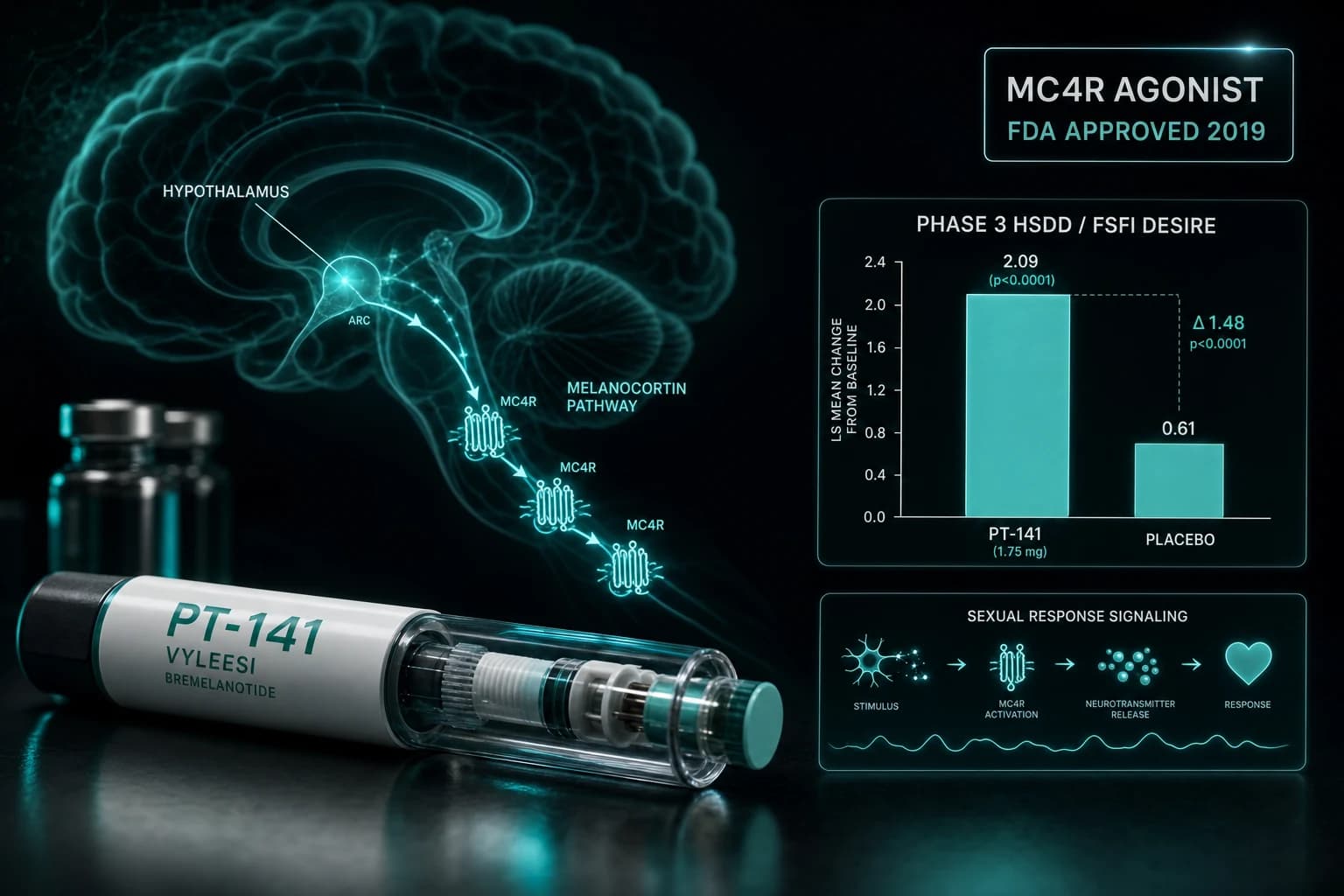
- PT-141 (bremelanotide) was FDA-approved as Vyleesi in 2019 for hypoactive sexual desire disorder (HSDD) in premenopausal women
- Mechanism: MC4R agonist that acts on central melanocortin pathways involved in sexual desire and arousal, distinct from Addyi/flibanserin's serotonin mechanism
- Standard dose: 1.75 mg subcutaneous via Vyleesi autoinjector, used as-needed at least 45 minutes before anticipated sexual activity
- Phase 3 RECONNECT trials (Kingsberg et al., 2019) showed statistically significant improvements in Female Sexual Function Index Desire domain and distress measures
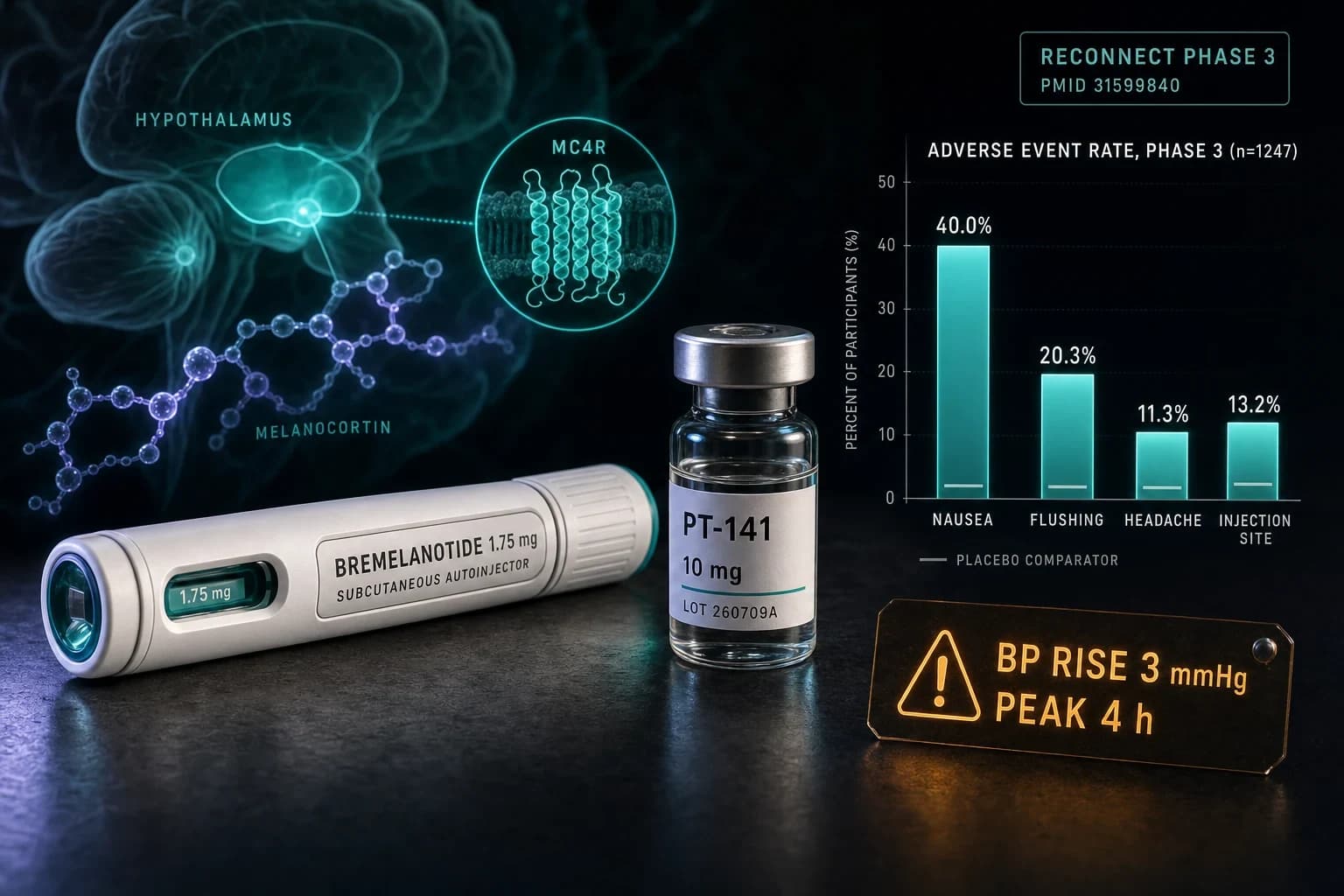
- Side effects: nausea (40%), flushing, injection-site reactions, transient BP increase; nausea is the most dose-limiting side effect
PT-141 (bremelanotide, marketed as Vyleesi) is the FDA-approved peptide treatment for hypoactive sexual desire disorder in premenopausal women. It was approved by the FDA in 2019 based on the RECONNECT Phase 3 trial program. The compound is the MC4R-selective derivative of Melanotan II, engineered specifically to produce the sexual response effects of MC4R activation without the broader melanocortin agonism that produces tanning, appetite suppression, and other off-target effects of MT-II.
This article covers what PT-141 actually is, the MC4R mechanism that distinguishes it from other sexual desire treatments, the Phase 3 evidence base, the standard clinical and research dosing, the side effect profile, and how it compares to the other FDA-approved HSDD treatment flibanserin (Addyi).
What PT-141 actually is
PT-141 (bremelanotide) is a synthetic cyclic heptapeptide:
| Property | PT-141 value |
|---|---|
| Sequence | Modified cyclic structure derived from α-MSH |
| Length | 7 amino acids in cyclic structure |
| Class | MC4R-selective melanocortin agonist |
| Brand name | Vyleesi (Palatin Technologies / AMAG Pharmaceuticals) |
| FDA approval | 2019 (HSDD in premenopausal women) |
| Route | Subcutaneous via autoinjector |
| Indication | Hypoactive sexual desire disorder |
PT-141 was developed by Palatin Technologies as the MC4R-selective successor to Melanotan II. The structural modifications increase MC4R selectivity over MC1R, reducing the pigmentation effect of MT-II while preserving the sexual response effect that comes from MC4R activation.
The compound was the result of decades of academic and pharmaceutical research into melanocortin pharmacology, building on the University of Arizona-developed Melanotan I and II compounds. For broader melanocortin context, see the Melanotan II compound guide and the Melanotan II dosing guide melanoma risk.
The MC4R mechanism
HSDD is characterized by distressing low sexual desire. The condition is reasonably common among premenopausal women but had limited pharmacological treatment options before 2015. PT-141's mechanism:
- MC4R receptors are densely expressed in hypothalamic regions involved in sexual desire and arousal regulation
- PT-141 activates MC4R, producing downstream effects on dopaminergic pathways involved in motivation and reward
- The activation is acute (peak effect 1-4 hours after dosing)
- Effects are mediated centrally rather than through peripheral mechanisms
This mechanism is distinct from flibanserin (Addyi), the other FDA-approved HSDD treatment:
| Compound | Mechanism | Dosing pattern |
|---|---|---|
| PT-141 (Vyleesi) | MC4R agonist (acute) | As-needed before activity |
| Flibanserin (Addyi) | 5-HT1A agonist / 5-HT2A antagonist (chronic) | Daily continuous |
PT-141's as-needed dosing is the practical differentiator. Patients use it before anticipated sexual activity, not as continuous daily therapy. This contrasts with flibanserin's daily continuous use requirement.
Phase 3 RECONNECT trial evidence
The pivotal Phase 3 trial program (RECONNECT) consisted of two trials evaluating bremelanotide in premenopausal women with HSDD.
RECONNECT trial design. Two parallel Phase 3 trials randomized approximately 1,200 premenopausal women with HSDD to bremelanotide 1.75 mg or placebo, both used as-needed, for 24 weeks.
Primary endpoints:
- Change in Female Sexual Function Index (FSFI) Desire domain
- Change in Female Sexual Distress Scale-Desire/Arousal/Orgasm (FSDS-DAO) item 13 (distress associated with low desire)
Results. Statistically significant improvements in both primary endpoints in the bremelanotide arms versus placebo. The effect sizes were modest but consistent across both trials.
Key publication. Kingsberg et al., Obstetrics & Gynecology, 2019 reported the combined RECONNECT trial results that supported FDA approval. The 1.75 mg bremelanotide dose produced approximately 0.35-0.40 point improvement in FSFI Desire domain (on a 1-5 scale) versus placebo.
Open-label extension. Edinoff et al., 2021 covered the longer-term safety and efficacy data from RECONNECT open-label extension.
Bottom line: PT-141 has the strongest sexual desire research evidence base of any peptide (Phase 3 RCT, FDA approval, established clinical use). Effect sizes are modest by absolute measure but statistically significant and consistent across the trial program.
Standard dosing protocol
The FDA-approved Vyleesi dosing protocol:
| Parameter | Vyleesi value |
|---|---|
| Dose | 1.75 mg subcutaneous |
| Route | Autoinjector (abdomen or thigh) |
| Timing | At least 45 minutes before anticipated sexual activity |
| Frequency | No more than one dose per 24 hours |
| Maximum frequency | No more than 8 doses per month |
| Onset of effect | Peak effect 1-4 hours after dosing |
The as-needed dosing pattern is the practical advantage. Patients use Vyleesi only when needed rather than as continuous daily therapy. This is generally well-accepted by patients.
For research-grade PT-141 (research-use disclosures), the dosing typically mirrors the approved Vyleesi protocol: 1.75 mg subcutaneous as-needed, with side effect monitoring.
Side effects
The most common reported side effects in the Phase 3 trials:
Nausea (40%). The most common and dose-limiting side effect. Most cases are mild-to-moderate and decrease with subsequent doses. Pre-dose antiemetics are sometimes recommended.
Flushing (20%). Facial flushing, particularly post-injection. Usually transient and mild.
Injection-site reactions (13%). Mild and transient.
Transient blood pressure increase. Modest acute elevation in some users; resolves within hours.
Headache (10%). Common but typically mild.
Vomiting (5%). Less common than nausea but can occur.
The 40% nausea rate is the most-cited concern with PT-141. For some patients, the nausea is severe enough that they discontinue use. For others, the nausea attenuates with continued dosing.
Vyleesi is not recommended in patients with uncontrolled hypertension or cardiovascular disease because of the acute blood pressure effect.
PT-141 versus Flibanserin (Addyi)
The two FDA-approved HSDD treatments differ substantially:
| Factor | PT-141 (Vyleesi) | Flibanserin (Addyi) |
|---|---|---|
| Mechanism | MC4R agonist | 5-HT1A agonist / 5-HT2A antagonist |
| Dosing | As-needed, 45 min before | Daily continuous |
| Route | Subcutaneous injection | Oral tablet |
| Approval year | 2019 | 2015 |
| Alcohol contraindication | No | Yes (must avoid alcohol completely) |
| Side effect profile | Nausea (40%), flushing | Dizziness, fatigue, somnolence |
| Patient preference factor | Acute action when desired | No dosing decisions before activity |
The choice between them often comes down to:
- Patient preference for as-needed vs daily dosing. Some patients prefer Vyleesi's targeted use; others prefer Addyi's daily approach.
- Alcohol use. Patients who consume alcohol should not use Addyi (contraindication). Vyleesi has no alcohol restriction.
- Tolerability profile. Some patients tolerate Vyleesi's nausea poorly; others struggle with Addyi's dizziness/fatigue.
- Injection vs oral preference. Patients with strong needle aversion may prefer Addyi.
For broader sexual response peptide context, see the Kisspeptin libido fertility HPG axis research and the Oxytocin nasal spray research protocol.
Combinations and stacking
PT-141 is not commonly stacked with other compounds in clinical practice. Some research and off-label combinations have been explored:
- PT-141 + tadalafil/sildenafil. For research targeting both desire (PT-141) and erectile function (PDE5 inhibitors) in male partners or in research contexts.
- PT-141 + estrogen/testosterone hormone optimization. For research targeting multiple hormonal pathways affecting sexual function.
- PT-141 + oxytocin nasal. Combines MC4R-mediated desire with oxytocin-mediated bonding effects. See the Oxytocin nasal spray research protocol.
These combinations are largely research-grade and not standardized clinical protocols.
Off-label use in men
While Vyleesi is FDA-approved for premenopausal women, PT-141 has also been studied in men with sexual response disorders. The Palatin development program originally targeted both male and female applications, but the female HSDD indication was the one that reached approval. Off-label PT-141 use in men is research-grade and not formally supported by FDA approval.
For male sexual function research with stronger evidence, the established PDE5 inhibitor class (sildenafil, tadalafil, vardenafil) remains the standard. PT-141 may have a research role for patients where PDE5 inhibitors are inadequate or contraindicated.
How PT-141 fits the 2026 regulatory landscape
PT-141 (Vyleesi) is FDA-approved as Vyleesi for HSDD in premenopausal women. The compound was not affected by the February 27, 2026 HHS peptide reclassification because it already has FDA approval status. Research-grade PT-141 is also available through retail peptide vendors with research-use disclosures.
For broader regulatory context, see the FDA peptide reclassification February 2026 complete breakdown.
Sourcing
For FDA-approved Vyleesi (PT-141 1.75 mg autoinjector), prescription through licensed clinicians is the standard channel. Insurance coverage varies; most plans require prior authorization for HSDD treatment.
For research-grade PT-141 (research-use disclosures), Ascension Peptides ships in the research peptide catalog with 50% off using code ENHANCED.
For our broader sourcing analysis, see the best legit peptide vendors 2026 ranking and the PT-141 bremelanotide libido peptide guide.
FAQ
What is PT-141?
PT-141 (bremelanotide) is an FDA-approved peptide treatment for hypoactive sexual desire disorder in premenopausal women, marketed as Vyleesi. It is an MC4R-selective melanocortin agonist that acts on central pathways involved in sexual desire and arousal.
What is the standard PT-141 dose?
1.75 mg subcutaneous via the Vyleesi autoinjector, used as-needed at least 45 minutes before anticipated sexual activity. Maximum 1 dose per 24 hours and no more than 8 doses per month.
How does PT-141 differ from Melanotan II?
Melanotan II is the non-selective melanocortin agonist that activates MC1R (pigmentation), MC4R (sexual response), and other MC receptors. PT-141 is the MC4R-selective successor designed to preserve the sexual response effect while removing the pigmentation effect of MT-II. PT-141 has FDA approval; MT-II does not.
What is the side effect profile of PT-141?
The most common side effects are nausea (40%), flushing (20%), injection-site reactions (13%), and transient blood pressure increase. Nausea is the most dose-limiting side effect. The compound is not recommended in patients with uncontrolled hypertension or cardiovascular disease.
How does PT-141 compare to Addyi (flibanserin)?
Both are FDA-approved for HSDD in premenopausal women. PT-141 is MC4R agonist used as-needed before activity; Addyi is serotonergic, taken daily continuously. PT-141 has no alcohol restriction; Addyi requires complete alcohol avoidance. Side effect profiles differ. The choice depends on patient preference and tolerability.
Can men use PT-141?
PT-141 has been studied in men but is not FDA-approved for male sexual function. Off-label use occurs in research contexts. The PDE5 inhibitor class (sildenafil, tadalafil) remains the standard for male erectile function. PT-141 may have a research role for patients where PDE5 inhibitors are inadequate.
Does PT-141 work for everyone?
No. Effect sizes in the Phase 3 trials were modest. Many patients experienced no benefit; many experienced significant nausea that limited use. Response prediction is not well-characterized; patients should expect 8-12 week trial to determine personal benefit before continuing.
Further reading
- PT-141 bremelanotide libido peptide guide
- Melanotan II dosing guide melanoma risk
- Kisspeptin libido fertility HPG axis research
- Oxytocin nasal spray research protocol
- Vasopressin nasal pair bonding research
- Best legit peptide vendors 2026
This article is for educational and research purposes only. PT-141 (bremelanotide) is FDA-approved as Vyleesi for hypoactive sexual desire disorder in premenopausal women. Research-grade PT-141 is sold under research-use disclosures. None of the content above constitutes medical advice. Consult a qualified clinician for individual medical questions about sexual function or HSDD.