At a glance
- Melanotan II is a synthetic cyclic heptapeptide developed at the University of Arizona; non-selective melanocortin receptor agonist (MC1R, MC3R, MC4R, MC5R)
- Standard research dose: 250-500 mcg subcutaneous daily during loading (1-2 weeks), then maintenance every 3-5 days based on pigmentation goal
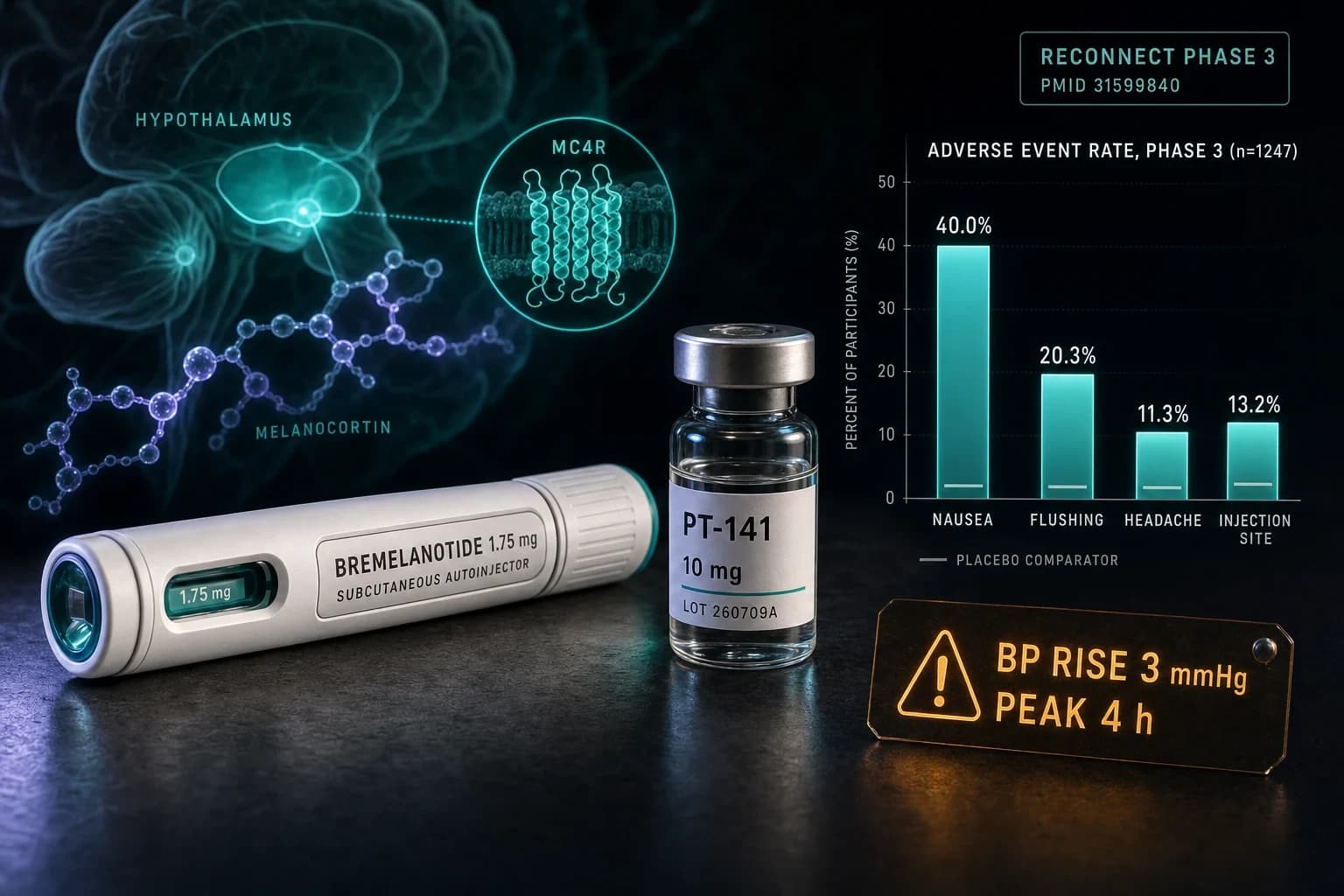
- MC1R activation produces tanning; MC4R activation produces libido/sexual response (this is the mechanism behind the PT-141/bremelanotide derivative)
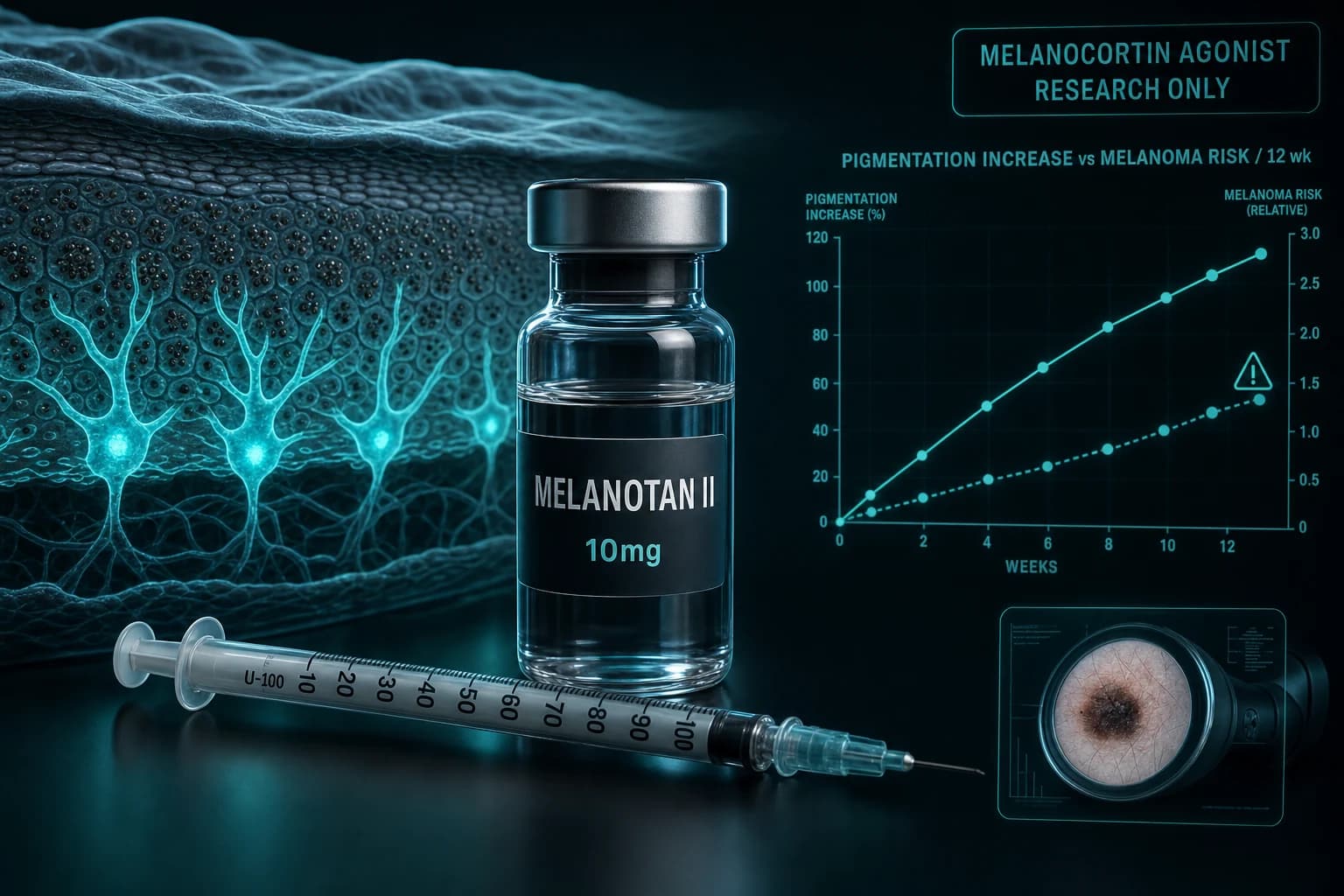
- Documented melanoma risk concern: case reports of dysplastic nevi and melanoma in MT-II users; the mechanism (MC1R activation increasing existing nevus melanocyte activity) is biologically plausible
- Side effects: nausea, facial flushing, spontaneous erections, darkening of existing nevi; the side effect intensity scales with dose and rate of titration
Melanotan II is one of the older synthetic peptides in the research catalog, developed in the 1990s at the University of Arizona as part of academic research into melanocortin pharmacology. The compound is a non-selective melanocortin agonist that produces both pigmentation effects (through MC1R) and sexual response effects (through MC4R). This dual-receptor activity is what made the molecule scientifically interesting and what led to its derivative PT-141 (bremelanotide), which was approved for hypoactive sexual desire disorder in 2019.
This article covers what Melanotan II actually is, the multi-receptor pharmacology, the standard research dosing protocols, the documented melanoma risk and other side effects, and how the compound fits the 2026 research landscape.
What Melanotan II actually is
Melanotan II (MT-II) is a synthetic cyclic heptapeptide modeled on alpha-melanocyte-stimulating hormone (α-MSH). The structural design produces:
| Property | Melanotan II value |
|---|---|
| Sequence | Cyclic [Nle-Asp-His-D-Phe-Arg-Trp-Lys]-NH2 |
| Length | 7 amino acids in cyclic structure |
| Class | Non-selective melanocortin agonist |
| Receptors | MC1R, MC3R, MC4R, MC5R |
| Developer | University of Arizona academic research |
| Half-life | Several hours (longer than natural α-MSH) |
| Route | Subcutaneous injection (primary) |
| Approval | None |
The molecular structure has key modifications from natural α-MSH:
- Cyclic structure for protease resistance and extended half-life
- D-Phe substitution at position 7 to prevent enzymatic degradation
- Reduced sequence length to focus on the core melanocortin-active region
The result is a stable, potent, non-selective melanocortin agonist that activates all four MC receptor subtypes. The PT-141 derivative was developed by adding modifications that increase MC4R selectivity over MC1R, reducing the pigmentation effect while preserving the sexual response effect.
For the compound-specific context, see the Melanotan II compound guide and the related PT-141 bremelanotide libido peptide guide.
The multi-receptor pharmacology
| Receptor | Tissue | Effect of activation |
|---|---|---|
| MC1R | Skin (melanocytes), immune cells | Increased melanin production (tanning) |
| MC3R | Hypothalamus, peripheral | Energy expenditure, inflammation |
| MC4R | Hypothalamus, brain | Appetite suppression, sexual response |
| MC5R | Exocrine glands | Sebum production, sweat gland function |
MT-II's non-selective profile means activating it affects all four pathways simultaneously. The dominant clinical effects are:
MC1R-mediated (tanning). Standard MT-II protocols are primarily used for pigmentation research and cosmetic tanning. The effect is real and substantial.
MC4R-mediated (libido). Spontaneous erections, sexual response, and appetite suppression occur as MC4R-mediated effects. These are the off-target effects that motivated PT-141 development for the specific MC4R applications.
MC3R-mediated. Effects on energy expenditure and inflammation pathways are documented but less prominently.
MC5R-mediated. Sebum production may increase; sweat gland effects are minimal.
Standard research protocol
The MT-II dosing protocol typically involves a loading phase followed by maintenance:
| Phase | Dose | Frequency | Duration | Purpose |
|---|---|---|---|---|
| Loading | 250-500 mcg | Daily SC | 1-2 weeks | Reach pigmentation goal |
| Maintenance | 250-500 mcg | Every 3-5 days | Ongoing | Maintain pigmentation |
| Acute pre-event | 500-1000 mcg | Single dose | Per event | Acute pigmentation boost |
Three reasons most protocols cap at 500 mcg per injection:
-
Side effect intensity scales with dose. Higher per-injection doses produce more facial flushing, nausea, and spontaneous erections.
-
MC4R effects are dose-dependent. Higher doses produce more pronounced sexual response and appetite effects (which may be undesirable or desirable depending on research goal).
-
Pigmentation pathway has diminishing returns. Beyond about 1 mg per injection, additional dose does not produce proportionally more pigmentation.
For reconstitution math, most retail MT-II ships as 10 mg lyophilized vials. Reconstituting with 1 mL bacteriostatic water produces 10 mg/mL concentration. A 0.025 mL draw (2.5 IU on a U-100 insulin syringe) delivers 250 mcg.
The reconstitution calculator handles arbitrary vial sizes.
The documented melanoma risk
The most serious safety concern with MT-II is the documented case-report literature of dysplastic nevi (atypical moles) and melanoma in MT-II users.
The mechanism case:
- MC1R activation increases melanocyte activity
- Melanocytes that already contain genetic mutations (existing dysplastic nevi) may proliferate more aggressively with MC1R activation
- The proliferation in pre-existing dysplastic cells may accelerate progression toward melanoma
Case reports. Multiple case reports have documented melanoma development in MT-II users, often with rapid progression of pre-existing nevi. Cousen et al., Clin Exp Dermatol, 2009 is one of the earlier published case reports linking MT-II to dysplastic nevus development.
Epidemiological evidence. No large epidemiological study has definitively established the magnitude of melanoma risk increase from MT-II use. The case-report literature is suggestive but does not provide population-scale risk estimates.
Mechanistic plausibility. The mechanism is biologically plausible. MC1R activation does increase melanocyte activity. Patients with existing dysplastic nevi (the population most at risk for melanoma) are precisely the population where additional MC1R activation could most plausibly accelerate progression.
Bottom line: Melanoma risk from MT-II use is documented through case reports with biologically plausible mechanism. The magnitude of population-scale risk is not well-characterized but is non-zero. MT-II should not be used by patients with personal or strong family history of melanoma, patients with multiple dysplastic nevi, or patients with risk factors for skin cancer.
Other side effects
Beyond the melanoma concern, MT-II's side effect profile is substantial:
Nausea. Common during loading phase and at higher doses. Typically subsides with continued use but can be severe at first injections.
Facial flushing. Common, particularly post-injection. Usually mild and transient.
Spontaneous erections. A predictable consequence of MC4R activation. Can be embarrassing or painful (priapism in extreme cases).
Appetite suppression. Common during loading. Some research protocols use MT-II specifically for this effect.
Darkening of existing nevi. Almost universal. Existing moles, freckles, and skin spots darken with MT-II use. This is a direct mechanism effect and is generally not reversible without bleaching agents.
Increased blood pressure. Modest acute elevation in some users.
Hyperpigmentation of mucous membranes. Lips, gums, and other mucous membranes may darken.
The combination of these side effects makes MT-II's tolerability profile substantially worse than most cosmetic peptides. The compound is appropriate only for research subjects who accept the side effect profile.
Comparison to PT-141 and other melanocortin compounds
| Compound | Receptor selectivity | Primary use | Approval |
|---|---|---|---|
| Melanotan I (afamelanotide) | MC1R selective | Erythropoietic protoporphyria | FDA approved 2019 (Scenesse) |
| Melanotan II | Non-selective | Research only | None |
| PT-141 (bremelanotide) | MC4R selective | Hypoactive sexual desire disorder | FDA approved 2019 (Vyleesi) |
| KPV | C-terminal MSH (anti-inflammatory) | Gut inflammation research | Research |
The melanocortin family demonstrates how receptor selectivity affects clinical utility:
- Melanotan I is MC1R-selective and is FDA-approved as Scenesse for the rare condition erythropoietic protoporphyria. Its specific receptor selectivity makes it appropriate for tanning without the MC4R off-target effects of MT-II.
- PT-141 is MC4R-selective for sexual response, FDA-approved as Vyleesi for HSDD. The selectivity removes the pigmentation and sebum effects.
- MT-II sits between these as the original non-selective compound. Its use for pigmentation is gray-market for cosmetic tanning rather than medical practice.
- KPV is the C-terminal MSH fragment that retains anti-inflammatory activity without melanocortin receptor effects. See the KPV oral peptide gut inflammation research.
How MT-II fits the 2026 regulatory landscape
MT-II is not approved by the FDA for any indication. It was not included in the February 27, 2026 HHS peptide reclassification because the compound's safety profile (particularly the melanoma concern) does not support broad compounding-pharmacy access.
The compound remains a research-grade compound available through retail peptide vendors with research-use disclosures. Some compounding pharmacies have offered MT-II in limited contexts but the compound is not generally part of standard compounding-pharmacy peptide catalogs.
For broader regulatory context, see the FDA peptide reclassification February 2026 complete breakdown.
Sourcing
Research-grade MT-II is available through retail peptide vendors with research-use disclosures. Quality varies; reputable vendors include those with public COA documentation.
For broader cosmetic and dermatology research peptides with better safety profiles, see the GHK-Cu for hair loss research protocol, Argireline topical guide, and the where to buy GHK-Cu peptide 2026.
FAQ
What is Melanotan II?
Melanotan II (MT-II) is a synthetic cyclic heptapeptide non-selective melanocortin agonist developed in the 1990s at the University of Arizona. It activates all four melanocortin receptor subtypes (MC1R, MC3R, MC4R, MC5R), producing pigmentation effects, sexual response effects, and appetite suppression.
What is the standard MT-II research dose?
Loading phase: 250-500 mcg subcutaneous daily for 1-2 weeks. Maintenance: 250-500 mcg every 3-5 days based on pigmentation goal. Side effect intensity scales with dose; conservative protocols start at 100-150 mcg to assess tolerance before reaching standard doses.
Does MT-II cause melanoma?
Multiple case reports have documented melanoma development in MT-II users, with biologically plausible mechanism (MC1R activation accelerating proliferation of pre-existing dysplastic melanocytes). Population-scale risk magnitude is not well-characterized but is non-zero. MT-II should not be used by patients with personal or strong family history of melanoma, multiple dysplastic nevi, or other skin cancer risk factors.
Why does MT-II cause spontaneous erections?
MT-II activates MC4R, which is the receptor responsible for the sexual response component of melanocortin signaling. The MC4R activation in MT-II is non-selective (the compound also activates other MC receptors), but the MC4R component reliably produces erectile response in male users. This same MC4R pathway is the basis for PT-141 (bremelanotide), the FDA-approved sexual desire disorder treatment.
Is MT-II safer than tanning beds or sun exposure?
The risk profiles are different and not directly comparable. Tanning beds and UV sun exposure produce DNA damage in skin cells that drives skin cancer. MT-II produces tanning without UV damage. However, MT-II's documented melanoma risk through pre-existing nevus stimulation is a separate concern. Both approaches carry skin cancer concerns through different mechanisms.
Can women use MT-II?
Yes, women can use MT-II for pigmentation research. The MC4R effects (appetite suppression, sexual response) occur in both sexes; the spontaneous erection effect is male-specific by anatomy. Women using MT-II may experience increased libido and appetite suppression.
How does MT-II compare to PT-141?
PT-141 (bremelanotide) is the MC4R-selective derivative of MT-II. PT-141 produces sexual response effects without the pigmentation, appetite, or sebum effects of MT-II. For research targeting sexual response specifically, PT-141 is the cleaner tool. For research targeting pigmentation specifically, MT-II's non-selectivity is irrelevant if the only goal is tanning. See the PT-141 bremelanotide libido peptide guide.
Further reading
- Melanotan II compound guide
- PT-141 bremelanotide libido peptide guide
- KPV oral peptide gut inflammation research
- Kisspeptin libido fertility HPG axis research
- Argireline topical acetyl hexapeptide-3 guide
- GHK-Cu for hair loss research protocol
- Reconstitution Calculator
- Best legit peptide vendors 2026
This article is for educational and research purposes only. Melanotan II is sold under research-use disclosures and is not approved by the FDA for any indication. Documented melanoma risk through pre-existing nevus stimulation requires careful consideration. MT-II should not be used by patients with personal or strong family history of melanoma, multiple dysplastic nevi, or other skin cancer risk factors. None of the content above constitutes medical advice.