At a glance
- Oxytocin is a 9-amino-acid peptide produced in the hypothalamus and released from the posterior pituitary; nonapeptide structure with cyclic disulfide bond
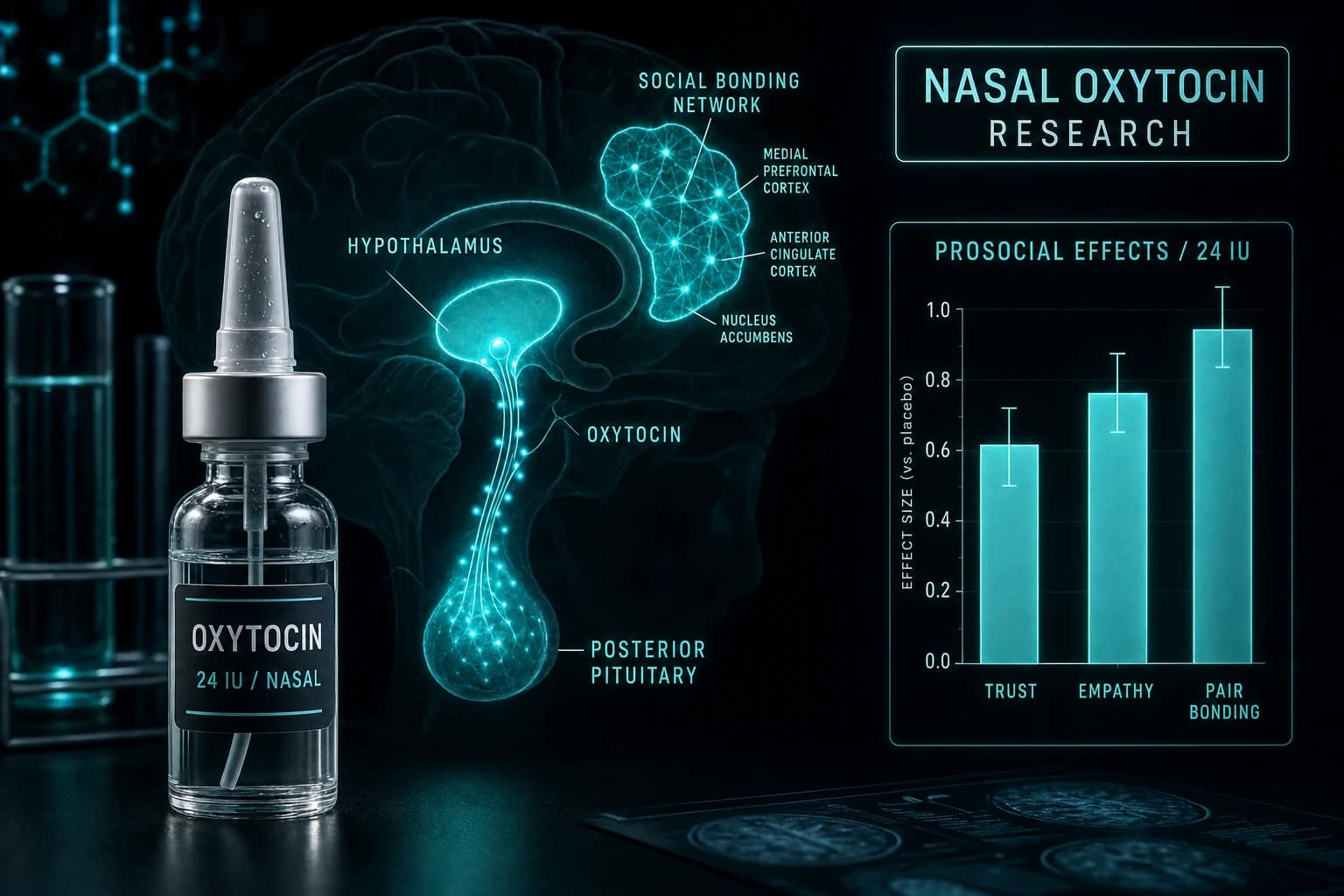
- Standard nasal research protocol: 24 IU (approximately 40 mcg) intranasal as single-dose for acute studies; chronic studies use daily dosing for 4-8 weeks
- Published acute effects: increased trust, increased emotional recognition, modulated stress response, reduced amygdala reactivity in fMRI studies
- Replication crisis caveat: many early oxytocin findings (especially in social trust research) have failed replication or shown smaller effects than initially reported
- Mechanism uncertainty: nasal oxytocin's CNS bioavailability is debated; some studies suggest meaningful CSF penetration, others suggest minimal central effect
Oxytocin nasal spray was one of the most-studied research peptides of the 2000s and 2010s. The compound generated initially striking findings on trust, social cognition, and prosocial behavior in healthy volunteers and in autism spectrum research. The subsequent decade has been a more sobering picture: many early findings have failed replication, effect sizes have shrunk on rigorous re-analysis, and the question of how much intranasal oxytocin even reaches the CNS has become a contested topic.
This article covers what oxytocin is, the standard nasal research protocols, the published evidence base in the post-replication-crisis era, the mechanism uncertainty around intranasal CNS delivery, and where nasal oxytocin fits in 2026 research applications.
What oxytocin actually is
Oxytocin (OXT) is a nonapeptide (9 amino acids) produced primarily in the paraventricular and supraoptic nuclei of the hypothalamus. The peptide is released from the posterior pituitary into circulation in response to various stimuli including labor, lactation, sexual activity, and social bonding interactions.
| Property | Oxytocin value |
|---|---|
| Sequence | Cys-Tyr-Ile-Gln-Asn-Cys-Pro-Leu-Gly-NH2 (cyclic via Cys disulfide) |
| Length | 9 amino acids (cyclic) |
| Source | Hypothalamic neurons (paraventricular/supraoptic nuclei) |
| Storage and release | Posterior pituitary |
| Half-life | 3-5 minutes circulating; longer in CNS |
| Receptor | Oxytocin receptor (OXTR) |
| Approved use | Pitocin (synthetic OXT for labor induction); intranasal not FDA-approved |
| Sister molecule | Vasopressin (similar structure, different receptor) |
Oxytocin and vasopressin are the two posterior pituitary nonapeptides; they differ in only two amino acids and are evolutionarily ancient. Oxytocin's roles include uterine contraction, milk ejection during lactation, social bonding, sexual behavior, and stress modulation.
For the broader compound context, see the Oxytocin compound guide and the related Vasopressin nasal pair bonding research.
The acute nasal oxytocin protocol
The single most-studied protocol in published research:
| Phase | Dose | Route | Timing | Duration |
|---|---|---|---|---|
| Acute single-dose study | 24 IU (~40 mcg) | Intranasal | 45 minutes before assessment | Single dose |
| Chronic daily | 24 IU | Intranasal | Once or twice daily | 4-8 weeks |
| Higher acute dose | 48 IU | Intranasal | 45 minutes before assessment | Single dose |
The 24 IU dose became the standard largely because of the influential early Kosfeld et al. study and subsequent replications. The 45-minute pre-assessment timing reflects the assumed CNS uptake window.
For acute social/cognitive testing, the standard protocol is:
- Patient self-administers 24 IU intranasal oxytocin
- Wait 45 minutes for CNS uptake
- Conduct behavioral or fMRI testing
- Measure effects (trust, emotional recognition, social cognition, amygdala reactivity)
The replication crisis context
The early 2000s-2010s produced striking oxytocin findings:
- Increased trust in economic decision-making tasks
- Enhanced emotional face recognition
- Improved theory-of-mind performance
- Reduced amygdala reactivity to threat stimuli
- Pro-social behaviors in various paradigms
These findings drove substantial research interest and led to many clinical trials in autism spectrum disorder, anxiety, depression, and social cognition disorders.
The post-2015 replication efforts have produced a more sobering picture:
Trust findings. The original Kosfeld et al. trust game results have not consistently replicated across larger and more rigorous study designs. Meta-analyses suggest the original effect size was inflated.
Autism spectrum trials. Multiple Phase 2/3 trials of intranasal oxytocin in autism spectrum disorder (notably the SOARS-B trial in pediatric patients, Sikich et al., NEJM, 2021) have not shown significant benefit. The largest pediatric autism trial was negative.
Acute social cognition. Effects on emotional face recognition and theory of mind have shown variable replication. Some effects survive rigorous re-analysis; others do not.
Amygdala reactivity. This is one of the more robust acute findings, with multiple imaging studies showing reduced amygdala response to threat stimuli after nasal oxytocin.
Bottom line: The post-replication-crisis oxytocin landscape suggests acute physiological effects (amygdala reactivity, modest social cognition modulation) are real but smaller than initial reports. The clinical translation to autism and other conditions has been disappointing.
The CNS delivery question
A central technical question for nasal oxytocin: does enough peptide actually reach the CNS to produce the reported effects?
The mechanism case for nasal CNS delivery:
- Nasal-administered peptides can cross the cribriform plate to access olfactory bulb and forebrain regions
- Oxytocin's small size (9 amino acids) makes nasal-to-CNS transit plausible
- CSF measurements after nasal oxytocin show measurable concentration increases
The mechanism case against:
- CSF concentration increases are modest
- Brain region distribution after nasal administration may not match what endogenous OXT produces
- The translation from CSF concentration to receptor-level effects is uncertain
- Some receptor-distribution studies suggest nasal oxytocin may produce primarily peripheral rather than central effects
Recent evidence. Lee et al., 2020 and other recent work has continued to characterize the CNS bioavailability question. The consensus position is that meaningful but modest CNS delivery occurs, with the magnitude potentially insufficient to fully account for the early behavioral findings.
For broader nasal peptide bioavailability context, see the nasal peptides bioavailability delivery guide.
Standard research applications
Despite the replication crisis caveats, several research applications remain active for nasal oxytocin:
1. Acute amygdala reactivity research. Reduced amygdala response to threat stimuli is one of the more robust findings. fMRI studies continue to use nasal oxytocin for this endpoint.
2. Social cognition research. Effects on emotional recognition and theory of mind are smaller than initially reported but not zero. Research continues in carefully designed paradigms.
3. Stress response research. HPA axis effects (cortisol response to acute stress) have been documented and remain a research area.
4. Trauma and anxiety research. Some clinical trial activity continues in PTSD and anxiety disorder research, though results have been mixed.
5. Pair bonding research. Animal research on oxytocin's role in pair bonding has driven human research interest, though clinical translation remains limited.
Combinations and stacks
Oxytocin is sometimes combined with other research compounds:
- Oxytocin + PT-141. Combines social bonding effects with MC4R-mediated sexual response. See PT-141 women HSDD research.
- Oxytocin + Selank. Anxiolytic combination for research. See Selank nasal vs injection dosing guide.
- Oxytocin + Vasopressin nasal. Two-compound posterior pituitary nonapeptide research. See Vasopressin nasal pair bonding research.
- Oxytocin + Kisspeptin. For sexual response and reproductive research. See Kisspeptin libido fertility HPG axis research.
None of these combinations have established formal trial evidence.
Safety profile
Nasal oxytocin has generally been well-tolerated across research applications:
Mild local nasal irritation. Common with any nasal spray.
Acute headache. Reported in some users.
Mild blood pressure effects. Modest and transient.
No documented severe adverse events at standard research doses across the substantial published literature.
The compound is contraindicated during pregnancy due to potential uterine effects.
How nasal oxytocin fits the 2026 regulatory landscape
Synthetic oxytocin (Pitocin) is FDA-approved for IV use in labor induction. Intranasal oxytocin for cognitive, social, or research applications is not FDA-approved. The compound is available through compounding pharmacies in some contexts and through research-grade peptide vendors with research-use disclosures.
Nasal oxytocin was not among the peptides reclassified in the February 27, 2026 HHS announcement because the compound's regulatory pathway is distinct (synthetic oxytocin has approved indications; nasal use is off-label or research).
For broader regulatory context, see the FDA peptide reclassification February 2026 complete breakdown.
Sourcing
For research-grade nasal oxytocin, Ascension Peptides ships in the nasal peptide catalog with 50% off using code ENHANCED. Some specialty compounding pharmacies also produce nasal oxytocin formulations for off-label clinical research.
For our broader sourcing analysis, see the best legit peptide vendors 2026 ranking.
FAQ
What is oxytocin nasal spray?
Oxytocin is a 9-amino-acid nonapeptide produced in the hypothalamus and released from the posterior pituitary. Nasal spray formulations deliver synthetic oxytocin intranasally for research applications in trust, social bonding, anxiety, and stress response research.
What is the standard nasal oxytocin research dose?
24 IU (approximately 40 mcg) intranasal, administered 45 minutes before behavioral or fMRI assessment, is the standard acute single-dose protocol. Chronic studies typically use daily or twice-daily 24 IU dosing for 4-8 weeks.
Does oxytocin reach the brain via nasal administration?
Yes, in modest amounts. CSF concentrations increase after nasal administration, though the magnitude and brain region distribution may not fully match endogenous oxytocin release. The translation from CSF concentration to receptor-level effects is uncertain. Current scientific consensus is that meaningful but modest CNS delivery occurs.
Does oxytocin make you trust people?
The original Kosfeld et al. trust game findings have not consistently replicated across larger and more rigorous studies. Effects on trust appear smaller and more context-dependent than initially reported. Some social cognition findings (emotional recognition, amygdala reactivity) are more robust; others have failed replication. The post-replication-crisis position is nuanced.
Why didn't oxytocin work for autism?
Multiple Phase 2/3 trials of intranasal oxytocin in autism spectrum disorder have shown limited or no benefit, including the largest pediatric autism trial (SOARS-B in NEJM 2021). The reasons are not fully understood but may include: dose insufficient to produce CNS effects in pediatric populations, mechanism not addressing the core autism deficits, replication-crisis effects in original signals that motivated the trials.
What is the safety profile of nasal oxytocin?
Generally well-tolerated across substantial published research. Mild local nasal irritation, occasional headache, modest transient blood pressure effects. No documented severe adverse events at standard research doses. Contraindicated during pregnancy.
Is nasal oxytocin legal?
Synthetic oxytocin (Pitocin) is FDA-approved for IV use in labor. Intranasal oxytocin for cognitive/social research is off-label. Research-grade nasal oxytocin is sold by peptide vendors with research-use disclosures. Some compounding pharmacies produce nasal oxytocin for off-label clinical applications.
Further reading
- Oxytocin compound guide
- Vasopressin nasal pair bonding research
- PT-141 bremelanotide libido peptide guide
- Kisspeptin libido fertility HPG axis research
- PT-141 women HSDD research deep dive
- Selank nasal vs injection dosing guide
- Nasal peptides bioavailability delivery guide
- Best legit peptide vendors 2026
This article is for educational and research purposes only. Synthetic oxytocin (Pitocin) is FDA-approved for IV use in labor induction; intranasal oxytocin for cognitive, social, or research applications is not FDA-approved. None of the content above constitutes medical advice. The post-replication-crisis oxytocin research landscape requires careful interpretation of effect sizes; researchers should approach with appropriate skepticism of older findings.