At a glance
- Vasopressin (AVP) is a 9-amino-acid posterior pituitary nonapeptide; differs from oxytocin in only 2 amino acids but binds distinct receptors (V1a, V1b, V2)
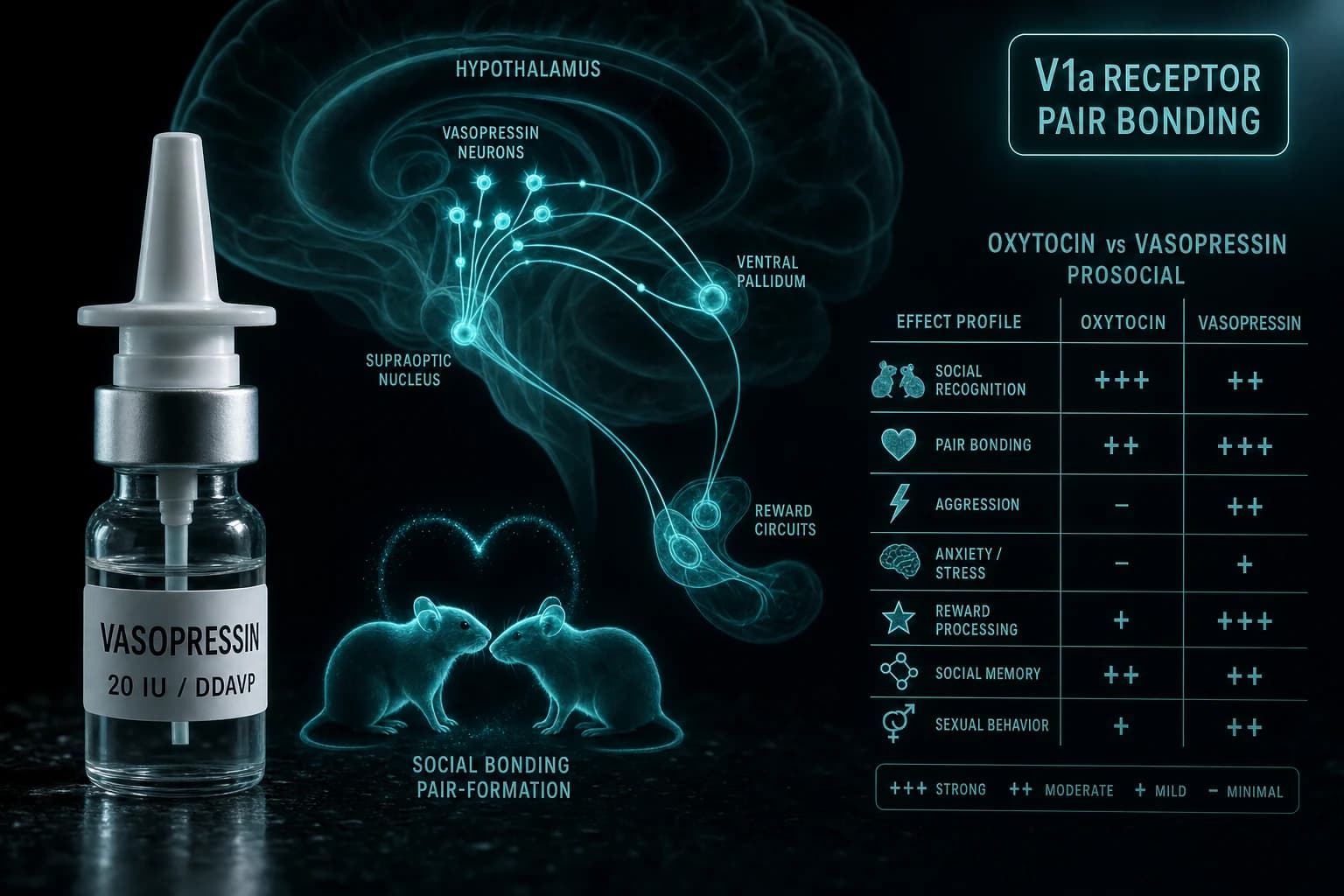
- V1a receptor activation mediates the central social behavior effects; vole research established the receptor's role in pair bonding in monogamous species
- Standard nasal research dose: 20 IU intranasal as single-dose for acute studies; chronic studies use daily dosing for shorter cycles (1-4 weeks)
- Published human effects: enhanced social memory, modulated aggression responses, modest effects on emotional processing; less-replicated than oxytocin research
- Synthetic DDAVP (desmopressin) is FDA-approved for diabetes insipidus and bedwetting; native AVP nasal for behavioral research is off-label/research-only
Vasopressin (AVP) and its synthetic analog desmopressin (DDAVP) sit at the intersection of established clinical use and behavioral research. The compound is FDA-approved as DDAVP for diabetes insipidus and pediatric bedwetting (where it acts as an antidiuretic). The behavioral research applications of native AVP nasal spray for pair bonding, aggression modulation, and social memory studies are a separate research arm with less established evidence.
This article covers what vasopressin is, the V1a receptor mechanism that distinguishes its behavioral effects from oxytocin's, the prairie vole research that established the pair-bonding mechanism case, the human research evidence base, and where vasopressin sits in 2026 research.
What vasopressin actually is
Vasopressin (AVP, arginine vasopressin, antidiuretic hormone) is a 9-amino-acid nonapeptide produced in the hypothalamic supraoptic and paraventricular nuclei and released from the posterior pituitary.
| Property | Vasopressin value |
|---|---|
| Sequence | Cys-Tyr-Phe-Gln-Asn-Cys-Pro-Arg-Gly-NH2 (cyclic via Cys disulfide) |
| Length | 9 amino acids (cyclic) |
| Source | Hypothalamic neurons (supraoptic/paraventricular) |
| Storage and release | Posterior pituitary |
| Half-life | 10-20 minutes circulating |
| Receptors | V1a (vascular, behavior), V1b (pituitary), V2 (renal) |
| Synthetic analog | DDAVP (desmopressin) - V2-selective |
| Sister molecule | Oxytocin (differs by 2 amino acids) |
The two posterior pituitary nonapeptides (vasopressin and oxytocin) are remarkably similar in structure but have distinct receptor selectivity:
- Vasopressin binds V1a (vascular smooth muscle, behavior), V1b (anterior pituitary, stress), and V2 (renal collecting ducts)
- Oxytocin binds the oxytocin receptor (OXTR)
The receptor selectivity drives the functional distinction. Vasopressin's V2 effects produce antidiuretic action (water retention by the kidney). Vasopressin's V1a effects produce vasoconstriction and behavioral effects. Oxytocin's OXTR effects produce uterine contraction, lactation, and social bonding behaviors distinct from vasopressin's.
For the compound-specific context, see the Oxytocin nasal spray research protocol.
The V1a mechanism and prairie vole research
The most influential body of vasopressin behavioral research comes from prairie vole studies. The mechanism case:
- Prairie voles (Microtus ochrogaster) are socially monogamous; pair bonds form between mates and persist after mating
- Closely-related meadow voles (Microtus pennsylvanicus) are socially promiscuous; no pair bonds form
- The difference between species is significantly explained by V1a receptor distribution in the brain (specifically in ventral pallidum)
- Manipulating V1a receptor distribution can shift monogamous voles toward promiscuous behavior and vice versa
This is one of the cleanest examples of a single receptor's distribution mapping to a complex behavioral trait in mammals. The findings have been extensively replicated and have driven substantial interest in V1a's role in human social bonding.
Key publications: Young et al., Nature, 1999 and subsequent work by the Young lab established the V1a receptor's role in vole pair bonding. The mechanism has been validated through both lesion studies and gene-transfer manipulations.
The vole research has shaped subsequent human research interest. The translation to human pair bonding is more complex because human social structures are not directly comparable to vole behavior, but the V1a receptor remains a central target for behavioral research.
Human research evidence
Vasopressin's human research evidence base is less developed than oxytocin's, but several research findings have been reported:
Social memory. Guastella et al., 2010 and subsequent work showed nasal vasopressin enhances memory for faces, particularly emotionally salient faces. The effect is on recognition memory rather than other memory domains.
Aggression modulation. Several studies show acute nasal vasopressin modulates aggressive responses in social paradigms, with sex-dependent effects (different patterns in male vs female participants).
Emotional processing. Effects on emotional face recognition and amygdala reactivity have been documented but with smaller magnitudes than initially reported. The replication crisis affecting oxytocin research has similarly affected vasopressin research.
HPA axis modulation. Vasopressin acts on V1b receptors in the anterior pituitary to support ACTH release, making it relevant for stress response research.
Autism trials. A Phase 2 trial of nasal vasopressin in autism spectrum disorder (Parker et al., Sci Transl Med, 2019) reported social interaction improvements in children with autism. Subsequent work has been more mixed.
For broader nasal peptide context, see the Selank nasal vs injection dosing guide, the Oxytocin nasal spray research protocol, and the nasal peptides bioavailability delivery guide.
Standard research protocol
The most common nasal vasopressin research protocol:
| Phase | Dose | Route | Timing | Duration |
|---|---|---|---|---|
| Acute single-dose study | 20 IU | Intranasal | 30-60 minutes before assessment | Single dose |
| Chronic daily | 20 IU | Intranasal | Once daily | 1-4 weeks |
| Higher acute dose | 40 IU | Intranasal | 30-60 minutes before assessment | Single dose |
The 20 IU dose is the most-used acute dose. Higher doses (40 IU) have been used in some specific behavioral paradigms but are less common.
Research protocols typically restrict to short durations because vasopressin's V2 effects on water retention can produce hyponatremia at sustained higher doses. The behavioral research protocols typically work within doses that minimize V2-mediated effects.
Vasopressin versus oxytocin: research comparison
| Factor | Vasopressin (AVP) | Oxytocin (OXT) |
|---|---|---|
| Structure | 9 AA cyclic, Phe-Gln-Asn-Cys-Pro-Arg-Gly | 9 AA cyclic, Ile-Gln-Asn-Cys-Pro-Leu-Gly |
| Receptors | V1a, V1b, V2 | OXTR |
| Pair bonding research | Strong vole evidence; human research limited | Mixed |
| Antidiuretic | Strong (V2-mediated) | Weak |
| Cardiovascular | V1a vasoconstriction; affects BP | Mild |
| Approved analog | DDAVP (V2-selective, diabetes insipidus) | Pitocin (labor induction) |
| Behavioral research evidence | Smaller database than OXT | Larger but post-replication-crisis |
The behavioral research distinction:
- Vasopressin is the "pair bonding receptor" research target through V1a
- Oxytocin is the "social cognition / trust / amygdala" research target through OXTR
Both contribute to social behavior; they activate different receptors and engage different downstream circuits.
Combinations and stacks
Vasopressin is sometimes combined with related neuropeptides in research:
- Vasopressin + Oxytocin nasal. Combines V1a-mediated pair bonding research with OXTR-mediated social cognition. Both are posterior pituitary nonapeptides with overlapping research applications. See Oxytocin nasal spray research protocol.
- Vasopressin + Selank or Semax. For cognitive and anxiolytic research stacks. See Selank nasal vs injection dosing guide.
- Vasopressin + PT-141. For research combining V1a effects with MC4R-mediated sexual response. See PT-141 women HSDD research deep dive.
These combinations are research-grade rather than clinical and have limited formal trial validation.
Safety profile
Vasopressin's safety profile in research applications:
Hyponatremia concern. The V2-mediated antidiuretic effect can produce water retention and hyponatremia if water intake is high or sustained dosing occurs. This is the most serious acute concern.
Cardiovascular effects. V1a-mediated vasoconstriction can produce modest blood pressure elevation. Patients with cardiovascular disease should not use vasopressin in research applications.
Local nasal irritation. Common with nasal administration; typically mild.
Headache. Reported in some users.
Mood and emotional effects. Some users report acute mood changes; the magnitude varies by dose and individual.
The compound is contraindicated during pregnancy (uterine effects), in cardiovascular disease (hypertension, heart failure), and in conditions with water retention concerns.
How vasopressin fits the 2026 regulatory landscape
Synthetic DDAVP (desmopressin) is FDA-approved for diabetes insipidus, primary nocturnal enuresis, and several other indications. The compound is V2-selective and does not engage V1a meaningfully, so it does not produce the behavioral effects of native vasopressin.
Native vasopressin nasal for behavioral research is off-label or research-only. It was not among the peptides reclassified in the February 27, 2026 HHS announcement.
For broader regulatory context, see the FDA peptide reclassification February 2026 complete breakdown.
Sourcing
For research-grade nasal vasopressin, Ascension Peptides carries it in the nasal peptide catalog with 50% off using code ENHANCED. For approved DDAVP nasal preparations (for diabetes insipidus or pediatric nocturnal enuresis), prescription through licensed clinicians is the standard channel.
For our broader sourcing analysis, see the best legit peptide vendors 2026 ranking.
FAQ
What is vasopressin nasal spray?
Vasopressin (AVP) is a 9-amino-acid nonapeptide produced in the hypothalamus and released from the posterior pituitary. Nasal spray formulations of native vasopressin are used in research applications targeting V1a receptor effects (pair bonding, social memory, aggression). The synthetic analog DDAVP (desmopressin) is V2-selective and is FDA-approved for diabetes insipidus and pediatric nocturnal enuresis.
How does vasopressin differ from oxytocin?
Both are 9-amino-acid nonapeptides produced in the hypothalamus and released from the posterior pituitary. They differ in only 2 amino acids but bind distinct receptors: vasopressin targets V1a, V1b, V2 receptors; oxytocin targets OXTR. The receptor selectivity produces different functional effects (antidiuretic, vasoconstriction, pair bonding for vasopressin; uterine contraction, lactation, social bonding for oxytocin).
What is the standard vasopressin research dose?
20 IU intranasal as single dose for acute studies, administered 30-60 minutes before behavioral or fMRI assessment. Chronic studies use daily 20 IU dosing for 1-4 weeks. Higher doses (40 IU) are used in some specific behavioral paradigms.
Does vasopressin actually affect pair bonding in humans?
The vole research showing V1a's role in pair bonding has not directly translated to robust human pair bonding effects. Human social bonding involves multiple receptor systems and complex psychological factors. Acute nasal vasopressin can modulate certain social cognition and memory tasks in humans, but claiming "vasopressin creates pair bonds" in humans overstates what the human data establishes.
Is DDAVP (desmopressin) the same as vasopressin?
No. DDAVP is a synthetic vasopressin analog that has been modified to be V2-selective (V2 receptor is the renal water-retention receptor). DDAVP does not engage V1a meaningfully and therefore does not produce the behavioral effects that native vasopressin does. DDAVP is FDA-approved for diabetes insipidus; native vasopressin nasal is research-only.
What are the safety concerns with nasal vasopressin?
Hyponatremia from V2-mediated water retention is the most serious concern at sustained doses. V1a-mediated vasoconstriction can produce modest blood pressure elevation. Patients with cardiovascular disease, water retention concerns, or hyponatremia should not use vasopressin in research applications.
Can vasopressin be combined with oxytocin nasal?
Some research protocols combine both posterior pituitary nonapeptides. The combination addresses different receptor systems (V1a + V2 for vasopressin; OXTR for oxytocin) and is mechanistically additive for social behavior research. Empirical data on combinations is limited.
Further reading
- Oxytocin nasal spray research protocol
- PT-141 women HSDD research deep dive
- Kisspeptin libido fertility HPG axis research
- Selank nasal vs injection dosing guide
- Nasal peptides bioavailability delivery guide
- FDA peptide reclassification February 2026 complete breakdown
- Best legit peptide vendors 2026
This article is for educational and research purposes only. Native vasopressin nasal for behavioral research is not FDA-approved. DDAVP (desmopressin), a V2-selective synthetic vasopressin analog, is FDA-approved for diabetes insipidus and several other indications. None of the content above constitutes medical advice. Consult a qualified clinician for individual medical questions.