At a glance
- Approved in 35+ countries with 30+ clinical trials across 11,000 subjects
- Reduced sepsis mortality by 10.7 percentage points in the ETASS trial
- Standard dose: 1.6 mg subcutaneous, twice weekly
- Reclassified to FDA Category 1 in February 2026 for US compounding
- Works as immunomodulator (thermostat), not just immune stimulant (heater)
Your thymus peaked when you were a teenager
By the time you hit 40, your thymus gland has already shrunk to a fraction of its original size. This process, called thymic involution, is one of the most predictable hallmarks of aging. The organ that once churned out naive T-cells like a factory quietly downsizes every decade, and the downstream effects are measurable: fewer new T-cells, weaker vaccine responses, slower infection clearance, and a chronic low-grade inflammation that immunologists call "inflammaging."
Thymosin alpha-1 (Tα1) is a 28-amino-acid peptide originally isolated from the thymus in the 1970s by Allan Goldstein's team at George Washington University. Its synthetic form, thymalfasin (marketed as Zadaxin), is now approved in over 35 countries for hepatitis B and as an immune adjuvant. It has been tested in more than 30 clinical trials involving over 11,000 human subjects (Dinetz and Lee, 2024). That makes it one of the most extensively studied peptides in existence. Yet most people in the peptide community have never encountered it.
Here is why that is about to change.
How thymosin alpha-1 works at the cellular level
Most peptides target a single receptor. Tα1 operates differently. It acts on multiple arms of the immune system simultaneously, which is part of why it keeps showing up in trials for conditions as varied as hepatitis, sepsis, and cancer.
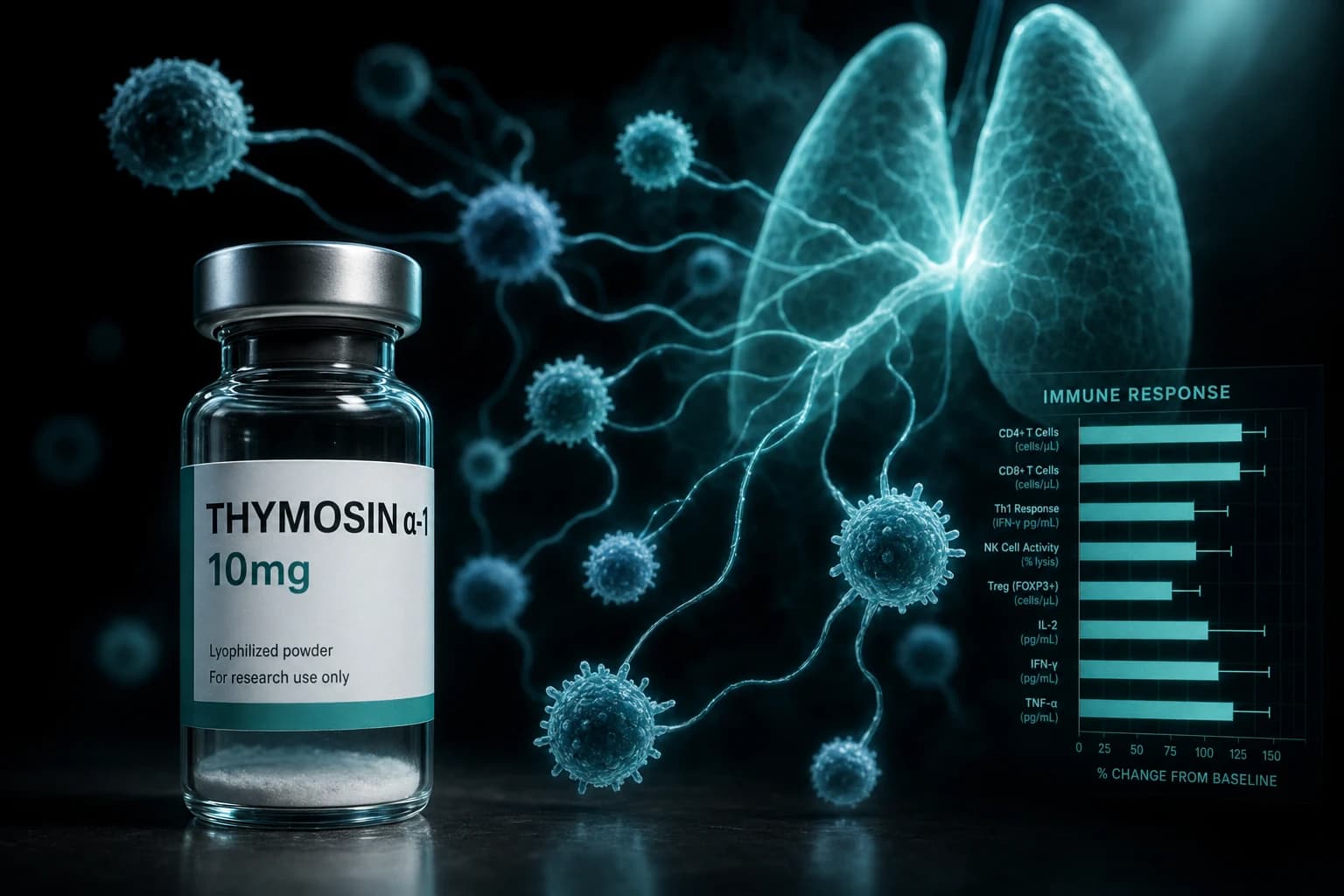
The primary mechanism involves Toll-like receptor 9 (TLR9) signaling on dendritic cells. Romani et al. (2004) demonstrated in Blood that Tα1 activates dendritic cells through TLR9, triggering the p38 MAPK/NF-κB pathway and driving production of interleukin-12. IL-12 is the key cytokine that pushes naive T-cells toward a Th1 response, the arm of your immune system responsible for clearing intracellular pathogens and infected cells.
But Tα1 does not just push the gas pedal. It also activates indoleamine 2,3-dioxygenase (IDO) in dendritic cells through TLR9 and type I interferon receptor signaling. IDO activation generates regulatory T-cells and produces IL-10, an anti-inflammatory cytokine. This dual action is what makes Tα1 an immunomodulator rather than a simple immune stimulant. It boosts responses that are too weak and dampens responses that are overactive.
Think of it like a thermostat rather than a heater. Your immune system does not always need more fire. Sometimes it needs recalibration.
Additional downstream effects include:
- T-cell maturation: Tα1 promotes differentiation of CD4+ and CD8+ T-cells from immature precursors
- NK cell activation: enhanced natural killer cell cytotoxicity against tumor cells and virus-infected cells
- Macrophage priming: increased phagocytic activity and antigen presentation
- Cytokine regulation: shifts from pro-inflammatory (TNF-α, IL-6) dominance toward balanced Th1/Th2 profiles
A literature review by Dominari et al. (2020) in the World Journal of Virology cataloged these mechanisms across dozens of preclinical and clinical studies, confirming Tα1 as a broad-spectrum immune regulator rather than a narrow-target compound.
The clinical evidence is unusually deep for a peptide
Most research peptides have a handful of animal studies and maybe one or two small human trials. Tα1 has a clinical dossier that would make some pharmaceutical drugs envious. Here are the most important data sets.
Hepatitis B: the original proving ground
Chronic hepatitis B was the first major indication for thymalfasin, and the data is robust. Chien et al. (1998) published a randomized controlled trial in Hepatology comparing 26-week Tα1 treatment, 52-week treatment, and observation in patients with chronic HBV infection. At 18 months follow-up, complete virological response rates (HBV DNA clearance and HBeAg seroconversion) were:
- 26-week Tα1 course: 40.6%
- 52-week course: 26.5%
- Observation only: 9.4%
The 26-week course was significantly superior to observation (p = 0.004). The shorter course outperforming the longer one was unexpected and suggested that Tα1 primes an immune response that continues working after dosing stops. This is consistent with its mechanism: you are not suppressing a virus directly, you are training the immune system to handle it.
Sepsis: the ETASS trial
Wu et al. (2013) conducted the ETASS trial (Efficacy of Thymosin Alpha 1 for Severe Sepsis), a multicenter, single-blind, randomized controlled trial across six tertiary hospitals in China. A total of 361 ICU patients with severe sepsis were randomly allocated to Tα1 or standard care.
Results at 28 days:
| Outcome | Tα1 Group (n=181) | Control (n=180) | Relative Risk | P-value |
|---|---|---|---|---|
| In-hospital mortality | 28.7% | 39.4% | 0.73 (0.54-0.98) | 0.032 |
| 28-day mortality | 26.0% | 35.0% | 0.74 (0.54-1.02) | 0.062 |
An absolute mortality reduction of 10.7 percentage points in sepsis patients. The Tα1 group also showed significantly improved mHLA-DR expression (a marker of immune function) compared to controls. No serious adverse events were attributed to the treatment.
Influenza vaccination in elderly populations
This is where Tα1's relevance to aging becomes concrete. Gravenstein et al. (1989) ran a double-blind, placebo-controlled trial in the Journal of the American Geriatrics Society. Ninety elderly men (ages 65 to 99, mean age 77.3 years) received either Tα1 at 900 μg/m² subcutaneously twice weekly for four weeks or placebo, alongside the standard trivalent influenza vaccine.
The Tα1 group showed enhanced antibody titers to all three influenza strains. In a subsequent Phase 2 study, the combination of Tα1 plus influenza vaccination decreased influenza incidence from 19% (vaccine alone) to 6% (vaccine plus Tα1). For context, that is a 68% relative reduction in actual influenza cases in a population where standard vaccination frequently fails.
COVID-19: a mixed but promising signal
The pandemic generated a wave of Tα1 studies. A systematic review and meta-analysis by Soeroto et al. (2023) in Inflammopharmacology pooled data from 8 studies and found that moderate to critical COVID-19 patients receiving Tα1 therapy had significantly lower mortality (RR 0.59, 95% CI 0.37 to 0.93, p = 0.02). Subgroup analysis showed the mortality benefit was strongest in patients over age 60 and in those with severe or critical disease, exactly the populations where immune function is most compromised.
Not all meta-analyses agreed. An earlier pooled analysis found no significant mortality benefit. The discrepancy likely comes down to patient selection: Tα1 appears to help most when the immune system is already failing, not when it is merely fighting a standard infection.
Clinical trial summary
| Indication | Study | Design | N | Key Result |
|---|---|---|---|---|
| Hepatitis B | Chien et al. (1998) | RCT | 96 | 40.6% virological response vs 9.4% control |
| Severe sepsis | Wu et al. (2013) | RCT, multicenter | 361 | 28.7% vs 39.4% mortality (p=0.032) |
| Influenza (elderly) | Gravenstein et al. (1989) | Double-blind RCT | 90 | Enhanced antibody titers; 19% to 6% incidence |
| COVID-19 | Soeroto et al. (2023) | Meta-analysis | 8 studies | RR 0.59 mortality (p=0.02) |
| Safety review | Dinetz and Lee (2024) | Narrative review | 11,000+ | Favorable safety across 30+ trials |
Dosing and pharmacokinetics
Thymalfasin's pharmacokinetic profile has been well characterized. Bioavailability studies in healthy volunteers showed rapid absorption after subcutaneous injection, with peak serum levels at approximately 2 hours post-dose. The elimination half-life is roughly 2 hours. Serum levels return to baseline within 24 hours. Urine excretion accounts for 31 to 60% of the administered dose.
The standard clinical dosing protocol across most published trials:
| Parameter | Value |
|---|---|
| Dose | 1.6 mg (or 900 μg/m² BSA) |
| Route | Subcutaneous injection |
| Frequency | Twice weekly |
| Duration | 6 to 12 months (hepatitis); variable for other indications |
| Half-life | ~2 hours |
| Tmax | ~2 hours |
The short half-life might seem like a problem. Why does a twice-weekly injection of something that clears in hours produce effects lasting months? Because Tα1 is not a drug that directly fights pathogens. It primes immune cells. Once those dendritic cells are activated, once those T-cells are differentiated, the effects persist well beyond the peptide's plasma presence. The Chien hepatitis B data showed sustained virological responses months after the last injection, supporting this "prime and sustain" model.
For researchers sourcing injectable thymosin alpha-1, Ascension Peptides carries it with 50% off using code ENHANCED. Proper reconstitution and sterile technique are critical for subcutaneous peptides.
The 2026 FDA reclassification changes everything
In February 2026, HHS Secretary Robert F. Kennedy Jr. announced that approximately 14 peptides previously restricted to FDA Category 2 would move back to Category 1. Thymosin alpha-1 is on that list. This reclassification means licensed compounding pharmacies in the United States can once again legally prepare Tα1 under a physician's prescription.
The timing matters. Tα1 was already approved in 35+ countries but was caught up in the 2023 FDA crackdown that restricted compounding of numerous peptides. For American researchers who relied on compounded thymalfasin, the past two years created a frustrating gap between the international evidence base and domestic access.
Category 1 status does not equal FDA approval. Tα1 remains an off-label therapeutic in the U.S. that requires physician supervision. But it restores a legal pathway that the clinical literature strongly supports.
Where thymosin alpha-1 fits in a peptide protocol
Tα1 is not a recovery peptide like BPC-157 or TB-500. It is not going to heal a torn tendon or reduce localized inflammation. Those compounds (available together in the Wolverine Stack) target tissue repair through angiogenesis and growth factor modulation.
Tα1 operates at the systems level. It recalibrates how your immune system responds to threats. That makes it relevant for:
- Age-related immune decline: if you are over 40 and noticing slower recovery from infections, weaker vaccine responses, or lingering colds that used to clear in days
- Chronic infection support: as demonstrated in the hepatitis B and COVID-19 data
- Post-illness immune recovery: particularly after prolonged illness that may have depleted T-cell reserves
- Adjunct to vaccination: the elderly influenza data suggests Tα1 can meaningfully improve vaccine efficacy in immunocompromised populations
For antimicrobial support, LL-37 is a complementary peptide that works through direct antimicrobial action rather than immune modulation. Tα1 trains your army; LL-37 fights on the front line. Pairing them is a logical research direction, though no published trials have tested the combination yet.
Safety profile
Across 30+ clinical trials and 11,000+ human subjects, Tα1's safety record is remarkably clean. The most common adverse effects are mild and localized: injection site redness, minor irritation, and occasional discomfort at the injection site. Systemic side effects are rare.
The ETASS sepsis trial (Wu et al., 2013) specifically noted no serious adverse events attributable to Tα1 in critically ill ICU patients. That is a population where adverse reactions are most likely to surface. The review by Dinetz and Lee (2024) concluded that the safety data across all studied indications was "consistent and favorable."
No hepatotoxicity. No nephrotoxicity. No immunosuppressive rebound after discontinuation. For a compound that modulates the immune system, this is an unusually clean profile.
The bottom line
Thymosin alpha-1 sits in a rare category: a peptide with real clinical depth, a well-characterized mechanism, approval in dozens of countries, and a safety profile built on thousands of human subjects. It is not a speculative compound riding forum hype. The data goes back to 1989. Multiple randomized controlled trials support its efficacy in hepatitis B, severe sepsis, and vaccine enhancement for elderly populations.
The 2026 FDA reclassification to Category 1 makes it accessible through U.S. compounding pharmacies again. For researchers focused on immune function, aging, and immunosenescence, Tα1 deserves a closer look.
Whether it belongs in your protocol depends on your research goals. If tissue repair is the priority, BPC-157 and TB-500 are the studied compounds. If cognitive function is the target, the Calm + Clarity stack addresses that axis. But if your question is "how do I support an aging immune system with the strongest clinical evidence available," thymosin alpha-1 has an answer backed by more human data than almost any other research peptide on the market.
This article is for educational and research purposes only. Thymosin alpha-1 (thymalfasin) is approved in certain countries for specific indications but is not FDA-approved in the United States. All dosing and clinical data are derived from published peer-reviewed research. Consult a qualified healthcare professional before making any decisions about peptide research.