At a glance
- KLOW = GLOW (GHK-Cu + BPC-157 + TB-500) plus KPV for NF-kB inhibition
- KPV blocks NF-kB nuclear translocation, shutting down inflammatory gene expression
- KPV reduced colitis scores in IBD mouse models via both oral and injectable routes
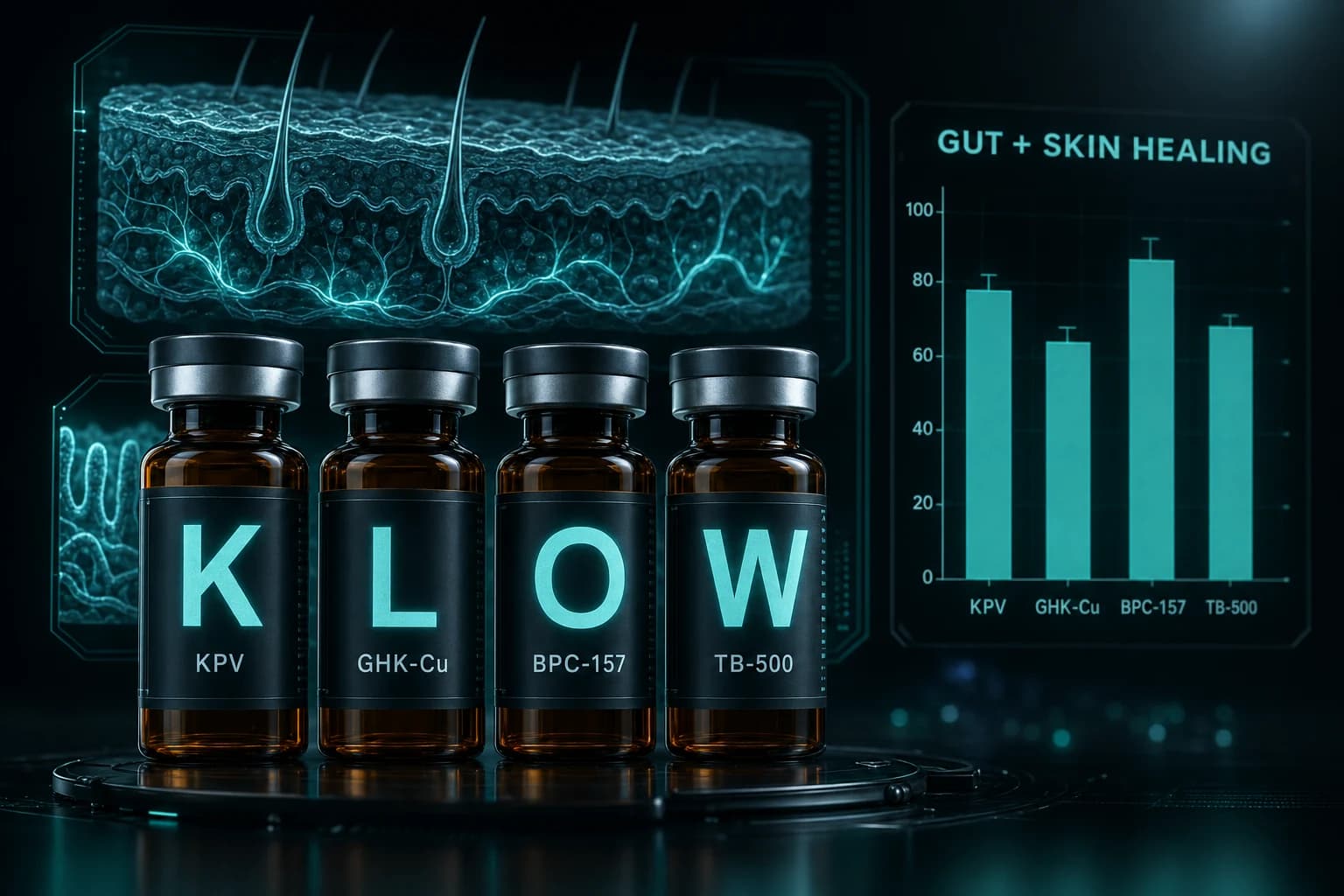
- Addresses both ends of the gut-skin axis: KPV/BPC-157 for gut, GHK-Cu/TB-500 for skin
- Choose GLOW if no gut component; choose KLOW if gut inflammation is an endpoint
The four-compound stack
The KLOW Blend is the premium configuration: GHK-Cu + BPC-157 + TB-500 + KPV in a single pre-mixed vial. It takes the GLOW Blend (three compounds covering recovery and skin) and adds KPV, a targeted anti-inflammatory tripeptide with specific gut and immune research.
This is the most comprehensive recovery stack available in a single vial. Four compounds, four distinct mechanisms, one reconstitution. The question isn't whether it works differently from GLOW. It does. The question is whether the fourth compound addresses something in your research that the first three don't.
This article breaks down exactly what KPV adds, the gut-skin axis research that makes it relevant, the practical protocol, and a direct GLOW vs KLOW comparison to help you decide which blend fits your research.
KPV: the fourth compound
KPV (Lysine-Proline-Valine) is a tripeptide derived from the C-terminal end of alpha-MSH (alpha-Melanocyte Stimulating Hormone). Alpha-MSH is a 13-amino-acid neuropeptide with well-documented anti-inflammatory properties, but it also causes melanogenesis (skin darkening) through MC1R activation. KPV retains the anti-inflammatory activity of the parent molecule while lacking the melanogenic effects. Those effects reside in the N-terminal and central portions of alpha-MSH, not the C-terminal fragment.
The NF-kB mechanism
KPV's primary action is intracellular inhibition of NF-kB (nuclear factor kappa-light-chain-enhancer of activated B cells). NF-kB is a transcription factor that acts as a master switch for inflammatory gene expression. When activated, it drives the production of TNF-alpha, IL-1beta, IL-6, and other pro-inflammatory cytokines.
Luger et al. (2003, Annals of the New York Academy of Sciences) demonstrated that alpha-MSH-derived peptides, including KPV, enter cells and directly interact with the NF-kB signaling cascade, preventing the translocation of NF-kB to the nucleus. Without nuclear translocation, the inflammatory gene program stays off.
This is a fundamentally different anti-inflammatory mechanism from TB-500's approach. TB-500 reduces inflammation indirectly through actin regulation and cell migration modulation. KPV goes straight to the transcriptional switch. Having both in the same stack means you're addressing inflammation from two angles: the cellular logistics level (TB-500) and the gene expression level (KPV).
IBD and gut inflammation data
KPV's most specific research application is intestinal inflammation. Dalmasso et al. (2008) showed that KPV ameliorated colitis in mouse models of IBD. The study used both DSS-induced colitis and a T-cell transfer model, demonstrating:
- Reduced colonic inflammation scores
- Decreased levels of pro-inflammatory cytokines (TNF-alpha, IFN-gamma)
- Improved histological architecture of the intestinal mucosa
- Oral and intraperitoneal routes both showed efficacy
Notably, the oral route worked. KPV is one of the few anti-inflammatory peptides with demonstrated oral bioavailability for gut-targeted effects. In the KLOW Blend (injectable formulation), the compound reaches the gut mucosa via systemic circulation. But the oral data is significant because it shows KPV's affinity for intestinal tissue regardless of delivery route.
Laroui et al. (2010, Gastroenterology) extended this work using KPV-loaded nanoparticles targeted to inflamed colonic tissue, showing even more efficient delivery and greater anti-inflammatory effect than free KPV. The research direction is clear: KPV has specific, reproducible anti-inflammatory effects in the gut, mediated through NF-kB inhibition.
Skin inflammation data
KPV's anti-inflammatory mechanism extends beyond the gut. In skin models, alpha-MSH-derived peptides (including KPV) suppress UV-induced inflammatory responses and reduce the expression of adhesion molecules that recruit immune cells to inflamed skin. Bohm et al. (2005) reviewed the immunomodulatory effects of alpha-MSH and its fragments, noting broad anti-inflammatory activity across keratinocytes, melanocytes, and dermal fibroblasts.
For the KLOW Blend specifically, this means KPV addresses skin inflammation at the immune level while GHK-Cu handles the structural rebuilding. Inflamed skin can't rebuild its collagen matrix efficiently. By calming the inflammatory environment first (KPV) and then driving matrix synthesis (GHK-Cu), the two compounds create conditions for more effective skin repair than either achieves alone.
The gut-skin axis
The gut-skin axis is not a marketing concept. It's a documented bidirectional communication system between the intestinal microbiome, the intestinal immune system, and cutaneous (skin) physiology. Understanding it explains why the KLOW Blend's gut + skin combination isn't arbitrary.
How it works
The gut mucosal immune system represents approximately 70% of the body's total immune tissue. When the gut barrier is compromised (increased intestinal permeability, often called "leaky gut" in common language), bacterial endotoxins (LPS) and partially digested proteins enter the bloodstream. This triggers a systemic inflammatory response via NF-kB activation in immune cells throughout the body.
That systemic inflammation reaches the skin. The result: accelerated collagen degradation via matrix metalloproteinases (MMPs), reduced fibroblast activity, impaired wound healing, and visible markers like redness, dryness, and premature aging. Bowe and Logan (2011, Gut Pathogens) described this pathway in detail, coining the term "gut-brain-skin axis" and documenting how intestinal dysbiosis correlates with acne, rosacea, and eczema severity.
Salem et al. (2018, Frontiers in Microbiology) reviewed the mechanistic links: short-chain fatty acids produced by gut bacteria modulate systemic inflammation; disrupted gut barrier function increases circulating inflammatory mediators; and these mediators directly impair skin barrier function and collagen homeostasis.
What this means for KLOW
The KLOW Blend addresses both ends of this axis:
- Gut end: KPV inhibits NF-kB in intestinal tissue, reducing the inflammatory signaling that drives gut barrier dysfunction. BPC-157 promotes gut mucosal healing directly (it was originally isolated from gastric juice, and its gut tissue repair data is the strongest in its entire literature).
- Skin end: GHK-Cu drives collagen synthesis, elastin production, and extracellular matrix remodeling. TB-500 clears systemic inflammation and promotes cell migration for repair.
Two compounds working the gut. Two compounds working the skin. The systemic inflammatory circuit that connects them gets addressed from both directions simultaneously. No single compound in the blend does this alone.
The four layers explained
Each compound in KLOW handles one node in the repair and recovery network:
Layer 1: Local tissue repair (BPC-157)
Angiogenesis, VEGF upregulation, growth factor modulation. The targeted healer. BPC-157 is the most-published peptide for tendon, ligament, gut, and nerve repair in animal models. In the KLOW context, its gut-healing properties are particularly relevant because they complement KPV's anti-inflammatory gut action.
Read: BPC-157 dosing protocols
Layer 2: Systemic recovery (TB-500)
Actin regulation, cell migration, broad anti-inflammatory support. TB-500 operates body-wide, ensuring repair cells reach injury sites efficiently and that the inflammatory environment doesn't block healing. Its NF-kB reduction is general; KPV's is targeted. Together they provide layered anti-inflammatory coverage.
Read: BPC-157 vs TB-500
Layer 3: Matrix rebuilding (GHK-Cu)
Collagen I/III synthesis via TGF-beta, decorin production, copper-dependent cross-linking via lysyl oxidase, and 4,000+ gene modulation. GHK-Cu is the structural architect. It determines whether repaired tissue ends up organized and strong versus scarred and weak.
Read: GHK-Cu research guide
Layer 4: Targeted anti-inflammatory (KPV)
NF-kB nuclear translocation inhibition. Pro-inflammatory cytokine suppression (TNF-alpha, IL-1beta, IL-6). Specific gut mucosal and skin anti-inflammatory effects without melanogenesis. This is the layer that distinguishes KLOW from GLOW.
GLOW vs KLOW: the decision framework
Both blends share the same GHK-Cu + BPC-157 + TB-500 foundation. The only variable is KPV. Here's when each blend makes sense:
| Factor | GLOW (3 compounds) | KLOW (4 compounds) |
|---|---|---|
| Recovery + skin | Yes | Yes |
| Gut-specific research | BPC-157 only | BPC-157 + KPV |
| NF-kB targeted action | No | Yes (KPV) |
| Gut-skin axis coverage | Partial | Full |
| IBD/IBS research | Limited | Supported |
| Skin inflammation focus | General | Targeted |
| Complexity | Simpler | Slightly more complex |
| Cost | Lower | Higher |
| Who it's for | Recovery + anti-aging | Recovery + anti-aging + gut/immune |
Choose GLOW if:
- Your research focuses on musculoskeletal recovery with a skin/anti-aging component
- You don't have gut inflammation as a primary or secondary endpoint
- You want the recovery + skin benefits at a lower price point
- You're upgrading from the Wolverine Stack and adding GHK-Cu is sufficient
Choose KLOW if:
- Gut health or intestinal inflammation is part of your research
- You're studying the gut-skin axis or systemic inflammation's effect on skin quality
- Inflammatory skin conditions (beyond normal aging) are an endpoint
- You want the broadest possible anti-inflammatory coverage
- You're running a comprehensive recovery, skin, AND gut protocol and want to avoid multiple separate vials
Start with GLOW, upgrade to KLOW?
This is a common path. GLOW and KLOW share the same foundation, so transitioning is straightforward. Running GLOW for one cycle establishes your baseline response to the three-compound protocol. If you then add KPV via KLOW in the next cycle, any differences are attributable to the fourth compound. From a research design perspective, this sequential approach is actually cleaner than starting with KLOW directly.
The practical protocol
Reconstitution
Add 2 mL of bacteriostatic water to the KLOW vial. Inject water slowly along the inside wall. Swirl gently. The solution may have a slight blue tint from GHK-Cu's copper complex. This is expected.
Do not shake. Refrigerate immediately. Use within 21-28 days.
Use the reconstitution calculator to compute exact draw volumes for your target dose.
Dosing
One subcutaneous injection daily. Draw volume depends on the vial's total compound mass and formulation ratio. Consult the vial label for per-compound amounts and calculate accordingly.
For gut-focused research: abdominal subcutaneous injection is standard. KPV reaches gut tissue via systemic circulation.
For localized injury + gut research: you can inject near the injury site. BPC-157 benefits from local placement; the other three compounds act systemically regardless of injection location.
Cycle structure
- Weeks 1-6: Daily subcutaneous injection
- Weeks 7-10: Off period for endpoint assessment
- Optional second cycle: Based on results from first cycle
The four-compound protocol follows the same cycle timing as GLOW or the Wolverine Stack. KPV doesn't require a different cycle length.
Monitoring gut endpoints
If gut health is a research focus, consider tracking these markers across the cycle:
- Subjective: Bloating frequency, stool consistency, abdominal discomfort
- Objective (if available): Fecal calprotectin (intestinal inflammation marker), zonulin (intestinal permeability marker)
- Timeline: Baseline before cycle start, midpoint (week 3), end of cycle (week 6), and 4 weeks post-cycle
Storage
- Lyophilized: -20C long-term, 2-8C short-term
- Reconstituted: 2-8C, use within 21-28 days
- Protect from light (copper complex is light-sensitive)
- Do not freeze reconstituted solution
Who KLOW is NOT for
Not every researcher needs four compounds. KLOW is specifically not the right choice if:
- You have no gut or inflammation component to your research. The Wolverine Stack or GLOW covers recovery and skin without the cost of a fourth compound.
- Budget is a primary constraint. KLOW is the premium-priced option. GLOW delivers the same recovery + skin benefits at a lower cost. The Wolverine Stack is the most cost-effective entry point for pure recovery research.
- You prefer to isolate variables. If you're trying to determine which specific compound is responsible for observed effects, a four-compound blend makes attribution difficult. Consider running individual compounds or simpler stacks first.
What the research supports (and what it doesn't)
Supported:
- KPV inhibits NF-kB nuclear translocation and reduces pro-inflammatory cytokines (Luger et al., 2003)
- KPV ameliorates colitis in IBD animal models via oral and injectable routes (Dalmasso et al., 2008)
- Alpha-MSH fragments suppress skin inflammation without melanogenesis (Bohm et al., 2005)
- The gut-skin axis is a documented bidirectional communication system (Bowe & Logan, 2011; Salem et al., 2018)
- GHK-Cu, BPC-157, and TB-500 each have independent preclinical support for their respective mechanisms
Not supported:
- Human clinical trial data for the four-compound combination. This is a research protocol based on the individual compound literature and mechanistic reasoning.
- "Cure" claims for IBD or any inflammatory condition. KPV research shows amelioration of inflammation in animal models, not disease resolution.
- Equivalence between injectable and oral KPV in this context. The KLOW Blend is injectable; KPV's oral gut data uses a different delivery route.
Research access
The KLOW Blend is available from Ascension Peptides with 50% off using code ENHANCED. Four compounds, pre-mixed, with certificates in the lab-tests library.
- KLOW Blend product page →
- GLOW Blend (3-compound alternative) →
- Wolverine Stack (recovery baseline) →
- GHK-Cu research guide →
- BPC-157 research guide →
- TB-500 research guide →
- KPV research guide →
- Reconstitution calculator →
Disclaimer
This article is provided for research and educational purposes only. The KLOW Blend compounds are not approved for general human use. Nothing here is medical advice. Consult a qualified healthcare professional before any decision to self-administer.