At a glance
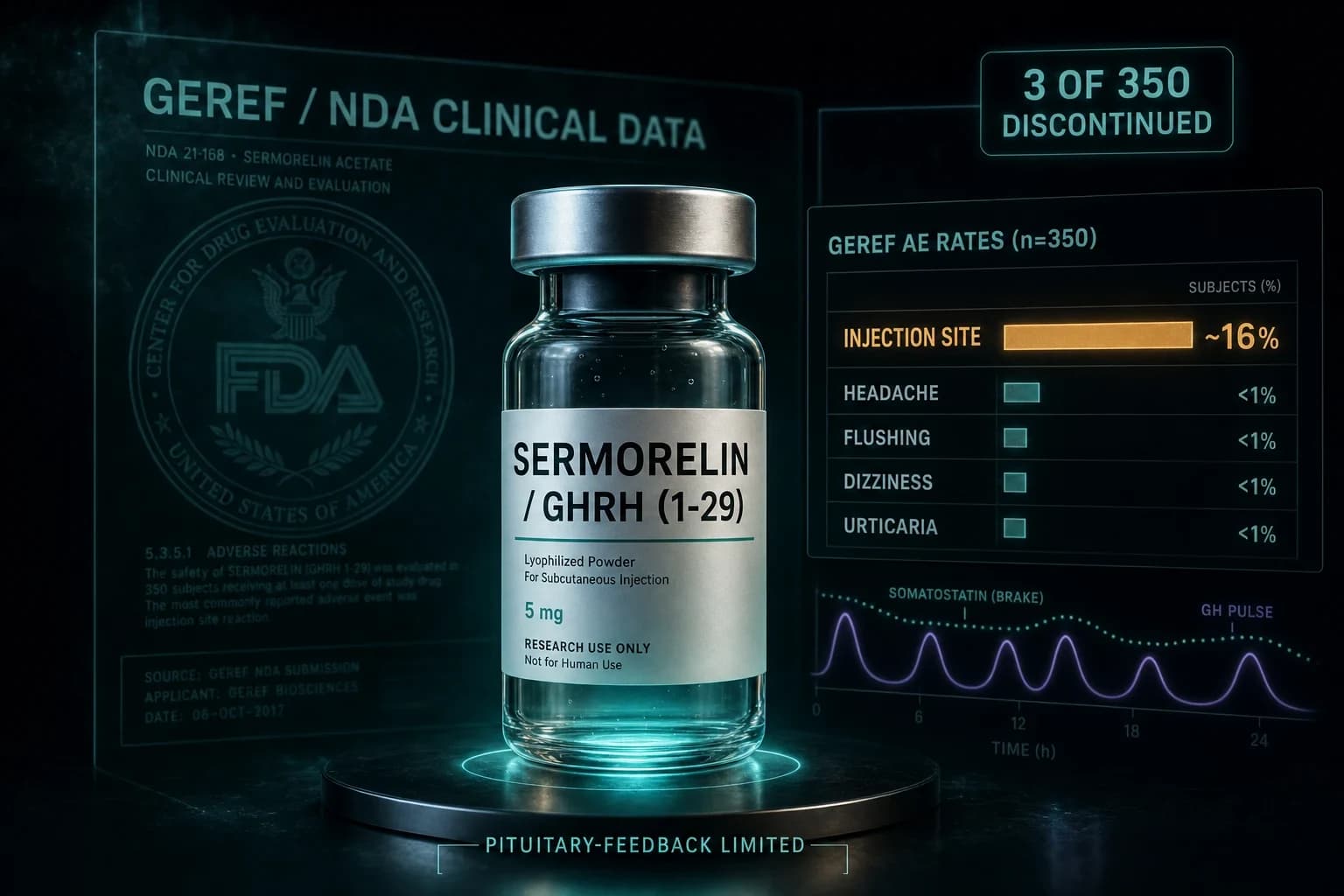
- Injection site reactions hit ~1 in 6 patients across ~350 in the FDA Geref clinical file; 3 discontinued therapy.
- Every other adverse event listed on the Geref label ran below 1%.
- Somatostatin feedback caps IGF-1 in GHRH-analog therapy, unlike exogenous HGH (Liu et al. 2007, PMID 17227934).
- Adult trials (Vittone 1997, Corpas 1992, Khorram 1997) did not reproduce the edema and arthralgia signal seen with rhGH.
- Hard contraindications: active malignancy, pregnancy, untreated hypothyroidism, uncontrolled diabetes.
Most articles about sermorelin side effects list the same seven bullet points and quote no numbers. The actual regulatory file gave numbers. In the clinical trials pooled into the FDA Geref application, roughly 1 in 6 patients had injection site pain, redness, or swelling. Every other adverse event ran below 1%. Three patients out of 350 stopped therapy for those reactions. That is the entire adverse-event picture at the level the FDA reviewed it, and it is why sermorelin still ships as a research peptide instead of getting flagged for a black-box warning.
The rest of the picture only becomes clear once you separate what sermorelin actually does from what recombinant growth hormone does. Sermorelin is a growth-hormone-releasing hormone analog. It acts upstream, on the pituitary. Recombinant HGH is the finished hormone itself and bypasses the whole feedback loop. Their side-effect profiles are not the same, and confusing them is why most consumer-facing sermorelin pages either overpromise or overwarn.
Bottom line: The dominant, expected sermorelin side effect is injection site irritation. Systemic effects at typical research doses are rare and mostly self-limiting, largely because somatostatin feedback caps IGF-1 in a way that exogenous HGH does not. Contraindications matter: active malignancy, pregnancy, and untreated hypothyroidism are the ones to take seriously.
What the Geref clinical file actually reported
Sermorelin was approved as Geref in 1997 for pediatric growth hormone deficiency (and earlier, in 1990, as Geref Diagnostic for pituitary reserve testing). It was voluntarily discontinued in 2008 for commercial reasons. The FDA confirmed in a 2013 Federal Register notice that the discontinuation was not for safety. The clinical data reviewed for the pediatric approval remains the largest structured safety dataset on the molecule.
The label numbers, pulled from that clinical file:
| Adverse event | Reported rate | Notes |
|---|---|---|
| Injection site pain, redness, swelling | ~16% (1 in 6) | Self-limited; three patients of 350 discontinued |
| Headache | <1% | Reported as treatment-related |
| Flushing | <1% | Also common with IV diagnostic use |
| Dysphagia | <1% | Rare; label lists as observed |
| Dizziness | <1% | Rare |
| Hyperactivity | <1% | Reported in pediatric cohort |
| Somnolence | <1% | Reported in pediatric cohort |
| Urticaria | <1% | Rare hypersensitivity |
The intravenous diagnostic protocol, where a bolus of sermorelin was given to test pituitary reserve, produced its own transient reactions: facial flushing, injection site pain, occasional nausea, headache, and a metallic taste. Those are provocation-test reactions to a large single IV dose and do not map onto the small subcutaneous doses used chronically. Chronic subcutaneous administration in the pediatric trial (30 microg/kg nightly) was well tolerated. The Prakash and Goa review in BioDrugs summarized that trial and noted that height velocity increased in 74% of GH-deficient children over six months at that dose.
Why sermorelin's safety profile is not the recombinant HGH profile
This is the single most important point on the whole topic, and it is the one that generic side-effect lists miss. Sermorelin is a GHRH analog. Recombinant HGH is the pituitary hormone itself. What it does is bind GHRH receptors on pituitary somatotrophs and let the pituitary do its own release. That has a specific consequence: somatostatin, the endogenous brake on GH release, keeps working. IGF-1 does not run away the way it does under exogenous HGH.
The Liu 2007 systematic review in the Annals of Internal Medicine pooled 220 healthy older adults across randomized trials of recombinant HGH. Rates for the classic GH-load side effects were substantial: soft tissue edema roughly 3-fold higher on odds ratio versus placebo, carpal tunnel symptoms nearly 4-fold higher, arthralgias about 3-fold higher, plus a bump in gynecomastia and impaired fasting glucose (Liu et al. 2007). Those are the numbers behind the reputation growth hormone has for edema and joint complaints.
Sermorelin studies in the same population do not reproduce those numbers. The 1997 Vittone trial gave 11 healthy men aged 64 to 76 nightly subcutaneous sermorelin for six weeks and reported that treatment "almost doubled the 12-h mean amount of GH released" without pushing serum GH above physiologic norms and without provoking the edema/arthralgia cluster (Vittone et al. 1997). Corpas et al., dosing GHRH(1-29) twice daily in older men for two weeks, restored GH and IGF-1 toward young-adult levels without the classic rhGH tolerability problems (Corpas et al. 1992). Khorram, Laughlin, and Yen at UCSD followed 19 age-advanced men and women through 16 weeks of nightly GHRH(1-29) at 10 microg/kg and again reported lean-mass and skin-thickness changes without the edema/arthralgia signal (Khorram et al. 1997).
The mechanistic reason is straightforward. Sermorelin cannot push GH beyond what the somatotrophs are willing to release under the current somatostatin tone. Blocking endogenous GHRH with a selective antagonist flattens the natural pulse pattern entirely, which is the direct evidence that GHRH is the pulse generator and that stimulating it amplifies an existing signal rather than overriding it (Jaffe et al. 1993). Sermorelin works with that ceiling. Recombinant HGH ignores it.
That is why the sermorelin adult trials look tame compared with the HGH trials in almost the same population. It is the same reason why comparing sermorelin to tesamorelin, the stabilized longer-acting GHRH analog, still lands you within the GHRH class rather than in the rhGH class.
What can still go wrong
Preserving the ceiling reduces the risk. It does not eliminate it. The events worth knowing about, in the order they matter:
Injection site reactions. The dominant expected event. Redness, warmth, transient welt, occasional bruising. Rotating sites across the abdomen and rotating between the four abdominal quadrants keeps any single spot from getting sensitized. Cold-pressing the site for a few minutes after injection reduces the local histamine flush. The reconstitution calculator and the sermorelin dosing chart both matter here because injecting too concentrated a bolus into a small subcutaneous depot is a common cause of the worst local reactions.
Vivid dreams and altered sleep architecture. Sermorelin dosed at bedtime is intended to amplify the early slow-wave GH pulse. Some users report unusually vivid dreams during the first two weeks, then normalization. The FDA label does not list this at a specific rate, though it shows up often enough in sermorelin.org and Reddit user-reports that a research protocol should expect it. If insomnia rather than vivid dreams appears, the fix is usually splitting the dose or moving it earlier.
Fluid retention and hand swelling. Present as a signal in most GH-class agents, less prominent with GHRH analogs than with rhGH, and usually dose-dependent. It becomes a real question at the top of the research range (500 mcg nightly) and is a signal to back off, not to push through.
Carpal tunnel or joint aches. Extremely rare at sermorelin doses in the published adult trials, but IGF-1 elevation past the top of the age-normal range is the underlying mechanism, so it is not zero. Serial IGF-1 monitoring, matched against an age-appropriate reference range, is the honest way to detect this early.
Hypothyroidism unmasking. GH-axis stimulation can nudge conversion of T4 to T3 and reveal a subclinical thyroid problem. It does not cause new hypothyroidism. It exposes existing pituitary or thyroid weakness. Baseline TSH, free T3, and free T4 make this catchable.
Blood sugar drift. Growth hormone is counter-regulatory. In pre-diabetic states, chronic GH stimulation can nudge fasting glucose upward. The published sermorelin trials in normoglycemic older adults did not show a significant glucose signal, but the theoretical route to a signal is real, particularly for someone already carrying insulin resistance.
Allergic reaction. Rare, listed on the label as urticaria at less than 1%. Any true anaphylactic sign (throat tightness, wheezing, generalized hives) requires stopping the peptide and getting evaluated.
What is not a side effect but gets blamed on sermorelin
Two categories account for most of the "I had a side effect from sermorelin" complaints on peptide forums, and both are worth calling out because they lead to unnecessary dose changes.
The first is bacteriostatic water and reconstitution errors. A stinging injection, a cloudy vial, or a delayed local reaction is usually an issue with reconstitution technique, water quality, or storage. The reconstitution guide covers the mechanics. Cold, freshly reconstituted, correctly diluted sermorelin should not sting significantly if the injection is truly subcutaneous.
The second is subjective effects wrongly attributed to a peptide with a 10 to 20 minute plasma half-life. If someone reports "sermorelin made me anxious for two days straight" or "my energy crashed a week in," the pharmacokinetics do not fit a direct causal story. Real sermorelin effects rise and fall with each dose and with the sleep pulse it augments. Persistent multi-day mood or energy changes are almost always about something else in the protocol, stack, or life context.
Who should not be using sermorelin
The contraindications are short and worth taking literally, not as marketing boilerplate. In peptide clinics they are the ones that actually get someone deferred:
- Active malignancy. IGF-1 is a growth signal. Elevating it in the presence of a known cancer is not a risk worth accepting for the research goals sermorelin serves. Cancer survivors are a case-by-case conversation with an endocrinologist and oncologist, and the Boguszewski et al. 2022 consensus statement on GH replacement in cancer survivors is the sensible reference point.
- Pregnancy. No safety data. Do not use.
- Untreated hypothyroidism. GH-axis stimulation can worsen symptoms before it is safe to run.
- Uncontrolled diabetes. GH is counter-regulatory to insulin.
- Severe pituitary insufficiency where the somatotrophs are gone. Sermorelin needs a working pituitary. It is not a substitute for exogenous HGH in true pituitary failure.
- Known hypersensitivity to any component of the formulation, including the mannitol excipient.
Sermorelin versus the rest of the GH-releasing class
The tolerability question does not exist in a vacuum. Anyone considering sermorelin is usually also weighing CJC-1295, ipamorelin, tesamorelin, and occasionally hexarelin. The relevant differences from a side-effect standpoint:
| Peptide | Class | Cortisol / prolactin bump? | Fluid retention risk | Notes |
|---|---|---|---|---|
| Sermorelin (GHRH 1-29) | GHRH analog | No meaningful bump | Low, dose-dependent | Reference GHRH analog, short half-life |
| CJC-1295 (no DAC / mod-GRF 1-29) | GHRH analog | No | Low-moderate | Similar profile, longer half-life via tetrasubstitution |
| CJC-1295 DAC | GHRH analog | No | Moderate; sustained IGF-1 elevation | The DAC extension pushes IGF-1 above natural pulse ranges |
| Ipamorelin | GHRP (ghrelin mimetic) | Minimal at typical dose | Low | Cleanest selectivity of the GHRPs |
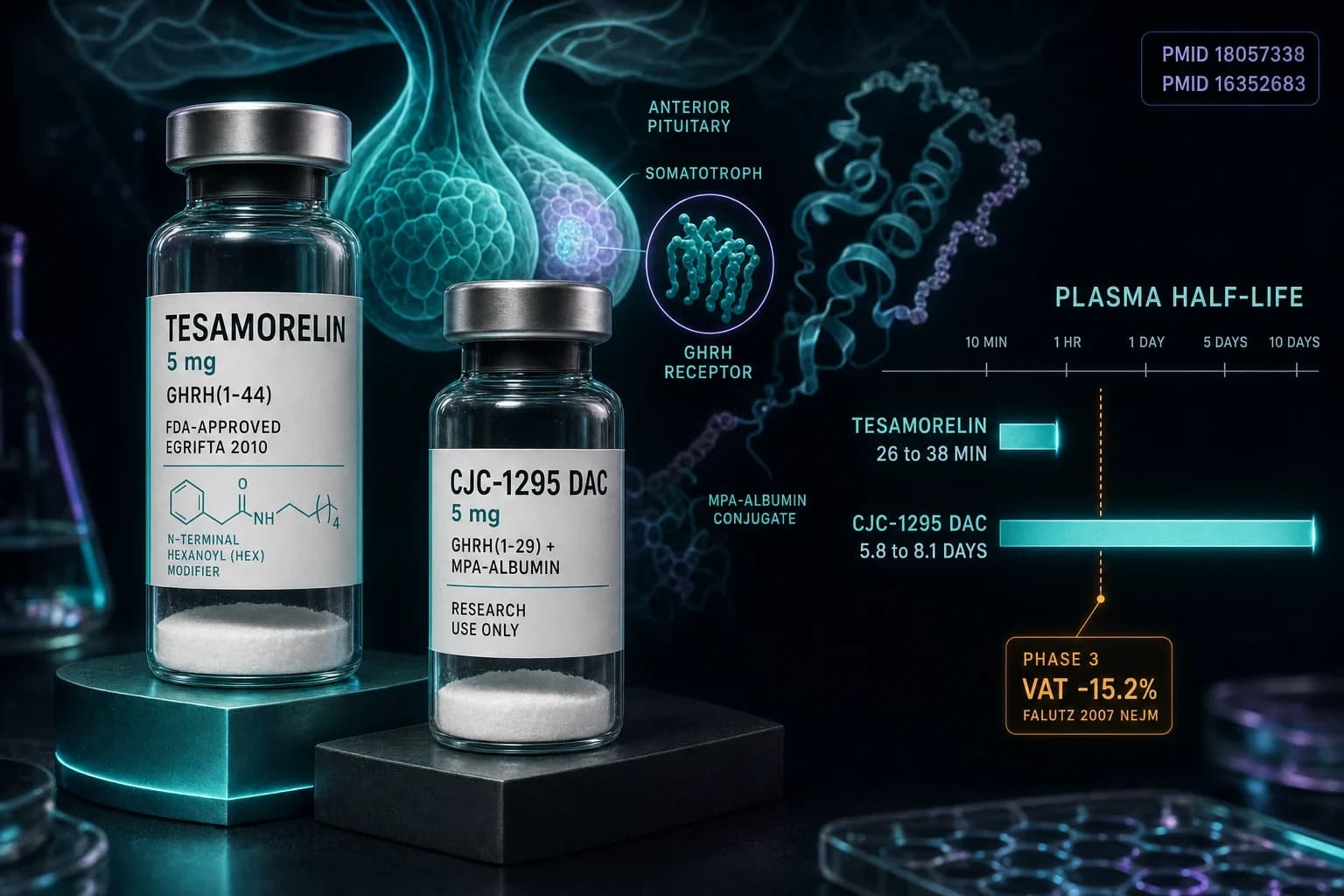
| Tesamorelin | GHRH analog (stabilized 1-44) | No | Low; label documents injection site reactions | FDA-approved for HIV-associated visceral fat |
| Hexarelin | GHRP | Yes, small cortisol and prolactin rise | Low | Older GHRP, cortisol signal is real |
The full three-way sermorelin vs CJC-1295 vs ipamorelin comparison walks through the pharmacokinetics side by side. The short summary: sermorelin has the shortest half-life and the lowest fluid retention signal in the class. That is the tolerability profile people are usually reaching for when they pick it.
What to actually watch for on protocol
If sermorelin is being studied in a legitimate research or physician-supervised setting, three data points cover most of the risk-monitoring picture:
- Baseline and 8 to 12 week IGF-1. Should stay within the age-adjusted reference range. A big jump above that range means either the dose is too high or a concurrent GHRP is stacking too aggressively.
- Baseline and follow-up fasting glucose and A1c. Particularly if there is any pre-existing metabolic issue.
- Baseline TSH and free T4. To catch a subclinical thyroid problem that may be unmasked.
None of these are exotic. All three sit inside standard hormone panels. Our lab-tests library flags which peptides pair with which markers when a research protocol needs the reference set.
Bottom line, and where sourcing enters the safety story
Bottom line: The published side-effect signal on sermorelin is small compared to what its reputation borrowed from recombinant HGH. Injection site reactions are the expected event. Systemic effects are rare and dose-dependent. Contraindications are short but real. What actually breaks the profile in practice is impure product, wrong reconstitution, or stacking sermorelin with a DAC-modified CJC or aggressive GHRP that removes the physiologic ceiling that makes sermorelin tolerable in the first place.
The sourcing point matters and is worth stating directly. Adverse events in research-peptide land are more often caused by contaminated or mis-dosed vials than by the molecule itself. Buying from vendors that publish third-party COAs, use FDA-registered peptides, and test batches by HPLC and mass spec is the single biggest safety lever a research protocol has. Our Ascension Peptides review walks through what a defensible COA library actually looks like, and code ENHANCED puts sermorelin at 50% off there. For readers who want the honest research profile of the molecule before or after the tolerability question, the sermorelin GHRH(1-29) clinical research guide sits next to this piece, and the sermorelin before-and-after page covers what the outcome studies actually reported alongside the safety data reviewed here.
This article is for research and educational purposes only. It is not medical advice and does not establish clinical efficacy. Sermorelin was voluntarily discontinued as a commercial product in 2008. Use of research peptides outside of an approved clinical study or physician-supervised setting is subject to local law. Consult a qualified clinician before pursuing any hormone-axis intervention, especially in the presence of malignancy, pregnancy, diabetes, thyroid disease, or pituitary dysfunction.