At a glance
- Direct CJC-1295 human safety data comes almost entirely from one Phase 1 trial (Teichman 2006, PMID 16352683), no serious adverse events reported.
- Injection site reactions are the most common finding, mild and self-limiting, mirroring 25% incidence seen in tesamorelin Phase 3 (PMID 20554713).
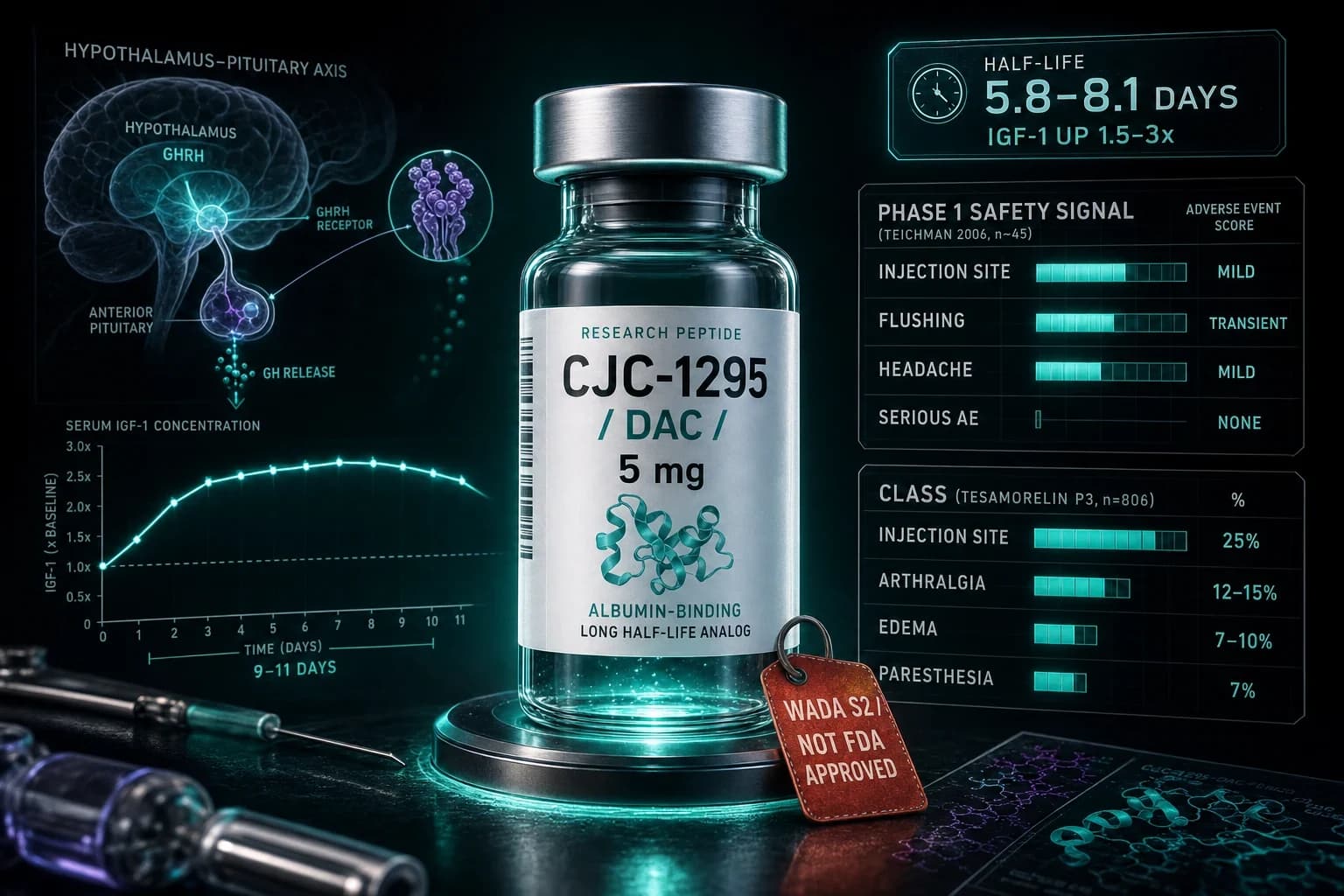
- CJC-1295 with DAC produces a 5.8 to 8.1 day half-life and 7.5-fold trough GH elevation, so its AE pattern resembles sustained GH excess more than pulsatile release.
- GHRH-class fluid retention side effects (arthralgia, edema, paresthesia, carpal tunnel) appear in 5 to 18% of patients on GH therapy (Molitch 2011 CPG, PMID 21602453).
- CJC-1295 is unapproved for any indication and remains on the WADA prohibited list under S2 at all times.
Most articles on CJC-1295 side effects lean on generic growth hormone safety copy. The primary human trial for CJC-1295 itself is a single 2006 Phase 1 study in about 45 healthy adults (Teichman et al. (2006)). Everything else you will read about CJC-1295 side effects is either extrapolated from that trial, borrowed from the closest FDA-approved GHRH analog (tesamorelin), or inferred from the well-characterized adverse-event profile of recombinant growth hormone therapy.
This piece grades each side effect against that evidence hierarchy: what CJC-1295 itself has actually shown in humans, what the drug class has shown in Phase 3, and what remains speculative. If a claim is not attached to a study or a mechanism, it does not belong in a safety article about a peptide most of your audience will never see inside a physician's office.
Where CJC-1295 side effect data actually comes from
CJC-1295 has never completed a Phase 2 or Phase 3 clinical program for any indication. ConjuChem shelved the program more than a decade ago after a safety signal in a separate diabetic peripheral neuropathy trial that used a related molecule. What remains, in descending order of evidence quality, looks like this.
| Evidence source | Strength | What it tells us about CJC-1295 side effects |
|---|---|---|
| Teichman et al. 2006 (PMID 16352683), Phase 1, n~45 | Direct human data | Dose-dependent GH and IGF-1 rises; no serious AEs; injection site pain and mild flushing most common |
| Ionescu and Frohman 2006 (PMID 17018654), n=11 | Direct human data | Pulsatile GH pattern preserved; trough GH up 7.5-fold; IGF-1 up 45% one week post-dose |
| Sackmann-Sala et al. 2009 (Growth Horm IGF Res) | Direct human data | Serum protein shifts after single CJC-1295 dose in 11 healthy men; no clinical AE endpoint |
| Tesamorelin Phase 3 pooled analysis (PMID 20554713), n=806 | Class analog | Injection site reactions in ~25%; arthralgia, myalgia, peripheral edema, paresthesia |
| Endocrine Society CPG on adult GH deficiency (PMID 21602453) | Downstream class | Fluid retention cluster in 5 to 18% on GH; carpal tunnel in ~2% |
| Community reports (Reddit, forums) | Anecdotal | Directional only; useful for tolerability language, not for causal claims |
Nothing else exists that is worth citing. Vendor pages that quote specific incidence percentages for CJC-1295 are almost always pulling from tesamorelin or somatropin trials without saying so.
What the Teichman Phase 1 trial actually reported
The Teichman group ran two randomized, placebo-controlled, double-blind, ascending-dose studies in healthy adults, ages 21 to 61, at two investigational sites. Doses spanned 30 to 250 mcg/kg subcutaneously. Study durations were 28 and 49 days. Findings that matter for a safety article:
- Estimated CJC-1295 half-life: 5.8 to 8.1 days.
- Mean plasma GH rose 2 to 10-fold for 6 days or longer after a single dose.
- Mean plasma IGF-I rose 1.5 to 3-fold for 9 to 11 days.
- After multiple doses, mean IGF-I stayed above baseline for up to 28 days.
- No serious adverse reactions in any dose arm.
- Investigators characterized the drug as "safe and relatively well tolerated," particularly at 30 or 60 mcg/kg.
- The most common adverse events were localized to the injection site (transient pain, redness, mild swelling) and were mild.
That is the entire direct human safety database for CJC-1295. Sample size in the low double digits per arm, dose exposure of a few months, no long-term follow-up, no cancer or cardiovascular endpoints, and every subject metabolically healthy at baseline. Any statement about long-term CJC-1295 safety in humans is extrapolation.
Bottom line: The Phase 1 dataset supports one honest claim: at doses of 30 to 60 mcg/kg for up to 49 days in healthy adults, CJC-1295 caused mild, injection-related adverse events and elevated GH and IGF-1 as expected. It does not answer whether five years of weekly research use is safe.
Why DAC vs no-DAC changes the side effect conversation
CJC-1295 exists in two forms, and lumping them together is how most safety writing goes wrong.
CJC-1295 with DAC (the drug affinity complex) binds covalently to serum albumin. Half-life is 5.8 to 8.1 days (Teichman et al. (2006)). Trough GH stays elevated for a week or longer after a single dose. Ionescu and Frohman found trough GH rose 7.5-fold and total GH secretion plus IGF-I increased 45% one week post-injection, while native pulsatility was preserved (Ionescu and Frohman (2006)).
Modified GRF 1-29 (CJC-1295 without DAC) carries the same four amino acid substitutions but no albumin anchor. Half-life is roughly 30 minutes. It produces a discrete GH pulse and clears. Effectively, this is short-acting sermorelin-analog territory.
Those pharmacokinetics translate directly into different adverse-event risk. Sustained IGF-1 elevation is the mechanism behind almost every "GH side effect" in the classical literature. The DAC form pushes IGF-1 above baseline for weeks; the no-DAC form does not. That is why the CJC-1295 with DAC vs modified GRF 1-29 comparison matters for a safety discussion, not just a dosing one. If you are reading trial-data extrapolations from tesamorelin (once-daily, sustained GH axis activation), those map to CJC-1295 with DAC. They do not map cleanly to no-DAC.
The closest FDA-approved analog: tesamorelin Phase 3 data
Tesamorelin is a stabilized GHRH(1-44) analog and the only GHRH analog with a completed Phase 3 program and FDA approval. Its trial data is the best proxy for what sustained CJC-1295 dosing would look like at scale.
The pooled Phase 3 analysis randomized 806 HIV-associated lipodystrophy patients 2:1 to tesamorelin 2 mg subcutaneously daily or placebo, with a 26-week primary phase and a 26-week safety extension (Falutz et al. (2010)). Injection site reactions were the most frequent adverse event, at roughly 25% versus 9% in placebo. Most were mild. The pivotal Phase 3 trial published earlier in NEJM tracked the same pattern in 412 patients over 26 weeks (Falutz et al. (2007)), and the 52-week extension identified no new adverse events.
Real-world class-level side effects to keep in mind when interpreting CJC-1295 tolerability:
| Class-level side effect | Approximate incidence on tesamorelin 2 mg/day | Mechanism |
|---|---|---|
| Injection site reaction | ~25% | Local subcutaneous irritation; peptide plus vehicle |
| Arthralgia | 12 to 15% | Fluid retention around joints from GH/IGF-1 axis activation |
| Myalgia | ~10% | Same mechanism as arthralgia; muscle-associated fluid shifts |
| Peripheral edema | ~7 to 10% | GH sodium and water retention |
| Paresthesia | ~7% | Fluid-related compression of peripheral nerves |
| Flushing | ~3 to 5% | GHRH direct vasodilation |
| Elevated fasting glucose | Small mean increase | GH-driven insulin resistance at supraphysiologic exposure |
Not every number transfers to CJC-1295 one for one. The HIV lipodystrophy cohort is not healthy young adults, tesamorelin dosing is daily rather than the twice-weekly pattern many CJC-1295 with DAC protocols use, and the two peptides differ by the amino acid substitutions and the DAC anchor. But the class signal is consistent: the risks scale with total AUC of GH and IGF-1 exposure, not with the specific analog.
The fluid retention cluster in plain terms
The Endocrine Society Clinical Practice Guideline on adult GH deficiency treatment characterizes the classic GH-driven side effect cluster as "fluid retention manifestations" (Molitch et al. (2011)). These are:
- Paresthesias (tingling, especially in the hands)
- Joint stiffness and arthralgias
- Peripheral edema (puffy hands, ankles)
- Myalgias
- Carpal tunnel syndrome in about 2% of adults on GH replacement
Incidence in the guideline is quoted at 5 to 18% for the cluster overall. Older patients, higher body weight, and female sex increase risk. Almost all of these effects are dose-dependent and improve with dose reduction. In self-experimentation with CJC-1295 with DAC, the same cluster shows up in community reports at high dose or long duration: hand tingling in the morning, rings feeling tight, a heavier feeling in the legs for the first two to four weeks. Reddit is not a data source, but the mechanistic story is coherent. Trough IGF-1 pushed above the physiologic range for weeks produces GH-like sodium and water retention, which produces the fluid-retention cluster.
Practical implication for anyone titrating: start low, hold the dose, watch the hands. If a research protocol layers CJC-1295 with DAC on top of another GH-axis compound like MK-677 or ipamorelin, the fluid-retention risk goes up because IGF-1 exposure stacks. The classic CJC-1295 with ipamorelin stack protocol is popular because the combination amplifies GH pulses, and that amplification comes with amplified side effect risk if the doses are pushed.
IGF-1 elevation, insulin resistance, and what to actually monitor
GH raises IGF-1. IGF-1 promotes protein synthesis, drives some of the recovery benefits people are looking for, and also, at supraphysiologic levels for long periods, produces insulin resistance and theoretical concerns about tissue growth. That is why oncology and endocrinology take chronic IGF-1 excess seriously.
Concrete numbers matter here. In healthy adults, a single CJC-1295 dose raised IGF-1 by 1.5 to 3-fold and held it elevated for 9 to 11 days. Multiple doses kept IGF-1 above baseline for up to 28 days (Teichman et al. (2006)). That is meaningfully higher than physiologic and is the biological mechanism connecting CJC-1295 to the same fluid-retention profile seen with GH itself.
Insulin resistance is the pharmacology-consistent metabolic concern. The tesamorelin Phase 3 program did not show clinically meaningful glucose parameter differences at week 26 or 52 in the HIV-lipodystrophy population (Falutz et al. (2010)), but that is a specific cohort with specific baseline metabolism. Anyone using a research protocol in a non-clinical setting has no such reassurance and should treat elevated fasting glucose, worsening HOMA-IR, or new hyperglycemia symptoms as a signal to stop.
Objective research-setting checks worth keeping:
- Baseline fasting glucose and HbA1c, repeated at week 6 to 8
- Baseline IGF-1, repeated at the same interval
- Baseline blood pressure, weight, and hand circumference for edema tracking
- Independent-lab COAs for the vial itself (peptide identity, purity, endotoxin)
For lab-side verification, our lab-tests library covers third-party COAs across common research peptides. Trusting the vial is a prerequisite to interpreting any personal side-effect data at all.
Injection site reactions in practice
Local reactions are the most common side effect at every level of evidence, from Teichman's Phase 1 to tesamorelin's Phase 3 to community reports. What that means at the syringe end:
- Redness or a raised welt at the site, usually within an hour and gone within a day. Mild and expected.
- Transient stinging on injection, often more pronounced with acidic reconstitution. Warming the vial to room temperature and using bacteriostatic water reduces this.
- Firm subcutaneous lump that resolves over a few days. Rotate sites (abdomen, quadriceps) to avoid layering doses on the same tissue.
Reconstitution is where a lot of self-reported "side effects" actually originate. Under-diluted vials produce more concentrated subcutaneous doses per unit and more local irritation; incorrect mixing (vigorous shaking, wrong volume of diluent) can degrade the peptide. Our reconstitution calculator and the step-by-step reconstitution guide handle the math without leaving room for user error.
Where the evidence gets thin
Three questions get asked constantly and cannot be answered honestly from current data.
Long-term cancer risk. IGF-1 is a mitogen and epidemiologic data link the upper physiologic IGF-1 range to modestly higher rates of certain cancers over decades. No prospective trial of CJC-1295 has followed enough people for long enough to say what chronic use does. The mechanistic concern is real. The direct evidence is absent.
Cardiovascular effects. GH excess in acromegaly is associated with cardiomyopathy over years to decades. CJC-1295 dosing in trials never approached that duration, and the population studied was small and metabolically healthy. Extrapolation to long-term twice-weekly CJC-1295 with DAC use is not supported by data in either direction.
Rare hypersensitivity. Reports exist in community sources of hives, itching, and one-off allergic reactions after CJC-1295 administration. These have not been characterized in trials. Any true allergic reaction (throat tightness, generalized urticaria, breathing changes) is a reason to stop immediately and seek medical care.
Compared to ipamorelin, sermorelin, and tesamorelin
Selectivity is the reason most GHRP protocols pair a GHRH analog like CJC-1295 with a selective ghrelin agonist. Ipamorelin was designed to release GH without raising ACTH, cortisol, or prolactin, and swine data at doses 200-fold above the ED50 for GH release confirmed that clean profile (Raun et al. (1998)). Stacking a selective GHRP with CJC-1295 concentrates the side-effect risk into the GH/IGF-1 axis itself and away from adrenal and lactotroph effects. That is why the full stack comparison matters when reading protocols.
Sermorelin is GHRH(1-29) with no half-life extension. Its side effect profile parallels CJC-1295 no-DAC: local injection reactions, transient flushing, occasional mild headache; fluid-retention cluster is less common because the IGF-1 exposure never sustains. The sermorelin side effects breakdown covers that comparison directly. Tesamorelin is the closest thing to CJC-1295 with DAC in class and dosing pattern, and its trial data (above) is the best available proxy for sustained CJC-1295 exposure.
The regulatory and sport-testing reality
CJC-1295 is not approved by the FDA for any human indication. It is sold under the "research chemical" label with a research-purposes-only requirement, and it is explicitly named on the World Anti-Doping Agency Prohibited List under Section S2.2.4 (Growth Hormone Releasing Factors), banned at all times, in and out of competition. For anyone subject to sport-federation, military, or workplace testing, a positive test for CJC-1295 or its metabolites carries the same consequences as any other prohibited GH secretagogue. That is not a side effect of the molecule. It is a side effect of using it in the wrong context.
Sourcing quality is a safety question
A lot of what people call "CJC-1295 side effects" is actually a side effect of the vial they injected, not the peptide. Underdosed vials, endotoxin contamination, and mislabeled sequences produce local reactions and systemic symptoms that get misattributed to the peptide itself. Independent COAs (HPLC identity, mass spec, LAL endotoxin) at 98% or higher purity are the minimum standard worth accepting, which is why the Ascension Peptides vendor audit exists on this site and is the single page most readers actually convert on.
Injectable research peptides including CJC-1295, Ipamorelin, Tesamorelin, and Sermorelin are available from Ascension Peptides with 50% off using code ENHANCED. Independent COAs are published per lot. For dosing calibration, our CJC-1295 dosage chart and the reconstitution calculator handle the math without leaving room for concentration errors that show up as "side effects" in first-time protocols.
Bottom line
Bottom line: Direct CJC-1295 safety evidence is thin: one Phase 1 trial in about 45 healthy adults, no serious adverse events, most reactions local and mild. The rest of what gets called "CJC-1295 side effects" is extrapolation from the GHRH-analog class (tesamorelin Phase 3) and from recombinant GH itself, and it centers on a fluid-retention cluster (edema, arthralgia, paresthesia, carpal tunnel) that scales with sustained IGF-1 elevation. The DAC form drives that IGF-1 exposure; the no-DAC form does not.
For side-by-side pharmacology and reconstitution, see the CJC-1295 compound page and the dosage chart. For the DAC-vs-no-DAC decision, the dedicated comparison walks through half-life, pulsatility, and protocol implications. For lab-verified vendor sourcing, the Ascension Peptides review is the primary trust reference on this site.
This article is for research and educational purposes only. It is not medical advice, and no content here should be used to diagnose, treat, or prevent any condition. CJC-1295 is not approved by the FDA for human use and is prohibited by WADA. Consult a qualified physician before making any decisions related to peptides, hormones, or health.