At a glance
- VENTURE Phase 2 subcutaneous (Bays et al. Obesity 2026, PMID 41508550): 14.7% mean weight loss at 13 weeks on 17.5 mg vs 1.6% on placebo across 176 adults
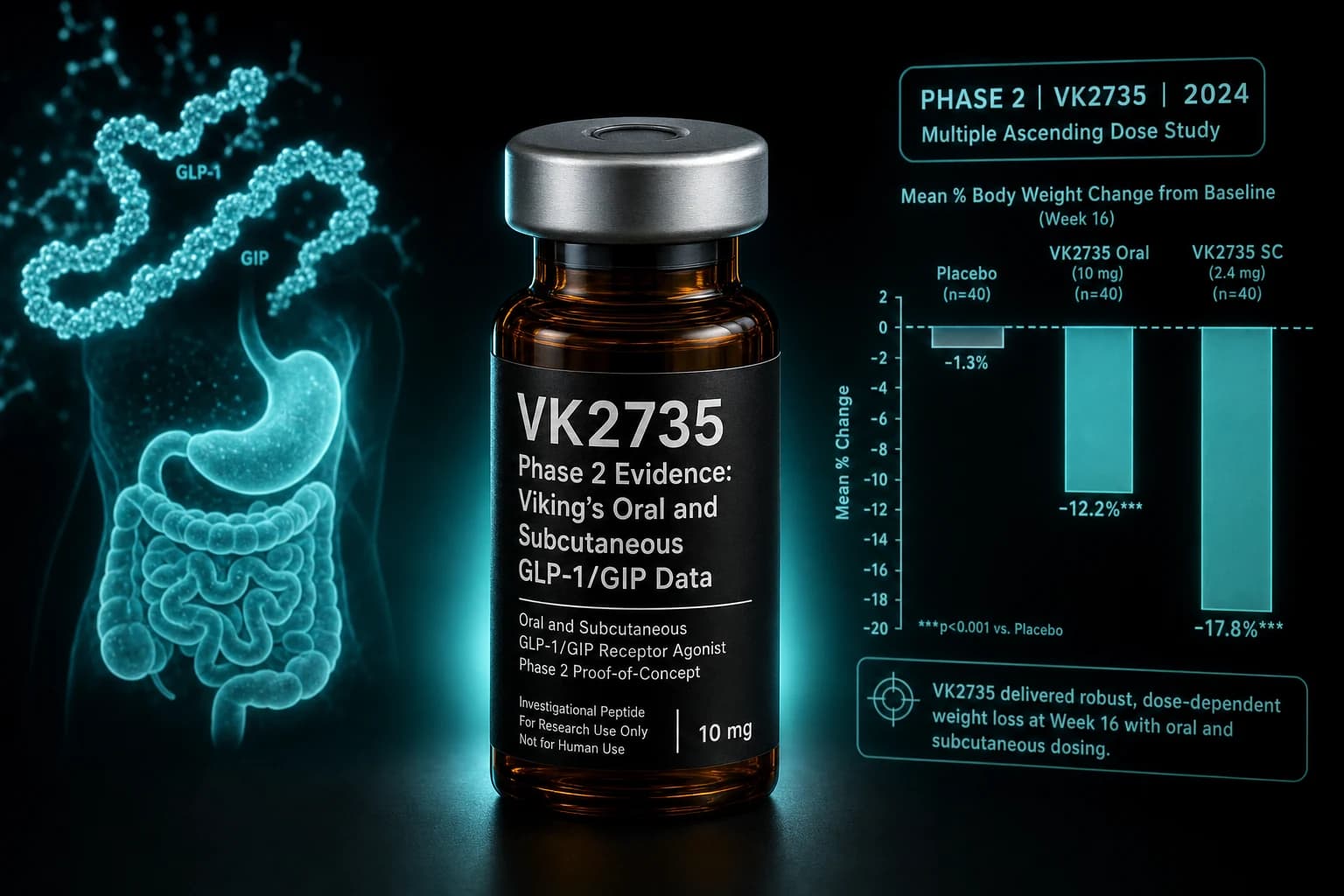
- VENTURE-Oral Phase 2 (ECO 2026): 12.2% mean weight loss at 13 weeks on 120 mg daily tablets, with 80% of patients losing at least 10%
- VK2735 binds GLP-1R (IC50 188 nM) and GIPR (IC50 325 nM), the same dual mechanism as tirzepatide but with a different chemical scaffold
- Phase 3 VANQUISH-1 (~4,650 obese adults) and VANQUISH-2 (~1,000 T2D + obese) are fully enrolled, both running 78-week treatment periods
- No head-to-head trial against tirzepatide, semaglutide, or orforglipron exists; FDA approval, if Phase 3 succeeds, is unlikely before 2028
Viking Therapeutics is doing something none of its larger rivals have published: running the same dual GLP-1/GIP receptor agonist as both a once-weekly subcutaneous injection and a daily oral tablet, in parallel Phase 2 trials with double-digit weight loss at 13 weeks. The VENTURE subcutaneous data are published in Obesity, the VENTURE-Oral data were presented at the European Congress on Obesity in May 2026, and the Phase 3 VANQUISH program is already fully enrolled on the subcutaneous side.
This article covers what VK2735 is, the 13-week Phase 2 data for both formulations, how it lines up against tirzepatide and semaglutide on the same time horizon, the open questions a 13-week trial cannot answer, and what the Phase 3 VANQUISH design tells you about Viking's regulatory bet.
What VK2735 is
VK2735 is a synthetic peptide that activates both the GLP-1 receptor and the GIP receptor, the same dual receptor profile as tirzepatide. Viking's preclinical disclosures put in vitro potency at IC50 188 nM at the human GLP-1 receptor and IC50 325 nM at the human GIP receptor. In diet-induced obese mice, the molecule produced more weight loss than equimolar semaglutide, consistent with the GIP-component hypothesis that tirzepatide later confirmed in humans.
The chemical scaffold is distinct from tirzepatide. Viking has not disclosed the full sequence, but the molecule was licensed from a Salk-affiliated discovery effort and is structurally separate from Lilly's compound. The clinical question is narrow: does Viking's specific molecule deliver comparable efficacy with acceptable tolerability, in a competitive formulation set, with manufacturing economics that allow scale. Dual GLP-1/GIP agonism produces weight loss in humans. SURPASS-2 and SURMOUNT-1 settled that question for the class. VK2735 has to clear the same bar with its own data.
VK2735 entered Phase 1 in early 2022 with subcutaneous dosing. Viking added an oral tablet formulation to the development program shortly afterward, completed a Phase 1 oral study with a weight signal at higher doses, and then ran Phase 2 trials of both formulations in parallel.
Bottom line: VK2735 is a dual GLP-1/GIP receptor agonist in the same mechanistic class as tirzepatide, with both subcutaneous and oral Phase 2 data through May 2026.
VENTURE Phase 2 subcutaneous (Bays et al. Obesity 2026)
The VENTURE Phase 2 trial randomized 176 adults with obesity (BMI at least 30) or overweight (BMI at least 27 with at least one weight-related comorbidity) to once-weekly subcutaneous VK2735 at 7.5 mg, 12.5 mg, or 17.5 mg, or placebo, for 13 weeks. Participants started at 2.5 mg with weekly dose escalation. The primary endpoint was percent change in body weight at week 13 (Bays et al., Obesity 2026, PMID 41508550).
Weight change at 13 weeks
| Arm | Mean weight change |
|---|---|
| Placebo | -1.6% |
| VK2735 7.5 mg | -11.7% |
| VK2735 12.5 mg | -13.3% |
| VK2735 17.5 mg | -14.7% |
Every active arm hit the primary endpoint. The 17.5 mg arm reached 14.7% mean weight loss at 13 weeks with no sign of plateau. By comparison, tirzepatide 15 mg in SURMOUNT-1 was at roughly 6% weight loss at the 12-week mark mid-titration, before continuing on toward the 21% steady-state result at 72 weeks (Jastreboff et al., NEJM 2022, PMID 35658024). Semaglutide 2.4 mg in STEP 1 was on a slower titration trajectory at the same window (Wilding et al., NEJM 2021, PMID 33567185).
Cross-trial 13-week comparisons cannot prove VK2735 is more potent than tirzepatide. Trial design, dose-escalation speed, population, and estimand all differ. What the Phase 2 read does establish is that VK2735 produces weight loss in the same magnitude class as the leading dual agonist with no early-stage signal that the curve flattens at single digits.
Tolerability
Gastrointestinal adverse events drove the safety profile, as expected for the class. Nausea, vomiting, diarrhea, and constipation were the most common adverse events and were predominantly mild to moderate. Discontinuation rates due to adverse events were comparable to placebo in the 7.5 mg arm and somewhat higher in the top-dose arm. No new safety signals emerged beyond the GLP-1 class profile.
Bottom line: Subcutaneous VK2735 produced 11.7% to 14.7% weight loss at 13 weeks. Tolerability was consistent with the GLP-1 class. The dose-response curve had not flattened at 17.5 mg.
VENTURE-Oral Phase 2 (ECO 2026)
The VENTURE-Oral Phase 2 trial tested VK2735 as a once-daily oral tablet in 280 adults with obesity for 13 weeks. Five dose arms (30 mg, 60 mg, 90 mg, 120 mg, plus a flexible-titration arm) were tested against placebo. The 120 mg arm was the headline cohort. Results were presented at the European Congress on Obesity in Istanbul in May 2026.
Weight change at 13 weeks (top-line)
| Arm | Mean weight change |
|---|---|
| Placebo | -1.3% |
| VK2735 120 mg oral | -12.2% |
The 120 mg arm produced 12.2% mean weight loss at 13 weeks against 1.3% on placebo (placebo-adjusted difference -10.9 percentage points, p < 0.0001). Eighty percent of patients on the 120 mg dose lost at least 10% of body weight, and up to 97% lost at least 5%. Weight loss was progressive across all 13 weeks without a plateau, matching the subcutaneous trajectory.
For context on what 12% oral weight loss at 13 weeks means, the comparable oral GLP-1 data set is small. Oral semaglutide 50 mg in OASIS 1 produced 15.1% weight loss at 68 weeks (Knop et al., Lancet 2023, PMID 37385278). Orforglipron at the highest dose reached 12.4% weight loss at 72 weeks in ATTAIN-1. VK2735 oral matched the OASIS 1 magnitude on roughly one fifth of the timeline, although the cross-trial caveats apply with full force.
Tolerability and formulation notes
The oral safety pattern tracked the subcutaneous read. GI adverse events were the dominant category, were typically mild to moderate, occurred early in the dose escalation, and largely resolved with continued dosing. The exact discontinuation breakdown across doses is in the conference materials; the headline read was that the safety profile was consistent with the subcutaneous formulation and the broader GLP-1 class.
One mechanistic note matters for the oral story. Oral semaglutide is paired with the absorption enhancer SNAC, which produces low and variable bioavailability and a strict fasting administration window covered in our Rybelsus vs orforglipron guide. VK2735 tablets do not depend on SNAC technology, though Viking has not disclosed the full formulation. The fact that 120 mg oral can produce 12.2% weight loss at 13 weeks suggests the absorption profile is workable, but Phase 3 data and the eventual label will determine the actual user experience.
Bottom line: Oral VK2735 at 120 mg produced 12.2% weight loss at 13 weeks, the strongest oral GLP-1 weight-loss signal at that time window in any published trial. Phase 3 design and data will decide whether the formulation experience matches the efficacy.
How VK2735 stacks up at 13 weeks
Cross-trial 13-week comparisons should always be read with caveats. Different populations, titration schemes, prior weight-loss histories, and estimands change the headline number. With that caveat in front, here is the rough field at the 13-week mark.
| Drug | Class | Route | Approximate weight loss at ~13 weeks |
|---|---|---|---|
| Tirzepatide 15 mg | GIP/GLP-1 | SC weekly | ~6% (mid-titration toward 21% at 72 wk) |
| Semaglutide 2.4 mg | GLP-1 | SC weekly | ~5% (mid-titration toward 14.9% at 68 wk) |
| Retatrutide 12 mg | GIP/GLP-1/GCG | SC weekly | ~8% (titration toward ~25% at 80 wk) |
| VK2735 17.5 mg | GIP/GLP-1 | SC weekly | 14.7% (no plateau at 13 wk) |
| VK2735 120 mg | GIP/GLP-1 | Oral daily | 12.2% (no plateau at 13 wk) |
| Orforglipron 36 mg | GLP-1 | Oral daily | ~5-7% (titration toward 12.4% at 72 wk) |
A few honest observations on this table:
The 13-week window is unusually short for drawing efficacy conclusions about obesity drugs. Most published Phase 3 obesity trials run 68 to 80 weeks, with weight-loss curves still descending at the end. The VK2735 data look unusually high partly because the titration scheme was aggressive and partly because some of the comparator drugs were still ramping up at week 13.
A 78-week Phase 3 trial of VK2735 will determine where the eventual steady state lands. If the 17.5 mg subcutaneous arm continues on the same trajectory it showed at 13 weeks, the trial would produce class-leading numbers. If the trajectory flattens, the result lands in tirzepatide territory or below.
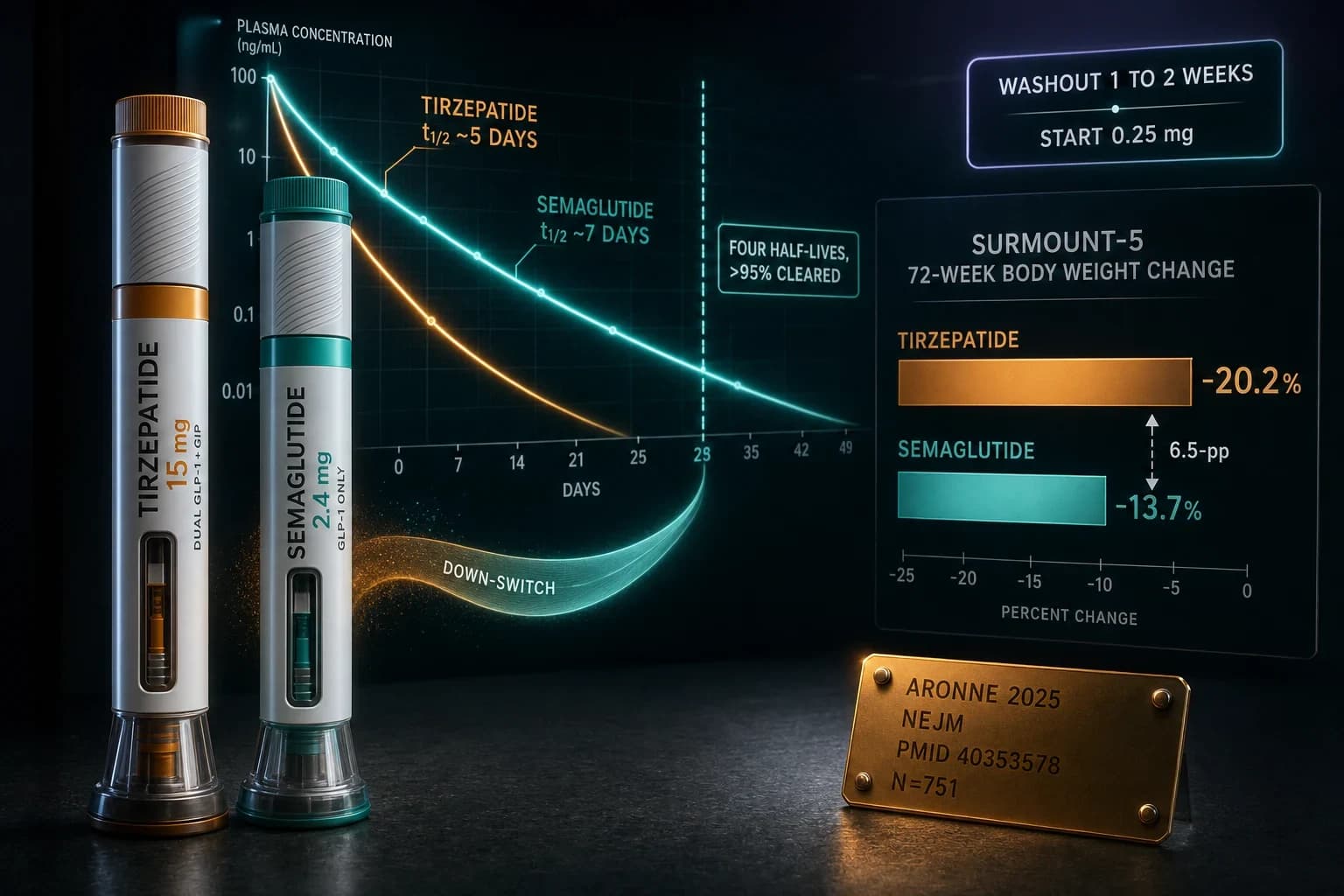
Head-to-head comparisons that would settle these questions have not been run. The closest direct comparison in the broader class is SURMOUNT-5, which showed tirzepatide produced 20.2% weight loss vs 13.7% on semaglutide at 72 weeks (Aronne et al., NEJM 2025, PMID 40353578). No equivalent VK2735 vs tirzepatide trial exists or has been announced.
For oral GLP-1 context, see our orforglipron Phase 3 evidence guide. The broader 2026 dose-response across the GLP-1 class sits in our GLP-1 dosing comparison 2026. Class mechanism background is in our tirzepatide vs semaglutide SURMOUNT-5 head-to-head article and the MariTide GIP antagonism deep dive.
Why two formulations
Most large pharma weight-loss programs commit to a single formulation early. Lilly took tirzepatide subcutaneous-only into the SURMOUNT program, then started orforglipron as a separate oral GLP-1 with a different chemical scaffold. Novo did the opposite: built out semaglutide as both injectable Wegovy and oral Rybelsus from a common molecule, but routed them through different regulatory pathways at different doses.
Viking's approach with VK2735 is to run the same molecule as both an injectable and an oral, with both formulations advancing through Phase 2 into separate Phase 3 plans. The strategic logic is straightforward. Patient preference research consistently shows a substantial fraction of weight-loss patients prefer oral dosing if efficacy is comparable. If subcutaneous VK2735 lands at tirzepatide-class efficacy and oral VK2735 lands at orforglipron-or-better efficacy with a workable administration window, Viking has a two-formulation franchise without licensing additional chemistry.
The trade-offs are real. Oral GLP-1 manufacturing at scale is harder than subcutaneous manufacturing, which is harder than small-molecule manufacturing. Tirzepatide and semaglutide already face supply constraints that compounding pharmacies have stepped into. Any oral GLP-1 program faces a supply-chain build before it can hit Phase 3 readouts at the dose levels VK2735 tested. The injectable vs oral peptides bioavailability guide covers the broader formulation economics.
The Phase 3 VANQUISH program
Viking moved VK2735 into Phase 3 in 2025 for the subcutaneous formulation. Two trials are enrolled.
| Trial | Population | Size | Duration | Status |
|---|---|---|---|---|
| VANQUISH-1 | Adults with obesity (BMI at least 30) or overweight plus comorbidity | ~4,650 | 78 weeks | Enrollment complete (Nov 2025) |
| VANQUISH-2 | Adults with type 2 diabetes plus obesity | ~1,000 | 78 weeks | Enrollment complete (Mar 2026) |
Both trials are randomized, double-blind, and placebo-controlled. The primary endpoint is percent change in body weight at week 78 in VANQUISH-1, with HbA1c and body weight as co-primary in VANQUISH-2. The dose ladder uses the 7.5, 12.5, and 17.5 mg subcutaneous doses tested in VENTURE Phase 2.
The oral formulation is on a separate Phase 3 track and was not in full Phase 3 enrollment as of May 2026. Viking has indicated the oral Phase 3 program will follow the subcutaneous one, with the VENTURE-Oral 13-week data informing dose selection.
Topline VANQUISH-1 data are expected in mid to late 2027 based on the 78-week treatment window plus follow-up. FDA approval, if Phase 3 succeeds, lands no earlier than 2028. There is no realistic 2026 catalyst for VK2735 approval.
What is still unknown
Five open questions before the VANQUISH data:
-
Does the 13-week trajectory continue? The big efficacy question is whether the no-plateau pattern at week 13 holds out to week 78. If yes, the registrational number could approach or exceed the SURMOUNT-1 ceiling. If the trajectory flattens, VK2735 lands in tirzepatide territory or below.
-
What is the long-term tolerability profile? GI adverse events at week 13 are not the same as GI adverse events at week 52 or week 78. The pattern in the published GLP-1 class is that GI symptoms attenuate over time, but discontinuation rates due to adverse events vary considerably across trials and populations.
-
How does muscle preservation look? Phase 2 trials at 13 weeks do not run DEXA-based body composition analyses. Tirzepatide and semaglutide both produce meaningful lean mass loss alongside fat mass loss, and whether VK2735 has a different ratio is unanswered. The GLP-1 muscle loss research covers the class baseline.
-
What is the durability after discontinuation? No discontinuation data exist for VK2735. The pattern across the GLP-1 class is meaningful weight regain within 12 months of stopping, covered in the stopping GLP-1 weight regain research. Whether VK2735 follows the same curve is not measurable from current data.
-
How does the oral formulation perform at scale? The 120 mg daily oral dose performed well in 280 patients at 13 weeks. The Phase 3 oral program will determine whether absorption variability, food effects, or co-administration constraints emerge at scale.
Tip: When tracking a pipeline molecule like VK2735, the next data inflection is the first Phase 3 interim look. Topline VANQUISH-1 sets the registrational efficacy number. Everything before that is hypothesis-generating, even if the hypothesis is supported by a 14.7% Phase 2 result.
Sourcing notes
VK2735 is not available as a research-grade compound as of May 2026. It is in active Viking Therapeutics clinical development with sponsor exclusivity. No reputable research peptide vendor produces or distributes it, and any vendor advertising "VK2735" should be treated with skepticism. The molecule's full sequence has not been publicly disclosed.
Researchers working with the closest available compound in the dual GLP-1/GIP class can source tirzepatide from Ascension Peptides with public per-batch COAs and 50% off using code ENHANCED. For GLP-1 monotherapy comparison work, semaglutide is also available from Ascension with the same code. For oral GLP-1 research, Limitless Biotech carries oral semaglutide and related oral peptides with code ENHANCED.
FAQ
What is VK2735?
VK2735 is a synthetic peptide that activates both the GLP-1 and GIP receptors, the same dual receptor profile as tirzepatide. It is being developed by Viking Therapeutics as both a once-weekly subcutaneous injection and a once-daily oral tablet for the treatment of obesity and type 2 diabetes.
Is VK2735 better than tirzepatide?
No head-to-head trial has been published. The Phase 2 13-week data show VK2735 17.5 mg producing 14.7% weight loss, which is higher than tirzepatide's typical 13-week titration result, but Phase 3 data at 78 weeks will determine where steady-state efficacy lands. Cross-trial comparisons at different time windows and dose ladders are not a reliable basis for ranking molecules.
When will VK2735 be approved?
FDA approval, if Phase 3 succeeds, is unlikely before 2028. The subcutaneous Phase 3 program (VANQUISH-1 and VANQUISH-2) completed enrollment in late 2025 and early 2026, and the trials run 78-week treatment windows. Topline data are expected in 2027.
Is the oral version as effective as the injection?
At 13 weeks, oral VK2735 120 mg produced 12.2% weight loss and subcutaneous VK2735 17.5 mg produced 14.7%. The oral formulation is on a separate Phase 3 track. Whether the relative efficacy ranking holds at 78 weeks is unknown.
Where can I buy VK2735?
VK2735 is not available as a research-grade compound from any vendor. It is in active clinical development under Viking Therapeutics sponsor exclusivity. Vendors advertising VK2735 are not selling the disclosed molecule.
This article is for educational and research purposes only. It summarizes Phase 2 clinical trial data and pre-clinical pharmacology for an investigational compound. VK2735 is not FDA-approved, not EMA-approved, and not available outside of clinical trials as of May 2026. Trial results described here reflect what was measured under controlled 13-week conditions and do not establish efficacy or safety for any individual outside of those trials. Long-term safety, durability after discontinuation, and outcomes in populations excluded from the Phase 2 trials are not yet characterized. Doses described here are what the published literature and the European Congress on Obesity conference materials tested, not protocols or recommendations.