At a glance
- VISTA (obesity, 36 wks): 11.8% weight loss at 75 mg vs 0.6% placebo
- SOLSTICE (T2D, 26 wks): HbA1c -1.88% at 75 mg vs -0.15% placebo, 7.7% weight loss
- Once-daily oral small molecule, no food or fluid restrictions
- No liver safety signal observed in either Phase 2 trial
- Phase 3 program in obesity, T2D, cardiovascular, and kidney outcomes announced June 2026
The 36-week readout
On June 8, 2026, The Lancet simultaneously published two Phase 2 trials of elecoglipron (AZD5004 / ECC5004), AstraZeneca's once-daily oral small molecule GLP-1 receptor agonist. The data were presented two days earlier at the ADA 86th Scientific Sessions in Chicago.
The headline numbers:
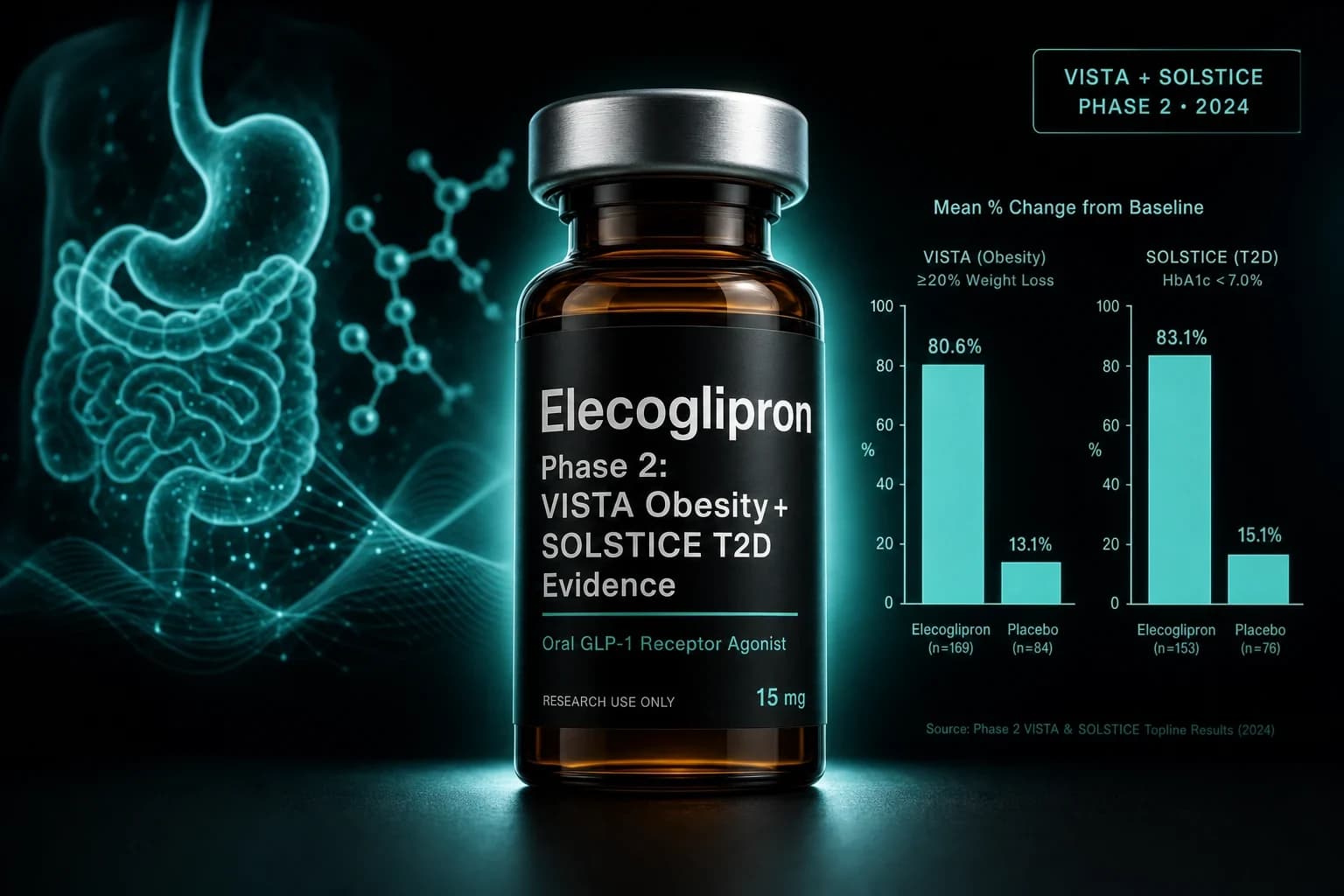
- VISTA (obesity, 310 adults without diabetes): 10.5% body weight reduction at 26 weeks and 11.8% at 36 weeks at the 75 mg dose, versus 0.6% with placebo (Davies et al., Lancet 2026, PMID 42259337).
- SOLSTICE (type 2 diabetes, 404 adults): HbA1c reduction of 1.88% at the 75 mg dose versus 0.15% with placebo, plus 7.7% body weight reduction at 26 weeks (Aroda et al., Lancet 2026, DOI 10.1016/S0140-6736(26)00802-0).
That puts elecoglipron in the same Phase 2 efficacy tier as Lilly's orforglipron, which is already FDA-approved for weight management as of April 2026. AstraZeneca announced the same day that elecoglipron will move into a full Phase 3 program covering obesity, type 2 diabetes, cardiovascular outcomes, and kidney outcomes.
Three things make this readout matter:
- It is the second small-molecule oral GLP-1 to clear a credible Phase 2 weight bar. The first, orforglipron, did 12.4% at 72 weeks in ATTAIN-1. Elecoglipron did 11.8% in less than half the time. Direct comparison is unfair, but the trajectory is there.
- No liver safety signal was observed in either trial. That matters because Pfizer's danuglipron program died in April 2025 after a drug-induced liver injury case in dose optimization. Elecoglipron is the first oral small-molecule GLP-1 to clear a Phase 2b readout after that precedent without a liver flag.
- No food or fluid restrictions. Unlike oral semaglutide (Rybelsus), which requires a fasted state and 30 minutes of waiting before food or other drugs, elecoglipron is dosed without any of that. If Phase 3 holds up, this becomes the practical differentiator versus the only currently-marketed oral GLP-1.
Bottom line: Elecoglipron is now the second small-molecule oral GLP-1 to show real Phase 2 efficacy without a liver flag. The trial-vs-trial weight numbers track with orforglipron's Phase 2. Practical convenience may be the bigger story if Phase 3 confirms.
What elecoglipron actually is
Elecoglipron started life as ECC5004, an oral small-molecule GLP-1R agonist discovered by Eccogene. AstraZeneca licensed global rights ex-China in November 2023, then advanced the program into Phase 2b through 2024 and 2025.
Mechanically, the compound is a Gs-biased partial agonist at the human GLP-1 receptor. It binds with high affinity (IC50 ~2.4 nM), drives cAMP signaling in beta cells with low-nanomolar potency (EC50 ~2-6 nM in HEK293 and beta-cell GSIS assays), but shows minimal β-arrestin recruitment and limited receptor internalization. The first-in-human paper covers the non-clinical pharmacology and a Phase 1 single-ascending-dose (1 to 300 mg in healthy volunteers) plus multiple-ascending-dose (5, 10, 30, 50 mg for 28 days in T2D patients) study (Haggag et al., Diabetes Obes Metab 2025;27(2):551-562, PMID 39495140).
The pharmacology has three practical implications:
- Once-daily oral dosing. Plasma half-life is consistent with single daily exposure, and the biased signaling profile is the same mechanistic strategy Lilly used with orforglipron.
- No fasting requirement. Unlike the peptide-based oral semaglutide, which uses the SNAC absorption enhancer and requires a fasted stomach plus 30 minutes before any food or fluid, elecoglipron is a small molecule with passive absorption. The Phase 2 trials dosed it without timing restrictions.
- No injection. This is the entire commercial thesis for small-molecule oral GLP-1s. Most patients prefer pills. The question has always been whether oral can match injectable efficacy without a safety penalty.
For context on why an oral small-molecule beats peptide-based oral semaglutide on convenience, see injectable vs oral peptide bioavailability and oral semaglutide vs orforglipron.
VISTA: the obesity Phase 2
VISTA enrolled 310 adults with obesity or overweight plus at least one weight-related comorbidity, with no diabetes. Sites were in Australia, Canada, Germany, Japan, Taiwan, the UK, and the USA. Participants were randomized to elecoglipron (range of doses up to 75 mg daily) or placebo, with the primary endpoint at 26 weeks and continued treatment to 36 weeks (Davies et al., Lancet 2026, PMID 42259337).
The efficacy:
| Endpoint | 75 mg elecoglipron | Placebo |
|---|---|---|
| Body weight change at 26 weeks | -10.5% | -0.6% |
| Body weight change at 36 weeks | -11.8% | (per published data) |
| Placebo-adjusted weight loss at 26 weeks | ~9.9 percentage points | reference |
The weight curve had not flattened at week 36, which is consistent with the Phase 2 patterns seen with tirzepatide SURMOUNT-5 vs semaglutide and retatrutide TRIUMPH-1. Whether the slope holds through a 72-week Phase 3 timeline like ATTAIN-1 is the open question.
A few caveats worth surfacing:
- VISTA was placebo-controlled. There is no active comparator arm in the obesity trial. The 11.8% number is meaningful but not directly benchmarked against subcutaneous semaglutide (STEP-1 14.9% at 68 wks) or tirzepatide (SURMOUNT-1 20.9% at 72 wks at 15 mg, Jastreboff et al., NEJM 2022;387:205-216, PMID 35658024).
- Treatment duration was 36 weeks. STEP-1 dosed for 68 weeks. SURMOUNT-1 dosed for 72 weeks. Phase 3 will need to match those durations before head-to-head efficacy claims become reasonable.
- The 75 mg dose was the highest tested. Whether Phase 3 lands at 75 mg or pushes higher will depend on the dose-response curve, which the manuscript reports across a 5 mg to 75 mg range.
SOLSTICE: the type 2 diabetes Phase 2b
SOLSTICE randomized 404 adults with type 2 diabetes (HbA1c 7.0 to 10.5%) across nine countries: Canada, Germany, Hungary, Japan, Poland, Slovakia, Spain, the UK, and the USA. The trial used a three-arm design: elecoglipron 5 to 75 mg daily, placebo, and oral semaglutide 14 mg as an active comparator (Aroda et al., Lancet 2026, DOI 10.1016/S0140-6736(26)00802-0).
Including an active comparator is the more interesting design choice. Most Phase 2 trials in obesity and diabetes default to placebo only. SOLSTICE compared elecoglipron against the currently-marketed oral GLP-1 standard.
The primary endpoint was change in HbA1c at 26 weeks:
| Dose | HbA1c change at 26 wks | Weight loss at 26 wks |
|---|---|---|
| Elecoglipron 5 mg | -0.91% | (lower than 75 mg) |
| Elecoglipron 75 mg | -1.88% | -7.7% |
| Placebo | -0.15% | -1.7% |
Glycemic target attainment at the 75 mg dose was striking. 90% of participants reached HbA1c <7.0%, and 85% reached <6.5%. That is a near-ceiling response rate for a Phase 2b GLP-1 trial in T2D.
For an honest sense of scale, semaglutide 1.0 mg weekly subcutaneous in the SUSTAIN program produced HbA1c reductions of 1.5 to 1.8%. Oral semaglutide 14 mg in PIONEER 4 produced 1.2% HbA1c at 26 weeks (Pratley et al., Lancet 2019;394:39-50, PMID 31186120). Elecoglipron 75 mg at -1.88% lands above oral semaglutide 14 mg and at or above subcutaneous semaglutide on glycemic control, in a Phase 2 sample.
The weight loss numbers in T2D patients (7.7% at 26 weeks) are lower than VISTA (10.5% at 26 weeks). That gap is expected. People with T2D consistently lose less weight on GLP-1s than people without T2D. SURMOUNT-1 (no diabetes) hit 20.9% on tirzepatide while SURMOUNT-2 (with T2D) hit 14.7%. The pattern is consistent across the class.
Adverse events: the table that matters
Tolerability is where small-molecule oral GLP-1s have historically lost to peptide injectables. Danuglipron failed on a combination of high GI dropout (twice-daily dosing made it worse) and a single hepatotoxicity case. Orforglipron got through with a class-typical AE profile. Elecoglipron lands in the same range.
| Adverse event | VISTA 75 mg | VISTA placebo | SOLSTICE 75 mg | SOLSTICE placebo |
|---|---|---|---|---|
| Nausea | 55% | 20% | 37% | 3% |
| Constipation | 41% | 6% | 29% | 4% |
| Diarrhea | 35% | 25% | 21% | 15% |
| Vomiting | 29% | 5% | 18% | 1% |
A few things to read here:
- Nausea at 55% in VISTA is on the high end for a Phase 2 GLP-1 trial, but the dose ramp and the 75 mg ceiling are the relevant frame. Tolerability in Phase 3 will depend on titration strategy more than the absolute peak number.
- GI events in SOLSTICE were lower than in VISTA. That can happen because T2D patients tend to be older with slower titration plans, and because background medications shift the GI baseline.
- No liver safety signal was observed in either trial. Adverse events leading to discontinuation were uncommon. Hypoglycemia was uncommon in SOLSTICE and no serious hypoglycemia events were attributed to elecoglipron.
Warning: Phase 2 trials are not powered to detect rare safety signals. Pfizer's danuglipron liver injury case appeared in dose-optimization data, not in the early Phase 2b weight readouts. Phase 3 elecoglipron data should be the gating event for safety conclusions, not these two Phase 2 papers.
How elecoglipron stacks up against the oral GLP-1 field
There are now four small-molecule or peptide-based oral GLP-1 receptor agonists with credible human data, in different stages of development.
| Compound | Sponsor | Type | Status | Best weight loss readout |
|---|---|---|---|---|
| Oral semaglutide (Rybelsus) | Novo Nordisk | Peptide + SNAC absorption enhancer | Approved T2D, weight management filing | ~17% at 68 wks (OASIS-1, 50 mg) |
| Orforglipron | Eli Lilly | Small molecule, Gs-biased | FDA approved Apr 2026 (weight management) | 12.4% at 72 wks (ATTAIN-1, Wharton et al., NEJM 2025, PMID 40960239) |
| Elecoglipron (AZD5004) | AstraZeneca / Eccogene | Small molecule, Gs-biased | Phase 2 complete, Phase 3 starting | 11.8% at 36 wks (VISTA) |
| VK2735 oral | Viking Therapeutics | Peptide GLP-1/GIP dual | Phase 2 ongoing | ~8.2% at 28 days (Phase 1) |
| Danuglipron | Pfizer | Small molecule | Discontinued Apr 2025 | N/A (liver safety) |
The way to read this table: elecoglipron's 11.8% at 36 weeks is competitive with orforglipron's Phase 2 trajectory, and is likely on track to land in the 13 to 15% range over a 72-week Phase 3 if the slope holds. Whether it beats orforglipron, matches it, or undercuts it is the next two years of Phase 3 data.
The competitive question has shifted. The remaining issue for the category is which compound wins on access, dosing convenience, and combination potential, not whether small-molecule oral GLP-1s can work at all.
For a fuller competitive map of the GLP-1 pipeline, see GLP-1 amylin combination pipeline 2026 and the GLP-1 dosing comparison.
What the Phase 3 program actually covers
AstraZeneca's June 8, 2026 release names the Phase 3 program as broad rather than narrowly weight-focused. The planned trials cover:
- Obesity outcomes in adults with overweight or obesity, with or without T2D
- Glycemic outcomes in T2D, likely with active comparator design given the SOLSTICE precedent
- Cardiovascular outcomes in patients at high cardiovascular risk, analogous to SELECT for semaglutide and SURPASS-CVOT for tirzepatide
- Kidney outcomes in patients with chronic kidney disease, analogous to FLOW for semaglutide
The CV and kidney trials matter for two reasons. First, they signal AstraZeneca is positioning elecoglipron as a long-term cardiometabolic therapy rather than a niche obesity drug. Second, an oral GLP-1 with proven CV and kidney outcomes would be a meaningful competitive moat against semaglutide and tirzepatide, both of which have outcomes data but require injection.
Phase 3 readouts on a typical timeline land in 2028 to 2030. Regulatory filing assuming positive results would push approval to 2029 or 2030 at earliest.
What this readout actually changes
Three changes are downstream of June 8.
Lilly now has a credible competitor in the small-molecule oral GLP-1 category. Orforglipron has FDA approval and is in market for weight management. Elecoglipron now has a Phase 2 portfolio that justifies a serious Phase 3 spend. The category has moved from "Lilly plus pipeline" to "two-horse race" in 18 months. AstraZeneca's capital position and cardiometabolic franchise make them a credible second mover.
The danuglipron shadow is partially lifted, but not fully. Elecoglipron Phase 2 data showed no liver flag across 714 randomized participants. That is reassuring. It is not the same as showing a clean safety profile across the larger and longer Phase 3 exposure, which is what killed danuglipron specifically.
Oral semaglutide loses its monopoly faster than expected. Rybelsus is the only marketed oral GLP-1 today. Orforglipron arrived in April 2026. If elecoglipron filings land in 2029, the oral GLP-1 market will look very different by 2030, with at least three distinct mechanisms competing on convenience, efficacy, and price.
For now, the practical implication for people researching peptide options is that none of this is buyable or accessible outside a clinical trial. The catalog at Ascension Peptides covers approved and research-grade peptides including semaglutide, tirzepatide, retatrutide, and BPC-157 with 50% off using code ENHANCED. Oral alternatives like Rybelsus are available by prescription. Elecoglipron is years from market.
How to track elecoglipron from here
If you want to follow the Phase 3 program as it unfolds, the trial registry entries on ClinicalTrials.gov will be the leading indicator. AstraZeneca typically discloses Phase 3 study designs through ClinicalTrials.gov 1 to 3 months before first patient dosing. Watch for trials under sponsor "AstraZeneca" with intervention term "AZD5004" or "elecoglipron."
The next data drop to expect is either an extended VISTA or SOLSTICE analysis (likely at EASD 2026 in September, or AHA Scientific Sessions in November), or initial Phase 3 sentinel data in 2027. ADA 2027 will likely host the first Phase 3 dose-finding readouts if AstraZeneca holds to standard timing.
For broader pipeline tracking, see the maridebart cafraglutide (MariTide) Phase 2 evidence for the Amgen monthly GLP-1 program and the berobenatide VESPER-3 evidence for the Pfizer monthly program. Together they map the three major near-term competitive vectors: oral small molecules, monthly long-acting peptides, and antibody-conjugated payload designs.
Bottom line: Elecoglipron's Phase 2 readout puts a second small-molecule oral GLP-1 on a credible Phase 3 track. The efficacy is competitive with orforglipron at the comparable Phase 2 timepoint, safety has no liver flag, and the dosing convenience advantage over oral semaglutide is real. The next milestone that matters is Phase 3 sentinel data, not these two papers.
This article is for research and educational purposes. Elecoglipron is an investigational compound. Phase 2 trial results do not establish clinical efficacy or safety for any patient population. None of the content here constitutes medical advice. Consult a licensed physician for any individual treatment decision.