At a glance
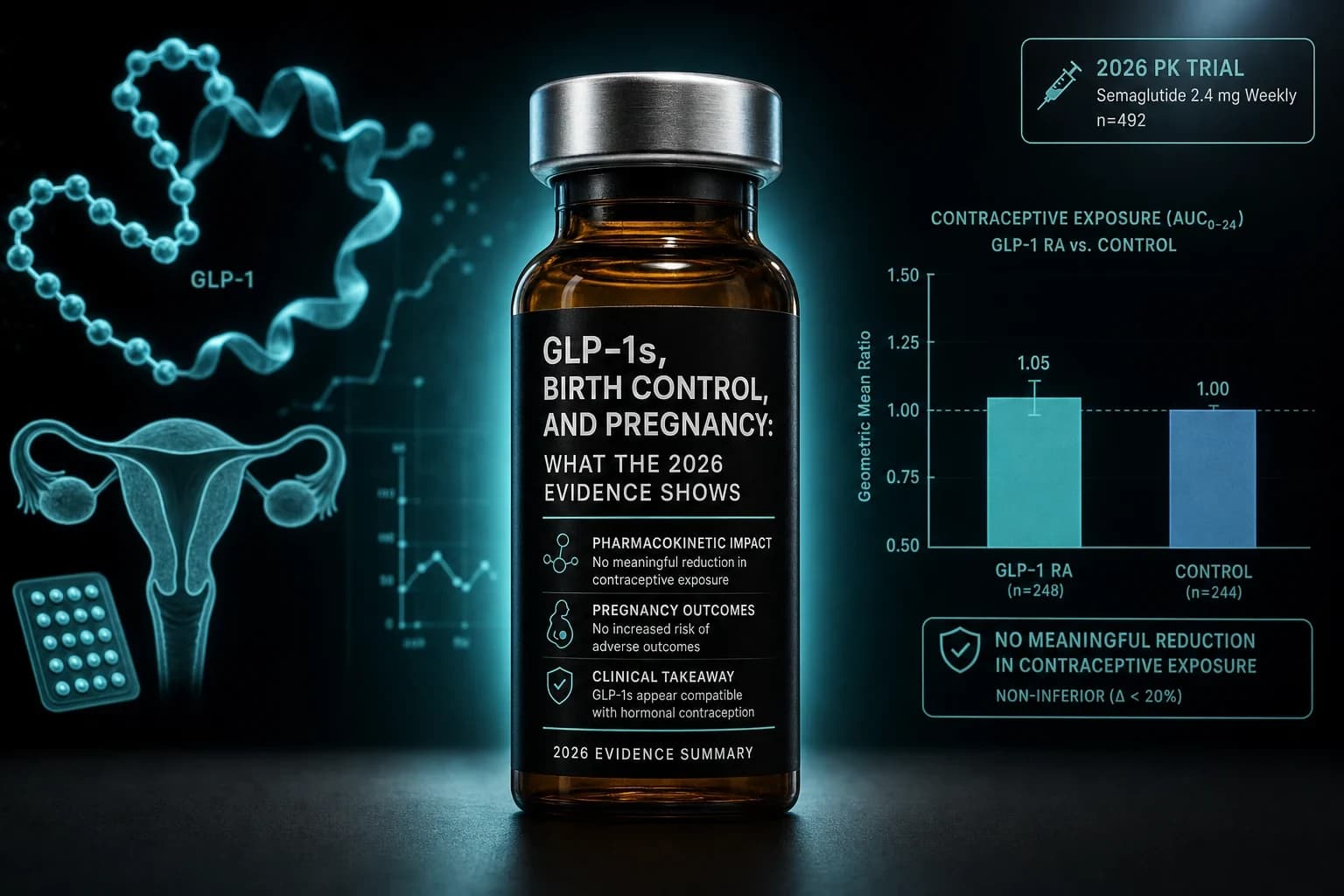
- Tirzepatide single 5 mg dose cuts ethinyl estradiol Cmax 59% and AUC 20% (Mounjaro FDA label); FDA requires 4 weeks of barrier or non-oral contraception after initiation and after each dose escalation.
- Semaglutide carries no comparable oral contraceptive warning; its label requires discontinuation at least 2 months before a planned pregnancy due to a ~1 week half-life.
- Cesta 2024 JAMA Intern Med (50,000+ pregnancies, InPreSS) and Kuitunen 2024 Acta Paediatrica (PMID 39206800) meta-analysis show no signal for major congenital malformations vs insulin in periconceptional GLP-1 RA exposure.
- Kolding 2025 BCPT (PMID 40083043, >100,000 pregnancies) and Dao 2024 BMJ Open (PMID 38663923, n=168) replicate the malformation-neutral signal; preterm birth and neonatal hypoglycemia track with underlying diabetes, not the drug.
- 'Ozempic babies' is a real fertility phenomenon driven by weight loss restoring ovulation in PCOS and obesity; Chen 2025 RCT (PMID 40713699) showed 35% vs 15% pregnancy in PCOS on metformin plus semaglutide vs metformin alone.
Why the reproductive-age GLP-1 user is the underdiscussed cohort
The fastest-growing GLP-1 user is a woman in her late twenties or thirties on Wegovy, Mounjaro, or compounded semaglutide for weight loss. She is also the user the labels and the literature were not built for. The Phase 3 obesity programs (STEP for semaglutide, SURMOUNT for tirzepatide) excluded pregnant or breastfeeding participants and required reliable contraception throughout. The result is that almost everything we know about semaglutide and tirzepatide in pregnancy comes from accidental exposures, claims-database reconstructions, and a handful of national teratology registers run by groups like ENTIS in Europe and the InPreSS consortium across Nordic, Israeli, and U.S. data.
Two clinical questions sit on top of each other and get conflated in popular coverage. The first is whether GLP-1 receptor agonists make oral contraceptives fail. The second is what happens when a GLP-1-exposed pregnancy is found in the first trimester. The answers are different by drug and different by question, and the 2023 to 2026 evidence is finally specific enough to separate them.
Bottom line: Only tirzepatide carries a documented oral contraceptive pharmacokinetic interaction that crosses into a label warning, and only after dose escalation. The first-trimester GLP-1 RA pregnancy data, now spanning more than 50,000 exposures across the InPreSS, ENTIS, and large U.S. claims cohorts, has not surfaced a malformation signal versus insulin. Animal teratology is real but mechanism-specific, and the rat finding does not extrapolate to humans the way the headlines imply. Discontinuation timing differs by half-life: semaglutide and tirzepatide labels recommend stopping at least 2 months before a planned pregnancy.
The two questions on the table
Reproductive-age GLP-1 patients are asking two things at once. Both deserve a clean answer.
| Question | Drug-specific risk | What the evidence says |
|---|---|---|
| "Will this make my birth control fail?" | Tirzepatide: yes, transiently after initiation and each dose step. Semaglutide, liraglutide, dulaglutide, exenatide: no documented interaction with combined oral contraceptives | Use barrier or non-oral contraception for 4 weeks after starting tirzepatide and after each dose escalation. No equivalent precaution for other GLP-1s |
| "What if I get pregnant on a GLP-1?" | All GLP-1 RAs: not recommended in pregnancy; discontinue when pregnancy is recognized | Stop the drug, consult OB. Cesta 2024 (InPreSS) and Kuitunen 2024 meta-analysis show no increased congenital malformation rate vs insulin. The decision is OB-led; do not panic |
The split matters because the prescribing conversation collapses both into "don't get pregnant on this." That overstates the malformation evidence and understates the contraceptive interaction that is actually documented.
Tirzepatide and oral contraceptives: the label data
Eli Lilly's clinical pharmacology submission for Mounjaro included a dedicated drug-drug interaction study with a combined oral contraceptive containing 0.035 mg ethinyl estradiol and 0.25 mg norgestimate. The study measured contraceptive pharmacokinetics in healthy female participants after a single subcutaneous 5 mg dose of tirzepatide.
The numbers in the Mounjaro prescribing information are striking enough that the FDA carved out a specific contraceptive warning.
| Hormone | Cmax reduction | AUC reduction | tmax delay |
|---|---|---|---|
| Ethinyl estradiol | 59% | 20% | 2.5 to 4.5 hours |
| Norgestimate | 66% | 21% | 2.5 to 4.5 hours |
| Norelgestromin (norgestimate metabolite) | 55% | 23% | 2.5 to 4.5 hours |
Translating those numbers into clinical action is concrete. After tirzepatide initiation and after each dose escalation, FDA recommends a non-oral contraceptive method (IUD, implant, depot injection, ring, patch) or addition of a barrier method for 4 weeks. The delay-and-blunt mechanism is the same delayed gastric emptying that drives weight loss and the GLP-1 gastroparesis signal: pyloric tone increase and slower gastric transit reduce peak hormone absorption from the oral pill. The single-dose 5 mg AUC drop of about 20 percent is the closest published GLP-1 contraceptive PK signal to the threshold where ovulation breakthrough is plausible.
Why does the effect attenuate after the first dose and each step? The same tachyphylaxis story the Jalleh gastric emptying scintigraphy data describes: most patients adapt to the slowed transit within a few weeks of a stable dose. That is why the FDA window is 4 weeks per dose change, not a permanent prohibition on oral contraceptives.
Why semaglutide, liraglutide, and dulaglutide do not carry the same warning
Selective GLP-1 receptor agonists were tested against oral contraceptives in their own development programs, and the results did not cross the threshold that tirzepatide's GIP plus GLP-1 combination did. The Ozempic label reports no clinically relevant effect on the pharmacokinetics of a combined oral contraceptive (0.03 mg ethinyl estradiol and 0.15 mg levonorgestrel). Liraglutide and dulaglutide ran similar interaction studies with similar conclusions.
A plausible explanation in the Urva et al. review of GLP-1 RA gastric-emptying effects on oral medications is dose-by-dose pharmacology. Tirzepatide is dosed at higher receptor-equivalent exposure than the selective agonists, and its dual GIP plus GLP-1 mechanism appears to push first-dose gastric emptying delay closer to a threshold where contraceptive absorption is measurably blunted. The selective GLP-1 agents sit below that threshold for oral contraceptive AUC. The clinical implication is asymmetric. Patients switching from semaglutide to tirzepatide pick up the 4-week contraceptive precaution as part of the switch, and patients on tirzepatide who downgrade dose then re-escalate pick it up again.
For patients researching the broader sourcing and dose-comparison map, the GLP-1 dosing comparison and tirzepatide vs semaglutide SURMOUNT-5 evidence cover the dose ladders where the warning thresholds matter.
Warning: The tirzepatide contraceptive warning is dose-step dependent. Every time the prescriber moves a patient from 2.5 mg to 5 mg, 5 mg to 7.5 mg, 7.5 mg to 10 mg, 10 mg to 12.5 mg, or 12.5 mg to 15 mg, the 4-week barrier or non-oral window resets. Patients on stable doses for more than 4 weeks do not need the additional precaution.
"Ozempic babies": why fertility actually goes up
The flip side of the cautious labeling is a real and underdiscussed fertility signal. The "Ozempic babies" headlines that started in late 2024 and accelerated through 2025 and 2026 are not pharmacology. They are downstream effects of weight loss on reproductive function.
Two mechanisms do most of the work. First, weight loss of 10 to 25 percent typically restores ovulation in women with PCOS-related anovulation, which is the most common cause of subfertility in obese women of reproductive age. Second, hyperinsulinemia and androgen excess attenuate with weight loss, which improves the LH-to-FSH ratio and the follicular environment. The effect is not GLP-1 specific. It is weight-loss specific. The reason it shows up in the GLP-1 era is that the magnitude and durability of weight loss on semaglutide 2.4 mg and tirzepatide 15 mg is unlike anything obese reproductive-age women had access to before.
The Chen 2025 randomized trial is the cleanest in-PCOS read. One hundred overweight or obese women with PCOS were randomized to metformin 1,000 mg twice daily or the same metformin plus semaglutide 1.0 mg weekly for 16 weeks. From week 16 to week 40 (semaglutide was discontinued at week 16), the combination group had a 35 percent natural pregnancy rate versus 15 percent on metformin alone (Chen et al. 2025, PMID 40713699). A 2025 Heliyon pilot of 20 PCOS patients on metformin plus semaglutide 0.25 to 0.5 mg weekly for five months reported 60 percent pregnancy during follow-up (PMID 41421448). For the broader picture, the semaglutide and tirzepatide in PCOS evidence and GLP-1 fertility long-term effects review cover the mechanism and the trial-level data.
This is the under-counseled risk for women who started a GLP-1 for weight loss and were not actively trying to conceive. The contraceptive question gets harder, not easier, in the same population where fertility is increasing. The clinical implication is that reproductive-age GLP-1 users need contraception planning that assumes their fertility is going up, not down.
What the first-trimester exposure data actually shows
Five lines of human evidence now bear on what happens when a GLP-1 exposed pregnancy is found in the first trimester.
| Study | Design | Sample | Comparator | Main finding |
|---|---|---|---|---|
| Cesta et al. 2024 JAMA Intern Med (DOI 10.1001/jamainternmed.2023.6663) | InPreSS multinational cohort | 50,000+ pregnancies with T2D | Insulin | No increased major congenital malformation risk vs insulin for GLP-1 RA, DPP-4i, SGLT2i, sulfonylureas |
| Kuitunen et al. 2024 Acta Paediatrica (PMID 39206800) | Systematic review and meta-analysis | Pooled across published cohorts | Mixed | GLP-1 RA in early pregnancy did not increase congenital malformations; evidence base limited |
| Dao et al. 2024 BMJ Open (PMID 38663923) | ENTIS multicentre prospective cohort | 168 first-trimester GLP-1 RA exposures | T2D + obese reference | Major birth defects 2.6% vs 2.3% vs 3.9%; adjusted OR 0.98 (95% CI 0.16 to 5.82) vs T2D, 0.54 (0.11 to 2.75) vs obese |
| Kolding et al. 2025 Basic Clin Pharmacol Toxicol (PMID 40083043) | Danish national cohort | >100,000 pregnancies; subset semaglutide-exposed | Insulin and unexposed | Higher preterm birth, LGA, neonatal hypoglycemia and jaundice vs unexposed; similar risk vs insulin (signal tracks with underlying diabetes) |
| Continued-GLP-1 target trial emulation 2026 Annals Intern Med (DOI 10.7326/ANNALS-25-04820) | MarketScan claims target trial emulation | 3,572 GLP-1 pre-pregnancy users | Discontinuation at conception | No substantial increased risk of nonlive birth, abnormal fetal growth, or major congenital malformation with continuation into first trimester |
The Cesta 2024 study is the most-cited because it is the largest. The InPreSS consortium pooled Nordic, Israeli, and U.S. registry data on more than 50,000 pregnancies in women with type 2 diabetes and compared periconceptional exposure to GLP-1 RAs, DPP-4 inhibitors, SGLT2 inhibitors, and sulfonylureas against insulin. None of the second-line classes showed a higher major congenital malformation risk than insulin. That is the analytically correct comparison, because background diabetes and its comorbidities (obesity, hypertension, glycemic variability) drive malformation risk independent of which glucose-lowering drug is chosen.
Dao 2024 ENTIS is the smallest of the five but the most specific to teratology. Six European teratology information services pooled their prospective consultation data on 168 pregnant women who took a GLP-1 RA in the first trimester, with an obese reference group and a non-GLP-1 T2D reference group. Major birth defects ran 2.6 percent in the GLP-1 RA arm versus 2.3 percent in the T2D comparator and 3.9 percent in the obese comparator. Point estimates are reassuring; confidence intervals are wide.
Kolding 2025 added scale. The Danish national-cohort design tracked more than 100,000 pregnancies, isolated the semaglutide-exposed subset, and compared neonatal outcomes against unexposed and insulin-exposed pregnancies. The headline is the obstetric outcome signal (preterm birth, LGA, neonatal hypoglycemia, jaundice) is similar to insulin-exposed pregnancies, which means it is tracking with the underlying diabetes severity rather than the drug. The malformation rate was not elevated.
Annals 2026 (target trial emulation) is the most recent and the closest to a counterfactual design in claims data. Using Merative MarketScan from 2011 to 2024, the team identified 3,572 pregnancies in women with a GLP-1 RA dispensation in the 90 days before the last menstrual period and compared continuing dispensation into the first trimester against not continuing. No substantial increase in nonlive birth, abnormal fetal growth, or major congenital malformation was detected with continuation. The estimates were imprecise for the rarer outcomes (major malformations, SGA), and the authors explicitly call for further research, but the direction of effect is consistent with Cesta, Kuitunen, Dao, and Kolding.
Across all five, the human pregnancy data now spanning multinational registries and a target trial emulation does not show a major congenital malformation signal versus the comparators that matter (insulin, untreated obesity, T2D). That body of work is not strong enough to call GLP-1 RAs safe in pregnancy, and labels still recommend discontinuation when pregnancy is recognized. It is strong enough to say that an accidental first-trimester exposure followed by prompt discontinuation is not the catastrophe the older animal-only labels implied.
The animal teratogenicity story (and why the rat finding does not extrapolate cleanly)
The animal data that drives the pregnancy contraindication in every GLP-1 RA label is real, but the species-specific mechanism deserves to be named. The Australian TGA non-clinical evaluation report for semaglutide is the most accessible source.
In pregnant rats given semaglutide during organogenesis, embryo-fetal mortality, growth impairment, and structural abnormalities were observed at subclinical plasma exposures. The mechanism is GLP-1 receptor-mediated effects on the inverted yolk sac placenta, which in rodents is the principal nutrient-supply structure to the embryo during organogenesis. Rats and rabbits have this structure. Primates (including cynomolgus monkeys and humans) do not.
Cynomolgus monkey studies (three reproductive arms) did not show teratogenicity. Increased early pregnancy loss was reported and is attributed to the maternal effect of marked body weight loss, not to direct embryonic toxicity. Rabbit studies showed pregnancy losses and minor visceral and skeletal abnormalities at clinically relevant exposures, and the rabbit data is the more conservative animal signal that supports the contraindication.
Translating this honestly: the rat data is the most alarming on paper and the least relevant to humans mechanistically. The rabbit data is more concerning because rabbits are closer to humans in placental anatomy. The monkey data is reassuring on teratogenicity but flags maternal weight loss as a pregnancy-loss mechanism. That cluster of findings is why every GLP-1 RA label retains a pregnancy contraindication while the human cohort data does not show a corresponding signal. The label is appropriately conservative; it is not the same as evidence that the drug is teratogenic in humans.
Washout periods by drug
Half-life drives the washout recommendation. The FDA labels for each agent specify the period before a planned pregnancy.
| Drug (brand) | Approximate half-life | Pre-conception washout per FDA label |
|---|---|---|
| Semaglutide (Ozempic, Wegovy, Rybelsus) | ~7 days | Discontinue at least 2 months before planned pregnancy |
| Tirzepatide (Mounjaro, Zepbound) | ~5 days | Discontinue when pregnancy is planned; label recommends discontinuation in advance given half-life and reproductive toxicity in animals |
| Liraglutide (Saxenda, Victoza) | ~13 hours | Discontinue when pregnancy is planned or recognized |
| Dulaglutide (Trulicity) | ~5 days | Discontinue when pregnancy is planned or recognized |
| Retatrutide (investigational) | ~6 days | Not approved; clinical trials exclude pregnancy and require contraception throughout |
The semaglutide 2-month rule is the longest in the class and the most-cited. It works out to roughly 5 to 7 elimination half-lives, which clears plasma to a sub-active concentration before the periconceptional window. Tirzepatide's slightly shorter half-life shortens the washout in theory; the label is conservatively framed as "discontinue in advance of planned pregnancy" rather than a fixed week number. Liraglutide and the older once-daily and twice-daily agents clear in days to weeks rather than months and have the most flexible washout planning.
For patients on a GLP-1 RA who are actively planning conception, the clinical pathway is: discontinue per label, switch to a non-teratogenic glucose-lowering or weight-management strategy (insulin and metformin are the preferred pregnancy-compatible agents in T2D), confirm a regular cycle resumes if applicable, and proceed with conception planning under OB or maternal-fetal medicine input.
Decision matrix for the reproductive-age GLP-1 user
The synthesis of the contraceptive and pregnancy data lands as a small set of clinical situations with clear answers.
| Situation | Recommended action |
|---|---|
| Starting tirzepatide on combined oral contraceptive | Add barrier method or switch to IUD, implant, ring, patch, or depot injection for 4 weeks. Re-apply the 4-week precaution at each dose escalation |
| Starting semaglutide, liraglutide, or dulaglutide on combined oral contraceptive | No additional precaution required; oral contraceptive PK is preserved |
| On semaglutide or tirzepatide, planning pregnancy | Discontinue at least 2 months before attempting conception; switch to pregnancy-compatible glucose-lowering or weight-management plan under OB input |
| On a GLP-1 RA, pregnancy discovered | Stop the drug; contact OB. Cesta 2024, Dao 2024, Kuitunen 2024, Kolding 2025, and the Annals 2026 target trial do not support a panic response |
| Reproductive-age user with PCOS or unexplained infertility on a GLP-1 RA | Counsel that fertility may improve as weight loss progresses; ensure contraception plan accounts for restored ovulation if pregnancy is not desired |
| Switching from semaglutide to tirzepatide | Apply the 4-week tirzepatide contraceptive precaution at switch and at each subsequent dose escalation |
| Breastfeeding on a GLP-1 RA | Labels recommend not using during breastfeeding due to limited human data. Decision is patient-specific under pediatric and lactation consult input |
The reason this matrix is short is that the contraceptive and pregnancy questions, despite generating enormous media coverage, resolve to relatively few drug-by-question cells once the data is read carefully. The complexity is in the counseling, not the pharmacology.
Tip: Reproductive-age GLP-1 users planning a pregnancy benefit from a 3-visit framework with the prescriber: a baseline visit to set the discontinuation timeline, a 2-month visit to confirm clearance and switch to pregnancy-compatible glucose-lowering or weight-management strategies, and a confirmation visit if pregnancy is achieved. For unplanned pregnancy on a GLP-1, the first call is to the prescriber and the second is to OB.
What the contraceptive question still does not answer
Three open questions sit just outside the published evidence.
First, the contraceptive PK signal for tirzepatide was characterized in a single-dose study at 5 mg in healthy female participants. The clinical real-world data on contraceptive failure rates at higher tirzepatide doses (10, 12.5, 15 mg) in obese women is largely pharmacovigilance and FAERS-based and has not been formally quantified. The label conservatism is appropriate, but the absolute breakthrough ovulation rate per cycle on the higher doses has not been published.
Second, the comparable data for the next generation of GLP-1 receptor agonists (orforglipron oral, retatrutide triple agonist, survodutide, maridebart cafraglutide, mazdutide, CT-388/enicepatide) is not yet published at the level of the tirzepatide oral contraceptive interaction study. The Phase 3 programs all enrolled with required contraception. Whether the contraceptive interaction transfers to GIP-containing duals and triples or to the orals is an open empirical question.
Third, the long-term offspring follow-up data does not exist yet. The first-trimester cohorts track pregnancy outcomes through delivery and the immediate neonatal period. Childhood metabolic, cognitive, and developmental outcomes after in-utero GLP-1 exposure will require another decade of registry follow-up to characterize. The current data does not rule out subtle effects on those endpoints.
Sourcing for researchers tracking the class
Researchers working on the reproductive endocrine effects of incretin-based therapies typically source semaglutide and tirzepatide research vials from vendors that publish lot-level certificates of analysis. Ascension Peptides covers the injectable research compounds in this class with code ENHANCED for 50 percent off. For oral GLP-1 research analogs (oral semaglutide research material, oral orforglipron analogs) and nasal-format incretin research tools, Limitless Biotech is the matched source with code ENHANCED. Neither sourcing channel is appropriate for any reproductive-age individual outside of a controlled research setting, and none of the pregnancy data summarized above is a basis for self-protocol decisions in pregnancy or contraception planning.
For dose-planning and the broader safety map, the GLP-1 dosing comparison, tirzepatide vs semaglutide SURMOUNT-5 evidence, GLP-1 fertility long-term effects review, and GLP-1 PCOS semaglutide and tirzepatide evidence cover the adjacent endpoints in the same population.
This article is for educational and research purposes only and is not medical advice. No GLP-1 receptor agonist is FDA-approved for use during pregnancy. Every product label in this class currently recommends discontinuation when pregnancy is recognized and a planned discontinuation period before attempting conception. The cohort and registry data summarized above derive from observational studies subject to confounding by indication, channeling bias, and exposure misclassification, and the confidence intervals on the smaller cohorts (Dao) are wide. Animal teratogenicity is established in rats and rabbits; the human pregnancy data does not show a corresponding malformation signal but is not powered for rare outcomes. Pregnancy, contraception, and fertility decisions for any individual on a GLP-1 RA belong to the patient and her OB-GYN, primary care prescriber, and maternal-fetal medicine consultant, not to a general-audience review article. Do not start, switch, stop, or self-source any GLP-1 receptor agonist on the basis of this article. Consult a qualified clinician about your individual circumstances before acting on any information here.