At a glance
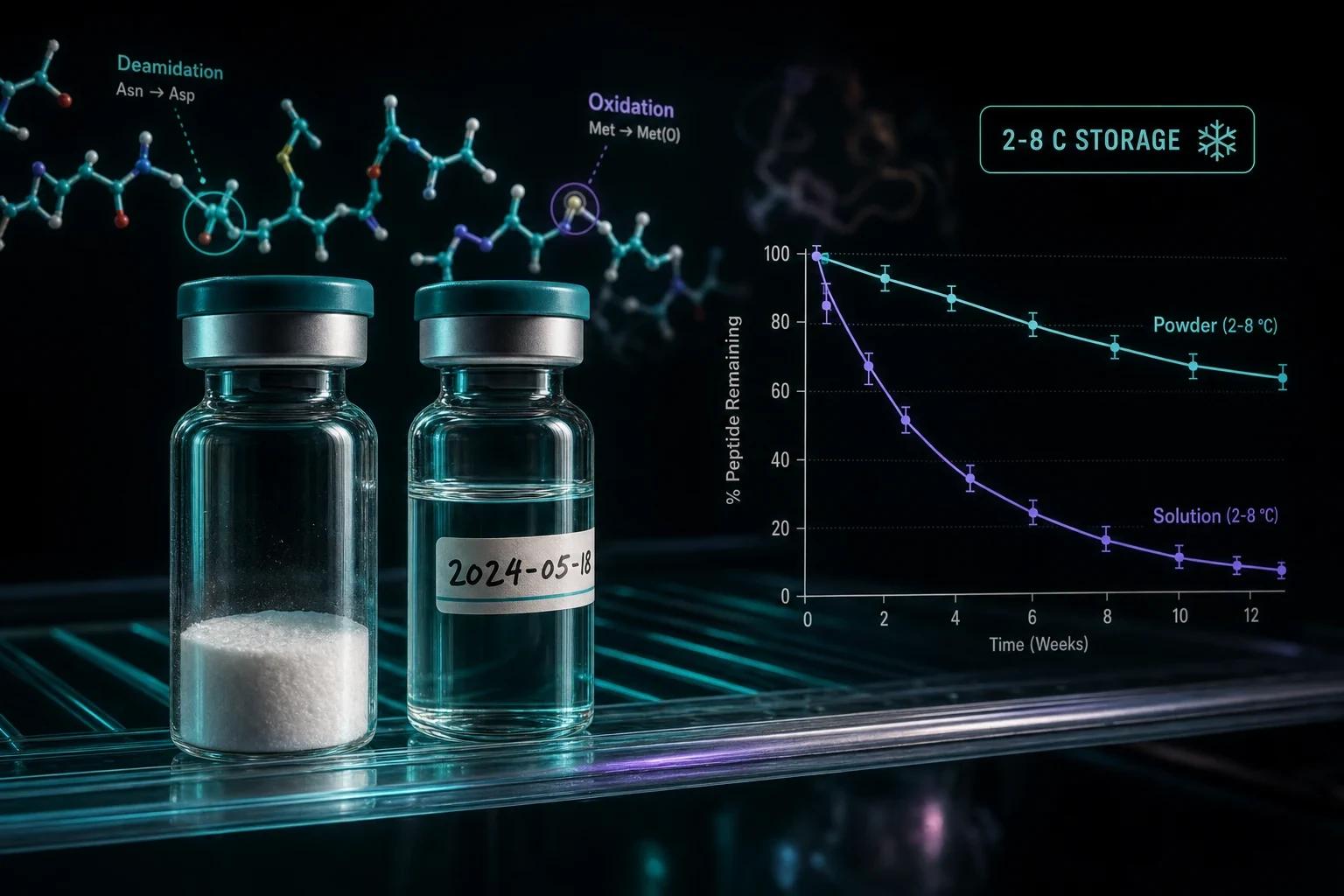
- Powder and liquid vials run on different clocks: dry lyophilized peptide holds up far longer than reconstituted solution.
- The common 14 to 30 day fridge window for mixed vials is a convention, not a measured result.
- Manufacturer pens carry tested in-use limits (Ozempic 56 days, Victoza 30 days). Research vials carry none.
- Each compound has its own clock: temperature, pH, buffer and preservative all shift degradation rates.
- Date the vial the day you mix it. Cloudiness or particles mean discard, but clear liquid proves nothing.
You mixed a vial two weeks ago. It is clear, it has been in the fridge the whole time, and you have no idea whether the peptide inside still does anything. The answer on most forums is "about 30 days," delivered with total confidence. Here is what the published science says about that number, and where it runs out.
Short version: a dry (lyophilized) vial keeps far longer than a mixed one, and the 2 to 8 degrees C fridge is the right place for a reconstituted vial. How many days you actually get is compound-specific, and for most research peptides nobody has published the measurement.
Powder and liquid are two different products
A research peptide ships as a freeze-dried cake. Removing the water stops most of the chemistry that damages peptides. Add bacteriostatic water and that chemistry restarts.
Reviews of therapeutic-peptide formulation list the same set of instability routes for peptides in water: oxidation, hydrolysis, deamidation, racemization, isomerization and disulfide exchange. An overview of stabilizing therapeutic proteins in aqueous solution and in freeze-dried solids exists precisely because the two states behave differently, and drug makers choose the dry form when a molecule will not hold up in solution.
| State | Typical storage | What is known | What is not |
|---|---|---|---|
| Unopened lyophilized vial | Cold and dry, away from light | Dry state slows water-driven degradation | Assigned retest date for your batch (ask for it) |
| Reconstituted vial, fridge | 2 to 8 degrees C | Chemistry resumes in water; rate depends on sequence, pH, buffer | Compound-specific days of potency for nearly all research peptides |
| Reconstituted vial, room temp | 15 to 25 degrees C | Faster degradation than the fridge (a general rate principle) | Safe holding time (no data for research vials) |
| Frozen aliquots | Minus 20 degrees C or colder | Widely used practice | Whether your specific peptide survives repeated thaw cycles |
The bacteriostatic water 28-day rule governs the diluent, which is a separate question from how long the peptide survives in it. Both clocks run at once, and the shorter one wins.
Why the "30 days" number exists
Look for the source of "reconstituted peptides last 30 days in the fridge" and you will find vendor FAQs and forum posts that repeat each other. We searched PubMed and the formulation literature for a measured shelf-life of a typical research peptide in bacteriostatic water and did not find one.
The number probably descends from two real things. First, the 28-day limit on opened multi-dose vials, which is about the preservative, not the peptide. Second, the labeled in-use periods for approved injectables. Those are real, tested numbers, but they belong to specific products.
Note: A rule of thumb that spreads because it is safe is still a rule of thumb. Treat "14 to 30 days" as a conservative working window, not a measured potency curve.
What tested products look like (and why your vial is different)
Approved pens are formulated and tested for their in-use period. By label, an opened Ozempic (semaglutide) pen may be kept 56 days at room temperature or in the fridge, and an opened Victoza (liraglutide) pen 30 days. The manufacturer picked those numbers with potency and impurity data behind them.
A study of four basal insulins in opened pens (in-use insulin pen stability study) found about 99 to 101% of labeled content after 28 days at fridge, room and 37 degrees C. That is reassuring about an engineered formulation. It says little about a lyophilized research peptide mixed with plain bacteriostatic water, because the pen contains a tuned buffer, pH and preservative system and the vial contains whatever you add.
Semaglutide is a good example of how much the formulation matters. A 2025 preformulation study of semaglutide tested buffering capacity, pH and temperature and concluded all three strongly affect its stability. A separate LC-HRMS study ran stress conditions at 25, 40, 60 and 80 degrees C across pH and buffer choices to map impurity formation. Neither tested a reconstituted vial in bacteriostatic water, so neither gives you a day count. They show that the surrounding solution changes the answer, which is the point.
The sequence decides more than the fridge does
Chemistry is sequence-specific. Asparagine and glutamine residues deamidate, methionine and cysteine oxidize, and aspartate bonds hydrolyze. A comparison of deamidation, diketopiperazine formation and oxidation in VEGF and model peptides found deamidation and oxidation rates in the protein were comparable to those in small model peptides, which is why peptide chemists can predict liabilities from sequence alone.
BPC-157 shows how this plays out. A 2026 review of BPC-157 biopharmaceutical challenges notes its sequence lacks methionine, cysteine, asparagine and glutamine, which favors oxidative and deamidation stability on paper. The same review flags that human pharmacokinetics remain poorly characterized and that formulation work is the missing piece for development. Favorable chemistry on paper is a reason to worry less, and it still leaves the shelf life unmeasured.
| Compound class | Sequence liability (general) | What the evidence does and does not give you |
|---|---|---|
| BPC-157 | No Met, Cys, Asn or Gln per the 2026 review | Favorable on paper; no published vial-in-fridge potency curve found |
| GLP-1 analogs (semaglutide) | Complex molecule, fatty-acid modified | Manufacturer pen limits exist; formulation-dependent stability studies show strong pH, buffer and temperature effects |
| Other research peptides | Depends on sequence | Check the sequence for Asn, Gln, Met and Cys; assume a shorter window when present |
Compound pages on this site list each sequence: see BPC-157, TB-500 and semaglutide, and the matching BPC-157 dosage chart and TB-500 dosage chart if you want protocol context.
Does the preservative help or hurt?
Bacteriostatic water contains 0.9% benzyl alcohol to keep bacteria from growing in a multi-dose vial. That helps sterility, though benzyl alcohol can also interact with proteins. A study of benzyl alcohol and interferon alpha-2a found that benzyl alcohol drove concentration-dependent unfolding and aggregation. Interferon is a large protein and most research peptides are far smaller, so the finding does not transfer directly. It still supports the broader point that the diluent is part of the stability system.
Sterile water avoids the preservative but removes the microbial protection, which is why the bacteriostatic vs sterile water comparison matters more for multi-dose vials.
A practical storage routine
None of this supports a precise day count. It does support a routine that keeps risk low:
- Mix only what you will use. If a vial holds more than you can finish in a few weeks, split it into aliquots at mixing time rather than repeatedly drawing from one vial.
- Write the mix date on the vial. Memory fails at week three.
- Fridge, upright, dark. Keep it at 2 to 8 degrees C, away from the door where temperature swings.
- Use the shorter clock. If the vendor gives a window, use it. If it exceeds the 28-day bacteriostatic water limit, the 28 days rules.
- Minimize warm time. Draw the dose and return the vial; do not leave it on the counter.
- Use the calculator, not guesswork. The reconstitution calculator shows how much volume and how many doses a vial holds, so you size the mix to the window. The reconstitution walkthrough covers the steps.
Warning: Clear liquid does not prove intact peptide. Cloudiness, floating particles or a color change mean discard. A visually perfect vial can still have lost potency, because many degradation products are invisible.
For injection technique once the vial is ready, see our peptide injection site guide.
Where storage meets sourcing
Storage guidance assumes the vial was in good shape when it arrived. A peptide that shipped warm or was under-dosed to begin with will not be rescued by the fridge. Batch testing matters here: our COA guide explains what a certificate does and does not tell you, and the lab test library lists the compounds we track. Our vendor audit of Ascension Peptides covers how that supplier handles testing and shipping.
If you are sourcing injectable research peptides, Ascension Peptides carries them and code ENHANCED takes 50% off. Ask any vendor for the batch retest date for the lyophilized vial; a vendor that cannot supply one is telling you something.
What we can and cannot say
What the evidence supports: peptides degrade faster in solution than as dry powder; temperature, pH, buffer and preservative all change the rate; approved products are tested to defined in-use limits; and a cold, dark, dated vial is a sound habit.
What it does not support: any specific day count for a given research peptide in bacteriostatic water. We did not find a published measurement, and anyone quoting "exactly 30 days" is extrapolating from convention or from different products.
Bottom line: Store dry powder cold and sealed, refrigerate mixed vials, date everything, and treat 14 to 30 days as a cautious convention rather than a tested expiry. When a manufacturer label exists, it beats forum advice every time.
This article is for research and educational purposes only and is not medical advice. Peptides discussed here are research compounds not approved for human use unless noted. Consult a qualified clinician before using any compound.