At a glance
- GHK-Cu has the deepest paper trail: ex vivo, rodent, and older small clinical evidence
- AHK-Cu has the cleanest single ex vivo human follicle study (Pyo 2007)
- PTD-DBM reactivates Wnt via CXXC5 disruption; mouse data only so far
- Thymosin beta-4 activates hair follicle stem cells (Philp 2004, Gao 2015)
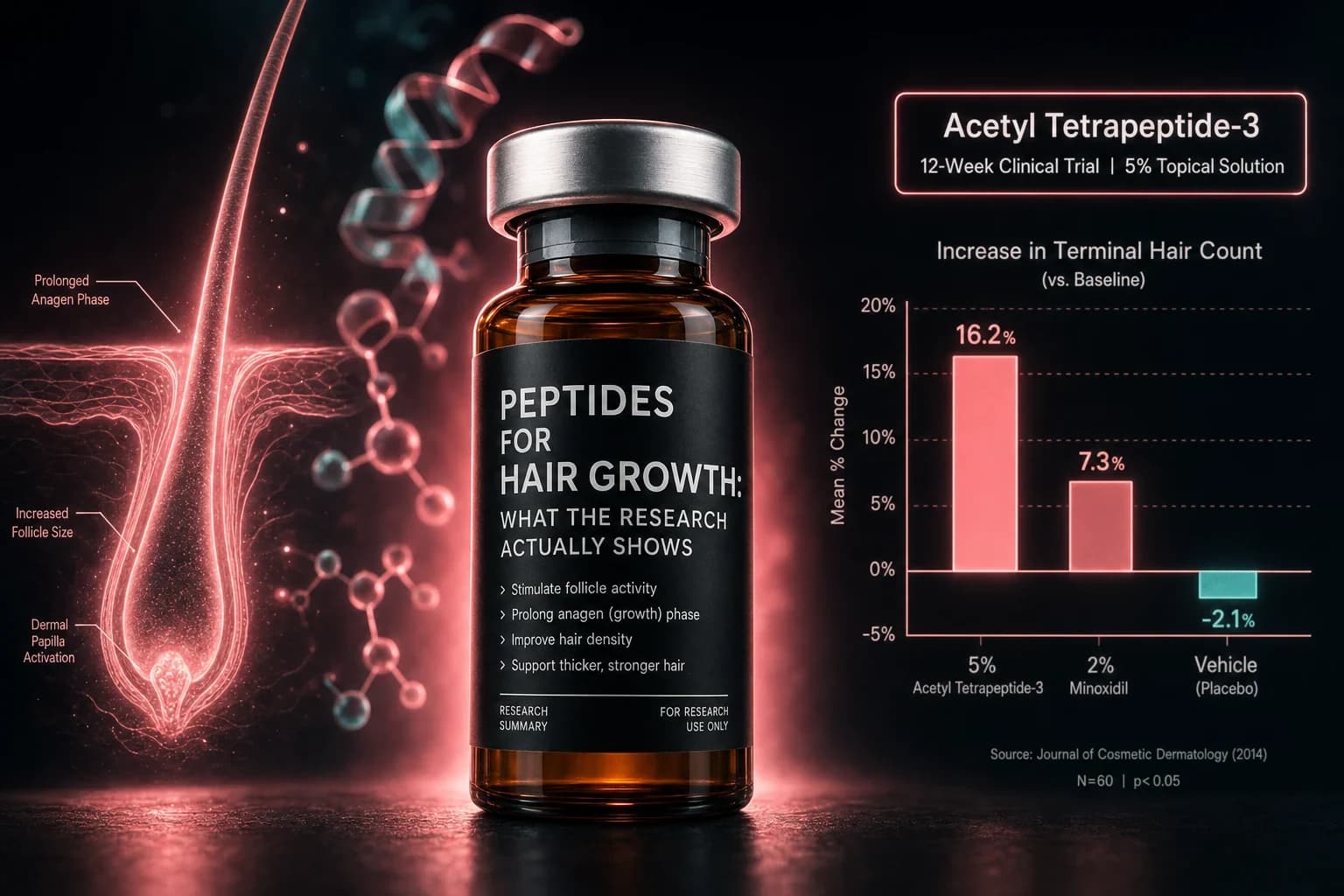
- No peptide here matches finasteride or minoxidil for clinical trial depth
Search "peptides for hair growth" and half the results are affiliate blogs pushing whatever the site sells. The other half quote the same three PubMed abstracts and stop there. Neither tells you which peptides actually have research behind the hair claim, which have research on skin or wounds that got extrapolated to hair by an intern with a Canva subscription, and which are just being marketed.
Here is the honest split, ranked by evidence depth: what the actual studies show, where the data is thin, and what to skip.
How hair follicles decide to grow
Every hair on your head runs on a cycle: anagen (active growth), catagen (regression), telogen (rest), then exogen (shed). Whether a follicle keeps producing hair or shrinks to nothing is controlled by the dermal papilla, a tight cluster of specialized fibroblast-like cells at the base of the follicle. Two molecular signals dominate.
The first is Wnt/β-catenin. When Wnt ligands bind, β-catenin accumulates inside dermal papilla cells and flips them from "resting" to "grow." Almost every peptide with credible hair evidence hits this pathway in one way or another. The second is VEGF (vascular endothelial growth factor), which builds the tiny capillary network that feeds each follicle. No blood supply, no growth phase. Peptides that raise VEGF around follicles tend to prolong anagen.
Keep those two pathways in mind. They are the reason some peptides have real papers behind them and others have only vibes.
GHK-Cu: the copper tripeptide with the deepest paper trail
GHK is glycyl-L-histidyl-L-lysine, a natural human tripeptide that binds copper with high affinity. Complexed with copper(II), it becomes GHK-Cu, and it is by far the most-studied peptide in the hair category.
A 2018 review by Pickart and Margolina in International Journal of Molecular Sciences pulls the mechanistic picture together: GHK-Cu modulates the expression of roughly 4,000 human genes, including those regulating tissue remodeling, angiogenesis, and skin stem cell activity. An earlier 2015 review by the same authors in BioMed Research International maps the skin-regeneration side of that story: collagen upregulation, decorin production, and modulation of the matrix metalloproteinases that remodel tissue.
For hair specifically, the mechanism has three legs. GHK-Cu raises VEGF in dermal papilla cells, feeding follicles. It shortens the telogen phase and speeds re-entry into anagen. And it activates Wnt/β-catenin signaling in the papilla, which is the same switch minoxidil eventually flips, just through a different upstream route.
The evidence hierarchy for hair is:
- Ex vivo human follicle work using a close analog (see AHK-Cu below) and dermal papilla cell studies with GHK-Cu itself.
- Rodent studies showing follicle enlargement and telogen-to-anagen acceleration.
- A small number of older uncontrolled or manufacturer-linked clinical evaluations that reported density improvements over months of topical use.
- No large, independent, randomized, placebo-controlled human trial on GHK-Cu monotherapy specifically for hair.
Bottom line: GHK-Cu has the deepest mechanistic case in the category and real ex vivo and animal data. It does not have the kind of large randomized trial that would let anyone call it "clinically proven" the way finasteride is.
Delivery is where researchers argue. Topical formulations (scalp serums, microneedling adjuncts) draw on a decade of skin absorption data. Subcutaneous scalp injections are studied in research settings for higher dermal exposure. Our copper peptides guide explains the cosmetic-versus-research grade distinction, and the GHK-Cu dosage chart has topical and injection protocols.
AHK-Cu: the less-famous copper peptide with the best ex vivo human data
AHK-Cu (alanine-histidine-lysine complexed with copper, sometimes labeled copper tripeptide-3) sits in GHK-Cu's shadow but has arguably the cleanest single hair-focused study of any peptide in this list.
Pyo et al. (2007), published in Archives of Pharmaceutical Research, cultured human dermal papilla cells and human hair follicles ex vivo. At AHK-Cu concentrations of 10⁻¹² to 10⁻⁹ M, they measured:
- Increased papilla-cell proliferation.
- Higher VEGF secretion.
- Lower TGF-β1 (a signal linked to catagen entry, the follicle regression phase).
- A shifted Bcl-2 to Bax ratio favoring survival over apoptosis.
- Elongation of intact human hair follicles in organ culture.
Ex vivo human follicle culture is a strong preclinical model because it uses actual human hair, not a mouse. That single paper is the reason AHK-Cu keeps showing up in scalp serums. It is one paper, though, and it has not been followed by a large randomized trial. Read it as strong mechanistic support, not proof of clinical efficacy.
PTD-DBM: the Wnt-reactivator with the most interesting recent mouse data
PTD-DBM is a synthetic peptide the Choi laboratory at Yonsei University designed to reactivate Wnt signaling from a very specific angle. The story goes: a protein called CXXC5 is a brake on the Wnt/β-catenin pathway. CXXC5 binds Dishevelled (Dvl), a Wnt-pathway relay, and blocks it. Kim and colleagues at Choi's lab identified this brake in a 2015 paper in Cell Death & Differentiation. Then they built a peptide (PTD-DBM) that competes with Dvl for CXXC5, pulls the brake off, and re-enables Wnt signaling.
Lee et al. (2017) in Journal of Investigative Dermatology is the hair paper. In mouse models, topical PTD-DBM applied to the dorsal skin during telogen produced accelerated hair regrowth, and, in a wound-healing model, induced follicle neogenesis in the wound bed (new follicles forming in an area that had none). The signal was strongest when PTD-DBM was combined with a small-molecule Wnt agonist called valproic acid.
Two honest caveats. First, the pivotal work is in mice, not humans. As of 2026 there is no completed peer-reviewed randomized human efficacy trial. Second, the mechanism is downstream of Wnt, which is well-conserved between species, so translation is plausible but not guaranteed.
Note: PTD-DBM sits in a research-only bucket. It has a mechanism, it has mouse data, and it has active academic follow-up. It does not yet have the human trial that would justify recommending it as a routine hair intervention.
Thymosin β4 and TB-500: the stem cell mobilizer
Thymosin beta-4 (Tβ4) is a small 43-amino-acid peptide that regulates actin, cell migration, and wound repair. TB-500 is a synthetic fragment of Tβ4 (residues 17-23) sold in research supply chains under that name. Whether they are functionally interchangeable for hair is contested, but both are discussed in the same conversation.
The pivotal paper is Philp et al. (2004), published in the FASEB Journal. In normal rats and mice, Tβ4 accelerated hair regrowth after shaving, and rat vibrissa follicle clonogenic keratinocytes migrated and differentiated in the presence of nanomolar Tβ4. The proposed mechanism was activation of hair follicle stem cells in the bulge region.
A later Gao et al. (2015) paper in PLOS ONE generated Tβ4-overexpressing and Tβ4-knockout mice. Overexpressers regrew hair faster and had denser, clustered follicles. Knockouts regrew hair slower. That is a strong loss-of-function complement to the earlier gain-of-function work.
The evidence for TB-500 (the fragment) specifically on hair is thinner than the evidence for full-length Tβ4, and the rodent-to-human translation for either compound has not been formally tested in a well-controlled hair trial.
The head-to-head comparison
| Peptide | Best evidence tier | Route studied | Primary mechanism | Where the evidence stops |
|---|---|---|---|---|
| GHK-Cu | Ex vivo, rodent, older small clinicals | Topical, injectable | VEGF up, telogen shortened, Wnt activation | No large independent randomized human hair trial |
| AHK-Cu | Ex vivo human follicle | Topical | VEGF up, TGF-β1 down, papilla survival | One solid ex vivo paper, no big RCT |
| PTD-DBM | Mouse | Topical | CXXC5-Dvl disruption, Wnt reactivation | No completed human efficacy trial |
| Thymosin β4 / TB-500 | Rodent | Injection, topical | Follicle stem cell activation, migration | Rodent-to-human hair translation untested |
Read the table diagonally, not vertically. GHK-Cu has the widest evidence base (skin, wounds, hair). AHK-Cu has the cleanest single hair paper. PTD-DBM has the most interesting recent mouse data on follicle neogenesis. Thymosin β4 has the strongest stem-cell mechanism. Nothing here beats finasteride or minoxidil for clinical trial depth, and honest peptide content should say so.
What is not well-evidenced for hair (skip list)
The internet loves to add peptides to lists. Some show up because someone once wrote a listicle and everyone else copied it.
- BPC-157 is a wound-healing pentadecapeptide with real preclinical data on angiogenesis and tendon and gut repair. It has no meaningful hair-follicle data. The BPC-157 research page covers what it actually does.
- Sermorelin, ipamorelin, CJC-1295, and other growth hormone secretagogues raise pulsatile GH. Elevated GH and IGF-1 can support skin turnover, but no controlled human trial has shown they regrow scalp hair. Their real use case is different (see sermorelin vs CJC-1295 vs ipamorelin).
- Semaglutide, tirzepatide, and retatrutide are being watched for hair effects, but the signal there is hair loss during rapid weight loss (telogen effluvium), not growth. See our GLP-1 hair loss evidence review.
- Melanotan variants pigment skin and hair. They do not regrow it.
- Any product claiming "peptide-powered hair growth" without naming the peptide is either GHK-Cu at a low concentration or a marketing bucket for hydrolyzed keratin, which is not the same molecule as the peptides in this article.
How researchers stack these
Two combinations show up most often in published protocol discussions and researcher self-reports.
Copper peptide plus microneedling. The dermal-papilla effects of GHK-Cu depend on the peptide reaching the follicle. Microneedling both drives transient wounding (which itself activates Wnt through a repair response) and mechanically improves peptide penetration. The Pickart & Margolina 2018 review discusses the rationale. Practical protocols pair a topical GHK-Cu serum with weekly-to-biweekly microneedling.
Wnt reactivator plus copper. PTD-DBM and GHK-Cu work on the same downstream pathway (Wnt/β-catenin) but from different angles. Some researcher protocols use PTD-DBM for its Wnt-reactivating specificity plus GHK-Cu for its broader signaling and VEGF support. Human data on this stack is nonexistent. Frame it as an experimental research combination, not a routine.
Thymosin β4 injections are usually run on their own because their systemic mechanism (stem-cell migration) is broader than a scalp topical.
Warning: No peptide here has the safety or efficacy record of FDA-approved oral finasteride or topical minoxidil. Anyone framing them as first-line hair loss treatments is either uninformed or selling something.
Where to source (and how not to get burned)
Copper peptides (GHK-Cu, AHK-Cu) and thymosin beta-4 are available as research-grade injectables from Ascension Peptides with 50% off using code ENHANCED. GHK-Cu also has topical formulations; the copper peptides guide walks through the cosmetic-versus-research grade distinction.
The single most important step before any research purchase, and one most peptide sites skip entirely, is verifying purity. Every reputable research vendor should provide a certificate of analysis (COA) tied to the specific lot you receive. Our lab test database collects real per-lot COAs from vendors we have independently verified. If a vendor cannot produce one, treat their product as unknown.
For dosing references, the GHK-Cu dosage chart and TB-500 dosage chart list the concentration ranges and reconstitution volumes used in the studies cited above. The reconstitution calculator converts between milligrams, milliliters of bacteriostatic water, and insulin syringe units.
What to actually do
If you want to try peptides for hair, start where the evidence is deepest and the mechanism is best-characterized. That is GHK-Cu topical, alone or paired with microneedling, over a 4-to-6-month research window. Track density with fixed-lighting monthly photos, not with vibes. Add AHK-Cu if you want a second copper peptide with cleaner ex vivo human data. Reserve PTD-DBM and thymosin beta-4 for later, once GHK-Cu has had a real run.
If you are dealing with genetic hair loss, understand that a real trial (finasteride, oral minoxidil, dutasteride) has decades of head-to-head randomized evidence that no peptide can match. Peptides are complementary or exploratory, not a replacement.
Bottom line: GHK-Cu has the deepest research file. AHK-Cu has the cleanest ex vivo human paper. PTD-DBM has the most interesting recent mouse data. TB-500 has follicle stem-cell activation. None of these has the trial depth of finasteride or minoxidil, and honest content says so.
This article covers reported research findings for informational and research purposes only. It is not medical advice and does not diagnose or treat any condition. Peptides discussed are not FDA-approved for hair growth. Consult a qualified medical professional before making any decision that could affect your health.