At a glance
- On July 23-24, 2026, an FDA advisory committee reviewed 7 peptides for the 503A compounding list.
- The seven: BPC-157, TB-500, KPV, MOTS-c, DSIP, Semax, and Epitalon.
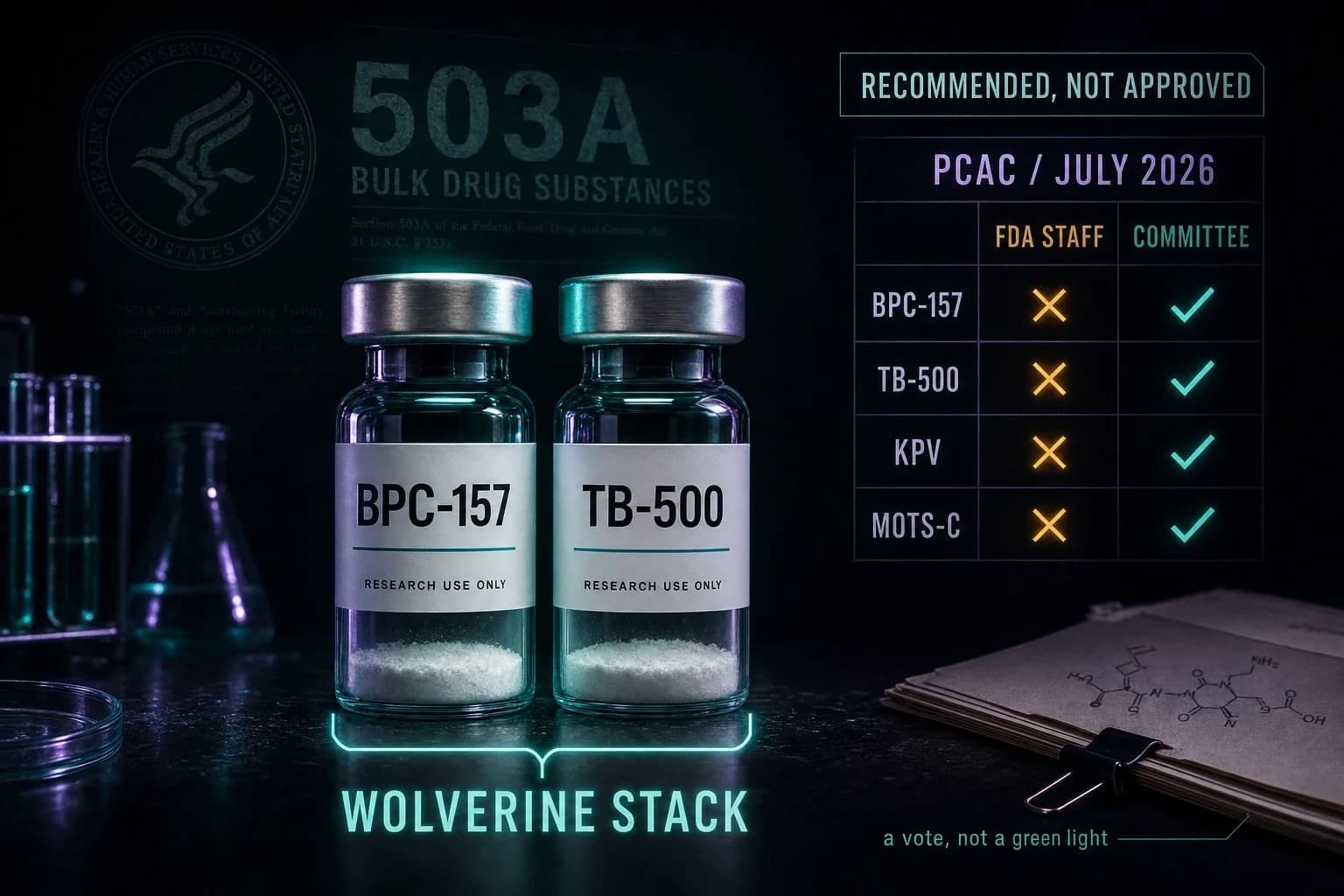
- FDA staff recommended against all seven. The committee voted in favor anyway.
- This is not FDA drug approval. Rulemaking could take 12+ months before anything changes.
- BPC-157 left the FDA's Category 2 restricted list on April 23, 2026.
Search "FDA approved BPC-157" this week and you will find a hundred pages celebrating. They are wrong about the one word that matters.
The FDA did not approve BPC-157. It did not approve any peptide on July 23. What its advisory committee actually did is stranger than an approval, and for the peptide world it may end up being bigger: a panel of outside experts voted to recommend seven research peptides for legal compounding, directly against the recommendation of the FDA's own scientists.
Here is exactly what happened, what it changes, and what it does not.
What the committee voted on
On July 23 and 24, 2026, the FDA's Pharmacy Compounding Advisory Committee (PCAC) met to evaluate whether seven peptides should be added to the Section 503A Bulk Drug Substances List. That list is the mechanism that lets compounding pharmacies legally prepare a substance for patients without it being an FDA-approved finished drug.
The seven under review:
| Peptide | Indication FDA reviewed | We stock it |
|---|---|---|
| BPC-157 | Ulcerative colitis | /peptides/bpc-157 |
| TB-500 (thymosin beta-4) | Wound healing | /peptides/tb-500 |
| KPV | Wound healing, inflammatory conditions | /peptides/kpv |
| MOTS-c | Obesity, osteoporosis | /peptides/mots-c |
| DSIP (emideltide) | Opioid withdrawal, insomnia, narcolepsy | /peptides/dsip |
| Semax | Cerebral ischemia, migraine, trigeminal neuralgia | /peptides/semax |
| Epitalon | Insomnia | /peptides/epithalon |
The headline is the split. The FDA's own briefing documents proposed the same conclusion for all seven compounds: do not add them. The committee heard that, then voted in favor of adding peptides anyway. TIME summarized it plainly the day of the vote: an FDA committee just voted in favor of peptides despite the agency's opposition.
An advisory committee overruling the agency staff that convened it is rare. That is the actual news, and it is why the peptide world spent this week losing its mind.
Bottom line: A PCAC vote is a recommendation, not a decision. It carries weight, but it does not add anything to the 503A list on its own, and it is not drug approval. Nothing you can legally buy changed on July 23.
The four words everyone is confusing
Most of the celebration online collapses four very different regulatory steps into the word "approved." They are not the same, and BPC-157 is only at the second one.
| Step | What it means | BPC-157 status |
|---|---|---|
| Category 2 removal | The explicit "significant safety concerns" prohibition on compounding is lifted | Done, effective April 23, 2026 |
| PCAC recommendation | An advisory panel suggests the FDA add a substance to the 503A list | Done, July 23, 2026 (committee voted yes) |
| 503A bulks list inclusion | Compounding pharmacies may legally prepare it with a prescription | Not done; requires rulemaking |
| FDA drug approval | Full new-drug application, clinical trials, marketed as an approved medicine | Not even in progress |
Read down that column. BPC-157 has cleared two gates and has two much larger ones ahead. The committee's recommendation still has to survive formal notice-and-comment rulemaking, a process that routinely takes 12 months or more and can end in the FDA declining the recommendation entirely.
So "FDA approved BPC-157" is off by two full stages and one federal rulemaking process.
Why the FDA's own scientists said no
The reason matters, because it is the same reason we have said for two years that most peptide marketing outruns the evidence. The human data is thin.
A 2026 review of therapeutic peptides in orthopaedics put it in one sentence. After walking through BPC-157, TB-500, GHK-Cu, epithalon, DSIP, Semax and others, the authors concluded that although the preclinical studies are promising, there is a current lack of clinical trials (Rahman et al. J Am Acad Orthop Surg Glob Res Rev 2026, PMID 41490200).
Take BPC-157, the most famous of the seven. The mechanistic work is genuinely interesting: in cultured rat tendon cells, BPC-157 accelerated fibroblast outgrowth, increased cell survival under oxidative stress, and drove cell migration in a dose-dependent way (Chang et al. J Appl Physiol 2011, PMID 21030672). Reviews from the group that has studied it longest describe cytoprotection across stomach, skin, liver, and other tissues, with no toxicity reached in animal testing (Sikiric et al. Gut Liver 2020, PMID 31158953; Seiwerth et al. Front Pharmacol 2021, PMID 34267654).
Notice what those citations are: rats, cell cultures, and reviews of rats and cell cultures. BPC-157 has appeared in early human work for ulcerative colitis and multiple sclerosis, which is why the FDA reviewed it under the ulcerative colitis indication, but there is no large completed randomized controlled trial establishing it as safe and effective in humans. The rest of the seven are in the same position. TB-500's parent molecule thymosin beta-4 has well-characterized roles in angiogenesis and wound repair (Sosne et al. FASEB J 2010, PMID 20179146). KPV shows real anti-inflammatory activity in mouse models of colitis (Kannengiesser et al. Inflamm Bowel Dis 2008, PMID 18092346). MOTS-c is a legitimate mitochondrial-derived peptide in metabolism research (Merry et al. Am J Physiol Endocrinol Metab 2020, PMID 32776825). All real science. Almost none of it in humans.
The committee did not vote yes because the evidence got stronger. It voted yes because the members concluded these compounds are being used regardless, and a regulated compounding pathway is safer than an unregulated gray market. That is a defensible position. It is also not the same as "the science is settled." We walk through exactly how large the gap is in the BPC-157 human clinical data gap.
Warning: A 503A recommendation is a statement about compounding access, not a safety endorsement. If BPC-157 eventually lands on the list, it would be dispensed by a licensed pharmacy against a prescription, with the evidence base exactly as thin as it is today. More access does not mean more proof.
The Wolverine stack just walked into the room
Two of the seven are the two most-searched recovery peptides on the internet, and together they have a nickname. BPC-157 and TB-500, stacked, are what the forums call the Wolverine stack, after the healing factor. "wolverine stack" alone draws more than 18,000 US searches a month.
Both cleared the committee on the same day. That is not a coincidence anyone planned, but it is the story the recovery community heard: the two headliners of the peptide healing world went before an FDA panel and came out with a favorable vote. Our Wolverine stack page covers the pre-mixed BPC-157 plus TB-500 protocol, and the individual BPC-157 and TB-500 pages carry the dosing and half-life detail, including the BPC-157 dosage chart.
If you want the mechanistic version of why those two get stacked, the short answer is that they hit different parts of the same repair process: BPC-157 leans on angiogenesis and tendon-cell migration, TB-500 on actin regulation and cell motility. The BPC-157 vs TB-500 comparison breaks down where each one actually has support.
What changes for you right now
Legally, nothing.
BPC-157 remains an unapproved, investigational compound. It is unscheduled under the Controlled Substances Act, and it is sold for research use only. That was true on July 22 and it is true today. The Category 2 removal in April lifted the compounding prohibition; the July vote recommended a path forward; neither one created a prescription product you can pick up at a pharmacy.
What did change is direction. For the first time, the regulatory momentum on these seven peptides is pointing toward legitimacy instead of away from it. If the rulemaking follows the committee, the medium-term future is compounded BPC-157 and TB-500 available through licensed pharmacies with a prescription and a clinician attached. That is a materially different world from the one where these compounds live entirely in the research-chemical gray market.
But that world is at least a year of federal process away, and it might not arrive.
What this means if you buy peptides
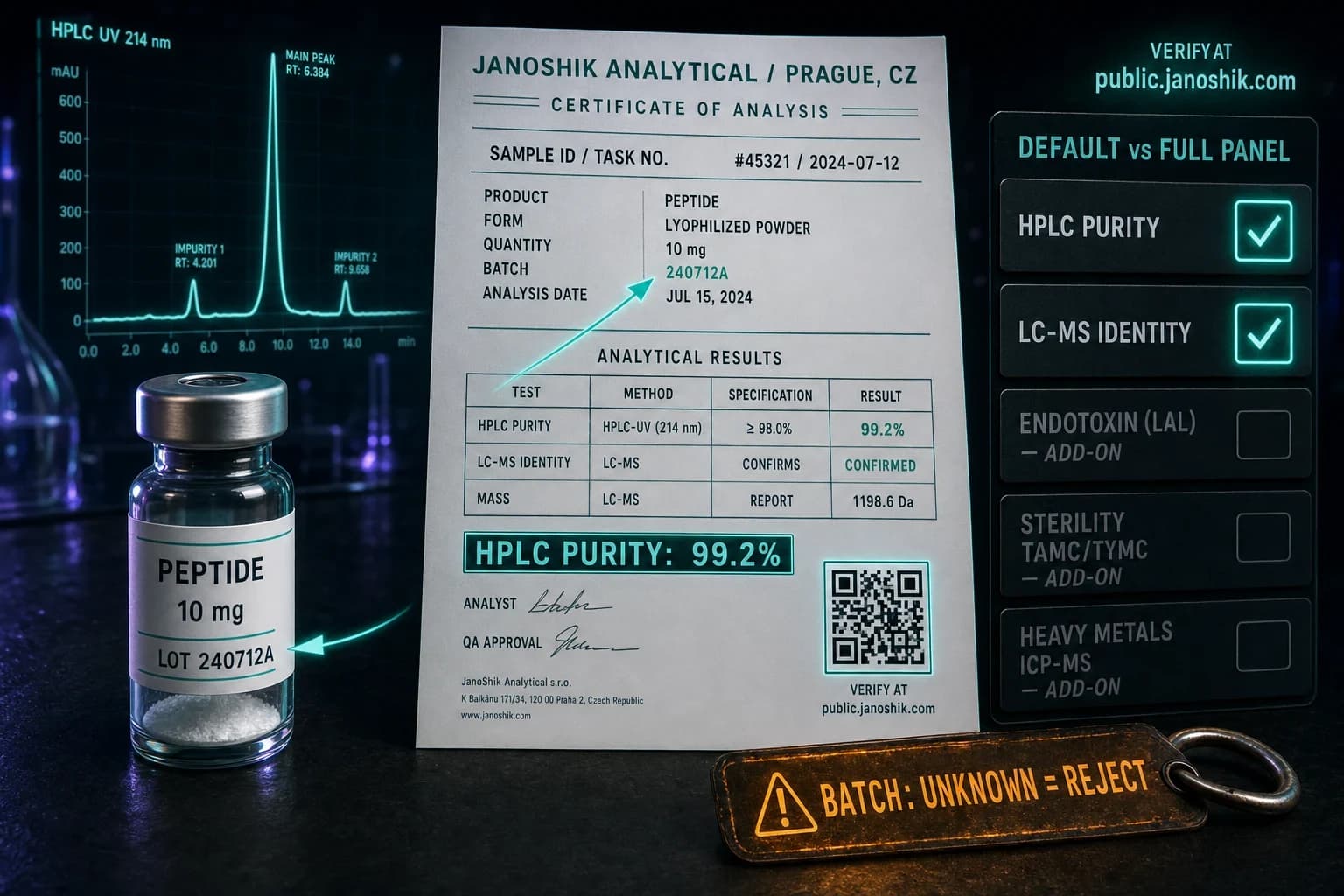
Until the pharmacy pathway actually opens, the seven peptides on that list are still what they were: research compounds, sold by vendors, with quality that varies wildly from lot to lot. A favorable FDA committee vote does not put a certificate of analysis in your vial.
That is the part worth internalizing. The single biggest variable in whether a research peptide does anything is whether the powder is what the label says at the purity claimed, and a regulatory headline does not touch that. Every compound we reference is cross-checked against our independent COA library, and if you are reconstituting these yourself, the reconstitution calculator handles the mg-to-units math.
BPC-157, TB-500, and the pre-mixed Wolverine stack are all available from Ascension Peptides with 50% off using code ENHANCED. The rest of the seven, KPV, MOTS-c, Semax, Epitalon, and DSIP, are stocked there too. Whatever the FDA does over the next 12 months, buy on purity and a published certificate, not on a headline.
Bottom line: An FDA advisory committee voted to recommend BPC-157, TB-500, and five more peptides for compounding, overruling the agency's own scientists. It is a real turning point and it is not approval. Nothing legal changed yet, the human evidence is still thin, and purity still decides everything. Treat the news as a direction, not a green light.
This article is for informational and educational purposes only and is not medical advice. As of July 2026, BPC-157, TB-500, KPV, MOTS-c, DSIP, Semax, and Epitalon are not FDA-approved drugs and are sold for research use only. A PCAC recommendation is non-binding and does not authorize human use. Consult a licensed physician before beginning any protocol.